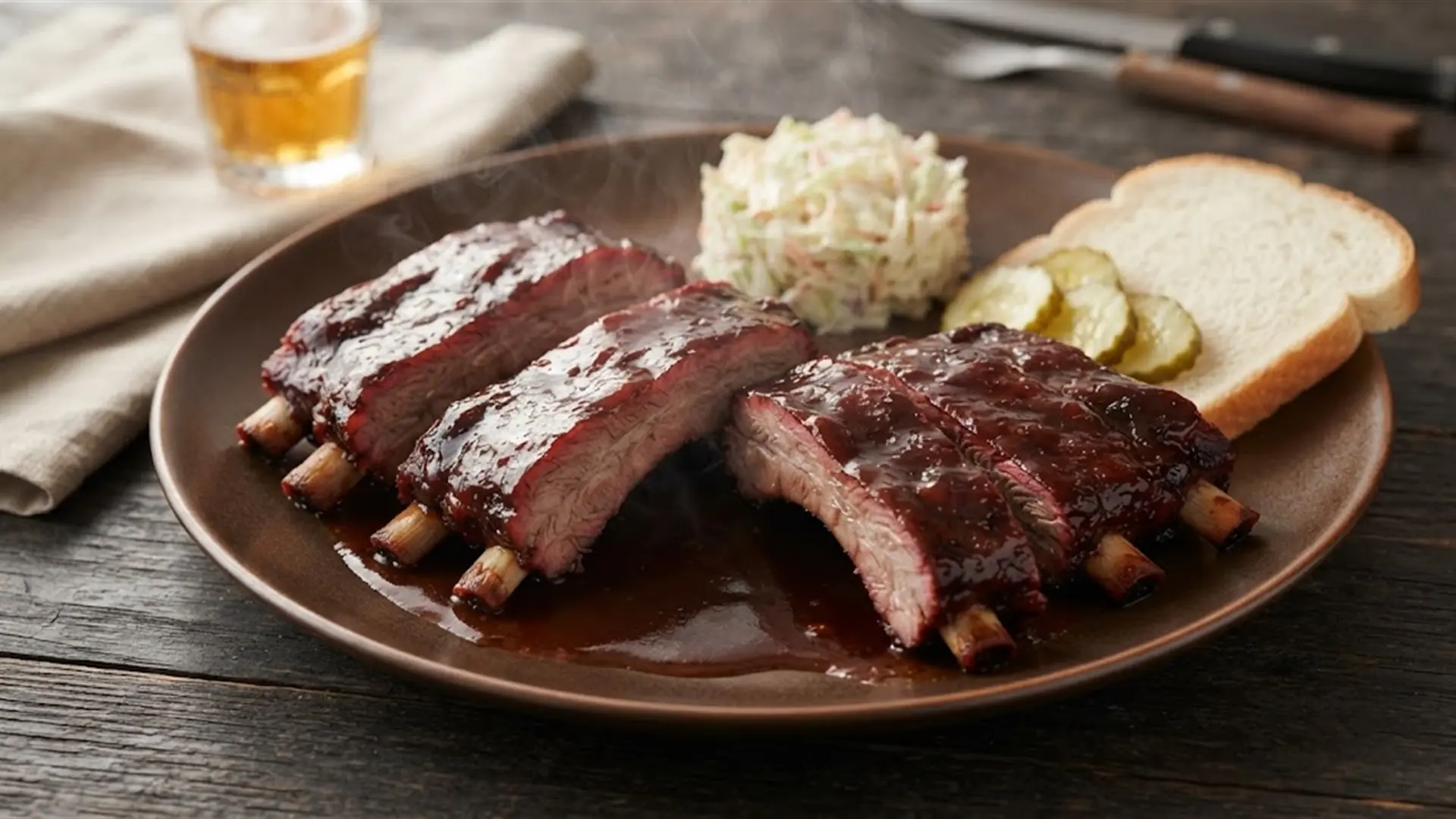
Summary: Barbecue Ribs are pork ribs cooked slowly at a low temperature and brushed with barbecue sauce – 1.8 kg of ribs for 6 servings, a dry rub of paprika, brown sugar, garlic, cumin and chilli, 3 to 4 hours at 120 °C and sauce applied only in the final stage. Total 230 minutes, medium difficulty.
Have you cooked the recipe? Share the result with the community.
Category: Pork, American cuisine
Success rate: not rated yet % of users managed the recipe
Quick overview
- Dish: Barbecue Ribs – slow-roasted or smoked pork ribs brushed with barbecue sauce
- Category: Pork, American cuisine
- Cuisine: American
- Main ingredient: Whole pork ribs, 1800 g (spareribs or loin ribs, meaty, with an even layer of fat)
- Guide: 12 most famous American dishes: traditional recipes from American cuisine
- Total time: 230 minutes (30 min preparation + 200 min cooking)
- Difficulty: Medium
- Servings: 6 (Serving weight: 267 g)
- Key technique: Low-temperature, long-time cooking, removing the membrane, dry rub, glazing with barbecue sauce at the end
- Preparation types: Roasting, Smoking, Slow cooking
- Dietary info & allergens:mustard, sulphites, fish
- Suitable for: Weekend cooking, gatherings with friends, barbecue season, celebrations
- Nutritional values (per 1 serving): 621 kcal, Protein: 34.5 g, Fat: 42.6 g, Carbohydrates: 25.8 g
- Storage: 4 days in the fridge, 3 months in the freezer
- Pairing: Pale lager or apple cider, dry rosé wine, apple juice
- In short: Ribs are not about the amount of sauce, but about time – three hours at 120 °C will do more than any seasoning.
WAGUU says: “Barbecue ribs are not recognised by the sauce, but by the bone. The moment the meat starts to pull away from the bone and the bone can be pulled out with slight resistance, it is done.”
Key facts
| Preparation time: | 30 minutes |
| Cooking time: | 200 minutes (120 °C in the oven; 110–130 °C in a smoker) |
| Temperature: | 120 °C for roasting, 150 °C for wrapped ribs, 200 °C for glazing |
| Number of servings: | 6 (1800 g of ribs, edible serving weight 267 g) |
In a nutshell
Pork ribs, dry rub and three hours in the oven. No complicated technique – just patience, low temperature and a sauce that only comes into play at the end. The result is a dark crust, meat that falls off the bone, and the aroma of smoke and paprika drifting from the oven all afternoon.
Ingredients
Base servings: 6 servings • Serving weight: 267 g
| Ingredient | Amount | Quality |
|---|---|---|
| Whole pork ribs | 1800 g | spareribs or loin ribs, meaty, with an even layer of fat |
| Ground sweet paprika | 20 g | sweet, finely ground |
| Brown sugar | 35 g | muscovado or dark cane |
| Ground garlic | 10 g | dried, finely ground |
| Ground cumin | 6 g | ground, freshly crushed |
| Ground chilli | 4 g | ground, according to heat tolerance |
| Fine sea salt | 12.1 g | fine, without anti-caking agents |
| Freshly ground black pepper | 4 g | whole peppercorns, crushed before use |
| Dijon mustard | 20 g | smooth, without added sugar |
| Ketchup | 250 g | without added flavourings, ideally gluten-free |
| Apple cider vinegar | 80 ml | fermented, 5% acidity |
| Worcestershire sauce | 30 ml | fermented, containing anchovies |
| Honey | 30 g | flower, liquid |
| Smoked paprika | 6 g | dried, ground, sweet |
| Garlic cloves | 3 pcs | fresh, firm, without sprouts |
Why you will love this recipe
- Low temperature instead of attention: The ribs go into the oven at 120 °C and you do not have to worry about them for the next three hours. The work is only in preparing the rub and in the last half hour.
- Works without a smoker: A baking tray with a rack in an ordinary oven gives meat just as tender as a smoker. The smoky undertone is provided by smoked paprika and Worcestershire sauce.
- The sauce will not burn: The sugar in barbecue sauce burns at a higher temperature, so it is applied only in the final stage. Until then, only the dry rub is working.
- Even a beginner can manage it: The recipe has six stages, three of which are preparation. Time and temperature decide, not hand technique.
Why it works: At 120 °C the internal temperature of the meat stays in the range where collagen slowly turns into gelatine and the meat remains juicy. The salt in the rub first draws moisture from the surface, dissolves in it and the solution returns to the meat – this is how the seasoning gets under the surface. The sugar and honey in the sauce are added only in the last 20 minutes, when the surface of the meat is dry and the temperature is enough for a glossy glaze, but not for burning.
Recipe overview
Preparation: 30 min | Cooking: 200 min | Difficulty: Medium | Servings: 6 | Type: Main course | Origin: American cuisine
Detailed method
Total progress: 3.44 % done
Stage 1: Preparing the ribs and removing the membrane – 10 min
Appliances: none
12.1 Line a baking tray with foil and place a rack on it. Place the ribs inner side up and use a narrow knife or the tip of a fork to lift the inner membrane at one edge. Grasp the membrane with a paper towel and pull it off in one go along the whole length. If it holds, help with a knife along the ribs, but do not cut into the meat. Turn the ribs over and dry both sides thoroughly with a paper towel. Brush them with Dijon mustard and spread it in a thin layer also into the folds between the bones. Season with fine sea salt and pepper with freshly ground black pepper.
VKB: The membrane is removed in one piece and on the inner side of the ribs bare bone and pink meat without a white coating are visible – that is where the rub holds and penetrates the meat.
Before you move on to the next step:
Do not wash the ribs. Water on the surface dilutes the rub, slows down crust formation and spreads bacteria around the kitchen. Dry them with a paper towel.
Phase 2: Dry rub and barbecue sauce – 15 min
Equipment: small saucepan, hob, bowl
2. In a bowl, mix the ground sweet paprika, brown sugar, ground garlic, ground cumin, ground chilli and smoked paprika. Divide the mixture into two parts – rub the larger part all over the ribs, on the sides, on top and between the bones, and set the remaining rub aside for later. In a second saucepan, combine the ketchup, apple cider vinegar, Worcestershire sauce, honey and garlic cloves sliced into rounds. Bring to a gentle simmer and cook for 10 minutes, until the sauce thickens slightly.
VKB: The sauce is smooth, glossy and holds a trail on the back of a spoon. When you drag a spoon across the bottom of the pan, the line closes slowly, not immediately.
Before you move on to the next step:
The sugar in the rub clings to a wet surface, so dry the ribs before rubbing. A dry surface means an even crust instead of weeping patches.
Phase 3: Resting in the cold – 5 min and marinating
Equipment: fridge
12.1 Place the rubbed ribs on a rack over a baking tray, cover them loosely with cling film and put them in the fridge for at least an hour, preferably overnight. During the rest, the salt and spices penetrate the surface layer of the meat. Meanwhile, let the sauce cool and store it in the fridge in a sealed container. Preheat the oven to 120 °C, at least 20 minutes before putting the meat in.
VKB: The surface of the meat is damp to the touch and the seasoning has soaked in – only a faint trace of the rub remains on your finger, not a crumbly layer.
Before you move on to the next step:
Do not put the meat into the oven straight from the fridge. Let it sit on the worktop for 20 minutes so the temperature evens out – cold ribs cook unevenly.
Phase 4: Dry cooking at a low temperature – 120 min
Equipment: oven 120 °C, smoker 110–130 °C (alternative)
4. Place the ribs on a rack meaty side up and put a foil-lined baking tray underneath the rack to catch the rendered fat. Cook for 120 minutes at 120 °C. During this time, do not turn the meat and do not open the oven more than once. If you have a smoker, smoke the ribs at 110–130 °C for the same time over indirect heat, adding a small amount of wood roughly once an hour.
VKB: The surface of the ribs has darkened to mahogany and is dry to the touch. When you press the meat with tongs it bends but does not break, and it has not yet pulled away from the bone.
Before you move on to the next step:
If the surface starts to scorch before the end of the phase, lower the temperature to 110 °C and cover the ribs loosely with foil. There is no point in raising the temperature to speed things up.
Phase 5: Wrapped ribs and glazing – 45 min
Equipment: oven 150 °C and 200 °C, foil, brush
5. Take the ribs out, place them on a double layer of foil, sprinkle with the remaining rub and wrap tightly. Return them to the oven at 150 °C and cook for 75 to 105 minutes, until the meat starts to pull away from the bone. Then open the foil, transfer the ribs back to the rack and brush them with barbecue sauce. Return them to the oven preheated to 200 °C and cook for 10 minutes. Take them out, brush with a second layer of sauce and cook for another 8 to 10 minutes, until the glaze starts to bubble and shine.
VKB: The glaze is glossy, dark red and clings to the surface of the meat; only the occasional drip forms on the tray under the rack, not streams. The meat has pulled away from the bone by about a centimetre and the bone can be pulled out with slight resistance.
Before you move on to the next step:
Apply the sauce in thin layers, not one thick one. A thick layer of sugar on the surface will blacken before the meat has heated through.
Phase 6: Resting and slicing – 10 min
Equipment: chopping board, large knife
12.1 Take the ribs out of the oven and let them rest for 10 minutes on a chopping board, loosely covered with foil. Then place them bone side down and cut with a large knife between the bones into individual ribs in one stroke. Gently reheat the remaining barbecue sauce and serve it separately in a bowl, so everyone can add as much as they like.
VKB: When slicing, the knife passes between the bones without resistance and the meat does not tear. The cross-section shows pink juices, not blood, and the meat holds to the bone.
Required equipment
| Utensils | Ideal size | Alternative | Risk |
|---|---|---|---|
| Large roasting tin | 40 × 30 cm | deep oven tray | A small tray forces you to stack the ribs on top of each other and the meat cooks unevenly. |
| Rack for the tin | 35 × 25 cm | grill grate or cooling rack | Without a rack, the ribs stew in their own fat and the surface stays soft instead of forming a crust. |
| Oven thermometer | up to 250 °C | oven with an accurate thermostat | An oven set to 120 °C may actually run at 150 °C, and then the meat dries out. |
| Foil | two layers of 40 cm each | baking paper and a covered roasting tin | A single layer tears during handling and the juices leak onto the tray. |
| Pastry brush | silicone, 4 cm | spoon and quick basting | Brushes with natural bristles deform in hot sauce and leave fibres behind. |
| Small saucepan | 1.5 l capacity | deeper frying pan with a lid | In a wide pan the sauce reduces quickly and catches on the bottom. |
Shopping list
Nutritional profile
Values per 1 serving of 267 g edible portion (without side dish). Calculated from average nutritional values of the ingredients; the weight refers to the edible portion of the ribs, which is roughly 60 % of the weight of raw ribs.
| Nutrient | Per 100 g | Per 1 serving | Per 6 servings |
|---|---|---|---|
| Energy | 233 kcal | 621 kcal | 3727 kcal |
| Fat | 16.0 g | 42.6 g | 255.4 g |
| of which saturates | 5.8 g | 15.5 g | 92.7 g |
| Carbohydrate | 9.7 g | 25.8 g | 154.5 g |
| of which sugars | 7.4 g | 19.8 g | 118.6 g |
| Protein | 13.0 g | 34.5 g | 207.1 g |
| Salt | 1.29 g | 3.44 g | 18.62 g |
Reference intake of an average adult (8400 kJ / 2000 kcal).
WAGUU Professional level
- Professional standard: Verified recipe with precise ratios and visual checkpoints.
- Tip 1: Choose ribs by the thickness of the meat, not by weight. Portions with less than a centimetre of meat on the bone will stay dry after a long cook, even if the rub is right.
- Tip 2: The rack under the meat and the foil-lined tray below matter more than they seem. The ribs do not roast in their own fat but in hot air, and that is what creates a crust on the surface instead of soft skin.
- Tip 3: If the meat is still holding to the bone after 165 minutes, wrap it again and add 20 minutes. The state of the meat decides, not the clock.
- Tip 4: Do not throw away the leftover sauce. Stir it with a spoonful of the pan drippings, bring to the boil and serve separately – the flavour will combine with the smoke from roasting.
Scientific background
Pork ribs contain a large amount of collagen, which turns into gelatine at temperatures between 70 and 95 °C. This conversion needs time, not high heat – that is why ribs are cooked at 120 °C for three hours and not at 200 °C for one hour. At a higher temperature, muscle fibres contract faster and squeeze out water before the collagen has time to convert. The salt in the dry rub dissolves surface proteins and, together with the spices, works its way into the surface layer of the meat. The sugars in the rub and the sauce undergo caramelisation at higher temperatures, which creates the colour and aroma of the glaze; above 180 °C, however, they start to burn, which is why the sauce is only applied in the final minutes. Smoking adds surface absorption of aromatic compounds from the smoke to these processes.
Fine Dining – Professional techniques
- Plate composition: Stack three ribs on top of each other in a slight fan, spoon the glaze over the top one and place a small quenelle of coleslaw separately alongside, so the meat juices do not touch the vegetables.
- Textural contrasts: Soft meat calls for something crunchy – fried tinned sweetcorn in butter, thin slices of fresh cucumber or crisp bread toasted dry.
- Temperature contrast: Serve the ribs hot and the coleslaw cold, straight from the fridge. The difference in temperature on one plate will bring out the smoky flavour of the meat.
- Aromatic additions: Before serving, grate the zest of one lime over the glaze and add a few coriander or parsley leaves. The sour, fresh note lightens the sweet sauce.
Sensory radar
- Appearance: A dark mahogany, glossy glaze, with pink meat peeking out between the ribs and the bones partly exposed.
- Aroma: Smoke, sweet paprika and caramelised sugar; once the foil is opened, a strong aroma of rendered pork fat comes through.
- Taste: Sweet and smoky sauce in the first wave, then cumin and chilli, finishing with the meaty flavour of pork and a mild vinegar acidity.
- Texture: The surface is sticky and glossy, the meat beneath is succulent, pulls away from the bone under the pressure of a fork and falls apart into strands in the mouth.
Pairing
- Beer: A pale lager with higher bitterness or an American pale ale. The bitterness cuts through the sweet glaze. Apple cider is a second option – its acidity works with both the smoke and the pork.
- Wine: A dry rosé or a younger red with lower tannins, such as Zinfandel or Garnacha. Tannic, oaky reds will overpower the delicate smoky flavour.
- Soft drinks: Apple juice, iced tea with lemon or a homemade lime and mint lemonade. The acidity and chill balance the sweetness of the sauce.
Different cooking variations
- Smoker variation: Smoke the ribs at 110–130 °C for 3 to 5 hours over indirect heat, adding wood once an hour. The surface will develop a more pronounced smoky layer, and the time will be longer depending on the outdoor temperature and wind.
- Slow cooker variation: Place the ribs in a slow cooker on low and cook for 6 to 8 hours. This produces softer meat without a crust, so transfer them to a baking tray, brush with sauce and finish in the oven for 12 minutes at 200 °C.
- Apple juice variation: During phase 4, baste the ribs every hour with apple juice or cider. The meat will take on a fruity sweetness and the surface will stay moister.
- Coffee rub variation: Add ground coffee to the dry rub for a darker colour and deeper flavour. The coffee won’t taste bitter when cooked if you use one teaspoon per kilogram of meat.
Allergens and dietary information
Contains: celery (ketchup, Worcestershire sauce); sulphites (ketchup, cider vinegar); fish (Worcestershire sauce); mustard (Dijon mustard) • Gluten: Worcestershire sauce and some ketchups contain barley malt, so you must choose products labelled gluten-free • Not suitable for: people with allergies to mustard, celery, fish and soy; if you have a gluten intolerance, you need to check the ingredients of the ketchup and Worcestershire sauce.
Suitable for
Weekend cooking, gatherings with friends, barbecue season, summer celebrations, watching sports. The food is eaten with your hands, so it suits informal occasions. It’s not suitable for a quick weeknight dinner or for people who are limiting their salt intake.
Substitution guide
- Pork ribs: loin ribs instead of spareribs – leaner, needs 20 minutes less cooking and more basting. Or beef short ribs, which increase the cooking time to 4 to 5 hours.
- Apple cider vinegar: wine vinegar or rice vinegar. The flavour will be sharper and less fruity, but the ratio stays the same.
- Worcestershire sauce: soy sauce with a tablespoon of vinegar and a pinch of anchovy paste or relish. The saltiness is higher, so reduce the salt in the rub by a third.
- Dijon mustard: whole-grain mustard without sugar or English mustard, which is hotter; use half the amount.
- Honey: maple syrup or molasses. Molasses gives a darker colour and less sweetness.
- Smoked paprika: sweet paprika with a pinch of liquid smoke. You must keep liquid smoke to just a few drops, otherwise it will overpower the whole dish.
- Ketchup: passata with a tablespoon of vinegar and a tablespoon of sugar. The sauce will be thinner, so cook it for five minutes longer.
FAQ
What’s the difference between loin and side ribs?
Loin ribs are smaller, leaner and have a thinner layer of meat – they’re done sooner, usually in 2.5 to 3 hours. Side ribs (spareribs) are flatter, fattier and have more connective tissue, so they need 3 to 4 hours and stay juicier. Both types are prepared the same way, only the cooking time differs.
Why is the membrane removed?
The membrane is a tough layer that stops the seasoning from penetrating the meat and shrinks during cooking, so the ribs curl on the bone. Once removed, the rub goes directly onto the meat and the ribs cook evenly. If the membrane is stuck fast, use a knife to help, but don’t cut into the meat.
Can I make the recipe without a smoker?
Yes, the whole recipe is written for an oven. A foil-lined baking tray with a rack over it is enough. The smoky undertone comes from the smoked paprika in the rub and the Worcestershire sauce. The difference compared to a smoker is in the intensity of the smoky layer, not in the tenderness of the meat.
How do I know the ribs are done?
The meat will start to pull away from the bone, a bare white patch will appear on the surface of the bone, and the bone can be pulled out with slight resistance. If the meat falls apart on its own and drops off the bone, it’s overcooked and dry.
Why is the barbecue sauce only added at the end?
The sauce contains sugar and honey, which burn and turn bitter at temperatures above 180 °C. During a long cook, it would blacken before the meat was cooked through. In the last 20 minutes at 200 °C, it’s enough for the sugar to caramelise and form a glossy glaze.
Do the ribs need to be marinated before cooking?
No. The dry rub just needs an hour to sit, ideally overnight. A marinade would only penetrate a few millimetres into the meat, and the wet surface would also prevent a crust from forming. The salt in the rub does more for the flavour than a liquid marinade.
What can I use instead of liquid smoke if I don’t have any?
Smoked paprika, which the recipe already uses, and a tablespoon of bacon fat from smoked bacon added to the sauce. Liquid smoke can be found in shops selling barbecue supplies. If you use it, stick to a few drops, otherwise it will overpower the paprika and cumin.
Can the ribs be prepared a day ahead?
Yes. Cook them according to phases 1 to 5, let them cool, wrap and store in the fridge. The next day, reheat them covered at 140 °C for about 25 minutes, then brush with sauce and finish for 10 minutes at 200 °C. This way the glaze goes on meat that’s already cooked.
WAGUU Petr advises: Cooking for 6 or more people?
6–8 people: Cook two racks side by side on one large baking tray, but swap them after 60 minutes so they cook evenly – the top rack cooks faster than the bottom one. Allow 2.5 to 3 ribs per person. 10+ people: Cook the ribs in two batches and keep the first batch covered in the oven at 90 °C. Make double the amount of sauce and glaze only just before serving, otherwise it will harden on the surface.
Sides and serving
Storage and reheating
Fridge: 4 days • Freezer: 3 months • Reheating: In the oven covered with foil at 140 °C for about 20 minutes; in the microwave briefly, but the meat will soften and the crust will lose its shine. Reheat the sauce separately so the meat doesn’t dry out in the oven. After defrosting, fat may separate on the surface – stir the juices back in when reheating gently.
Author: WAGUU Petr & Team • Published: 6 Oct 2026 • Updated: 9 Oct 2026
More recipes from the article
Guide: 12 most famous American dishes: traditional recipes from American cuisine
Pulled Pork – slow-roasted or smoked pork shredded into strands and served with barbecue sauce
Mac and Cheese – pasta with a rich cheese sauce, often cheddar, baked until golden
More recipes you might like
Why WAGUU?
Recipes on WAGUU are checked for accuracy of ingredients, methods and nutritional values.
Photo gallery from the process
Photos from the community: Cook it, photograph it and share the result.
You can upload photos in the comments below or send them by email.
Have you filmed a video of our recipe? Post a link to YouTube, YouTube Shorts, TikTok, Instagram Reels, Facebook Reels, Pinterest, Vimeo or X (Twitter) in the comments – we’ll be happy to publish it and help get you and your content noticed.
Most common mistakes
- Membrane not removed – the membrane keeps the seasoning out of the meat and shrinks during cooking, so the ribs curl on the bone and are tough. Remove it with a thin knife and a paper towel before applying the rub.
- Sauce applied at the start – the sugar and honey in the sauce will blacken and turn bitter during a long cook. Cook dry first and only apply the sauce in the last 20 minutes at 200 °C.
- High temperature instead of time – at 200 °C the meat contracts and squeezes out water before the collagen can turn into gelatine. Keep it at 120 °C for 3 to 4 hours; the state of the meat is what matters, not the clock.
- Meat put in the oven straight from the fridge – cold ribs cook unevenly and need longer to warm through. Leave them on the counter for 20 minutes and preheat the oven at least 20 minutes beforehand.