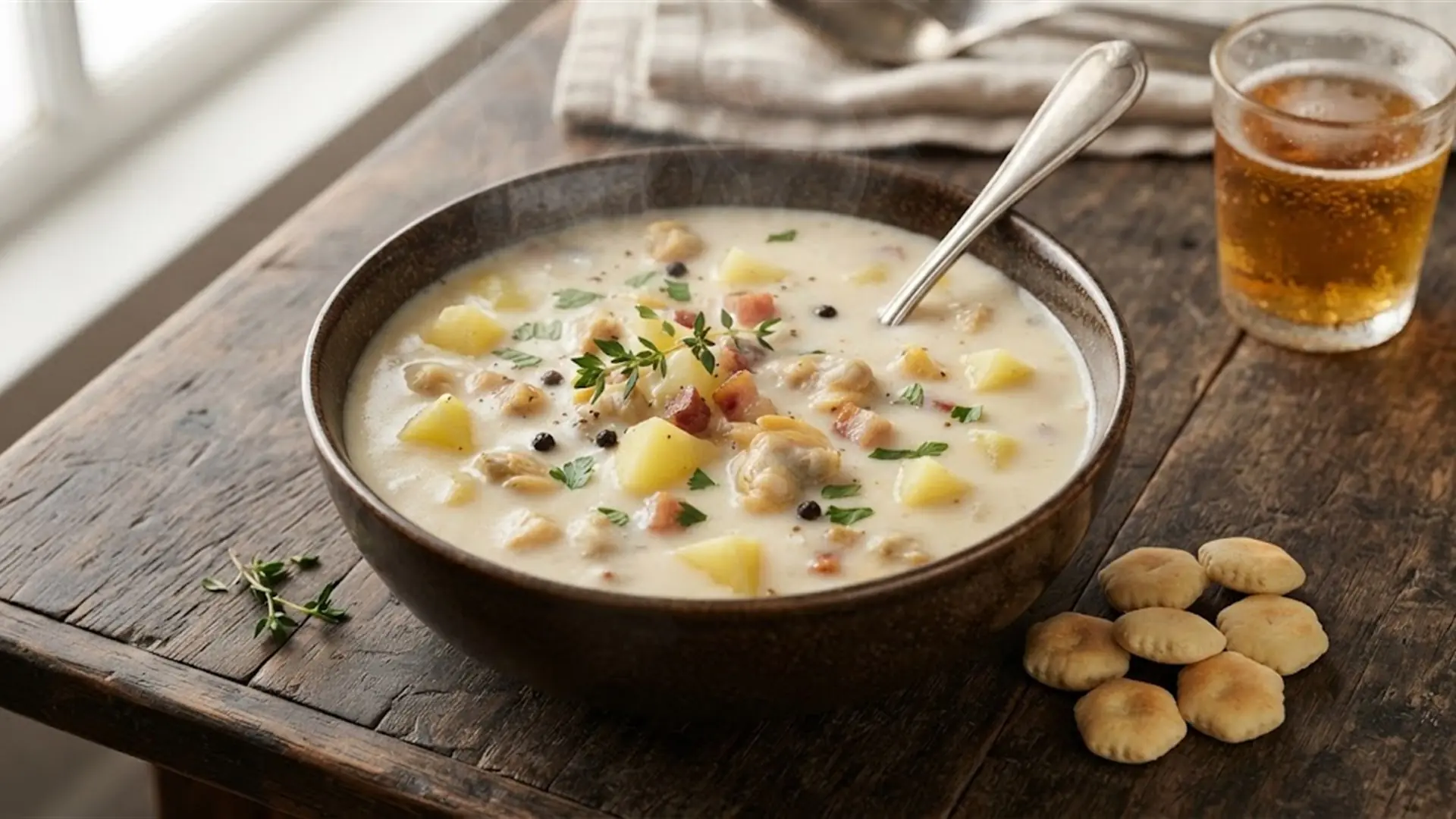
Summary: A thick, creamy soup of clams, potatoes, onion, celery and bacon. The stock is made from the shells, the base is bacon with a roux, and the cream goes in at the very end so it doesn’t curdle. Total time 55 minutes, makes 6 servings.
Have you cooked this recipe? Share the result with the community.
Category: Soups, American cuisine
Success rate: not rated yet % of users managed this recipe
Quick overview
- Dish: Clam Chowder – a thick, creamy soup of clams, potatoes, onion and milk or cream, typical of New England
- Category: Soups, American cuisine
- Cuisine: American
- Main ingredient: Whole vongole clams, 1000 g (about 250 g edible meat)
- Guide: The 12 most famous American dishes: traditional recipes from American cuisine
- Total time: 55 minutes (20 minutes preparation + 35 minutes cooking)
- Difficulty: Medium
- Servings: 6 (Serving weight: 383 g)
- Key technique: Making stock from the shells, thickening with a roux, finishing with cream off the heat
- Cooking methods: Classic boiling, simmering
- Dietary info & Allergens:molluscs, celery, gluten, fish, milk
- Suitable for: Festive starter, winter dinner, weekend lunch, autumn menu
- Nutritional values (per 1 serving): 390 kcal, Protein: 15.0 g, Fat: 23.8 g, Carbohydrates: 28.0 g
- Storage: 2 days in the fridge, 1 month in the freezer (without cream)
- Pairing: Dry white wine, pale lager, homemade lemonade
- In short: Stock from the shells, a roux from the bacon and cream off the heat – three steps that decide whether the soup will be thick and full of clam flavour.
WAGUU says: “Chowder isn’t a soup of clams, it’s a soup of their stock. The clams go back in the pot for the last two minutes, otherwise they turn rubbery.”
Key facts
| Preparation time: | 20 minutes |
| Cooking time: | 35 minutes |
| Temperature: | Gentle simmer 90–95 °C, cream added at 80 °C |
| Number of servings: | 6 (serving weight 383 g) |
In a nutshell
It’s not flour that makes chowder thick, it’s potato starch. The potatoes are cooked in the soup until soft and some of them break down; their starch thickens the soup naturally and gently. The roux made from bacon adds flavour and the fat in which the aromas of celery and onion dissolve. The cream only goes into the soup at the end, when the soup is no longer boiling – at a rapid boil the milk protein would contract and the cream would split.
Ingredients
Base servings: 6 servings • Serving weight: 383 g
| Ingredient | Amount | Quality |
|---|---|---|
| whole vongole clams | 1000 g | live, closed, about 250 g edible meat |
| potatoes | 600 g | waxy, firm |
| smoked bacon | 120 g | roughly chopped, with rind |
| onion | 200 g | yellow, medium |
| celery | 150 g | stick celery, firm stalks |
| plain flour | 30 g | type 450, sifted |
| fish stock | 700 ml | unsalted, homemade or from a cube |
| double cream | 200 ml | 33 %, fresh |
| butter | 30 g | 82 % |
| bay leaf | 2 pcs | dried, whole |
| thyme | 3 g | fresh or dried |
| ground black pepper | 2 g | freshly ground |
| fine sea salt | 4 g | according to the saltiness of the stock |
| parsley | 10 g | fresh, chopped |
Why you’ll love this recipe
- Flavour from clams, not from a cube: The stock is made from the shells, so the soup has a depth of the sea that seasonings can’t replace.
- Thick without unnecessary flour: The soup is thickened by potato starch; the roux just adds flavour and fat.
- Precise ratios for 6 servings: 1000 g clams, 600 g potatoes and 200 ml cream for six servings weighing 383 g.
- Even a beginner can manage it: Five stages, one pot and clear checkpoints.
Why it works: Clams contain glutamates and glycine, which are released into the water during cooking, which is why stock made from the shells is richer than stock made from the meat. The bacon is fried until golden: at temperatures above 140 °C Maillard reactions take place on its surface and the aromatic compounds formed dissolve in the fat, which then carries the flavour through the whole soup. The flour in the roux is cooked so it loses the taste of raw starch, and its starch swells and binds water at temperatures above 60 °C. The potatoes are cooked in the soup until soft; some of their starch passes into the liquid and thickens the soup more gently than flour. The cream is added at 80 °C: milk protein contracts at a rapid boil and the fat separates, whereas below boiling point the cream simply blends with the soup.
Recipe overview
Preparation: 20 min | Cooking: 35 min | Difficulty: Medium | Servings: 6 | Type: Soup | Origin: American
Detailed method
Overall progress: 0 % done
Stage 1: Clams and stock – 15 min
Equipment: lidded pot, colander, kitchen scales
1. Sort through the clams: discard broken and open ones. Bring water to the boil in a large pot, add the clams, cover and cook for 4 minutes until the shells open. Remove the clams, pick out the meat and set aside; return the shells to the pot, add the fish stock and simmer for 10 minutes over a low heat. Strain the stock through a fine sieve.
VKB: All the shells are open, the meat is firm and smells of the sea. The stock is clear, slightly yellowish and tastes strongly of clams.
Before you move on to the next step:
Rinse the shells before making the stock so no sand is left in the soup. Throw away any clams that don’t open after 5 minutes of cooking.
Stage 2: Bacon base – 8 min
Equipment: large heavy-bottomed saucepan, wooden spoon
2. Cut the bacon into cubes and fry in a dry pan for 5 minutes until the cubes render their fat and turn golden. Add the butter, chopped onion and celery and sweat for 5 minutes until the onion turns translucent. Sprinkle in the plain flour and stir for 2 minutes to cook out the roux.
VKB: The bacon is golden and crisp, the onion translucent. The roux is smooth, light brown and smells nutty, not of raw flour.
Before you move on to the next step:
Do not let the roux darken to brown. In a chowder it should stay light; a dark roux would colour the soup and overpower the flavour of the clams.
Phase 3: Cooking the potatoes – 15 min
Equipment: large saucepan, whisk
3. Pour the strained stock into the roux in stages, whisking so no lumps form. Add the potatoes cut into 2 cm cubes, the bay leaf and the thyme. Simmer gently for 15 minutes until the potatoes are tender. Mash a third of the potatoes with a fork directly in the pan so the soup thickens.
VKB: The potatoes can be halved with a spoon without resistance. The soup coats the spoon and runs off slowly, and no flour settles at the bottom.
Before you move on to the next step:
Do not stir the soup too vigorously or the potatoes will break down into mush. An occasional stir from the bottom is enough to stop the roux catching.
Phase 4: Cream and clams – 5 min
Equipment: saucepan, thermometer, whisk
4. Take the pan off the heat and let the soup cool for two minutes until the thermometer reads 80 °C. Then pour in the cream and stir with a whisk. Add the drained clam meat, season with salt and pepper and let the soup warm through for two minutes – do not boil again.
VKB: The soup is creamy and evenly pale, with no fat floating on the surface. The clams are firm and warm, not rubbery.
Before you move on to the next step:
Do not cook the clams any further. Two minutes of warming is enough; longer cooking makes them tough and loses their sweetness. Likewise, once the cream is in, the soup must not boil.
Phase 5: Resting and serving – 5 min
Equipment: ladle, deep bowls
5. Let the soup rest for five minutes so the flavour of the clams melds with the cream. Serve it in deep bowls and scatter each portion with chopped parsley. Add crackers or a slice of toasted bread to taste.
VKB: The soup is thick but pourable. No skin forms on the surface, no fat separates at the edge of the bowl, and the flavour of the clams comes through before the cream.
Required equipment
| Utensils | Ideal size | Alternative | Risk |
|---|---|---|---|
| large heavy-bottomed saucepan | 4 l capacity, 24 cm diameter | cast-iron pot or casserole | in a thin base the roux will catch and the soup will turn bitter |
| fine sieve | 20 cm diameter, fine mesh | muslin or tea strainer | without straining, sand from the shells stays in the stock |
| whisk | silicone, with thick wires | wooden spoon and fast stirring | a thin whisk will not break up lumps of roux |
| thermometer | probe, up to 150 °C | estimate by cooling | cream added to boiling soup will curdle |
| kitchen scales | with 1 g resolution | measuring cup | an inaccurate amount of flour in the roux changes the thickness of the soup |
Shopping list
Nutritional profile
Values per 1 portion (without side dish). Portion weight 383 g. For clams, edible meat is counted; the weight of the shells is not included in the portion.
| Nutrient | Per 100 g | Per 1 portion | Per 6 portions |
|---|---|---|---|
| Energy | 102 kcal | 390 kcal | 2338 kcal |
| Fat | 6.2 g | 23.8 g | 143.1 g |
| of which saturates | 3.2 g | 12.4 g | 74.3 g |
| Carbohydrate | 7.3 g | 28.0 g | 168.0 g |
| of which sugars | 0.9 g | 3.6 g | 21.6 g |
| Protein | 3.9 g | 15.0 g | 89.8 g |
| Salt | 0.64 g | 2.45 g | 14.70 g |
| of which sodium | 0.26 g | 0.98 g | 5.88 g |
Reference intake of an average adult (8400 kJ / 2000 kcal).
WAGUU Professional level
- Professional standard: A verified recipe with precise ratios and visual checkpoints.
- Tip 1: Keep the ratio of flour to liquid at 30 g per 900 ml. A thicker roux makes the soup pasty, a thinner one breaks down on reheating.
- Tip 2: Cook the stock from the shells briefly, no more than 10 minutes. Longer cooking releases bitter compounds and gives the soup a metallic aftertaste.
- Tip 3: Cut the potatoes into evenly sized cubes. Uneven sizes mean the smaller ones break down before the larger ones are tender.
- Tip 4: Reheat the soup the next day slowly to 70 °C, not to boiling point. On rapid heating the cream separates and fat appears on the surface.
The science behind it
The flavour of a chowder develops in two layers. The first is the stock: clams contain free amino acids, mainly glycine and glutamate, which are released into the water when heated. It is the glutamate that gives the soup its perceived fullness, which is why no flavour enhancers are needed. The second layer is fat. Bacon heated in a dry pan above 140 °C undergoes Maillard reactions on its surface; the aromatic compounds formed are fat-soluble, and when butter and vegetables are added to the pan, the fat carries them through the whole soup. Thickening is provided by two starches. The wheat starch from the roux has already been cooked out to lose the taste of raw flour, and its chains uncoil above 60 °C and bind water. Potato starch is released directly from the potatoes during cooking; some of the potatoes mashed with a fork break down and release starch grains that thicken the soup more gently. The cream is added at 80 °C because milk proteins contract above 85 °C and squeeze out fat – the soup would separate into fat and water.
Fine Dining – Professional techniques
- Plate composition: Pour the soup into a wide deep bowl, place three clams in their shells in the centre and scatter a few drops of herb oil around.
- Textural contrasts: Serve crisp toasted bread and the bacon cubes set aside alongside the smooth cream, adding them at the table.
- Temperature contrast: Serve the soup hot and place a spoonful of cold herb cream alongside, which will melt into the bowl on its own.
- Aromatic touches: Before serving, grate a little lemon zest over the bowl and add a pinch of cayenne pepper. It lifts the richness of the cream.
Sensory radar
- Appearance: A creamy pale beige soup with visible cubes of potato, pieces of bacon and pale clam meat. Green parsley on the surface.
- Aroma: The briny aroma of clams, a smoky undertone of bacon and butter. In the background, a delicate note of celery and thyme.
- Taste: Salty and briny clam flavour, followed by smoked bacon and finishing with creamy sweetness and a hint of pepper.
- Texture: The cream is smooth and thick, the potatoes soft, the clam meat firm, the bacon crisp.
Pairing
- Dry white wine: Chablis or Muscadet with a mineral character. The acidity cuts through the cream and brings out the flavour of the clams.
- Light lager: The bitterness of the hops cleanses the palate after a rich dish. Serve chilled at 6–8 °C.
- Homemade lemonade: The citric acid refreshes after the cream. A good option for children and drivers.
- Apple cider: The fruity acidity and gentle tannins work against the fattiness of the bacon.
Different preparation variations
- Manhattan version: Use 400 g of passata instead of cream and simmer the stock for 20 minutes. The soup is red and thinner, with a more acidic taste.
- With sweetcorn: Add 200 g of sweetcorn along with the potatoes. The soup is sweeter and more filling.
- Without bacon: Omit the bacon and make the base with 40 g of butter. The soup will be milder but will lose its smoky undertone.
Allergens and dietary information
Contains: molluscs (whole vongole clams); fish (fish stock); milk (double cream, butter); celery (celery); gluten (plain flour) • Gluten: yes, in the roux • Not suitable for: people with lactose intolerance, an allergy to molluscs and celery, or coeliac disease
Suitable for
A festive starter, a winter supper, a weekend lunch, an autumn menu, a dinner for guests.
Substitution catalogue
- Vongole clams: cockles or mussels. The flavour is less sweet, the stock more pronounced.
- Fish stock: vegetable stock with a tablespoon of soy sauce. The seafood undertone will be lost.
- Double cream: 12% single cream or whole milk with a tablespoon of butter. The soup will be thinner.
- Celery sticks: celery leaves or celeriac. The flavour is stronger, so reduce it to 100 g.
- Smoked bacon: smoked pork collar cut into cubes. The fat content will be lower, so add 10 g of butter.
- Bay leaf: allspice or extra thyme. The flavour will shift towards a darker profile.
FAQ
Why did my soup curdle?
The cream went into boiling soup. Take the pan off the heat, wait until the thermometer reads 80 °C, and pour in the cream while stirring constantly.
Can I use tinned clams?
Yes, but replace the shell stock with 700 ml of fish stock and add the liquid from the tin. The flavour will be flatter, but the soup will thicken just the same.
How do I tell if clams are fresh?
Closed shells that don’t open when tapped are alive. Open ones that don’t close when tapped should be thrown away before cooking.
Why does the soup thin out the next day?
The starch from the potatoes reorders when cold and binds less water. Reheat the soup slowly and thicken it as needed with a tablespoon of mashed potato, not flour.
Can I freeze the soup?
Freeze it before adding the cream. The cream will separate on defrosting and the soup will be grainy. After defrosting, reheat it and add fresh cream.
What should I serve chowder with?
With crackers, toasted bread or cornbread. The classic is small salted crackers sprinkled straight into the bowl.
WAGUU Petr advises: Cooking for 6 or more people?
6–8 people: Cook in a five-litre pan and add the clams to the finished soup in batches so they warm through evenly. • 10+ people: Double the batch, but cook the shell stock in a separate pan. Cut the potatoes into two-centimetre cubes so they don’t break down in the larger volume.
Sides and serving
Storage and reheating
Fridge: 2 days • Freezer: 1 month without the cream • Reheating: Slowly to 70 °C, stirring constantly. Do not boil the soup; curdled cream won’t come back.
Author: WAGUU Petr & Team • Published: 6 Oct 2026 • Updated: 9 Oct 2026
More recipes from the article
Guide: 12 most famous American dishes: traditional recipes from American cuisine
Barbecue Ribs – slow-roasted or smoked pork ribs brushed with barbecue sauce
Pulled Pork – slow-roasted or smoked pork shredded into strands and served with barbecue sauce
Mac and Cheese – pasta with a rich cheese sauce, often cheddar, baked until golden
More recipes you might like
Why WAGUU?
Recipes on WAGUU are checked for accuracy of ingredients, methods and nutritional values. For this recipe, the quantities are given in the same form in the ingredient table, in each stage of the method, in the shopping list and in the printable version – the stock from 1000 g of clams is cooked separately and returned to the soup strained.
Photo gallery from the method
Photos from the community: Cook it, photograph it and share the result.
You can upload photos in the comments below or send them by email.
Have you filmed a video of our recipe? Post a link to YouTube, YouTube Shorts, TikTok, Instagram Reels, Facebook Reels, Pinterest, Vimeo or X (Twitter) in the comments – we’ll be happy to publish it and help raise the profile of you and your content.
Most common mistakes
- Cooking the clams twice – the meat toughens and loses its sweetness. The second time, just warm the clams through for two minutes, don’t boil them.
- Cream into boiling soup – the cream separates and fat floats on the surface. Wait until the temperature drops to 80 °C.
- Unstrained shell stock – sand and shell fragments will remain in the soup. Always strain the stock through a fine sieve.
- Flour tipped into boiling liquid – lumps will form. Make the roux separately and add the stock in batches.