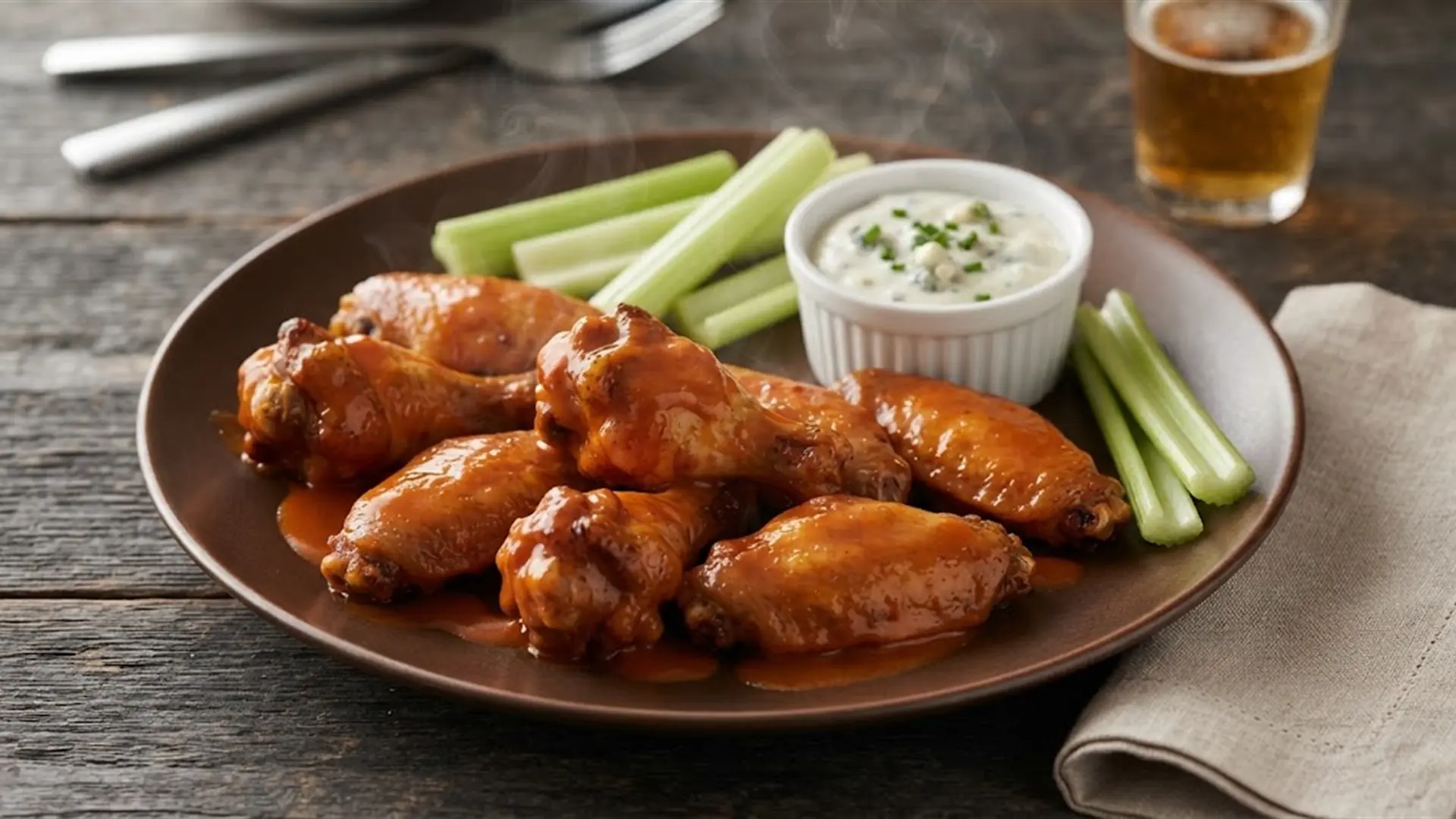
Summary: Chicken wings coated in cornstarch, deep-fried, and tossed in a sauce of hot pepper sauce and butter. Served with a sour cream and blue cheese dip and celery sticks. The butter in the sauce keeps the spicy component on the skin’s surface, so the sauce doesn’t drip off. Total time 40 minutes, makes 6 servings.
Did you make this recipe? Share your result with the community.
Category: Poultry, American cuisine
Success rate: not rated yet% of users mastered this recipe
Quick overview
- Dish: Buffalo Wings – fried or baked chicken wings coated in spicy Buffalo sauce, traditionally served with blue cheese dip
- Category: Poultry, American cuisine
- Cuisine: American
- Main ingredient: Chicken wings, 1200 g
- Guide: 12 most famous American dishes: traditional recipes from American cuisine
- Total time: 40 minutes (18 minutes prep + 22 minutes cooking)
- Difficulty: Medium
- Servings: 6 (Serving size: 229 g)
- Key technique: Deep-frying at 345°F, emulsifying the sauce with butter
- Preparation types: Frying, baking
- Dietary info & Allergens:milk, mustard, celery
- Suitable for: Parties, watching sports, dinner with friends, picnics
- Nutritional values (per 1 serving): 585 kcal, Protein: 29.9 g, Fat: 47.0 g, Carbohydrates: 8.5 g
- Storage: 2 days in the refrigerator, 1 month in the freezer
- Pairing: Light lager, dry cider, homemade lemonade
- In short: Dry skin, oil at 345°F, and butter in the sauce – three things that determine whether the wings get crispy and whether the sauce stays on the surface.
WAGUU says: “Buffalo sauce isn’t just hot peppers. The butter in it is an emulsifier – without it, the sauce runs off the wing onto the plate and only the heat remains.”
Key facts
| Prep time: | 18 minutes |
| Cook time: | 22 minutes |
| Temperature: | Oil 345°F, internal meat temperature 165°F |
| Number of servings: | 6 (serving size 229 g) |
In a nutshell
Wings are divided into two parts that behave differently: the drumette is meatier, the flat has more skin and fat. The cornstarch coating dries the skin and during frying creates a thin crispy layer that holds up even after tossing in sauce. The sauce is made by melting butter in hot pepper sauce; the butter coats the fat and keeps it on the wing’s surface, so the sauce doesn’t soak through the crust or drip off.
Ingredients
Base servings: 6 servings • Serving size: 229 g
| Ingredient | Amount | Quality |
|---|---|---|
| chicken wings (drumettes and flats) | 2.6 lb | fresh, skin left on, separated into two parts |
| cornstarch | 1.5 oz | pure, no additives |
| sweet paprika | 0.3 oz | sweet, ground |
| garlic powder | 0.18 oz | dried, ground |
| ground black pepper | 0.14 oz | freshly ground |
| fine sea salt | 1.5 tsp | for coating |
| canola oil | 5 cups | for deep-frying, high smoke point |
| hot pepper sauce | 4.0 oz | fermented, with vinegar and chili |
| butter | 3.0 oz | 82%, unsalted |
| Dijon mustard | 0.4 oz | smooth, medium-hot |
| sour cream | 4.0 oz | 30%, thick |
| blue cheese | 2.0 oz | aged, crumbly |
| celery | 5.5 oz | firm stalks, for sticks |
Why you’ll love this recipe
- Ready in 40 minutes: The wings aren’t battered and don’t rest overnight. The dry coating holds on its own.
- Crust that stays crispy: The starch coating dries the skin, so the sauce doesn’t soak into the meat.
- Exact ratios for 6 servings: 200 g wings per serving, 150 g sauce, and 30 g cheese dip per person.
- Beginner-friendly: Five phases, two appliances, and clear checkpoints.
Why it works: Chicken wing skin contains both water and fat. When a piece is placed in oil at 345°F, water on the surface evaporates quickly and the skin dries; the starch coating binds this water and swells above 140°F, creating a thin continuous layer. It’s much thinner than batter, so crispiness lasts even after tossing in sauce. In the sauce, butter plays the main role: hot pepper sauce is a water-based solution of vinegar and chili, butter is fat. When stirred while hot, the fat disperses into tiny droplets and the proteins in butter keep them separated – an emulsion forms that clings to the wing’s surface. If the sauce gets too hot, the emulsion breaks and the butter separates. Dijon mustard reinforces this emulsion, which is why it’s added even to such a simple sauce.
Recipe overview
Prep: 18 min | Cook: 22 min | Difficulty: Medium | Servings: 6 | Type: Main dish | Origin: American
Detailed instructions
Total progress: 0 % done
Phase 1: Preparing wings and coating – 12 min
Appliances: kitchen scale, refrigerator
1.5 Separate the chicken wings at the joint into drumettes and flats and pat them dry with a paper towel. In a wide bowl, mix cornstarch, sweet paprika, garlic powder, ground black pepper, and fine sea salt. Coat the wings in this mixture on all sides and place them on a rack so the coating can rest for ten minutes.
VKB: The wing skin is matte and dry, and the coating adheres in a thin, even layer. There are no water droplets on the rack under the wings.
Before moving to the next step:
Don’t wash the wings or leave them wet. Water on the skin causes the oil to splatter violently and washes off the coating. Pat them dry with a paper towel and let the coating rest for ten minutes.
Phase 2: Heating the oil – 8 min
Appliances: deep fryer or deep pan, oil thermometer
2.26 Pour canola oil into the deep fryer and heat it to 345°F. Fill the pot to at most two-thirds of its volume. Monitor the temperature with a thermometer, because wings have thin skin and will burn within a minute at higher temperatures.
VKB: The thermometer reads 350°F. A bit of coating dropped into the oil is immediately surrounded by bubbles and floats to the surface.
Before you move to the next step:
Add the wings to the oil one at a time with tongs. Dropping them in splashes the oil and knocks the coating off on impact.
Phase 3: Frying – 12 min
Equipment: deep fryer, tongs, meat thermometer
3. Add half the wings to the oil and fry for 8 to 9 minutes, until the skin turns golden brown. Turn the pieces halfway through. After removing them, place them on a rack over a baking sheet and let the oil return to 350°F, then fry the second half for the same amount of time.
VKB: The skin is golden brown and dry on the surface, and sounds hollow when tapped with tongs. The thermometer at the bone reads 165°F.
Before you move to the next step:
Do not fry all the wings at once. Overcrowding the pot drops the oil temperature by 20°F and the skin soaks up fat, so instead of crispy it turns greasy and soft.
Phase 4: Buffalo sauce – 10 min
Equipment: small saucepan, whisk, large bowl
4. In a small saucepan, melt the butter over low heat and let it cool to about 140°F. Then whisk in the hot pepper sauce and Dijon mustard and whisk for 30 seconds, until the sauce is an even color. Put the wings in a large bowl, pour the sauce over them, and toss twice to coat on all sides.
VKB: The sauce is evenly orange, with no visible droplets of fat on the surface. The wings are coated in a thin layer, and the sauce does not run down to the bottom of the bowl.
Before you move to the next step:
Do not let the butter boil. Above 175°F the emulsion breaks, the fat separates, and the sauce will be greasy on the wings instead of glossy.
Phase 5: Dip and serving – 5 min
Equipment: bowl, knife
5. Stir the sour cream with the crumbled blue cheese and let the dip firm up in the refrigerator for five minutes. Cut the celery into sticks about 3 inches long. Serve the wings hot, with the dip and celery cold alongside.
VKB: The dip holds on a spoon and does not run off. The celery sticks are firm and dry, the wings are coated in a thin layer of sauce that does not slide onto the plate.
Required equipment
| Utensil | Ideal size | Alternative | Risk |
|---|---|---|---|
| deep fryer | 4 qt capacity, 9.5 in diameter | deep cast-iron skillet with lid | in a shallow pan the wings fry unevenly |
| oil thermometer | up to 425°F, with clip | coating-drop test | thin skin burns at 375°F within one minute |
| large bowl for coating | 3 qt capacity, with lid | large pot | in a small bowl the sauce rubs against the sides and the wings coat unevenly |
| rack over baking sheet | 12 × 8 in | oven rack set over a baking sheet | on a plate steam collects under the skin and the crispness disappears |
| frying tongs | long, metal | slotted spoon | short utensils mean burns from splattering oil |
Shopping list
Nutrition profile
Values per 1 serving (without sides). Serving weight 229 g. For wings, the edible portion is counted, meaning meat and skin; bone weight is not included in the serving. Frying oil is not included in the weight; only the fat absorbed during frying is in the values.
| Nutrient | Per 100 g | Per 1 serving | Per 6 servings |
|---|---|---|---|
| Energy | 250 kcal | 586 kcal | 3513 kcal |
| Fat | 20.5 g | 47.0 g | 282.0 g |
| of which saturated | 7.6 g | 17.4 g | 104.4 g |
| Carbohydrates | 3.7 g | 8.5 g | 51.0 g |
| of which sugars | 0.6 g | 1.4 g | 8.1 g |
| Protein | 13.1 g | 29.9 g | 179.3 g |
| Salt | 0.99 g | 2.26 g | 16.81 g |
| of which sodium | 0.49 g | 1.12 g | 6.72 g |
Reference intake of an average adult (8400 kJ / 2000 kcal). Salt comes mainly from the hot pepper sauce, the blue cheese, and the coating.
WAGUU Pro level
- Pro standard: Tested recipe with exact ratios and visual checkpoints.
- Tip 1: Keep the butter-to-hot-sauce ratio at 1:2. More butter makes the sauce milder, but the wings will be greasy and the crispness will disappear.
- Tip 2: Toss the wings in the sauce with two motions, not ten. Every extra toss soaks the coating and the crispness is lost.
- Tip 3: Make the dip 30 minutes ahead and leave it in the refrigerator. Blue cheese needs time to release its flavor into the cream.
- Tip 4: Cut the celery into sticks and soak them in ice water for 10 minutes. The ribs firm up and stay crisp even after an hour on the table.
Science background
Crispy wing skin forms in two ways. During frying, water evaporates from the surface and the skin dries out; the surface temperature rises above 280°F and Maillard reactions begin, creating the brown color and aromatic compounds. Cornstarch also gelatinizes on the surface and forms a thin continuous layer that acts as a barrier – it prevents water from escaping the meat and at the same time blocks the sauce from penetrating the skin. In the sauce, emulsification plays a key role: hot pepper sauce is a water-based solution of vinegar, salt, and capsaicin, while butter is fat. When the butter melts and is whisked in, tiny fat droplets coated with milk proteins form; these droplets stay evenly dispersed in the sauce. When the sauce goes above 175°F, the proteins tighten, the emulsion breaks, and the fat floats to the surface. Capsaicin, the heat component of chili, is soluble in fat, not water – that is why the heat is released from the sauce thanks to the butter and we perceive it more strongly than from the pepper sauce alone. The blue cheese in the dip contains enzymes that break down milk fat into fatty acids; these give the dip a sharp, slightly pungent flavor that tempers the heat on the tongue.
Fine Dining – Professional techniques
- Plate composition: Stand three wings on the edge of a white plate in a fan, put a scoop of dip in the center, and place three celery sticks vertically alongside like a fence.
- Texture contrasts: Add crisp celery and a smooth dip to the crispy skin. Three levels of firmness in one bite hold attention.
- Temperature contrast: Serve the wings straight from the oil, the dip and celery ice-cold. The temperature difference highlights the heat.
- Aromatic additions: Add a teaspoon of honey and a pinch of smoked paprika to the sauce. The sweetness softens the sharpness and the smoky note connects the wings to the grill.
Sensory radar
- Appearance: Orange glossy layer of sauce on golden-brown skin, with the crispy coating showing through at the edges. White dip with blue veins of cheese.
- Aroma: Vinegar and chili from the sauce, roasted chicken skin, and butter. In the background, the sharp aroma of blue cheese.
- Taste: First the acidity of the vinegar, then buttery depth, and at the end heat that unfolds only after swallowing. The dip tempers it and adds saltiness.
- Texture: Skin crispy, meat tender and juicy, celery firm and juicy, dip thick and smooth.
Pairing
- Light lager: Hop bitterness and hop aroma temper the heat. Serve chilled to 43–46°F.
- Dry cider: The citric acid cuts through the fat from the butter and the chicken skin. Good for hotter variations.
- Homemade lemonade: Water with lemon and mint, served over ice. A non-alcoholic option for kids and designated drivers.
- Buttermilk: The dairy protein binds capsaicin, so the heat fades quickly.
Different cooking methods
- Baked version: Toss the wings in cornstarch, place on a wire rack, and bake at 425°F for 40 minutes, flipping halfway. Less fat, but the skin is drier and less crispy.
- Sweet-and-sour variation: Add 1 tablespoon of honey and the juice of one lime to the sauce. Good for those who can’t handle high heat.
- Air fryer version: Cook the wings at 400°F for 25 minutes, flipping halfway. Oil use drops to a tablespoon, but crispiness is weaker.
Allergens and dietary information
Contains: celery (celery); milk (sour cream, butter, blue cheese); mustard (Dijon mustard) • Gluten: no, this recipe is gluten-free • Not suitable for: people with lactose intolerance, milk allergy, mustard allergy, or celery allergy
Great for
Parties and game days, dinner with friends, picnics, celebrations for six to ten people, a homemade version of pub food.
Substitution guide
- Hot pepper sauce: freshly blended chiles with vinegar and salt, simmered for 10 minutes. The heat will be higher and the color darker.
- Butter: clarified butter or ghee. The emulsion forms the same way, with a slightly more pronounced flavor.
- Blue cheese: feta or aged Camembert. Less sharp, thicker dip.
- Sour cream: Greek yogurt or crème fraîche. The dip will be tangier but just as thick.
- Chicken wings: boneless thighs cut into strips. Fry for two minutes less.
- Cornstarch: potato starch. The coating will be harder and less flaky.
FAQ
Why does the sauce separate into fat and water?
Because the butter overheated. Stir the sauce at around 140°F; if it breaks, add a tablespoon of cold water and whisk off the heat.
Do I have to split the wings into two parts?
You don’t have to, but we recommend it. The drumette and flat have different meat-to-skin ratios, and if left whole, they cook unevenly and blood remains at the joint.
What hot sauce is suitable?
A fermented sauce made from chiles, vinegar, and salt, with no tomatoes or sugar. If you use sweet chili sauce, the result will be too sweet and will burn.
Can I prepare the wings ahead of time?
Yes, keep the coated wings in the fridge for up to 12 hours and fry them just before serving. Make the sauce ahead and reheat it to 140°F, no higher.
What can I substitute for blue cheese in the dip?
Feta or aged Camembert. If you don’t want blue cheese at all, just use sour cream with garlic and chives.
How do I reheat leftovers so the skin stays crispy?
In the oven at 400°F for 8 minutes on a wire rack. In the microwave, the skin gets soggy and crispiness never comes back.
WAGUU Petr advises: Cooking for 6 or more?
6–8 people: Fry in three batches of 14 oz each and hold the finished wings in the oven at 175°F. Check the oil temperature between batches. • 10+ people: Make two bowls of sauce and coat the wings in batches, otherwise the sauce cools and doesn’t coat evenly. Make a double batch of dip—it gets used up faster than you think.
Sides and serving
Storage and reheating
Fridge: 2 days • Freezer: 1 month • Reheating: In the oven at 400°F for 8 minutes on a wire rack. Thaw frozen wings overnight in the fridge; store the dip separately and never reheat it.
Author: WAGUU Petr & Team • Published: 6 Oct 2026 • Updated: 9 Oct 2026
More recipes from the article
Guide: 12 most famous American dishes: traditional recipes from American cuisine
Barbecue Ribs – slow-roasted or smoked pork ribs brushed with barbecue sauce
Pulled Pork – slow-roasted or smoked pork shredded into strands and served with barbecue sauce
Mac and Cheese – pasta with a rich cheese sauce, often Cheddar, baked until golden
Gumbo – thick Louisiana stew-like dish with meat or seafood, vegetables, and a boldly spiced base
More recipes you might like
Why WAGUU?
WAGUU recipes are checked for accuracy of ingredients, methods, and nutritional values. For this recipe, the amounts are given in the same form in the ingredient table, in each step, in the shopping list, and in the printable version—1.4 oz of cornstarch gives a thin coating on all 2.6 lb of wings, and 2.8 oz of butter keeps 5.3 oz of hot sauce in emulsion.
Photo gallery from the process
Community photos: Cook, snap a photo, and share your result.
You can upload photos in the comments below or send them by email.
Did you film a video of our recipe? Paste the link to YouTube, YouTube Shorts, TikTok, Instagram Reels, Facebook Reels, Pinterest, Vimeo, or X (Twitter) in the comments—we’ll be happy to publish it and help get you and your content noticed.
Most common mistakes
- Wet chicken skin – the oil splatters and the coating washes off. Pat the wings dry with paper towels and let the coating rest for ten minutes.
- Overcrowded fryer – the oil temperature drops and the skin absorbs fat. Fry at most half the wings at a time.
- Boiling butter in the sauce – the emulsion breaks and the fat floats. Melt the butter over low heat and stir the sauce at 140°F.
- Wings coated too far in advance – crispiness disappears. Coat them with sauce just before serving, with at most two tosses.