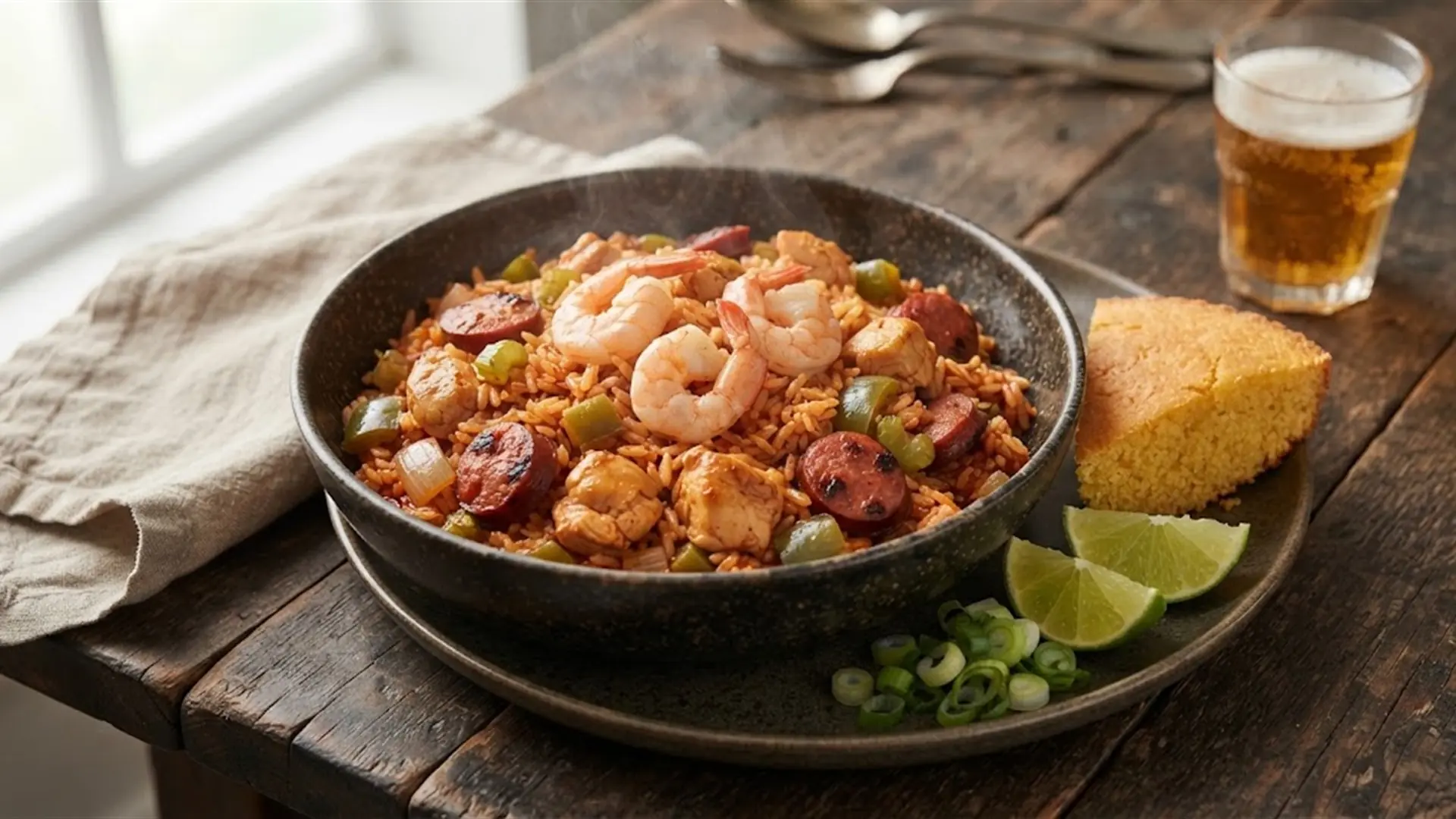
Summary: A spicy rice dish from Louisiana with chicken, smoked sausage, shrimp, and a vegetable base of onion, celery, and bell pepper. The rice cooks right in the same pot with the broth, so it soaks up all the flavor. Total time 65 minutes, makes 6 servings.
Did you make this recipe? Share your result with the community.
Category: Rice and grains, American cuisine
Success rate: not rated yet% of users nailed this recipe
Quick overview
- Dish: Jambalaya – a heavily spiced rice dish from Louisiana with meat, sausage, vegetables, and depending on the version, seafood
- Category: Rice and grains, American cuisine
- Cuisine: American
- Main ingredient: Long-grain rice, 14 oz
- Guide: 12 most famous American dishes: traditional recipes from American cuisine
- Total time: 65 minutes (20 minutes prep + 45 minutes cooking)
- Difficulty: Medium
- Servings: 6 (Serving weight: 17.7 oz)
- Key technique: Cooking rice together with broth in one pot, toasting spices
- Preparation types: Stewing, pan-frying, classic cooking
- Dietary info & Allergens:crustaceans, celery
- Suitable for: Weekend lunch, party, family celebration, freezing winter day
- Nutritional values (per 1 serving): 664 kcal, Protein: 44.4 g, Fat: 24.9 g, Carbohydrates: 63.0 g
- Storage: 3 days in the fridge, 2 months in the freezer
- Pairing: Cold lager, iced tea, dry rosé wine
- In short: The vegetable base, toasted spices, and rice cooked in the exact ratio of broth – three things that decide whether the jambalaya turns out fluffy or mushy.
WAGUU says: “Jambalaya isn’t cooked twice. The rice goes in once and then the pot gets covered – every stir turns it into mush.”
Key facts
| Prep time: | 20 minutes |
| Cook time: | 45 minutes |
| Temperature: | Sear at 200°F pan surface, simmer at 95°F, internal chicken temperature 75°F |
| Number of servings: | 6 (serving weight 17.7 oz) |
At a glance
Jambalaya is one of those dishes where the rice cooks together with the other ingredients – just like risotto or paella. The ratio is what matters: for 14 oz of rice, you need 27 fl oz of broth, so double. The rice absorbs the liquid, releases starch, and stays fluffy. Shrimp go in at the end because they need two minutes; if they cooked the whole time, they’d turn to rubber.
Ingredients
Base servings: 6 servings • Serving weight: 17.7 oz
| Ingredient | Amount | Quality |
|---|---|---|
| long-grain rice | 14 oz | long grain, unrinsed |
| boneless chicken thighs | 21 oz | fresh, skin left on |
| smoked sausage | 9.0 oz | coarse-ground, high meat content |
| shrimp | 11 oz | peeled, deveined |
| onion | 7.0 oz | yellow, medium |
| celery | 5.5 oz | stalk, firm ribs |
| green bell pepper | 7.0 oz | firm, no bruises |
| tomato paste | 2.0 oz | double concentrated |
| chicken broth | 3.4 cups | unsalted, homemade or from bouillon |
| canola oil | 2 tbsp | for searing, high smoke point |
| sweet paprika | 0.4 oz | sweet, ground |
| cayenne pepper | 0.11 oz | ground, hot |
| ground black pepper | 0.11 oz | freshly ground |
| fine sea salt | 1.5 tsp | according to broth saltiness |
| thyme | 0.11 oz | dried |
Why you’ll love this recipe
- One pan, one meal: Meat, vegetables, and rice cook in one pot, so no flavor gets lost.
- Exact rice-to-broth ratio: 14 oz rice to 27 fl oz broth. When the ratio is right, the rice stays fluffy and doesn’t stick.
- Exact proportions for 6 servings: 3.5 oz chicken, 1.8 oz sausage, and 1.8 oz shrimp per serving.
- An advanced beginner can handle it: Five phases and one pot, but it requires attention to the liquid ratio.
Why it works: Rice absorbs water through the surface of the grains. When cooked in seasoned broth, it soaks up dissolved aromatic compounds along with the water – that’s why jambalaya has the flavor of meat and spices even inside the grains. The ratio of two parts liquid to one part rice matches how much water a grain can take before it softens; with more liquid, the excess isn’t absorbed and the rice gets mushy. Toasting spices in fat is key: capsaicin from cayenne and pigments from paprika are fat-soluble, not water-soluble, so they release into the oil and spread throughout the dish. The vegetable base of onion, celery, and bell pepper is sautéed until translucent, which breaks down plant cells and releases aromatic compounds. Shrimp go in for the last two minutes because their proteins contract and squeeze out water during longer cooking – shrimp turn to rubber.
Recipe overview
Prep: 20 min | Cook: 45 min | Difficulty: Medium | Servings: 6 | Type: Main dish | Origin: American
Detailed instructions
Overall progress: 0 % done
Phase 1: Prep ingredients – 15 min
Equipment: kitchen scale, cutting board, knife
1.5 Pat the chicken thighs dry with a paper towel and cut into 1-inch cubes. Slice the sausage into 1/4-inch rounds, leave the shrimp whole. Cut the onion, celery, and green bell pepper into equally sized cubes. Get the rice, broth, and spices ready: sweet paprika, cayenne pepper, ground black pepper, salt, and thyme.
VKB: All ingredients are cut and measured into bowls. The chicken is dry to the touch, the vegetable cubes are the same size, the rice is dry and unrinsed.
Before you move to the next step:
Do not rinse the chicken. Water spreads bacteria around the kitchen and wet meat steams in the pan instead of searing. Pat it dry with a paper towel.
Phase 2: Searing the meat and sausage – 10 min
Equipment: large heavy-bottomed pot, wooden spoon
3.50 Heat the canola oil in the pot and sear the chicken for 4 minutes on all sides until the surface turns golden. Remove the meat to a plate. Add the sausage to the pot and cook for 3 minutes to render its fat and brown. Transfer the sausage to the chicken and leave only the fat in the pot.
VKB: The chicken has a golden-brown crust and is still pink inside. The sausage is curled at the edges and a layer of fat, not water, remains in the pot.
Before you move to the next step:
Do not overcrowd the pot. When meat sears in two layers, it releases water and turns gray instead of forming a crust. Sear in batches instead.
Phase 3: Vegetable base and rice – 8 min
Equipment: pot, wooden spoon
1.5 Add the onion, celery, and bell pepper to the fat in the pot and sweat for 6 minutes over medium heat until the onion turns translucent. Add the sweet paprika, cayenne, black pepper, salt, and thyme and stir for 30 seconds to toast the spices. Stir in the tomato paste and spread it across the bottom with the spoon. Add the rice and stir for two minutes until the grains begin to turn translucent.
VKB: The vegetables are soft but hold their shape. The rice is coated in fat and translucent at the edges. No free liquid remains in the pot.
Before you move to the next step:
Do not rinse the rice. Water would wash away the surface starch that holds the dish together, and the jambalaya would be dry and fluffy like side-dish rice.
Phase 4: Simmering – 25 min
Equipment: pot with lid, meat thermometer
4. Return the chicken and sausage to the pot and pour in the chicken broth. Bring to a boil, then reduce the heat so the liquid barely bubbles, and cover. Simmer for 20 minutes without stirring. After 20 minutes, check that only a small layer of liquid remains above the rice.
VKB: The rice is tender but the grains hold their shape and do not stick together. A thermometer inserted into the chicken reads 165°F. No starchy mush collects on the surface.
Before you move to the next step:
Do not lift the lid or stir during simmering. Every peek releases steam and the rice then lacks enough liquid to cook evenly.
Phase 5: Shrimp and resting – 7 min
Equipment: pot, fork
5. Place the shrimp on top of the rice, cover, and let them warm through in the steam for two minutes. Then remove the pot from the heat and let the dish rest for five minutes without stirring. Before serving, fluff the rice with a fork from the bottom to separate the grains.
VKB: The shrimp are pink, curled into a C shape, and firm to the touch. The rice is fluffy, the grains separate with a fork, and the dish is not wet.
Required equipment
| Tool | Ideal size | Alternative | Risk |
|---|---|---|---|
| large heavy-bottomed pot | 5 qt capacity, 10 in diameter, with lid | Dutch oven or large skillet with lid | in a small pot the rice cooks in a deep layer and turns mushy at the bottom |
| wooden spoon | long, with a flat end | silicone spatula | a metal spoon crushes the rice and the dish becomes sticky |
| meat thermometer | probe | checking the color of the juices | chicken cooks unevenly in the rice; without measuring it easily overcooks |
| liquid measuring cup | up to 4 cups, with markings | kitchen scale | an inaccurate broth ratio determines whether the rice turns out fluffy |
| kitchen scale | with 1 g resolution | rice measuring cup | rice measured by volume is inaccurate, which changes the ratio with the broth |
Shopping list
Nutrition profile
Values per 1 serving (without side dish). Calculated from average nutrient values of ingredients. Serving weight 502 g.
| Nutrient | Per 100 g | Per 1 serving | Per 6 servings |
|---|---|---|---|
| Energy | 135 kcal | 690 kcal | 4143 kcal |
| Fat | 5.0 g | 24.9 g | 149.4 g |
| of which saturated | 1.3 g | 6.7 g | 40.3 g |
| Carbohydrates | 12.6 g | 63.0 g | 377.9 g |
| of which sugars | 1.0 g | 5.0 g | 29.7 g |
| Protein | 8.8 g | 44.4 g | 266.2 g |
| Salt | 0.7 g | 3.5 g | 20.03 g |
| of which sodium | 0.27 g | 1.34 g | 8.01 g |
Reference intake of an average adult (8400 kJ / 2000 kcal). Salt comes mainly from the smoked sausage, shrimp, and broth; if using homemade unsalted broth, reduce salt to 6 g.
WAGUU Pro level
- Pro standard: Verified recipe with precise ratios and visual checkpoints.
- Tip 1: Keep the broth-to-rice ratio at 2:1. For older rice, add 50 ml extra; for new rice, reduce by the same amount.
- Tip 2: Do not rinse the rice before cooking. The surface starch helps the dish hold its shape and bind flavor.
- Tip 3: Add the shrimp only in the last two minutes and just warm them through in the steam under the lid. Cooked shrimp are tough and lose their sweetness.
- Tip 4: Let the finished dish rest for five minutes without stirring. The rice absorbs the remaining liquid and the grains separate with a fork.
Scientific background
Rice is mostly starch, which swells and absorbs water above 140°F. The grain takes in water through its surface and with it dissolved substances from the broth – that is why jambalaya tastes of the meat even inside the grains, unlike rice cooked separately. The ratio of two parts liquid to one part rice matches the amount of water the grain can take up before it softens; excess is not absorbed and the rice turns to mush. Toasting spices in fat has a reason: capsaicin from cayenne and pigments from paprika are soluble in fat, not water, so they are released into the oil and spread throughout the dish. The vegetable base of onion, celery, and bell pepper is sweated until translucent; heat breaks down cell walls and releases aromatic compounds that would not be freed in water. Shrimp are 80% water bound in proteins. When boiled longer than three minutes, the proteins contract, water is squeezed out, and the meat becomes rubbery – that is why they are added in the last two minutes.
Fine Dining – Professional techniques
- Plate composition: Spoon the dish into a ring mold in the center of the plate, remove the mold, and top with three shrimp fanned out and a sprig of fresh thyme.
- Texture contrasts: To the soft rice, add seared sausage cut into thin rounds and crispy fried onions.
- Temperature contrast: Serve the jambalaya hot with a spoonful of cold yogurt dip on the side to tame the heat.
- Aromatic additions: Before serving, grate lime zest over the portion and add a few drops of smoked paprika oil.
Sensory radar
- Appearance: Orange-brown rice with visible cubes of chicken, rounds of sausage, pink shrimp, and green strips of bell pepper.
- Aroma: Smoked sausage and toasted paprika, with sweet onion and celery in the background. Shrimp add a subtle marine note.
- Flavor: The salty, smoky flavor of the sausage, the meaty depth of the chicken, and a cayenne heat that lingers on the palate.
- Texture: Rice fluffy and tender, meat succulent, shrimp firm, vegetables soft but holding their shape.
Pairings
- Cold lager: Hop bitterness and cold temperature tame the heat. Serve chilled at 40–45°F.
- Iced tea: Tannins cut through the fat, and sugar softens the sharpness.
- Dry rosé: Acidity and fruitiness balance the smoked sausage. Serve chilled at 46–50°F.
- Buttermilk: Milk proteins bind capsaicin, so the heat fades quickly.
Variations
- Cajun version without tomatoes: Omit the tomato paste and increase the broth to 4 cups. The dish is darker, sharper, and closer to a smoked flavor.
- Seafood jambalaya: Replace the chicken with 1½ lb clams and keep 10 oz shrimp. Add the seafood in the last three minutes.
- Vegetarian version: Replace the meats with 14 oz mushrooms and 7 oz chickpeas, and use vegetable broth. The flavor will be lighter, but the dish remains hearty.
Allergens and Dietary Information
Contains: crustaceans (shrimp); celery (smoked sausage, celery); mustard (smoked sausage); sulfites (smoked sausage) • Gluten: no, if the sausage and broth are gluten-free; check labels • Not suitable for: people with allergies to crustaceans, celery, and mustard
Suitable for
Weekend lunch, party for six to ten people, family celebration, winter dinner, next-day meal.
Substitution Guide
- Smoked sausage: smoked pork shoulder or a good-quality coarse-ground sausage. The flavor will be less smoky, with less fat.
- Shrimp: chunks of white fish or clams. Add fish in the last four minutes.
- Long-grain rice: basmati or jasmine. The aroma will be more pronounced, and the grains will stick together more.
- Chicken broth: vegetable broth with a tablespoon of soy sauce. The dish loses some meaty depth.
- Tomato paste: crushed tomatoes reduced by half. The flavor will be fresher and more acidic.
- Cayenne pepper: ground chili or chipotle pepper. Chipotle adds a smoky undertone.
FAQ
Why is my jambalaya mushy?
Most often because of too much broth or stirring during simmering. Keep the ratio of 2 cups rice to 4 cups broth and don’t lift the lid while simmering.
What’s the difference between jambalaya and gumbo?
In jambalaya, the rice cooks with the other ingredients. Gumbo is a dark roux-based stew served with rice on the side. Jambalaya is fluffy; gumbo is thick.
Can I leave out the shrimp?
Yes, add 10 oz extra chicken and ½ cup more broth. The dish will be shellfish-free but still filling.
Is jambalaya very spicy?
Moderately. The heat comes from cayenne pepper, about 1 teaspoon. If you reduce it to ½ teaspoon, the dish will be only mildly seasoned.
Can I make jambalaya ahead of time?
Yes, it keeps for three days in the fridge and tastes even fuller the next day. But add the shrimp only when reheating, or they’ll toughen.
How do I thicken jambalaya if it’s runny?
Nothing. Let it rest for five minutes uncovered; excess water will evaporate. Thickening with flour turns it into porridge.
WAGUU Petr advises: Cooking for 6 or more?
6–8 people: Cook in a 6-quart pot so the rice sits in a thin layer. In a deep layer, the grains at the bottom overcook before the top is heated through. • 10+ people: Double the batch and cook in two pots, because a larger volume heats unevenly on the stove. Divide the shrimp between both pots at the end.
Sides and Serving
Storage and Reheating
Refrigerator: 3 days • Freezer: 2 months • Reheating: In a pot with a tablespoon of broth over low heat, covered, for 10 minutes. In the microwave, the rice dries out and the dish loses texture.
Author: WAGUU Petr & Team • Published: 6 Oct 2026 • Updated: 9 Oct 2026
More recipes from the article
Guide: 12 most famous American dishes: traditional recipes from American cuisine
Barbecue Ribs – slow-roasted or smoked pork ribs brushed with barbecue sauce
Pulled Pork – slow-roasted or smoked pork shredded into strands and served with barbecue sauce
Mac and Cheese – pasta with a rich cheese sauce, often Cheddar, baked until golden
Gumbo – thick Louisiana stew-like dish with meat or seafood, vegetables, and a heavily seasoned base
More recipes you might like
Why WAGUU?
WAGUU recipes are checked for accuracy of ingredients, methods, and nutritional values. For this recipe, the amounts are given in the same form in the ingredient table, in each step, in the shopping list, and in the printable version – 2 cups rice to 4 cups broth, the exact ratio of two parts liquid to one part rice.
Photo gallery from the process
Community photos: Cook, snap a photo, and share your result.
You can upload photos in the comments below or send them by email.
Did you film a video of our recipe? Paste the link to YouTube, YouTube Shorts, TikTok, Instagram Reels, Facebook Reels, Pinterest, Vimeo, or X (Twitter) in the comments – we’ll be happy to publish it and help you and your content get noticed.
Most common mistakes
- Too much broth – the rice turns to mush. Keep the ratio of 2 cups rice to 4 cups broth and measure with a cup.
- Stirring during simmering – the rice releases starch and the dish gets gluey. Keep the pot covered and stir only before serving with a fork.
- Shrimp cooked the whole time – they lose water and become tough. Add them in the last two minutes and just heat through with steam.
- Rinsed rice – the surface starch is needed for the dish to hold its shape. Do not rinse the rice before cooking.