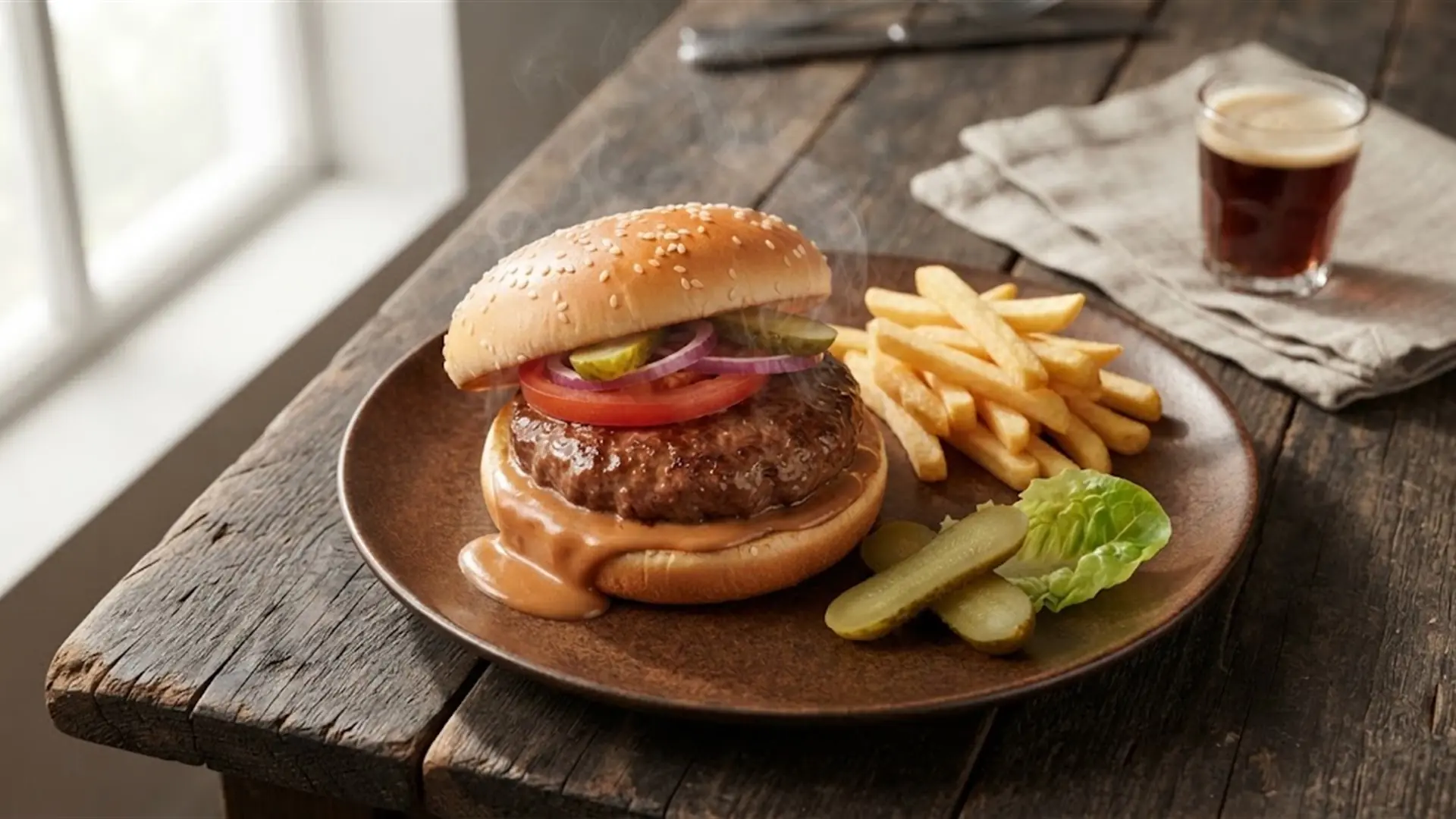
Summary: A ground beef hamburger with about 20% fat. 6-oz patties are seared in a very hot skillet and flipped only once. Buns are toasted cut-side down in the skillet, and the meat rests for two to three minutes after cooking. Toppings include iceberg lettuce, tomato, red onion, pickles, and Cheddar. Total time 27 minutes, makes 6 servings.
Did you make this recipe? Share your result with the community.
Category: Beef, American cuisine
Success rate: not rated yet% of users nailed this recipe
Quick overview
- Dish: Hamburger – a juicy beef burger on a bun with classic toppings like lettuce, tomato, onion, pickles, and sauce
- Category: Beef, American cuisine
- Cuisine: American
- Main ingredient: Ground beef chuck, 2.4 lb (20% fat)
- Guide: 12 most famous American dishes: traditional recipes from American cuisine
- Total time: 27 minutes (15 minutes prep + 12 minutes cooking)
- Difficulty: Easy
- Servings: 6 (Serving size: 15.6 oz)
- Key technique: Searing patties in a very hot cast-iron skillet, flipping only once
- Cooking methods: Pan-frying, grilling, and roasting
- Dietary info & Allergens:gluten, milk, mustard, egg
- Great for: Quick family dinner, weekend lunch, backyard grilling, party with friends
- Nutrition (per serving): 954 kcal, Protein: 44.6 g, Fat: 61.9 g, Carbs: 53.3 g
- Storage: 3 days in the fridge, 2 months in the freezer
- Pairing: Pale lager, dry red wine, homemade lemonade
- In short: A screaming-hot skillet, patties with 20% fat, a single flip, and buns toasted cut-side down – four things that decide the outcome.
WAGUU says: “A hamburger is a ground beef patty that holds its shape only thanks to the fat in the meat – so don’t overwork the meat and preheat the skillet before the meat goes in, not after.”
Key facts
| Prep time: | 15 minutes |
| Cook time: | 12 minutes |
| Temperature: | Cast-iron skillet heated to 450–465 °F, internal temperature of patties 155–160 °F |
| Servings: | 6 (serving size 15.6 oz) |
At a glance
A hamburger hinges on two things that are easy to get wrong: the fat content of the ground beef and the temperature of the skillet. Meat with 20% fat stays juicy even after a hard sear, and a screaming-hot surface forms a crust before the juices can cook off. Toasting the bun cut-side down creates a fat barrier that keeps the bottom from getting soggy. The rest is about layering order and flipping the patty only once.
Ingredients
Base servings: 6 servings • Serving size: 15.6 oz
| Ingredient | Amount | Quality |
|---|---|---|
| ground beef chuck, 20% fat | 2.4 lb | freshly ground, chilled to 40 °F |
| potato burger buns | 6 pcs | soft, 3 oz, sesame-topped |
| butter | 1.0 oz | 82%, for toasting buns |
| fine sea salt | 1.25 tsp | for seasoning patties |
| ground black pepper | 0.14 oz | freshly ground |
| canola oil | 1 tbsp | for greasing the skillet, high smoke point |
| Cheddar cheese | 4.0 oz | aged, sliced into 6 slices |
| iceberg lettuce | 3.0 oz | crisp leaves, no bruises |
| tomato | 2 pcs | large, firm, ripe |
| red onion | 1 pcs | medium, 4 oz |
| dill pickles | 8 pcs | firm, sliced |
| ketchup | 6 tbsp | tomato-based, no preservatives |
| yellow mustard | 3 tbsp | medium-hot |
| mayonnaise | 1/4 cups | unsweetened |
Why you’ll love this recipe
- Done in 27 minutes: The meat rests in the fridge, not in a marinade. From the moment you pull out the skillet, you’re done in under half an hour.
- Flavor from the skillet, not a packet: The crust forms on a screaming-hot cast-iron surface. Nothing goes into the meat but salt and pepper – the flavor comes from the beef itself.
- Exact ratios for 6 servings: 6 oz of meat per patty, 0.7 oz of cheese per serving, 1 oz of butter for all six buns. Everything recalculates based on the actual number of diners.
- Beginner-friendly: Three phases, five checkpoints, and one appliance. What sets it apart from an average burger is the skillet temperature and resting the meat.
Why it works: A hard sear at 450–465 °F triggers Maillard reactions on the surface of the meat, creating a brown crust and aromatic compounds – that crust then holds the juices inside. The fat making up 20% of the meat’s weight renders as it heats, basting the patty from within so it stays tender even after cooking through. During the two- to three-minute rest, pressure in the capillaries equalizes and juices return to the fibers; cut into the patty immediately and they run onto the plate. Toasting the bun cut-side down in butter seals the starch surface with a fat film that blocks moisture from the tomato and lettuce.
Recipe overview
Prep: 15 min | Cook: 12 min | Difficulty: Easy | Servings: 6 | Type: Main course | Origin: American
Detailed instructions
Overall progress: 0 % done
Phase 1: Prep the ingredients – 6 min
Appliances: none
1. Get all ingredients ready before you turn on the skillet. Weigh the ground beef chuck, slice the Cheddar, and let the butter soften at room temperature. Pat the meat dry with a paper towel so the surface isn’t wet – a wet surface first steams off in the skillet and the crust forms later.
VKB: The meat is dry, the cheese is sliced to even thickness, the butter is soft to the touch. Sliced pickles are on the work surface and sauces are measured out in bowls.
Before you move to the next step:
Don’t rinse the ground meat. Water spreads bacteria around the sink and steams off in the skillet first, so the crust forms later. Pat it dry with a paper towel.
Phase 2: Shaping the patties – 4 min
Appliances:kitchen scale, refrigerator
2.Divide the meat into as many equal portions as there are servings. Gently shape each portion into a patty about 4 1/2 inches in diameter and 3/4 inch thick – use only enough movements to hold the shape. Press a shallow dimple into the center of each patty with your thumb. Place the finished patties on a plate and refrigerate them until the skillet is searing hot.
VKB:The patties on the plate are the same size, each with a dimple in the center. The surface is smooth but not compressed into a dense mass.
Before you move to the next step:
Do not knead the meat longer than necessary. A compressed patty loses its springiness and dries out during searing. Make the dimple in the center every time – the patty contracts during cooking and domes up without it.
Phase 3: Toppings and Sauces – 4 min
Appliances:none
3.Rinse the iceberg lettuce leaves, dry them, and tear into pieces. Cut the tomatoes into thicker slices, the red onion into thin rings, and the pickles into diagonal slices. Divide the ketchup, mustard, and mayonnaise into three bowls so you can spoon them on as needed, not squeeze from the bottle.
VKB:The lettuce is dry to the touch, the tomatoes and onions are sliced to an even thickness, and the sauces are standing in bowls. Everything is ready on one surface next to the skillet.
Before you move to the next step:
Dry the lettuce thoroughly after rinsing. Water droplets on the leaves soak into the bun and make it soggy. Cut the tomatoes thicker – thin slices fall apart under the weight of the meat.
Phase 4: Toasting the Buns – 3 min
Appliances:cast-iron skillet or grill pan
4.Place the cast-iron skillet over the highest heat and let it heat for three to four minutes, until it just begins to smoke faintly. Coat the surface with canola oil. Split the buns and place as many as fit cut-side down. Toast them for one to two minutes until golden, then brush them with softened butter and set them on a wire rack cut-side up so steam does not collect underneath.
VKB:The cut sides of the buns are golden brown with lighter and darker spots, the butter has soaked in, and the surface is matte. The buns rest on a rack, not on a plate.
Before you move to the next step:
If the oil in the skillet starts smoking hard, pull the skillet off the heat for a moment. Overheated fat gives a bitter taste and the crust darkens before the meat cooks through.
Phase 5: Searing the Patties – 5 min
Appliances:cast-iron skillet, spatula, meat thermometer
1.25Take the patties out of the refrigerator and season both sides with salt and pepper. Place them in the hot skillet two or three at a time and do not press them down with the spatula. Let them sear for two to three minutes, until a brown crust forms at the edges and beads of juice appear on the surface. Then flip each patty in a single motion and sear for another two to three minutes. During the last minute, place a slice of Cheddar on each patty and cover with a lid so the cheese softens.
VKB:The surface of the patties is dark brown, the cheese is melted and pulls away with the patty. A thermometer inserted into the center reads 155–160 °F and the patties release clear juice, not pink.
Before you move to the next step:
Flip the patty only once. Every extra flip costs it juice. Do not press with the spatula – squeezed-out juice burns in the skillet and the meat ends up dry.
Phase 6: Assembly and Rest – 5 min
Appliances:wire rack, knife
6.Transfer the finished patties to a wire rack and let them rest for two to three minutes. Spread the bottom buns with ketchup and mustard, the top buns with mayonnaise. Place a lettuce leaf on the bottom bun, then the patty with melted cheese, then tomato slices, red onion rings, and pickle slices. Top with the upper bun and press the burger lightly with your palm so the layers hold together. Serve immediately.
VKB:The juice from the patties stayed on the rack, not on the plate. The bun holds its shape and springs back when pressed. The lettuce and tomato are under the meat, the sauces on both bun halves.
Required equipment
| Tools | Ideal size | Alternative | Risk |
|---|---|---|---|
| cast-iron skillet | 11-inch diameter, heavy base | grill pan or heavy stainless steel skillet | a thin base does not hold heat, so the patties steam instead of searing |
| kitchen scale | 1 g resolution | measuring cup and dividing the meat into six equal portions | uneven patties cook through at different times |
| meat thermometer | probe type, up to 570 °F | checking juice color and patty firmness by touch | without measuring, doneness is judged only by surface color |
| spatula | thin, 4 inches wide | two turners | a thick spatula tears the patty and juice leaks out |
| wire cooling rack | 12 × 8 inches | oven rack set over a sheet pan | on a plate, steam collects under the patties and the crust softens |
Shopping list
Nutrition profile
Values per 1 serving (without sides). Calculated from average nutritional values of the ingredients. Serving weight 15.6 oz.
| Nutrient | Per 100 g | Per 1 serving | Per 6 servings |
|---|---|---|---|
| Energy | 216 kcal | 954 kcal | 5723 kcal |
| Fat | 14.0 g | 61.9 g | 371.5 g |
| of which saturated | 5.6 g | 24.6 g | 147.7 g |
| Carbohydrates | 12.1 g | 53.3 g | 319.9 g |
| of which sugars | 2.7 g | 11.9 g | 71.1 g |
| Protein | 10.1 g | 44.6 g | 267.4 g |
| Salt | 0.79 g | 3.5 g | 20.31 g |
| of which sodium | 0.31 g | 1.35 g | 8.12 g |
Reference intake of an average adult (8400 kJ / 2000 kcal).
WAGUU Pro level
- Pro standard: Tested recipe with precise ratios and visual checkpoints.
- Tip 1: Keep the ground meat cold before shaping – cold meat holds its shape better. The fat in the meat firms up at 40 °F and the patty will not slide apart in the skillet.
- Tip 2: Heat the skillet empty for three to four minutes. A drop of water on the surface should evaporate instantly – only then add the meat.
- Tip 3: Add the cheese to the patty in the last minute and cover with a lid. The cheese melts from the heat of the patty, not direct heat, so it does not dry out or release fat.
- Tip 4: If you make the patties ahead, salt them only right before searing. Salt on the surface of the meat draws out water and the patty would stew in its own juice.
The science behind it
Burger flavor develops on the surface of the meat. Above 285 °F, Maillard reactions occur between the amino acids of the proteins and reducing sugars – producing browning and a range of aromatic compounds that cannot form with dry heat alone. That is why a boiled meat patty tastes different from one seared in cast iron. The fat in the meat makes up about 20 % of its weight. Fat conducts heat more slowly than water, so a patty with a higher fat content heats more gradually and its interior stays tender even when the surface reaches 390 °F. Myofibrillar proteins contract at 140 to 160 °F and push water out of the muscle fibers; that is exactly why a patty needs two to three minutes of rest after cooking – the water is partly reabsorbed and the pressure in the capillaries equalizes. The crust prevents further juice loss: the firm layer on the surface limits the passage of liquid. In the bun, starch plays a role. Toasting in butter creates a thin layer of fat on the surface that repels water – that is why a toasted bun does not get soggy as quickly as a fresh one. The sweetness of the onion and tomato balances the saltiness of the cheese and mustard, so the final impression is not just salty.
Fine Dining – Professional techniques
- Plate composition: Cut the burger in half and stand both halves on the plate cut-side forward so the layers are visible. Place three pickle slices and a small bowl of ketchup alongside.
- Texture contrasts: Put the crisp lettuce under the patty, the soft tomato above it. Let the firm Cheddar melt only partially so it keeps a slight resistance when bitten.
- Temperature contrast: Take the toppings out of the refrigerator only when assembling. The difference between the warm patty and the cold pickle is part of the experience.
- Aromatic additions: Stir a teaspoon of Dijon mustard and a pinch of smoked paprika into the mayonnaise. The smoky note ties the burger to the grilled flavor without overpowering the meat.
Sensory Radar
- Appearance: Dark brown crust on the patty surface, glossy melted cheddar, green lettuce and red tomato slices in the cross-section. Bun golden brown with a matte surface from butter.
- Aroma: Seared beef and butter from the toasted bun. Background of sweet-tangy ketchup and a vinegary note from pickles.
- Taste: Salty, meaty flavor of the patties, followed by the acidity of pickles and tomato, finishing with a mild heat from mustard and sweetness from ketchup.
- Texture: The patty crust offers slight resistance when bitten, the interior is tender and juicy. Bun soft, lettuce crisp, cheese stretchy.
Pairings
- Light Lager: Hop bitterness cuts through the fat from meat and cheese. Serve chilled at 43–46 °F.
- Dry Red Wine: Cabernet Sauvignon or Merlot with lower tannins. Tannins bind with meat proteins and the flavor balances out.
- Homemade Lemonade: Citric acid refreshes after a rich meal. Non-alcoholic option for kids and drivers.
- Iced Tea with Lemon: Sweet option for spicier burger versions with chili or buffalo sauce.
Preparation Variations
- Double Patty: Two thinner 3-oz patties instead of one thick one. Cook them separately, place a slice of cheddar between them. The meat-to-cheese ratio is more pronounced and the patties cook faster.
- Grilled Version: Cook the patties on a grill over direct heat for two to three minutes per side. You get a smoky aroma, but the crust won’t be as even as on cast iron.
- Burger with Caramelized Onions: Cook red onion over low heat for 30 to 40 minutes until brown and place it on top of the patty instead of raw. The sweetness of the onion balances the saltiness of the cheese.
Allergens and Dietary Information
Contains: milk (Cheddar cheese, butter); celery (ketchup); sulfites (ketchup); eggs (mayonnaise); mustard (yellow mustard); wheat/gluten (potato burger buns) • Gluten: yes, in the potato bun • Not suitable for: individuals with celiac disease, lactose intolerance, egg and mustard allergies
Suitable for
Quick weeknight dinner, weekend lunch in the garden, grilling with friends, celebration for six to eight people, homemade version of street food.
Substitution Catalog
- Ground beef chuck, 20% fat: ground beef brisket or beef shoulder with 10% ground pork belly added. The result will be juicier, flavor less pronounced.
- Potato buns: brioche buns or soft milk buns. Harder breadcrumbs crumble when toasted and break in the cut.
- Cheddar: eidam with higher fat content or gouda. Less pronounced flavor, but the cheese stretches better.
- Pickles: pickled peppers or sauerkraut. Acidity remains, texture will be softer.
- Mayonnaise: Greek yogurt with a tablespoon of olive oil. Significantly more acidic, but with much lower fat content.
- Ketchup: strained tomatoes with a tablespoon of cane sugar and a dash of vinegar. Flavor is fresher and less sweet.
FAQ
Why meat with 20% fat and not leaner?
Fat lubricates the patty from the inside during cooking and transfers heat more gradually, so the interior stays tender. Lean meat with 10% fat dries out on a very hot pan and the patty cracks when flipped.
How do I know the patty is done?
A thermometer inserted into the center reads 155–160 °F and clear juices run out. During cooking, droplets of juice appear on the surface and the edges darken.
Can I prepare the patties ahead and reheat them?
Yes. Salt the patties just before cooking, store them in the refrigerator, and reheat them in a dry pan for two minutes per side. In the microwave they become soft and the crust is lost.
Why shouldn’t the patty be pressed with a spatula?
Pressing squeezes the juice onto the pan, where it burns and becomes bitter. You also lose the fat that lubricated the patty. Let the patty cook without pressure and flip it only once.
How to prevent the bun from getting soggy?
Toast the bun cut-side down in a pan with butter and place the lettuce under the patty, not above it. The lettuce creates a layer that separates the meat from the bun.
Can the recipe be made without a cast-iron pan?
Yes, use a heavy stainless steel pan or a grill pan. The important thing is a thick bottom that holds heat when you place cold meat on it. A thin pan loses heat and the patties stew in their own juices instead of searing.
WAGUU Petr advises: Cooking for 6 or more people?
6–8 people: Set aside two pans or cook in two batches and keep finished patties in the oven at 175 °F. Shape the patties ahead and keep them in the refrigerator – with two batches, the pan has time to return to the needed temperature. • 10+ people: Choose the variation with two thinner 3-oz patties, they cook faster and more fit in the pan. Prepare sauces in bowls ahead, get a helper for assembling.
Sides and Serving
Storage and Reheating
Refrigerator: 3 days • Freezer: 2 months • Reheating: Reheat patties in a dry pan for two minutes per side or in the oven at 325 °F for 8 minutes. Re-toast buns cut-side down in a pan, add toppings only after the patties are heated.
Author: WAGUU Petr & Team • Published: 6 Oct 2026 • Updated: 9 Oct 2026
More recipes from the article
Guide: 12 Most Famous American Dishes: Traditional Recipes of American Cuisine
Barbecue Ribs – slow-roasted or smoked pork ribs brushed with barbecue sauce
Pulled Pork – slow-roasted or smoked pork shredded into strands and served with barbecue sauce
Mac and Cheese – pasta with a rich cheese sauce, often cheddar, baked until golden
More recipes you might like
Why WAGUU?
Recipes on WAGUU undergo checks for accuracy of ingredients, procedures, and nutritional values. For this recipe, the quantities are given in the same form in the ingredient table, in the individual preparation steps, in the shopping list, and in the print version – 1080 g of meat corresponds to six 6-oz patties, 120 g of cheese to six 0.7-oz slices.
Photo Gallery from Preparation
Community photos: Cook, take a photo, and share the result.
You can upload photos in the comments below or send them to the email.
Did you make a video of the preparation for our recipe? Insert a link to YouTube, YouTube Shorts, TikTok, Instagram Reels, Facebook Reels, Pinterest, Vimeo, or X (Twitter) in the comment – we’ll be happy to publish it and help promote you and your content.
Most Common Mistakes
- Cold pan – meat starts to release before the surface seals, and the patty dries out before it gets a crust. Heat the pan for three to four minutes empty and add the meat only when a drop of water evaporates immediately.
- Meat kneaded too long – proteins tighten and the patty becomes tough. Combine the meat with just enough movements to hold the shape, and make a dimple in the center.
- Pressing with a spatula – juice runs onto the pan and burns. Let the patty cook without pressure and flip it with a single motion.
- Wet lettuce and warm bun – water from the leaves and steam under the bun cause the burger to fall apart. Dry the lettuce, place buns on a rack after toasting, and assemble just before serving.