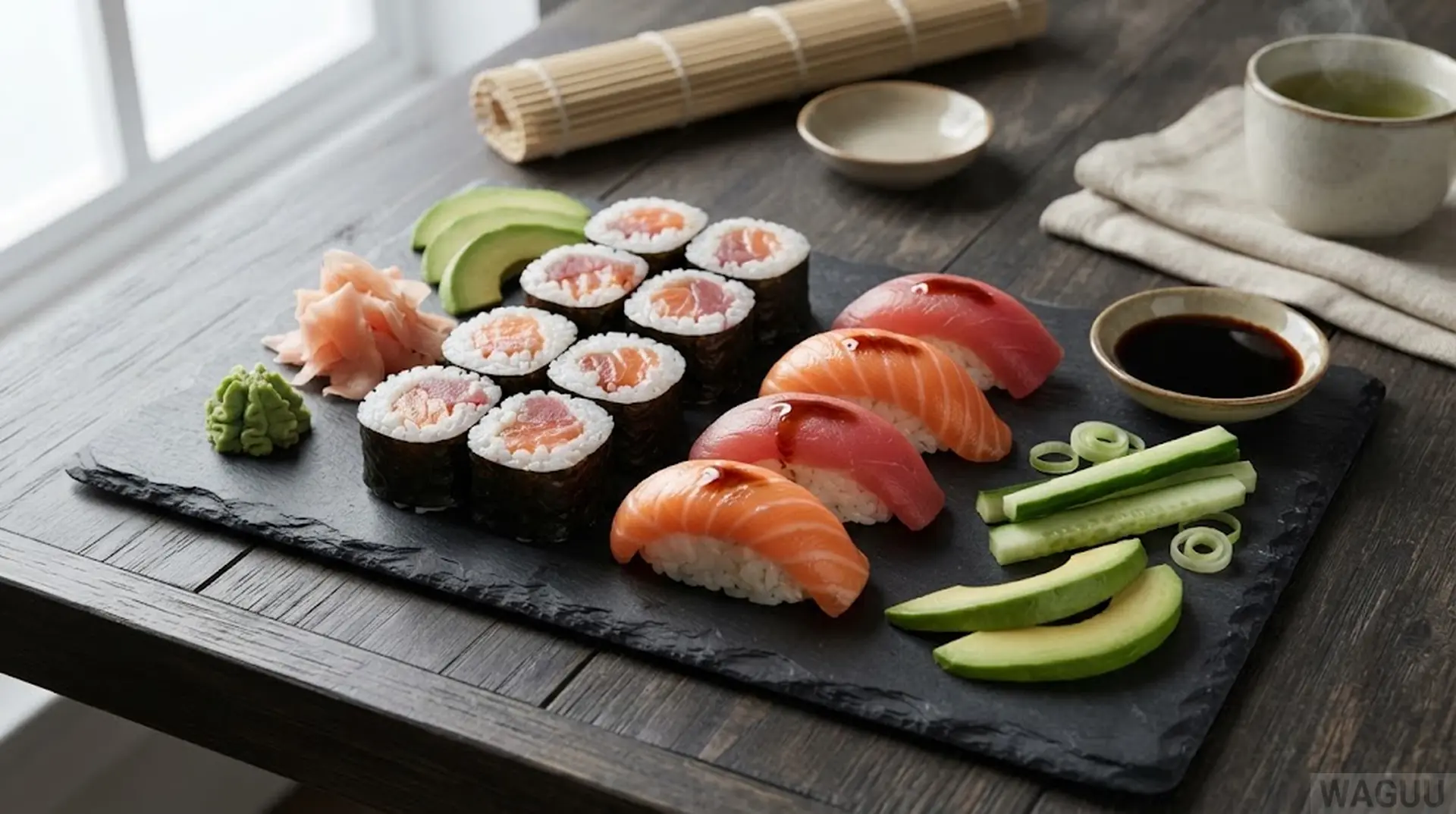
Summary: Sushi made from short-grain rice cooked at a 1:1.2 ratio and seasoned with rice vinegar. The foundation is maki rolled in a bamboo mat and nigiri shaped by hand. The rice is rinsed before cooking until the water runs clear, and after seasoning it cools to room temperature. Salmon and tuna are sliced with a wet knife against the grain. Total time 105 minutes, makes 6 servings.
Did you make this recipe? Share your result with the community.
Category: fish-and-seafood, japanese-cuisine
Success rate: not rated yet % of users nailed this recipe
Quick overview
- Dish: Sushi – rice seasoned with rice vinegar combined with fresh fish, seafood, vegetables, or other ingredients
- Category: fish-and-seafood, japanese-cuisine
- Cuisine: Japanese
- Main ingredient: Japanese short-grain rice, 900 g (rinsed, drained) (quality specification)
- Guide: 12 most famous Japanese dishes: traditional recipes of Japanese cuisine
- Total time: 105 minutes (45 min prep + 60 min cooking)
- Difficulty: Challenging
- Servings: 6 (Serving weight: 360 g)
- Key technique: Cooking rice at a 1:1.2 ratio and slicing with a wet knife against the grain of the fish
- Preparation types: Classic cooking, hand shaping
- Dietary info & allergens: fish (salmon, tuna), soy (soy sauce), gluten (soy sauce)
- Great for: Holiday dinner, celebration for six to eight people, romantic dinner, evening with friends at a Japanese table, homemade version of a restaurant classic.
- Nutrition (per 1 serving): 565, Protein: 30.0 g, Fat: 12.0 g, Carbs: 89.0 g
- Storage: 1 day in the fridge, 0 months in the freezer
- Pairing: Japanese light lager, dry white wine, sencha green tea
- In short: Sushi made with short-grain rice cooked in a 1:1.2 ratio and seasoned with rice vinegar. Total time 105 minutes, 6 servings.
WAGUU says: “Sushi isn’t about the fish. It’s about the rice – if the rice isn’t at the right temperature and moisture, even the best fish won’t save it.”
Key facts
| Prep time: | 45 minutes |
| Cook time: | 60 minutes |
| Temperature: | Rice cooked covered over low heat, water at 212 °F, rice cools to 86–95 °F after seasoning |
| Servings: | 6 |
At a glance
Sushi comes together in two steps you can’t skip: the rice must be rinsed until clean and cooled to hand temperature after seasoning, and the fish must be sliced in a single stroke with a wet knife. Rice vinegar isn’t just flavor – it’s the acid that keeps the grains firm and slows bacterial growth. When rice is pressed with wet hands, the grains fall apart and the roll won’t hold. When fish is sliced with pressure, the fibers crush and lose their juices.
Ingredients
Base servings: 6 servings • Serving weight: 360 g
| Ingredient | Amount | Quality |
|---|---|---|
| japanese short-grain rice | 32 oz | koshihikari variety or another short-grain, harvested within the last year |
| water for cooking rice | 4.6 cups | soft, chlorine-free |
| rice vinegar | 1/2 cups | clear, 4.5 % acidity |
| granulated sugar | 1.5 oz | fine, white |
| fine sea salt | 0.14 oz | for the vinegar mixture |
| salmon fillet | 11 oz | fresh, sashimi grade, skinless and boneless |
| tuna steak | 11 oz | fresh, deep red, sashimi grade |
| avocado | 1 pcs | ripe, soft to the touch, 200 g |
| english cucumber | 1 pcs | firm, seedless, 300 g |
| green onion | 4 pcs | fresh, with firm stalks |
| nori sheets | 6 pcs | toasted, 8.25 × 7.5 in format |
| wasabi paste | 0.7 oz | sharp, no artificial colors |
| soy sauce | 1/3 cups | naturally fermented, dark |
| pickled ginger | 3.0 oz | thin slices, sweet-and-sour brine |
Why you’ll love this recipe
- Rice is the foundation, not a side: Three hundred grams of raw rice for six servings, rinsed until the water runs clear and seasoned with vinegar. Sushi’s flavor rests on the rice; the fish complements it.
- Two kinds in one batch: Maki rolled in a mat and nigiri shaped by hand. You’ll learn both in one process and pick whichever suits you.
- Exact ratios for 6 servings: Rice, vinegar, sugar, and salt in a ratio that keeps the grains firm. Amounts recalculate based on your actual number of diners.
Success guaranteed: Rice vinegar lowers the pH of the rice to around 4.2. In an acidic environment, starch grains stay firmer and the rice doesn’t turn to mush during shaping. Rinsing before cooking removes loose starch from the surface of the grains – otherwise it would release into the water and make the rice sticky. A 1:1.2 ratio gives the rice enough water to swell without softening the grains. The fat in salmon and tuna is stored in thin layers between muscle fibers. A cut made against the grain shortens those fibers, so they don’t stretch into a long strand when you bite. Cooled rice holds its shape during shaping because set starch resists finger pressure better.
Recipe overview
Prep: 45 min min | Cook: 60 min min | Difficulty: Challenging | Servings: 6 | Type: Main dish | Origin: Japanese
Detailed instructions
Overall progress: 0 % done
Phase 1: Rinsing and draining the rice – 15 min
Equipment: none
1. Pour the rice into a wide bowl, cover with cold water, and rinse it with a circular motion of your hand. Pour off the water, add fresh water, and repeat until the water stays clear after stirring. Then transfer the rice to a strainer and let it drain until only occasional drops fall.
2. Let the drained rice rest in the strainer under a damp towel. During the rest, the grains absorb the remaining surface water and cook evenly.
QC: The water after the final rinse is as clear as tap water. The grains in the strainer are loose, not clumped, and slide between your fingers when pressed.
Before you move to the next step:
Don’t rinse the rice under running water in a strainer with holes that are too small. The grains break apart and too many are lost. Rinse in a bowl and change the water.
Phase 2: Cooking the rice – 20 min
Equipment: heavy-bottomed pot with lid, stove
1. Pour the drained rice into a heavy-bottomed pot and add the measured water. Cover the pot with the lid and set it over medium heat. Once the water comes to a boil, lower the heat to the lowest setting and cook covered until all the water is absorbed.
2. Remove the pot from the heat and let the rice rest, covered, off the burner. During resting, the steam inside equalizes and the grains finish cooking evenly. Do not lift the lid; escaping steam will dry out the rice.
VKB: You do not hear boiling water in the pot and no new droplets form on the lid. When you tilt the pot, the rice does not hold together but slides apart. A grain pressed between your fingers gives way but does not turn to mush.
Before you move to the next step:
Do not lift the lid during cooking and do not stir the rice. Every time you uncover the pot, you release the steam that cooks the rice, and the grains stay hard inside.
Phase 3: Seasoning with vinegar mixture – 10 min
Equipment: small saucepan, wide wooden bowl
1. In a small saucepan, warm the rice vinegar with sugar and salt until the sugar dissolves. Do not boil the mixture; just heat it until it feels warm to the touch. Transfer the rice from the pot to a wide wooden bowl and spread it evenly up the sides.
2. Pour the vinegar mixture around the edge of the bowl, not in the center, and fold the rice with a flat paddle using a cutting motion. Cut from top to bottom and lift the rice rather than stirring it in circles. Keep folding until the rice cools to room temperature.
VKB: The rice is glossy, the grains separate and do not clump together. When you breathe in over the bowl, you smell a mild vinegar tang, but the rice does not smell sharply of vinegar. The bowl under the rice is not wet.
Before you move to the next step:
Do not stir the rice in a circular motion and do not press down with the paddle. Pressure crushes the grains and makes the rice sticky. Cut from top to bottom and let the paddle glide.
Phase 4: Preparing the fish and fillings – 12 min
Equipment: refrigerator, sharp long knife, cutting board
1. Take the salmon and tuna out of the refrigerator and let them rest until the surface loses its icy chill. Place the fillets on a cutting board and slice them with a long stroke of the knife against the grain into strips of even thickness. Dip the knife between cuts in water with a drop of vinegar and wipe it dry.
2. Halve the avocado, remove the pit, and cut the flesh into long thin slices. Peel the cucumber, halve it, scoop out the seeds with a spoon, and cut the flesh into strips the same length as the fish. Cut the scallions on the diagonal into thin rings.
VKB: The fish strips hold their shape, there are no traces of juice on the cutting surface, and the pieces do not stick to the board. The avocado is creamy and has not browned when cut. The cucumber strips are the same length as the fish strips.
Before you move to the next step:
Do not rinse the fish under water and do not leave it on the cutting board at room temperature for more than fifteen minutes. Pat the surface of the fish dry with a paper towel.
Phase 5: Rolling maki and shaping nigiri – 25 min
Equipment: bamboo mat, wooden bowl with vinegar water
1. Place the bamboo mat on your work surface and lay a sheet of nori on it, shiny side down. With wet hands, spread a layer of rice over the nori, leaving a strip at the top edge without rice. Place strips of fish, avocado, cucumber, and scallion rings in the center.
2. Fold the mat over the filling and press firmly, then slide the roll forward and continue rolling. Let the finished roll rest seam-side down for a moment. For nigiri, take a handful of rice in your palm, gently press it into an oval, and top with a slice of fish, pressing it onto the rice with your thumb and index finger.
VKB: The roll holds its shape, does not spring back when lightly pressed, and the filling does not stick out. The nori sits tightly against the rice around the edge. The nigiri has a slice of fish covering the entire top surface and the rice underneath is not visible from the side.
Before you move to the next step:
Do not press the rice onto the nori with your palm. Pressure crushes the grains and the roll falls apart when sliced. Spread the rice with your fingertips and leave a free strip at the edge of the nori.
Phase 6: Slicing and serving – 8 min
Equipment: sharp knife, damp towel
1. Place the roll seam-side down on the cutting board and make each cut in a single stroke, wiping the knife with a damp towel after each piece. Cut the roll into pieces of equal width. Stand the nigiri on a plate at an angle, fish side up.
2. Add slices of pickled ginger and wasabi in a small dish to the finished pieces. Pour soy sauce into separate small bowls so the rice does not soak before serving.
VKB: The cuts are straight, the filling stays inside the roll, and there are no traces of rice on the cutting board. The pieces on the plate stand on their own and do not overlap.
Required equipment
| Tools | Ideal size | Alternative | Risk |
|---|---|---|---|
| bamboo mat | 24 × 24 cm, thin slats | sturdy plastic wrap folded over a towel | a coarse mat with thick slats deforms the roll during rolling |
| fish knife | 24 cm blade, thin and smooth | long smooth knife without serrations | a serrated blade tears the fish and crushes the fibers |
| wide wooden bowl | 30 cm diameter | large shallow stainless steel bowl | a narrow bowl prevents folding the rice and the grains stick together |
| heavy-bottomed pot | 3 qt capacity, tight-fitting lid | rice cooker with a sushi rice setting | a thin bottom burns the rice at the bottom before the water is absorbed |
| kitchen scale | 1 g resolution | rice measuring cup and precise water measurement | estimating the water amount determines whether the rice holds its shape |
Shopping list
Nutrition profile
Values per 1 serving (without sides). Calculated from average nutritional values of ingredients.
| Nutrient | Per 100 g | Per 1 serving | Per 6 servings |
|---|---|---|---|
| Energy | 657 kJ / 157 kcal | 2364 kJ / 565 kcal | 14184 kJ / 3390 kcal |
| Fat | 3.3 g | 12.0 g | 72.0 g |
| of which saturated | 1.0 g | 3.7 g | 22.2 g |
| Carbohydrates | 24.7 g | 89.0 g | 534.0 g |
| of which sugars | 1.4 g | 5.1 g | 30.6 g |
| Protein | 8.3 g | 30.0 g | 180.0 g |
| Salt | 0.5 g | 1.7 g | 10.2 g |
Reference intake of an average adult (8400 kJ / 2000 kcal).
WAGUU Pro level
- Pro standard: Tested recipe with precise ratios and visual checkpoints.
- Tip 1: Tested recipe with precise ratios and visual checkpoints.
- Tip 2: Rinse the rice in a bowl with a circular motion of your hand and change the water until it runs clear. This takes eight to ten changes and determines whether the rice will be fluffy or sticky.
- Tip 3: Dip the fish knife in water with a drop of vinegar and cut in a single stroke. Pressure crushes the fibers and juice leaks onto the board.
- Tip 4: When shaping nigiri, dip your hands in vinegar water only lightly. Hands that are too wet make the rice mushy, dry hands stick to it and crush the grains.
Scientific background
Sushi rice is cooked in a ratio that leaves the grains enough water to swell but not so much that they burst. The short-grain variety has a higher amylopectin content than long-grain, so it becomes sticky on the surface after cooking but holds its shape inside. Rinsing removes free starch that would otherwise be released into the water and create a sticky film on the grains. Rice vinegar lowers the pH, and in an acidic environment the grains stay firmer, so the rice does not become wet after seasoning. The sugar and salt in the vinegar mixture are not just for flavor: salt partially draws water from the surface of the grains and sugar balances the sharpness of the vinegar. For fish, the direction of the cut matters. Muscle fibers run lengthwise, and when you cut against the grain, they shorten, so they do not break into a long fiber that would stay between your teeth when you bite. The fat stored between the fibers stays in the slice and melts on the tongue at room temperature. That is why salmon and tuna are not cut straight from the refrigerator – cold fat has no flavor.
Fine Dining – Professional techniques
- Plate composition: Stand the nigiri on a plate at an angle, fish side up, and leave a finger-width gap between pieces. Place a thin slice of ginger next to each piece.
- Texture contrasts: In addition to fish, add a piece of avocado and cucumber to the roll. Soft avocado and crisp cucumber provide contrast against the firm rice core.
- Temperature contrast:Serve wasabi in a small dish on the side. Mixed into the rice, it loses its sharpness and overpowers the fish.
- Aromatic additions:Before serving, wipe the rim of the plate with vinegar water and place a slice of ginger on it. The aroma of vinegar and ginger blends with the rice before the first bite.
Sensory radar
- Appearance:Rice white, glossy, and loose; grains hold together but are not sticky. Salmon slices orange with white fat lines, tuna dark red. Nori dark green to black, matte.
- Aroma:Sharp vinegar aroma of rice, followed by fresh sea fish and a hint of seaweed. Wasabi adds a pungent note that rises to the nose.
- Taste:Sour and slightly sweet rice, clean fish flavor, saltiness of soy sauce on the edge. Wasabi burns in the nose, not on the tongue.
- Texture:Rice soft but grainy and slightly sticky. Fish breaks into fine fibers when bitten. Nori offers a brief resistance that snaps immediately.
Pairings
- Japanese light lager:Gentle bitterness and high carbonation cleanse the palate between pieces. Serve chilled at 45–46°F.
- Dry white wine:Riesling or Pinot Blanc with higher acidity. The wine’s acidity pairs with vinegared rice and balances the flavor.
- Sencha green tea:Warm but not boiling. The tea’s bitterness cuts through the fat in salmon and cleanses the mouth between bites.
Variations
- Nigiri::Instead of a roll, shape oval mounds of rice by hand and top with a slice of fish. You save nori and the fish comes into direct contact with the rice.
- Vegetarian roll::Replace fish with avocado, cucumber, carrot cut into thin strips, and pickled radish. Rice and vinegar remain the same.
Allergens and dietary information
Contains:fish (salmon, tuna), soy (soy sauce), gluten (soy sauce) • Gluten:yes, in soy sauce (wheat) • Not suitable for:individuals with celiac disease, fish and soy allergies
Suitable for
A festive dinner, a celebration for six to eight people, a romantic dinner, an evening with friends at a Japanese table, a homemade version of a restaurant classic.
Substitution catalog
- Rice vinegar::white wine vinegar diluted with water in a 3:1 ratio with an extra half teaspoon of sugar. The flavor is sharper and less sweet.
FAQ
What rice to use for sushi?
Short-grain variety, preferably koshihikari. It has a higher amylopectin content, so it holds its shape after cooking but is sticky on the surface. Long-grain rice falls apart after seasoning with vinegar and the roll doesn’t hold.
Can I season the rice ahead of time?
Let seasoned rice cool to room temperature and use within two hours. In the refrigerator, grains harden and lose moisture. If you must delay, cover the bowl with a damp cloth.
Why dip the knife in vinegar water?
Vinegar water reduces friction between the blade and rice. A dry knife sticks to rice, tears grains, and the cut isn’t clean. Wipe the knife with a damp cloth between cuts.
Is sushi safe from fresh fish?
Buy fish from a vendor who labels it as suitable for raw consumption. After purchase, keep it refrigerated and use within 24 hours. Freezing at low temperature reduces parasite risk, so ask your vendor about it.
How to prevent rolls from falling apart?
Spread rice in a thin layer, leave a free strip at the top edge of nori, and roll firmly but without pressing with your palms. Rice should not be wet or mushy.
What to substitute for rice vinegar?
White wine vinegar diluted with water in a three-to-one ratio and an extra half teaspoon of sugar. The flavor will be sharper and less sweet, but the rice will stay firm.
WAGUU Petr advises: Cooking for 6 or more people?
6–8 people:Prepare two bamboo mats and roll in two batches. Keep rice in a bowl covered with a damp cloth to prevent drying, and cut maki just before serving. • 10+ people:Choose nigiri – shaping by hand is faster than rolling and uses less nori. Slice fish in advance and store in the refrigerator on a plate covered with plastic wrap.
Sides and serving
Serving:Serve with a bowl of soy sauce, pickled ginger slices, and wasabi. A light soup and green tea are served with sushi. Assemble sushi on the plate just before serving; in the refrigerator, rice hardens.
Storage and reheating
Refrigerator:1 day • Freezer:0 months • Reheating:Refrigerator: 1 day • Freezer: not recommended, rice loses texture • Reheating: sushi is not reheated. Let rolls sit at room temperature for 15 minutes; rice softens and flavor returns.
Author: WAGUU Petr & Team • Published: 7 Oct 2026 • Updated: 10 Oct 2026
More recipes from the article
Guide: 12 most famous Japanese dishes: traditional recipes of Japanese cuisine
Ramen – noodle soup with rich broth, meat, egg, vegetables, and other typical toppings
Tempura – lightly battered and fried seafood or vegetables in a thin crispy batter
Tonkatsu – breaded and fried pork cutlet served with finely shredded cabbage and tonkatsu sauce
Takoyaki – round fried batter balls filled with octopus, typical of Osaka
Katsudon – bowl of rice with breaded pork cutlet tonkatsu, egg, and onion in seasoned broth
Gyudon – bowl of rice topped with thin slices of beef and onion simmered in a sweet-salty sauce
More recipes you might like
Why WAGUU?
Recipes on WAGUU are checked for accuracy of ingredients, procedures, and nutritional values.
Photo gallery of the process
Community photos:Cook, take a photo, and share the result.
You can upload photos in the comments below or send them to email.
Did you make a video of our recipe? Paste the link to YouTube, YouTube Shorts, TikTok, Instagram Reels, Facebook Reels, Pinterest, Vimeo, or X (Twitter) in the comments – we’ll be happy to publish it and help promote you and your content.
Most common mistakes
- Rice not rinsed thoroughly – free starch from the surface of grains remains in the water and rice sticks together into mush. Rinse until water is clear, then cook the rice.
- Rice seasoned while hot – vinegar evaporates and grains absorb too much liquid. Spread rice in a wide bowl, pour over vinegar mixture, and fold until cool.
- Fish cut with pressure – fibers are crushed, juice leaks out, and the slice falls apart. Guide the knife in a single stroke against the grain and wipe between cuts.
- Wet hands during shaping – wet hands make rice mushy and the roll falls apart when cut. Lightly moisten hands with vinegar water and wipe after each piece.