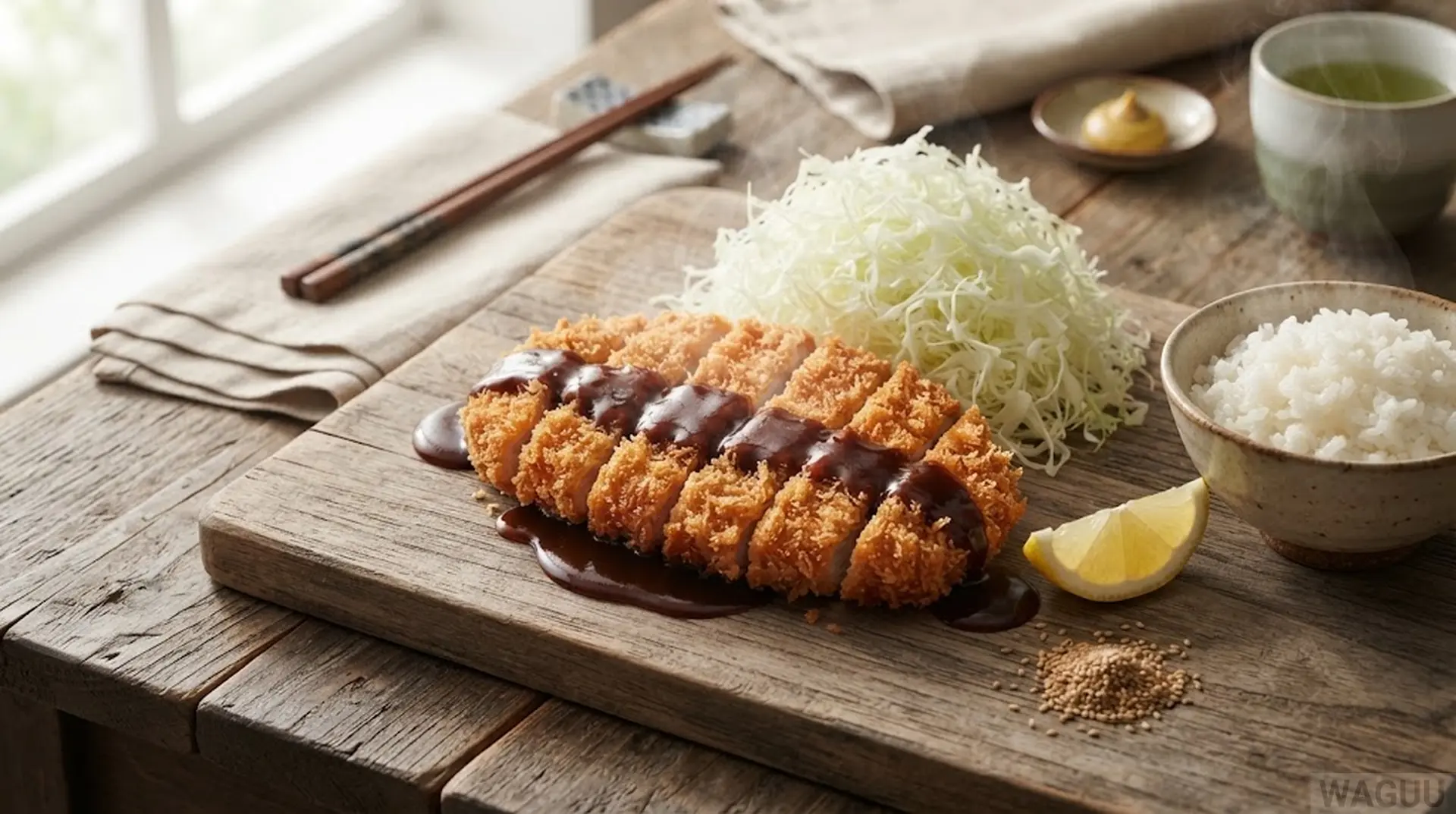
Summary: Tonkatsu made from pork shoulder steaks pounded to an even thickness and coated in flour, egg, and panko. The cutlets are fried at 350°F until light golden, then rested on a wire rack. Cabbage is shredded finely and served separately so the coating stays dry. A cold coating won’t set properly. Total time 55 minutes, makes 6 servings.
Did you make this recipe? Share your result with the community.
Category: pork, japanese-cuisine
Success rate: not rated yet % of users mastered this recipe
Quick overview
- Dish: Tonkatsu – breaded, fried pork cutlet served with finely shredded cabbage and tonkatsu sauce
- Category: pork, japanese-cuisine
- Cuisine: Japanese
- Main ingredient: Boneless pork shoulder, 2 lb (6 pieces of 5 oz each) (quality specification)
- Guide: 12 most famous Japanese dishes: traditional recipes of Japanese cuisine
- Total time: 55 minutes (25 min prep + 30 min cooking)
- Difficulty: Medium
- Servings: 6 (Serving size: 13 oz)
- Key technique: Double coating in flour, egg, and panko, then frying at 350°F until light golden
- Preparation types: Deep-frying, pan-frying
- Dietary info & allergens: gluten (panko, all-purpose flour, soy sauce), egg (egg), soy (soy sauce), fish (Worcestershire sauce), celery (Worcestershire sauce)
- Suitable for: Quick weeknight dinner, weekend lunch for six, family meal with kids, dinner after a long day, homemade version of Japanese diner food.
- Nutrition (per 1 serving): 615, Protein: 34.0 g, Fat: 34.0 g, Carbs: 43.0 g
- Storage: 2 days in the fridge, 2 months in the freezer
- Pairing: Japanese light lager, dry white wine, cold mugi barley tea
- In short: Tonkatsu made from pork shoulder pounded to an even thickness and coated in flour, egg, and panko. Total time 55 minutes, 6 servings.
WAGUU says:“You don’t judge tonkatsu by the color of the coating, but by how the cutlet behaves after you pull it from the oil – if you cut it right away, the juice runs onto the cutting board.”
Key facts
| Prep time: | 25 minutes |
| Cook time: | 30 minutes |
| Temperature: | Oil 350°F, internal meat temperature 145°F, do not pierce the meat after coating |
| Servings: | 6 |
In a nutshell
Tonkatsu hinges on two things that are easy to get wrong: even thickness of all meat pieces and oil temperature. If one piece is thicker, you’ll pull it out raw or dry. Panko differs from regular breadcrumbs: its flakes are large and dry, so the coating stays light and doesn’t absorb as much oil as fine breadcrumbs. After frying, the cutlet needs two to three minutes of rest so the juices redistribute. Cabbage is shredded finely and served separately so steam doesn’t soften the coating.
Ingredients
Base servings: 6 servings • Serving size: 13 oz
| Ingredient | Amount | Quality |
|---|---|---|
| boneless pork shoulder | 32 oz | 6 pieces of 5 oz each, with a thin fat layer |
| all-purpose flour | 4.0 oz | wheat, finely milled |
| eggs | 3 pcs | fresh, room temperature, size M |
| panko breadcrumbs | 9.0 oz | Japanese, large dry flakes |
| green cabbage | 32 oz | firm head, fresh, finely shredded |
| canola oil | 5 cups | for frying, high smoke point |
| fine sea salt | 0.2 oz | for meat and coating |
| ground black pepper | 0.14 oz | freshly ground |
| soy sauce | 3 tbsp | naturally fermented, for tonkatsu sauce |
| Worcestershire sauce | 1/4 cups | thick, dark |
| ketchup | 3 tbsp | tomato, no preservatives |
| cane sugar | 0.7 oz | fine, light |
| toasted sesame seeds | 0.7 oz | white, dry-toasted |
| lemon | 1 pcs | thick skin, juicy |
| jasmine rice | 21 oz | long-grain, as a side |
Why you’ll love this recipe
- Coating that stays light: Panko instead of regular breadcrumbs keeps the coating airy. The flakes don’t absorb as much oil as fine breadcrumbs.
- Finely shredded cabbage: Cabbage is cut into thin strands and served separately. It stays crisp and the coating underneath doesn’t get soggy.
- Exact ratios for 6 servings: Five ounces of meat per piece, even thickness, and oil temperature at 350°F. Everything scales with the number of diners.
Guaranteed success: Panko coating behaves differently from fine breadcrumbs. Panko flakes have a large surface area and low moisture, so oil doesn’t penetrate the coating as much during frying and it stays airy. The three coating layers each have a role: flour absorbs surface moisture from the meat and forms a thin film, egg binds that film to the panko, and panko creates the final crust. If any layer is missing, the coating will slide off during frying. Salting the meat before coating would draw water to the surface and the coating would separate, so salt the meat only lightly. The time needed to heat the meat increases with the square of the piece’s thickness: a piece twice as thick needs about four times as long. That’s why pieces are pounded to an even thickness. After frying, the heat inside the meat continues, fibers contract and push out juice. During the two to three minutes of rest, pressure equalizes and some juice returns to the fibers. Cutting earlier means leaving juice on the cutting board.
Recipe overview
Prep: 25 min | Cook: 30 min | Difficulty: Medium | Servings: 6 | Type: Main course | Origin: Japanese
Detailed instructions
Total progress: 0 % done
Phase 1: Preparing meat and cabbage – 15 min
Appliances: refrigerator, kitchen mallet, shredder
1. Place pork shoulder pieces between two layers of plastic wrap and pound them with the flat side of a mallet to an even thickness. Work from the center outward and check thickness by holding against the light.
2. Cut cabbage in half, remove the core, and shred the head into thin strands. Submerge the shredded cabbage in a bowl of ice water, let it rest for a while, then drain and dry thoroughly. Refrigerate the cabbage.
VKB: All pounded pieces have the same thickness and bend equally when placed on your palm. Cabbage is shredded into strands of even width, dry to the touch, and crisp when tasted.
Before you move to the next step:
Do not wash the meat or dry it with paper towels too early before coating. Wipe surface water just before flouring so the coating stays in place.
Phase 2: Triple coating – 12 min
Appliances: three shallow bowls, kitchen tongs
1. Sift all-purpose flour into the first bowl, whisk the eggs with a splash of water in the second, and pour the panko into the third. Season the pork slices lightly with salt and pepper on both sides and bread them right away.
2. Dredge each slice in flour first and shake off the excess, then dip it through the egg, and finally press it into the panko. Do not press the panko onto the slice with your palm—just press it with your fingertips and shake off the excess. Set the breaded slices on a sheet pan in a single layer.
VKB: The coating feels dry to the touch, the panko flakes stick to the meat, and no meat or flour shows through anywhere. The coating does not lift at the edges and does not peel off when you lift a slice.
Before you move to the next step:
Do not salt the meat ahead of time. Salt pulls water to the surface, the flour gums up, and the coating peels off in sheets during frying.
Phase 3: Heating the oil – 8 min
Equipment: deep fryer or tall pot, kitchen thermometer
1. Pour oil into the deep fryer so the level reaches one third of the way up the vessel. Heat it over medium heat and monitor the temperature with the thermometer.
2. Check the temperature by dropping in a few panko flakes. The flakes should rise to the surface immediately and be surrounded by fine bubbles, not turn brown.
VKB: The thermometer reads 350 °F. The test panko flake rises, gets coated in bubbles, and turns light golden in a few seconds.
Before you move to the next step:
Never heat the oil over the highest flame and never let it smoke. Overheated fat turns bitter and the coating darkens before the meat is heated through.
Phase 4: Frying – 18 min
Equipment: fryer, tongs, wire rack
1. Lower the slices into the oil one or two at a time and keep space between them. Do not pierce or press on them while frying—the coating must not be pressed against the meat.
2. Flip the slice when the bottom turns light golden, and fry it to the same color on the other side. Lift the finished slice out with tongs and let it drain over the oil.
VKB: The coating is light golden, evenly colored across the whole surface, and no meat shows through at the edges. The bubbles around the slice are fine and fast. After it comes out of the oil, the coating does not collapse and holds its shape.
Before you move to the next step:
Do not add all the slices to the oil at once. The escaping steam cools the oil, the coating soaks up fat, and it stays pale and soft.
Phase 5: Resting and slicing – 5 min
Equipment: wire rack set over a sheet pan, sharp knife
1. Set the finished slices on the rack standing up so fat and steam can escape from underneath. Let them rest until the heat inside the meat settles and the juices return to the fibers.
2. Place the rested slice on a cutting board and cut it into finger-width strips, perpendicular to the coating. Push the knife forward rather than sawing back and forth.
VKB: No juice is left on the board after cutting. The cut is clean, the coating does not separate from the meat, and the strips hold their shape. The center of the meat is light pink, not gray.
Before you move to the next step:
Do not cut the cutlet right after it comes out of the oil. The juice runs out onto the board, the coating gets soggy, and the meat ends up dry.
Phase 6: Sauce and serving – 5 min
Equipment: none
1. In a small bowl, combine soy sauce, Worcestershire sauce, ketchup, and brown sugar and stir until smooth. Adjust the seasoning only if needed, then pour the sauce into two small bowls.
2. Pile shredded cabbage on a plate, place the sliced cutlet next to it, and add a bowl of sauce. Sprinkle the cabbage with toasted sesame seeds and add a lemon wedge.
3. Serve tonkatsu with steamed rice in a separate bowl. Keep the cabbage away from the cutlet so the coating stays crisp.
VKB: The cabbage on the plate is crisp and dry, the coating on the cutlet is glossy and not greasy. The sauce is smooth and shiny, and the sesame seeds cling to the cabbage instead of falling to the bottom.
Required equipment
| Tool | Ideal size | Alternative | Risk |
|---|---|---|---|
| deep fryer | 4 qt capacity, with a basket and temperature dial | tall pot and kitchen thermometer | a shallow pan cannot hold the temperature and the coating soaks up fat |
| meat mallet | flat side, 14 oz weight | bottom of a heavy pot | the spiked side tears the meat and juice leaks into the coating |
| kitchen thermometer | up to 480 °F, with a fast response | check with a panko flake | without measuring temperature, the coating burns outside while the meat stays raw |
| mandoline or sharp knife | 8 in blade or a mandoline | vegetable peeler | a dull knife bruises the cabbage and it releases water |
| draining rack | 12 × 8 in, with ½ in openings | oven rack set over a sheet pan | on paper towels, steam condenses under the coating and it goes soft |
Shopping list
Nutrition facts
Values per 1 serving (without sides). Calculated from average nutritional values of the ingredients.
| Nutrient | Per 100 g | Per 1 serving | Per 6 servings |
|---|---|---|---|
| Energy | 695 kJ / 166 kcal | 2573 kJ / 615 kcal | 15439 kJ / 3690 kcal |
| Fat | 9.2 g | 34.0 g | 204.0 g |
| of which saturated | 3.1 g | 11.6 g | 69.6 g |
| Carbohydrates | 11.6 g | 43.0 g | 258.0 g |
| of which sugars | 2.4 g | 8.7 g | 52.2 g |
| Protein | 9.2 g | 34.0 g | 204.0 g |
| Salt | 0.6 g | 2.4 g | 14.4 g |
Reference intake of an average adult (8400 kJ / 2000 kcal).
WAGUU Pro level
- Pro standard: A tested recipe with exact ratios and visual checkpoints.
- Tip 1: A tested recipe with exact ratios and visual checkpoints.
- Tip 2: Pound the pork slices between two sheets of plastic wrap to an even thickness. A spiked mallet tears the meat and juice leaks into the coating.
- Tip 3: Do not press the panko with your palm. Let the flakes cling loosely and shake off only the excess, otherwise the coating peels off in sheets during frying.
- Tip 4: Set the finished cutlets on a rack standing up, not stacked. The steam that condenses underneath is just as damaging as too little oil—the coating goes soft.
The science behind it
A panko coating behaves differently from a fine breadcrumb coating. Panko flakes have a large surface area and little moisture, so during frying the oil does not penetrate the coating as much and it stays airy. Each of the three layers has its own job: the flour absorbs surface moisture from the meat and forms a thin film, the egg binds that film to the panko, and the panko forms the final crust. If any layer is missing, the coating peels off during frying. Salting the meat before breading would draw water to the surface and the coating would separate, which is why the meat is only lightly seasoned. The time needed to heat the meat through increases with the square of the slice thickness: a slice twice as thick needs roughly four times as long. That is why the slices are pounded to an even thickness. After the cutlet comes out of the oil, the heat inside the meat keeps working, the fibers contract, and they push out juice. During two to three minutes of resting, the pressure equalizes and some of the juice returns to the fibers. Cutting too early means leaving that juice on the board.
Fine Dining – Professional Techniques
- Plate Composition: Cut the cutlet into strips through the coating and stand them on the plate so the pink center is visible. Place shredded cabbage alongside and a small bowl of sauce.
- Texture Contrasts: The crispy coating and crunchy cabbage are on the same side, while the tender meat inside is on the other. Do not cut into the coating, only slice through.
- Temperature Contrast: Serve tonkatsu immediately while the coating is hot. A cold coating becomes soggy and loses its structure, so it is never served from the refrigerator.
- Aromatic Additions: Grate a pinch of toasted sesame over the cabbage and place a lemon slice next to it. The citric acid cuts through the fat and the sesame aroma blends with the heat of the coating.
Sensory Radar
- Appearance: The coating is light golden, evenly colored all over, with distinct and dry panko flakes. When cut, the meat is light pink with a thin layer of fat at the edge. The cabbage is white, finely shredded, and the sauce is dark brown and glossy.
- Aroma: The smell of fried coating and pork, followed by a fresh note of shredded cabbage. Tonkatsu sauce adds fruity acidity and a hint of spice.
- Taste: Salty flavor of the coating and meat, followed by sweet and sour sauce with a fruity undertone. The cabbage refreshes the palate and cuts through the fat.
- Texture: The coating is crispy and airy, crumbling when bitten. The meat is tender, holds its grain, and remains juicy. The cabbage is crunchy, with thin strands breaking when chewed.
Pairings
- Japanese Light Lager: Carbonation and mild bitterness cut through the fat of the coating. Serve chilled at 45–46°F.
- Dry White Wine: Sauvignon or Grüner Veltliner with higher acidity. The wine’s acidity cleanses the palate after the fried coating.
- Sencha Green Tea: Warm but not boiling. The tea’s bitterness balances the saltiness of the tonkatsu sauce.
Variations
- Chicken Katsu:: Replace pork loin with boneless chicken thigh and pound to the same thickness. Chicken cooks faster, so fry for a shorter time.
- Katsudon:: Place sliced cutlet on a bowl of rice, pour over a mixture of broth, soy sauce, onion, and egg, and let the egg set only slightly. The coating stays crispy only at the edges.
Allergens and Dietary Information
Contains: gluten (panko, all-purpose flour, soy sauce), egg (egg), soy (soy sauce), fish (Worcestershire sauce), celery (Worcestershire sauce) • Gluten: yes, in panko, all-purpose flour, and soy sauce • Not suitable for: individuals with celiac disease, egg allergy, soy allergy, fish allergy, and celery allergy
Suitable for
Quick weeknight dinner, weekend lunch for six, family meal with kids, dinner after a long day, homemade version of Japanese bistro dishes.
Substitution Catalog
- Worcestershire Sauce:: dark soy sauce with a teaspoon of vinegar and a teaspoon of sugar. The flavor will be less fruity, but the balance of salty and sweet remains.
FAQ
Why panko and not regular breadcrumbs?
Panko has large, dry flakes that create an airy coating when fried. Fine breadcrumbs absorb more oil, making the coating heavy, dark, and soggy.
How to pound meat to even thickness?
Place slices between two layers of plastic wrap and pound with the flat side of a mallet from center to edges. Check thickness by holding against light; thin spots will be more translucent.
When to salt the meat?
Just before breading, lightly on both sides. Salt draws out moisture; if salted ahead, the flour becomes gluey and the coating falls off during frying.
Why does the cutlet rest after frying?
The heat inside the meat continues even after removal from oil. During two to three minutes of resting, pressure in the capillaries equalizes and juices partially return to the fibers. Cutting immediately means losing juice on the cutting board.
What to substitute for Worcestershire sauce?
Dark soy sauce mixed with a teaspoon of vinegar and a teaspoon of sugar. The flavor will be less complex, but the balance of salty and sweet remains.
Can I make tonkatsu ahead of time?
The breading tastes best right after frying. You can keep the breaded slices in the refrigerator and fry them just before serving. Reheat the finished cutlets in the oven at 350°F; in the microwave, the breading gets soggy.
WAGUU Petr’s tip: Cooking for 6 or more people?
6–8 people: Bread all the slices ahead and keep them in the refrigerator on a tray in a single layer. Fry in two batches and hold the finished cutlets upright on a rack in the oven at 175°F. • 10+ people: Choose the chicken version; the slices are thinner and fry more quickly. Cook the rice ahead and keep it in a rice cooker; shred the cabbage in two batches so it doesn’t dry out.
Sides and Serving
Serving: Serve with steamed rice in a separate bowl, a mound of shredded cabbage, and a bowl of tonkatsu sauce. Keep the cabbage separate from the cutlet so the breading stays dry. A bowl of miso soup is also served with the meal.
Storage and Reheating
Refrigerator: 2 days • Freezer: 2 months • Reheating: Refrigerator: 2 days • Freezer: 2 months • Reheating: Reheat the cutlets in the oven at 350°F for 8 minutes or in an air fryer. In the microwave, the breading gets soggy. Always serve the cabbage fresh.
Author: WAGUU Petr & Team • Published: 7 Oct 2026 • Updated: 10 Oct 2026
More recipes from the article
Guide: 12 most famous Japanese dishes: traditional recipes from Japanese cuisine
Ramen – noodle soup with a rich broth, meat, egg, vegetables, and other typical toppings
Tempura – lightly battered and fried seafood or vegetables in a thin, crispy batter
Takoyaki – round fried batter balls filled with octopus, typical of Osaka
Gyudon – a bowl of rice topped with thin slices of beef and onion simmered in a sweet-savory sauce
More recipes you might like
Why WAGUU?
WAGUU recipes are checked for accuracy of ingredients, procedures, and nutritional values.
Photo gallery from the process
Photos from the community: Cook, take a photo, and share your result.
You can upload photos in the comments below or send them by email.
Did you film a video of our recipe? Paste the link to YouTube, YouTube Shorts, TikTok, Instagram Reels, Facebook Reels, Pinterest, Vimeo, or X (Twitter) in the comments – we’ll be happy to publish it and help you and your content get noticed.
Most common mistakes
- Slices of uneven thickness – a thin slice dries out, a thick one stays raw inside. Pound all slices to the same thickness and check them by holding them up to the light.
- Meat salted before breading – salt draws water to the surface, the breading slides off and separates in the oil. Salt the meat only lightly and just before breading.
- Oil temperature too low – the breading absorbs oil and stays pale and soft. Keep the oil at 350°F and let it return to temperature between batches.
- Cutlets stacked on top of each other – steam condenses underneath and the breading gets soggy from the bottom. Place them on a rack upright, not on paper towels and not on top of each other.