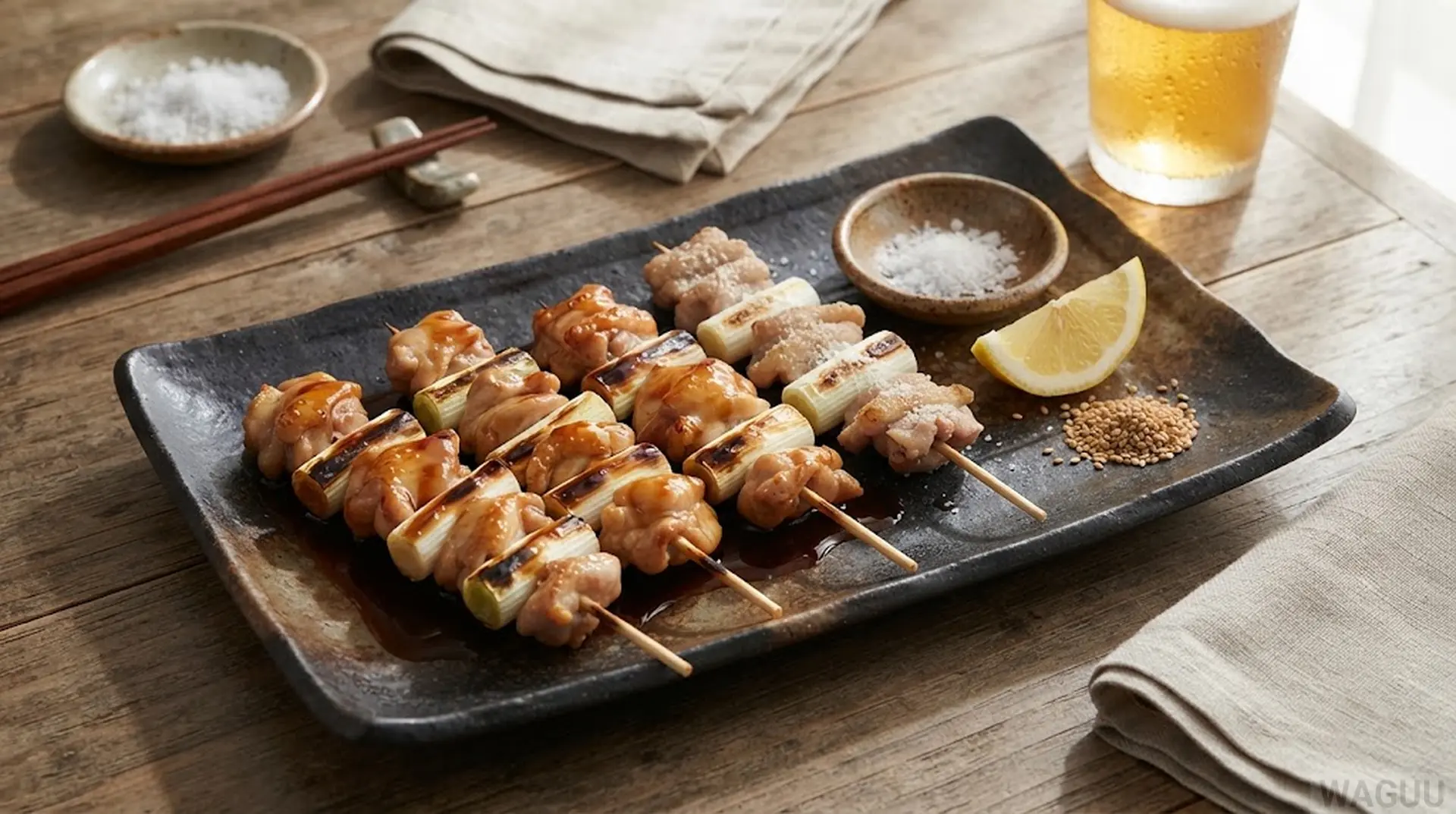
Summary: Yakitori made from chicken thigh cut into equal pieces and skewered alternately with scallions. The skewers are grilled first over high heat, then moved to lower heat. Tare sauce is brushed on only in the last minute so the sugar doesn’t burn. Some skewers are seasoned with just salt to keep the meat’s flavor clean. Total time 70 minutes, base 6 servings.
Did you cook this recipe? Share your result with the community.
Category: poultry, japanese-cuisine
Success rate: not rated yet % of users mastered the recipe
Quick overview
- Dish: Yakitori – grilled chicken skewers cooked over heat and brushed with tare sauce or seasoned with salt
- Category: poultry, japanese-cuisine
- Cuisine: Japanese
- Main ingredient: Boneless chicken thigh, 2.6 lb (with skin) (quality specification)
- Guide: 12 most famous Japanese dishes: traditional recipes of Japanese cuisine
- Total time: 70 minutes (30 min prep + 40 min cooking)
- Difficulty: Easy
- Servings: 6 (Serving weight: 11 oz)
- Key technique: Grilling over direct heat in two temperature zones and brushing with tare sauce only in the last minute
- Preparation types: Grilling and roasting
- Dietary info & allergens: soy (soy sauce), gluten (soy sauce, sake), sesame (toasted sesame)
- Suitable for: Evening with friends at the grill, summer garden gathering, celebration for six to eight people, quick weeknight dinner, homemade version of Japanese street food.
- Nutrition facts (per 1 serving): 575, Protein: 47.0 g, Fat: 35.0 g, Carbohydrates: 13.0 g
- Storage: 2 days in the refrigerator, 2 months in the freezer
- Pairing: Japanese light lager, dry white wine, sencha green tea
- In short: Yakitori made from chicken thigh cut into equal pieces and skewered alternately with scallions. Total time 70 minutes, 6 servings.
WAGUU says: “Tare sauce is not applied to the skewer continuously. The sugar in it burns before the meat does, leaving a black crust that tastes bitter.”
Key facts
| Prep time: | 30 minutes |
| Cook time: | 40 minutes |
| Temperature: | Upper grill zone 425–465 °F, lower zone 300–340 °F, internal meat temperature 165 °F |
| Servings: | 6 |
At a glance
Yakitori relies on two things: equally sized pieces of meat and dividing the grill into two temperature zones. Equal pieces heat through at the same time, so nothing dries out and nothing stays raw. The pieces are threaded onto flat skewers so they can be turned as a whole. Tare sauce is brushed on only at the end, because the sugar in it caramelizes and burns within seconds. The other batch of skewers gets only salt – the flavor of the chicken and grill smoke shines without sauce.
Ingredients
Base servings: 6 servings • Serving weight: 11 oz
| Ingredient | Amount | Quality |
|---|---|---|
| boneless chicken thigh | 2.6 lb | with skin, fresh, sinew-free |
| scallions | 8 pcs | thick stalks, fresh |
| soy sauce | 1/2 cups | naturally fermented, for tare sauce |
| mirin | 1/3 cups | sweet rice cooking wine |
| sake | 1/4 cups | dry, for cooking |
| turbinado sugar | 0.9 oz | fine, light |
| fine sea salt | 0.4 oz | for salt-seasoned skewers |
| ground black pepper | 0.11 oz | freshly ground |
| toasted sesame seeds | 0.5 oz | white, dry-toasted |
| lemon | 1 pcs | thick zest, juicy |
Why you’ll love this recipe
- Two flavors from one batch: Half the skewers get tare sauce, half get just salt. One batch of meat and two different flavors on the table.
- Equal-sized pieces: Two to three centimeters per piece, same size on one skewer. They heat through at the same time and nothing dries out.
- Exact ratios for 6 servings: Seven ounces of meat per serving, six skewers per person, and a sauce that is brushed on only at the end. Everything recalculates based on the number of diners.
Guaranteed success: Chicken thigh tolerates higher heat better than breast meat. It contains more fat and connective tissue that melt during grilling over direct heat and baste the meat from within. If the skewer is brushed with tare sauce from the start, the sugar in the sauce begins to burn at temperatures above 340 °F, before the meat heats through to the center. The result is a black crust and a raw center. Dividing the grill into two zones solves both: in the upper zone the surface sears and colors, in the lower zone the meat heats through to the center. Salt on the surface draws water from the first millimeters of meat, but because the skewer is turned, the water doesn’t have time to be pushed deeper and the surface stays juicy. The skin on the thigh contains collagen that turns into gelatin during longer heat and gives the meat richness.
Recipe overview
Prep: 30 min min | Cook: 40 min min | Difficulty: Easy | Servings: 6 | Type: Main dish | Origin: Japanese
Detailed instructions
Total progress: 0 % done
Phase 1: Preparing meat and skewers – 20 min
Appliances: refrigerator, sharp knife, wooden skewers
1. Soak wooden skewers in cold water and let them absorb. Pat chicken thighs dry with paper towels and cut into pieces of equal weight, do not remove the skin. Cut out the sinews; they would toughen during grilling.
2. Cut scallions into equally long pieces. Place meat pieces and scallions side by side on a tray and put them in the refrigerator.
VKB: Meat pieces have the same weight and the same thickness to the touch. The skin stays on each piece. Skewers are soaked with water and don’t break when bent.
Before you move to the next step:
Do not wash the chicken under running water. Wipe surface water with a paper towel; wet meat first steams on the grill and the skin doesn’t crisp.
Phase 2: Tare sauce – 10 min
Appliances: small saucepan, stove
1. In a small saucepan, combine soy sauce, mirin, sake, and turbinado sugar. Place the saucepan over medium heat and stir until the sugar dissolves.
2. Let the sauce bubble briefly, then remove from heat and let it cool. Pour some sauce into a bowl for brushing, leave the rest for serving.
VKB: The sauce is smooth, glossy, and slightly thick, holding a thin film on a spoon. The aroma is sweet with a strong note of soy sauce and no sugar burnt on the bottom.
Before you move to the next step:
Do not cook the sauce long and hard. Sugar starts to scorch at the bottom and the flavor turns bitter. It’s enough when the sugar dissolves and the sauce bubbles briefly.
Phase 3: Skewering – 12 min
Appliances: none
1. Thread meat pieces onto the skewer so they touch each other but are not compressed. Insert scallion pieces between meat pieces and alternate pieces with and without skin.
2. Keep pieces of equal weight on one skewer. Place finished skewers on a tray, leave space between them, and leave some of them without sauce.
QC:The pieces on the skewer hold together and do not rotate when you lift the skewer by its end. There are no gaps or overlaps between pieces. The skewer is filled along its entire length except for the handle.
Before moving to the next step:
Do not force the meat onto the skewer. Compressed pieces loosen with heat and spin on the skewer. Pierce them through the center, not the edge.
Phase 4: Setting up the grill and grilling – 20 min
Equipment: charcoal grill or grill pan, tongs, instant-read thermometer
1.Arrange the charcoal so that one half of the grill is densely covered and the other half only sparsely. Let them burn until covered with gray ash, then clean the grate with a brush.
2.Place the skewers first over the dense part of the grill and let them sear on all sides. Then move them over the sparse part and continue grilling until the meat is heated through to the center. Turn the skewers with tongs by the end, not by the meat.
QC:The surface of the meat is golden brown with signs of caramelized skin, but not black. An instant-read thermometer inserted into the thickest piece reads 165°F. The juices run clear when pierced.
Before moving to the next step:
Do not leave the skewers over the dense charcoal the entire time. The skin will burn and the meat inside will remain raw. Move them over the sparse part as soon as the surface takes on color.
Phase 5: Glazing with sauce and finishing – 5 min
Equipment: grill brush, tongs
1.In the last minute of grilling, brush half of the skewers with tare sauce and let them stay over the heat a little longer. The sauce should shine but must not blacken. Skewers meant for salt seasoning should be salted only after removing from the grill.
2.Transfer the finished skewers to a platter and let them rest briefly so the juices redistribute. Then sprinkle with toasted sesame seeds and grated lemon zest.
QC:The sauce on the skewers is glossy and dark amber, without black spots. The salt on the other skewers clings to the surface and the meat underneath remains moist. The sesame seeds shine on the meat.
Before moving to the next step:
Do not brush the sauce on a skewer twice or in a thick layer. A second layer will not set and will burn. Always glide the brush lightly over the surface of the meat.
Phase 6: Serving – 3 min
Equipment: warmed platter
1.Stand the skewers on a plate alongside each other so they do not touch. Place a bowl of tare sauce next to the glazed skewers, and a bowl of salt and lemon next to the salt-seasoned skewers.
2.Serve immediately while the skin is crisp. Serve yakitori with steamed rice and pickled vegetables in separate bowls.
QC:The skin on the skewers is crisp and cracks when pressed with a finger, the meat underneath is juicy. There are no juice stains on the plate and the sauce in the bowl is smooth and glossy.
Required equipment
| Item | Ideal size | Alternative | Risk |
|---|---|---|---|
| charcoal grill | 18-inch diameter, with lid | stovetop grill pan or electric contact grill | a gas grill with a single heat zone will not allow moving skewers to a lower temperature |
| wooden skewers | 10-inch, flat | metal skewers that do not need soaking | dry wood burns and the meat slides off the skewer |
| kitchen tongs | long, narrow jaws | two forks with long handles | short tongs bring your hand close to the heat |
| instant-read thermometer | probe, up to 570°F | check juice color and meat firmness by touch | without measuring, doneness is estimated only by surface color |
| grill brush | silicone, with long handle | a bundle of herbs tied to a skewer | a short brush brings your hand close to the heat and the sauce is applied unevenly |
Shopping list
Nutrition profile
Values per 1 serving (without sides). Calculated from average nutritional values of ingredients.
| Nutrient | Per 100 g | Per 1 serving | Per 6 servings |
|---|---|---|---|
| Energy | 774 kJ / 185 kcal | 2406 kJ / 575 kcal | 14435 kJ / 3450 kcal |
| Fat | 11.3 g | 35.0 g | 210.0 g |
| of which saturated | 3.2 g | 9.8 g | 58.8 g |
| Carbohydrates | 4.2 g | 13.0 g | 78.0 g |
| of which sugars | 2.0 g | 6.2 g | 37.2 g |
| Protein | 15.2 g | 47.0 g | 282.0 g |
| Salt | 1.0 g | 3.1 g | 18.6 g |
Reference intake of an average adult (8400 kJ / 2000 kcal).
WAGUU Pro level
- Pro standard: Verified recipe with precise ratios and visual checkpoints.
- Tip 1: Verified recipe with precise ratios and visual checkpoints.
- Tip 2:Cut the meat into pieces of equal weight, not just equal size. A piece with skin heats differently than one without, so alternate them evenly on a single skewer.
- Tip 3:Soak the skewers in cold water before threading. The wood absorbs water and burns later on the grill, so the skewer holds its shape throughout grilling.
- Tip 4:Brush the tare sauce only at the end and let it drip off the skewer. A thick layer of sauce on hot meat burns within seconds.
Scientific background
Chicken thigh contains more fat and connective tissue than breast meat, so it tolerates higher heat. During grilling, connective tissue turns into gelatin and the meat stays moist. If you brush the skewer with tare sauce from the start, the sugar in the sauce begins to burn at temperatures above 340°F, before the meat is heated through to the center. Dividing the grill into two zones solves both: in the hot zone the surface sears, in the cooler zone the meat heats through. Salt on the surface draws water from the first millimeters of meat, but because the skewer is turned, the water does not have time to be pushed deeper.
Fine Dining – Professional techniques
- Plate composition:Stand the skewers on a plate alongside each other, ends over the edge of the plate. Place a bowl of salt and a bowl of tare sauce next to them.
- Texture contrasts:Alternate pieces of meat with a piece of scallion. The crisp scallion provides contrast against the soft meat and sweet sauce.
- Temperature contrast:Serve half of the skewers immediately after removing from the grill, when the skin is crispiest. Let the other half rest for a minute and serve as a second course.
- Aromatic additions:Grate a pinch of lemon zest over the finished skewers and sprinkle with toasted sesame seeds. The aroma is released by the heat of the meat and cuts through the smoky undertone.
Sensory radar
- Appearance:The skin on the skewers is golden brown and crisp, the meat light pink with white streaks of fat. The scallion pieces are browned at the edges. The sauce on the skewers is glossy, sesame seeds cling to the surface of the meat.
- Aroma:Smoky aroma from the grill and sweet aroma of tare sauce, followed by a fresh note of scallion and toasted sesame.
- Taste:Salty and sweet taste of the sauce, followed by the distinct flavor of chicken meat and a smoky undertone. The scallion refreshes the taste.
- Texture:Skin crisp, meat soft and juicy, falling apart into fibers when bitten. The scallion offers a brief resistance.
Pairing
- Japanese light lager:Carbonation and mild bitterness cut through the fat from the chicken skin. Serve chilled at 43–46°F.
- Dry white wine:Grüner Veltliner or Riesling with higher acidity. The wine’s acid cuts through the palate after the sweet tare sauce.
- Sencha green tea: Warm, but not boiling. The tea’s bitterness balances the saltiness and smoky undertone from the grill.
Variations
- Negima:: Alternate pieces of chicken thigh with pieces of scallion and brush with tare sauce. The sweet scallion caramelizes on the grill and the flavors meld with the sauce.
- Tsukune:: Instead of pieces, shape ground chicken into oblong meatballs and grill them the same way. Serve them brushed with tare sauce and sprinkled with egg yolk.
Allergens and Dietary Information
Contains: soy (soy sauce), gluten (soy sauce, sake), sesame (toasted sesame) • Gluten: yes, in soy sauce and sake • Not suitable for: people with celiac disease, soy allergy, or sesame allergy
Suitable for
An evening with friends around the grill, a summer garden gathering, a celebration for six to eight people, a quick weeknight dinner, a homemade version of Japanese street food.
Substitution Guide
- Sake:: dry white wine or water with a splash of rice vinegar. The flavor will be a bit sharper, but the sweet-salty balance remains.
FAQ
Why cut the meat into equal weights?
Pieces of equal weight heat through at the same time. If pieces on one skewer are different sizes, the small one dries out and the large one stays raw inside.
When to brush the skewers with tare sauce?
Only in the last minute of grilling. The sugar in the sauce begins to burn above 170°F, which is before the meat heats through to the center, leaving a black bitter crust on the surface.
What can I use instead of sake?
Dry white wine or water with a teaspoon of rice vinegar. The flavor will be a bit sharper, but the sweet-salty balance remains.
Can I make yakitori in a pan?
Yes, in a cast-iron grill pan. Heat it over medium-high heat, sear the skewers on all sides, then lower the heat. You won’t get the smoky flavor, though.
How do I know the meat is done?
A thermometer inserted into the thickest piece reads 165°F and clear juices run out when pierced. The surface is golden brown, but not black.
How many skewers per serving?
Count on six skewers per person when yakitori is the main course, and three skewers when served as an appetizer with rice and soup.
WAGUU Petr advises: Cooking for 6 or more?
6–8 people: Skewer ahead and keep them in the refrigerator on a tray. Grill in two batches and hold finished skewers in the oven at 175°F on a rack. • 10+ people: Choose salt-seasoned skewers; they’re quicker to prepare and easier to handle in larger quantities. Serve the sauce in bowls at the table.
Sides and Serving
Serving: Serve on a warmed platter with a bowl of tare sauce, a bowl of salt, and lemon wedges. Yakitori is served with steamed rice, pickled vegetables, and a light soup.
Storage and Reheating
Refrigerator: 2 days • Freezer: 2 months • Reheating: Refrigerator: 2 days • Freezer: 2 months • Reheating: Warm the skewers in the oven at 350°F for 6 minutes or on a grill pan. In the microwave, the skin turns soft.
Author: WAGUU Petr & Team • Published: 7 Oct 2026 • Updated: 10 Oct 2026
More recipes from the article
Guide: 12 Most Famous Japanese Dishes: Traditional Recipes from Japanese Cuisine
Ramen – noodle soup with a rich broth, meat, egg, vegetables, and other typical toppings
Tempura – lightly battered and fried seafood or vegetables in a thin, crispy batter
Tonkatsu – breaded, fried pork cutlet served with finely shredded cabbage and tonkatsu sauce
Takoyaki – round fried batter balls filled with octopus, typical of Osaka
Katsudon – a bowl of rice with breaded pork cutlet tonkatsu, egg, and onion in a seasoned broth
Gyudon – a bowl of rice topped with thin slices of beef and onion simmered in a sweet-savory sauce
More recipes you might like
Why WAGUU?
WAGUU recipes are checked for accuracy of ingredients, procedures, and nutritional values.
Photo Gallery from the Process
Photos from the community: Cook, take a photo, and share the result.
You can upload photos in the comments below or send them by email.
Did you film a video of our recipe? Paste a link to YouTube, YouTube Shorts, TikTok, Instagram Reels, Facebook Reels, Pinterest, Vimeo, or X (Twitter) in the comments – we’ll be happy to publish it and help you and your content get noticed.
Most Common Mistakes
- Sauce on the skewer from the start – the sugar in the sauce burns before the meat heats through, and the surface turns bitter. Brush only in the last minute of grilling.
- Dry wooden skewers – the skewer burns on the heat and the meat slides off. Soak them in cold water for at least half an hour before skewering.
- Different-sized pieces on one skewer – the small piece dries out, the large one stays raw. Cut the meat into pieces of equal weight and skewer them in a single order.
- Meat pierced with a fork – juices run out onto the coals and the meat stays dry. Turn the skewer with tongs by the end of the skewer, not by the meat.