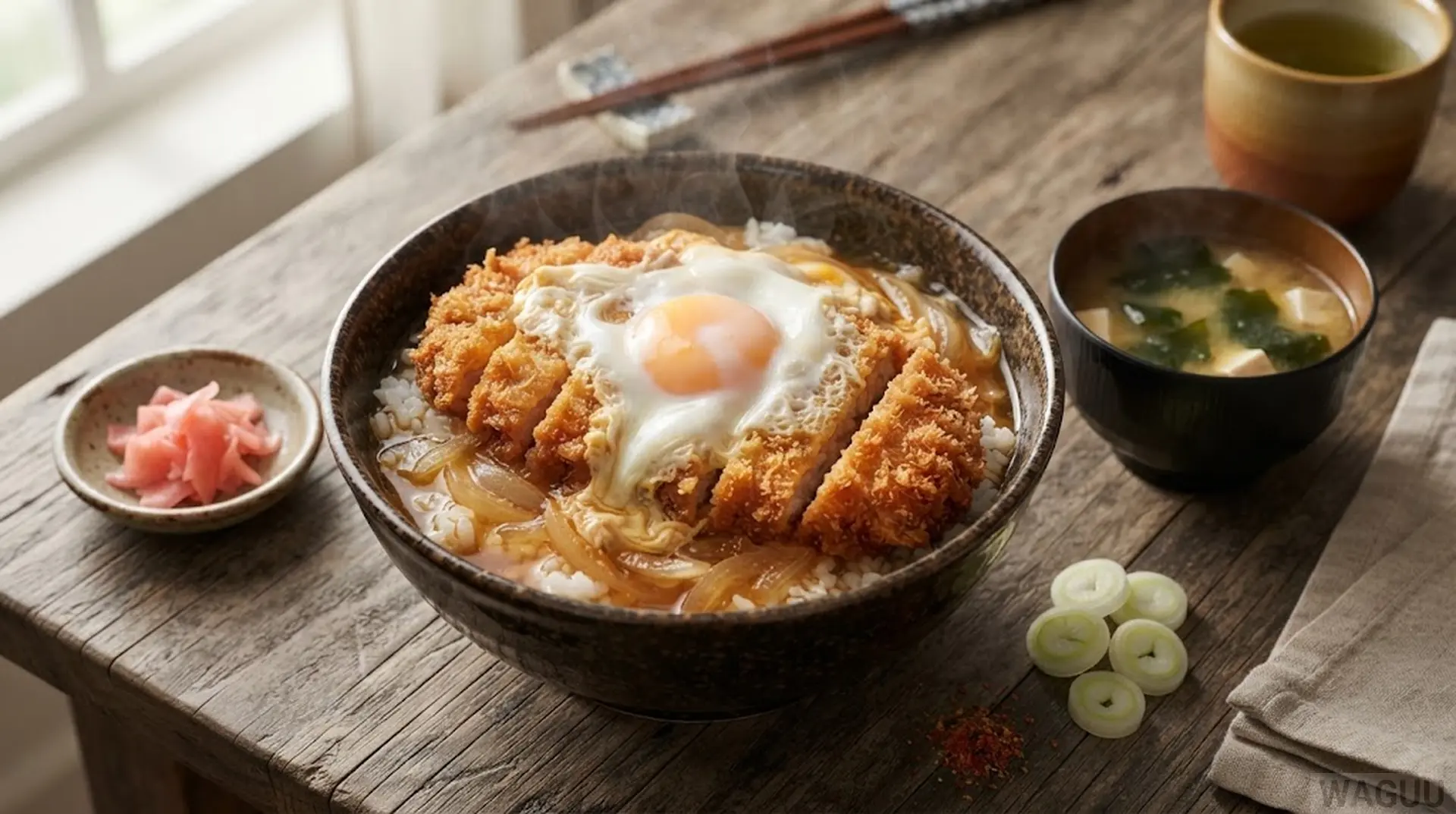
Summary: Katsudon is a bowl of rice topped with sliced breaded pork cutlet simmered in a seasoned broth with onion and egg. The cutlet is fried separately and added to the broth at the last moment to keep the crust crisp. The egg is beaten lightly and left to set only partially in the pan. The finished mixture is poured over a bowl of rice so the broth soaks into the rice. Total time 70 minutes, base 6 servings.
Did you cook this recipe? Share your result with the community.
Categories: pork, japanese-cuisine
Success rate: not rated yet % of users mastered the recipe
Quick overview
- Dish: Katsudon – a bowl of rice with breaded pork cutlet tonkatsu, egg, and onion in a seasoned broth
- Categories: pork, japanese-cuisine
- Cuisine: Japanese
- Main ingredient: Boneless pork shoulder, 2 lb (6 slices of 5 oz each) (quality specification)
- Guide: 12 most famous Japanese dishes: traditional recipes of Japanese cuisine
- Total time: 70 minutes (30 min prep + 40 min cooking)
- Difficulty: Medium
- Servings: 6 (Serving weight: 15 oz)
- Key technique: Frying the breaded cutlet and finishing it in a seasoned broth with egg that is left only partially set
- Preparation types: Frying, simmering
- Dietary info & allergens: gluten (panko, all-purpose flour, soy sauce), egg (egg, batter), soy (soy sauce), fish (dashi, Worcestershire sauce), celery (Worcestershire sauce)
- Suitable for: Hearty weekday lunch, family dinner, one-bowl meal for kids, quick meal after a long day, homemade version of Japanese diner food.
- Nutritional values (per 1 serving): 790, Protein: 40.0 g, Fat: 31.0 g, Carbohydrates: 88.0 g
- Storage: 2 days in the fridge, 1 month in the freezer
- Pairing: Japanese light lager, dry white wine, sencha green tea
- In short: Katsudon made from a breaded pork cutlet sliced into strips, finished in a seasoned broth with onion and egg. Total time 70 minutes, 6 servings.
WAGUU says: “The egg in katsudon is not cooked through. If you let it set fully, the bowl loses the reason katsudon is made – a creamy yolk that runs into the rice.”
Key facts
| Prep time: | 30 minutes |
| Cook time: | 40 minutes |
| Temperature: | Frying oil 350 °F, broth 200 °F, egg left to set to 80% |
| Servings: | 6 |
In a nutshell
Katsudon is a two-part dish that comes together in the last minute: a crisp cutlet and a soft egg in seasoned broth. The cutlet is fried separately and added to the broth only briefly so the crust absorbs flavor without getting soggy. The broth is made ahead so the sweetness of mirin and the saltiness of soy sauce have time to blend. The egg is beaten with just three strokes of the whisk: the white and yolk remain in separate streaks and form two different textures in the pan. The rice is served warm and not completely covered with broth—only about two-thirds.
Ingredients
Base servings: 6 servings • Serving weight: 15 oz
| Ingredient | Amount | Quality |
|---|---|---|
| boneless pork shoulder | 32 oz | 6 slices of 5 oz each, with a thin layer of fat |
| all-purpose flour | 3.5 oz | wheat, finely milled |
| eggs | 9 pcs | fresh, room temperature, size M |
| panko breadcrumbs | 7.0 oz | Japanese, large dry flakes |
| jasmine rice | 32 oz | long-grain, pre-cooked |
| onion | 3 pcs | medium, yellow, 12 oz |
| dashi broth | 2 1/2 cups | from seaweed and dried fish |
| soy sauce | 1/2 cups | naturally fermented |
| mirin | 6 tbsp | sweet rice cooking wine |
| cane sugar | 0.7 oz | fine, light |
| canola oil | 4.2 cups | for frying, high smoke point |
| fine sea salt | 0.14 oz | for meat and breading |
| ground black pepper | 0.11 oz | freshly ground |
| green onions | 4 pcs | fresh, cut into thin rings |
| shichimi togarashi | 0.11 oz | Japanese seven-spice blend |
Why you’ll love this recipe
- Whole dinner in one bowl: Rice, meat, egg, and onion in one bowl. No extra dishes, no sides on the table.
- Egg that stays soft: The egg is beaten with just three strokes and left partially set in the pan. The yolk runs into the rice and brings the flavors together.
- Exact ratios for 6 servings: Five ounces of meat per bowl, one egg per serving, and broth measured by the ladle. Everything scales with the number of diners.
Success guaranteed: Katsudon relies on two processes happening at the same time. In one pot, dashi, soy sauce, and mirin simmer. Salt and sugar draw water from the onion, the onion softens and sweetens, and the broth gains body. In another pan, the breaded cutlet fries. The panko in the coating dries out with heat and forms an airy crust that binds fat. When the finished cutlet is added to the boiling broth, water enters the coating and the crust softens. That’s why the cutlet goes in at the very end in a single layer, not submerged. Egg sets between 149 and 158 °F. When beaten only lightly, white and yolk set into different textures, and part of the yolk remains runny in the pan. That yolk runs when poured over the rice and coats the grains, so the dish holds together in both texture and flavor.
Recipe overview
Prep: 30 min min | Cook: 40 min min | Difficulty: Medium | Servings: 6 | Type: Main dish | Origin: Japanese
Detailed instructions
Total progress: 0 % done
Phase 1: Preparing meat and rice – 18 min
Equipment: kitchen mallet, pot, refrigerator
1. Place the pork shoulder slices between two layers of plastic wrap and pound them with the flat side of the mallet to an even thickness. Pat the meat dry with a paper towel and keep it in the refrigerator.
2. Rinse the rice until the water runs clear, and cook it using your usual ratio. Let the cooked rice rest covered and keep it warm.
3. Cut the onion in half and slice it into thin half-moons. Slice the green onions into rings and set aside.
VKB: The meat slices are of even thickness and bend the same way when placed on your palm. The rice is fluffy, grains hold together but are not sticky. The onion is cut into evenly thick half-moons.
Before you move to the next step:
Do not wash the meat or leave it at room temperature. Wipe surface moisture with a paper towel just before breading.
Phase 2: Breading and Frying the Cutlets – 17 min
Equipment: three shallow bowls, deep fryer, wire rack
1. Sift all-purpose flour into the first bowl, beat three eggs in the second, and put panko in the third. Season the pork slices with salt and pepper on both sides and coat them in the order flour, egg, and panko.
2. Heat oil to 350°F and fry the cutlets one or two at a time until they are light golden brown all over. Place the finished cutlets on a wire rack in an upright position, not stacked.
VKB: The coating is light golden and evenly colored, and the panko flakes adhere to the meat. After removing from the oil, the coating holds its volume and does not fall off. The oil thermometer reads 350°F.
Before you move to the next step:
Do not salt the meat in advance. Salt draws water to the surface, the flour becomes gluey, and the coating will peel off all over during frying.
Phase 3: Seasoned Broth – 8 min
Equipment: wide skillet or deeper saucepan
1. Pour dashi stock into a wide skillet, add soy sauce, mirin, and brown sugar. Bring the mixture to a boil and let the sugar dissolve.
2. Taste the broth and dilute with water if needed. The saltiness should be pronounced but not sharp, as some will soak into the rice. Keep the broth at a gentle simmer.
VKB: The broth is clear, dark amber, and smells of dashi and soy sauce. The taste is balanced: sweet from mirin, salty from soy sauce, without bitterness. There are no impurities on the surface.
Before you move to the next step:
Do not boil the broth for a long time over high heat. Soy sauce thickens and becomes saltier as it cooks. It is enough for the sugar to dissolve and the broth to heat through.
Phase 4: Simmering the Onion – 7 min
Equipment: wide skillet
1. Add the sliced onion to the boiling broth and simmer until it softens and becomes translucent. The onion should move freely in the liquid, not stick to the bottom.
2. Do not cover the skillet during simmering, so the broth does not dilute with condensed steam. Meanwhile, the flavor of the broth should meld with the flavor of the onion.
VKB: The onion is soft, translucent at the edges, and holds the shape of half-moons. The broth has reduced slightly and is glossy. The taste is sweeter than at the beginning.
Before you move to the next step:
Do not simmer the onion over high heat without enough liquid. The sugar from the mirin will burn on the bottom and the broth will become bitter. Keep a gentle simmer and occasionally lift the skillet.
Phase 5: Eggs and Finishing – 6 min
Equipment: wide skillet, lid, whisk
1. Beat the remaining eggs with a whisk for just three strokes, so the whites and yolks remain distinctly separate. Place the sliced cutlets on the surface of the broth with the onion in a single layer.
2. Pour the eggs over the cutlets in a circular motion and cover the skillet. Let the eggs set only halfway, then remove the skillet from the heat. The eggs will finish cooking from the residual heat and should not become fully set when poured over.
VKB: The eggs are set at the edges but remain moist and glossy in the center. The whites form white strands, and the yolks show orange. The cutlet coating is at the surface, not submerged.
Before you move to the next step:
Do not leave the eggs on the stove until fully set. A few seconds is enough for the yolks to turn green and lose their creamy texture.
Phase 6: Assembling the Bowls and Serving – 4 min
Equipment: deep bowls, ladle
1. Mound hot rice into warmed deep bowls in a slight cone. Pour the cutlet and egg mixture around the edge of the bowl so the broth runs down to the rice and the cutlets stay on top.
2. Garnish the bowl with sliced green onions and a pinch of shichimi togarashi. Serve immediately, while the cutlet coating is crisp and the eggs are warm.
VKB: The broth has soaked into the top layer of rice and colored it brown, while the bottom rice remains white. The cutlets on the surface have a crisp coating. The eggs pull with the spoon.
Required Equipment
| Utensil | Ideal Size | Alternative | Risk |
|---|---|---|---|
| wide skillet | 28 cm diameter, 6 cm deep | two smaller skillets and cooking in two batches | a small skillet won’t hold six servings and the broth will evaporate |
| deep fryer or tall pot | 4 L capacity, with thermometer | deeper skillet with oil one-third full | a shallow skillet won’t hold temperature and the coating will absorb oil |
| kitchen mallet | flat side, 400 g weight | bottom of a heavy pot | the spiked side tears the meat and juices leak into the coating |
| wire rack | 30 × 20 cm, with 1 cm mesh | oven rack set over a baking sheet | on paper towels, steam condenses under the coating and it softens |
| deep bowls | 700 ml capacity, ceramic | deep plates | a shallow plate won’t hold the broth and the rice will spill |
Shopping List
Nutrition Profile
Values per 1 serving (without side dish). Calculated from average nutritional values of ingredients.
| Nutrient | Per 100 g | Per 1 serving | Per 6 servings |
|---|---|---|---|
| Energy | 761 kJ / 182 kcal | 3305 kJ / 790 kcal | 19832 kJ / 4740 kcal |
| Fat | 7.1 g | 31.0 g | 186.0 g |
| of which saturated | 2.3 g | 10.2 g | 61.2 g |
| Carbohydrates | 20.2 g | 88.0 g | 528.0 g |
| of which sugars | 1.6 g | 6.8 g | 40.8 g |
| Protein | 9.2 g | 40.0 g | 240.0 g |
| Salt | 0.6 g | 2.7 g | 16.2 g |
Reference intake of an average adult (8400 kJ / 2000 kcal).
WAGUU Pro Level
- Pro standard: Verified recipe with precise ratios and visual checkpoints.
- Tip 1: Verified recipe with precise ratios and visual checkpoints.
- Tip 2: Beat the eggs with just three strokes of the whisk. If you mix them until smooth, they will set into a uniform mass in the pan and katsudon will lose the layers of white and yolk.
- Tip 3: Add the cutlet to the broth only at the end and only briefly. Every extra half-minute in the hot liquid means a softer coating.
- Tip 4: The bowl can be warmed before filling with rice from the pot. A cold bowl will drop the temperature of the broth and the rice will harden before you bring it to the table.
Scientific Background
Katsudon combines two processes. In the broth of dashi, soy sauce, and mirin, sugars are released from the onion, the onion softens, and the broth gains body. In the second pan, the breaded cutlet is fried, the panko dries out from the heat and creates an airy crust. When the finished cutlet is placed in the boiling broth, water enters the coating and the crust softens, so it is added only at the end. Eggs coagulate between 149 and 158°F; when beaten only lightly, the white and yolk set in different structures and part of the yolk remains runny.
Fine Dining – Professional Techniques
- Plate Composition: Mound the rice into a bowl in a slight cone shape and pour the egg mixture around the edge of the bowl, not in the center. This way, the cross-section shows both the white rice and the dark broth.
- Texture Contrasts: Place the sliced cutlet on top so the strips stay above the surface. The crispy coating on top and the soft egg underneath maintain the contrast.
- Temperature Contrast: Katsudon is served very hot. Therefore, warm the bowl with hot water and empty it just before filling.
- Aromatic Additions: Finally, add sliced green onions and a pinch of Japanese shichimi togarashi spice blend. The aroma is released by the heat of the egg and cuts through the sweetness of the broth.
Sensory Radar
- Appearance: In the bowl, you can see white rice, dark broth, and light-colored egg with white egg white strands and orange yolk. The cutlets on the surface have a golden-brown coating, and green onions go on top.
- Aroma: The aroma of dashi broth and sweet mirin, followed by the smell of the fried coating and a fresh note of green onion.
- Taste: The sweet and salty taste of the broth, followed by the flavor of the pork and crispy coating. The yolk rounds out and softens the flavor.
- Texture: The coating is crispy only on the surface, the egg is creamy and clings to the spoon. The rice under the egg is soft and soaked with broth.
Pairings
- Japanese Light Lager: The carbonation and mild bitterness cut through the fat from the coating and meat. Serve chilled at 45–46 °F.
- Dry White Wine: Pinot Gris or Chablis with higher acidity. The wine’s acidity cleanses the palate after the sweet broth.
- Sencha Green Tea: Warm, but not boiling. The tea’s bitterness balances the sweetness of the mirin and the egg flavor.
Various Preparation Variations
- Chicken Katsudon:: Replace the pork loin with boneless chicken thigh and pound it to the same thickness. Chicken cooks faster, so fry it for a shorter time.
- Katsudon with Two Eggs:: For one bowl, use one extra egg and divide it into two stages. First, let half the egg set, then add the second half so the egg forms two layers.
Allergens and Dietary Information
Contains: gluten (panko, all-purpose flour, soy sauce), eggs (egg, coating), soy (soy sauce), fish (dashi, Worcestershire sauce), celery (Worcestershire sauce) • Gluten: yes, in panko, all-purpose flour, and soy sauce • Not suitable for: individuals with celiac disease, egg allergy, soy allergy, fish allergy, and celery allergy
Suitable for
A hearty weekday lunch, family dinner, one-bowl meal for kids, quick meal after a busy day, homemade version of Japanese bistro dishes.
Substitution Catalog
- Shichimi Togarashi:: a blend of ground chili, sesame, and lemon peel. The spiciness and aroma will be similar, just less complex.
FAQ
Why is the egg beaten only three strokes?
If the egg is mixed until smooth, it sets into a uniform mass in the pan. With brief stirring, the egg white and yolk remain separate, creating a layered structure with a creamy center.
When to add the cutlet to the broth?
At the very end, when the broth is seasoned and the onion is soft. Every additional half-minute in the hot liquid means a softer coating, so the cutlet is placed in a single layer on the surface, not submerged.
Can I use a cutlet from the previous day?
Yes, but reheat it in the oven at 350 °F to make the coating crispy again. In the broth, it heats only briefly, otherwise the coating absorbs water and falls apart.
What can I substitute for dashi broth?
Broth made from kombu seaweed and dried shiitake mushrooms or chicken bones. The flavor will be less pronounced, but the sweet and salty ratio remains the same.
What rice is suitable?
Short-grain or jasmine rice that holds together after cooking. Long-grain rice falls apart in the hot broth and the bowl loses its shape.
Can I prepare katsudon ahead of time?
Prepare the cutlets and broth separately and combine them just before serving. The entire finished bowl in the fridge becomes soggy and the egg hardens. Reheat in a pan, not in the microwave.
WAGUU Petr advises: Cooking for 6 or more people?
6–8 people: Fry the cutlets ahead and keep them on a rack in the oven at 175 °F. Prepare the broth in one pot and fill the bowls in two batches. • 10+ people: Choose the chicken variation, the slices are thinner and fry for a shorter time. Keep the rice in a rice cooker and beat the eggs into two bowls so they can be used up.
Side Dishes and Serving
Serving: Serve in a warmed deep bowl with green onions and a pinch of shichimi togarashi. Accompany with a bowl of miso soup and pickled vegetables.
Storage and Reheating
Refrigerator: 2 days • Freezer: 1 month • Reheating: Refrigerator: 2 days • Freezer: 1 month • Reheating: Reheat the cutlets in the oven at 350 °F and heat the broth separately in a pan. Never reheat the finished bowl from the fridge in the microwave.
Author: WAGUU Petr & Team • Published: 7 Oct 2026 • Updated: 10 Oct 2026
More Recipes from the Article
Guide: 12 Most Famous Japanese Dishes: Traditional Recipes of Japanese Cuisine
Ramen – noodle soup with rich broth, meat, egg, vegetables, and other typical toppings
Tempura – lightly battered and fried seafood or vegetables in a thin crispy batter
Tonkatsu – breaded and fried pork cutlet served with finely shredded cabbage and tonkatsu sauce
Takoyaki – round fried batter balls filled with octopus, typical of Osaka
Gyudon – bowl of rice topped with thin slices of beef and onion simmered in a sweet-savory sauce
More Recipes You Might Like
Why WAGUU?
Recipes on WAGUU are checked for accuracy of ingredients, procedures, and nutritional values.
Photo Gallery from the Process
Community Photos: Cook, take a photo, and share your result.
You can upload photos in the comments below or send them to email.
Did you film a video of our recipe? Post the link to YouTube, YouTube Shorts, TikTok, Instagram Reels, Facebook Reels, Pinterest, Vimeo, or X (Twitter) in the comments – we’ll be happy to publish it and help promote you and your content.
Most Common Mistakes
- Egg beaten until smooth – the egg sets into a uniform mass and loses layering. Beat it only three strokes with a whisk and let it half-set in the pan.
- Cutlet submerged in broth – the coating absorbs water and softens within seconds. Place it on the surface of the broth in a single layer and only at the end.
- Overcooked or oversalted broth – soy sauce thickens with cooking and saltiness intensifies. Just bring the broth to a boil and season it only at the end.
- Cold rice – cold rice lowers the temperature of the broth and the egg doesn’t set. Serve rice directly from the pot, still hot.