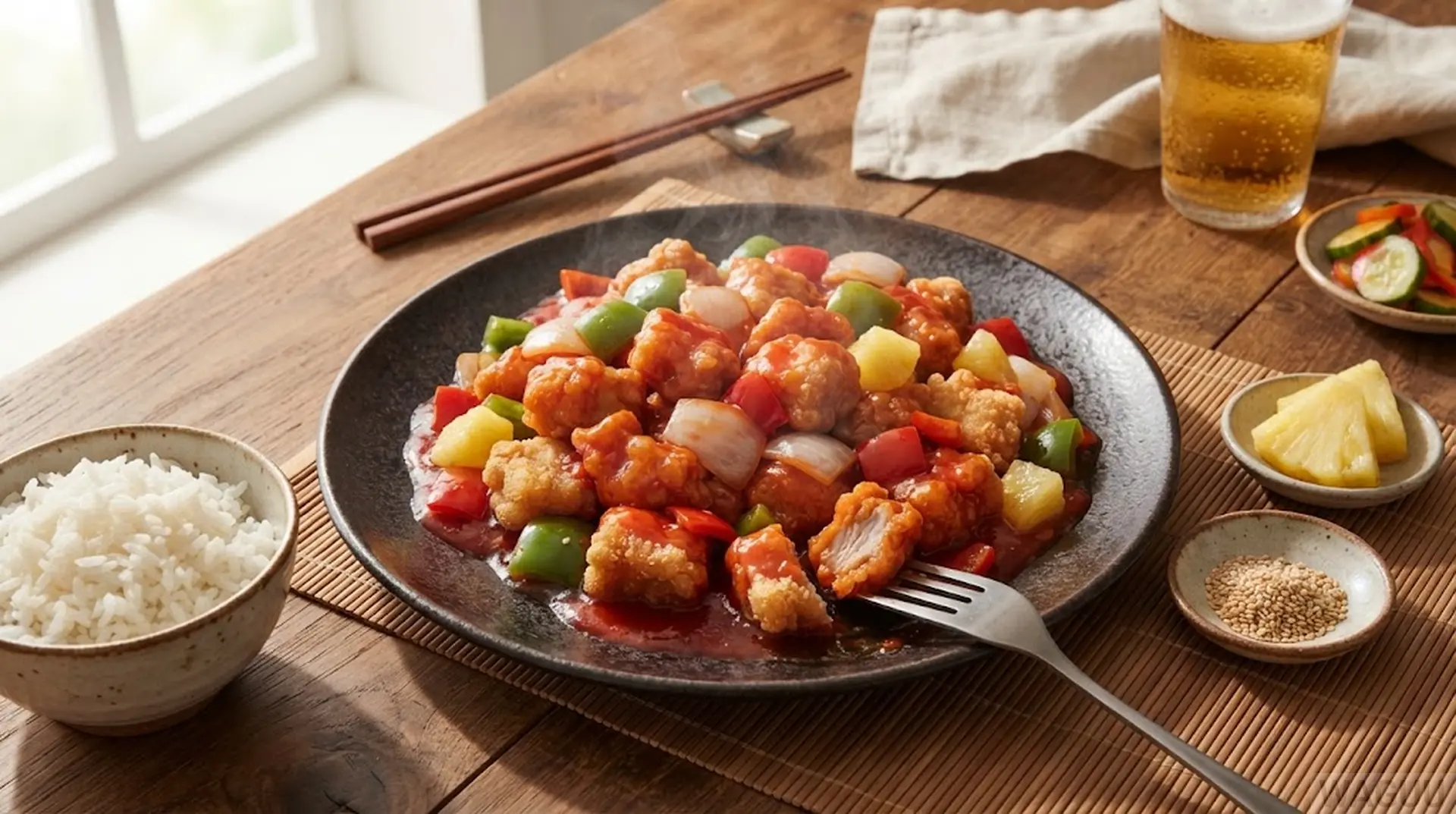
Summary: The takeout favorite made properly at home: cubes of lean pork leg marinated in soy sauce and egg, coated in cornstarch and flour, fried twice so the crust stays crisp, then tossed for a minute in a sauce of ketchup, rice vinegar, sugar and pineapple juice with fresh pineapple and peppers. A little cornstarch thickens the sauce at the end so it clings to the crust instead of running off. Total time 60 minutes, base 6 servings.
Cooked this recipe? Share the result with the community.
Category: Pork, Chinese cuisine
Success rate: not rated yet % of users managed this recipe
Quick overview
- Dish: Sweet and sour pork – fried pork pieces in the classic sweet and sour sauce
- Category: Pork, Chinese cuisine
- Cuisine: Chinese
- Main ingredient: Boneless pork leg, 31.5 oz (5 oz per portion)
- Guide: 12 most famous Chinese dishes: traditional recipes from Chinese cuisine
- Total time: 60 minutes (35 minutes prep + 25 minutes cooking) plus 20 minutes marinating
- Difficulty: Medium
- Servings: 6 (Portion weight: 12 oz)
- Key technique: Double-frying the coated pork and adding the sauce at the last moment
- Method types: Deep-frying, stir-frying, reducing a sauce
- Dietary info & allergens: gluten, egg, soy
- Great for: Family dinners, kids’ parties, anyone who likes a sweet-savory sauce, batch frying with the sauce made to order
- Nutrition (per portion): 560 kcal, Protein: 1 1/4 oz, Fat: 3/4 oz, Carbohydrates: 1 3/4 oz
- Storage: 3 days in the fridge, 1 month in the freezer without the sauce
- Pairing: Jasmine tea, dry Riesling, light lager
- In short: Dry marinated pork, a double fry and a sauce added off the heat – three steps that decide whether the crust stays crisp or goes soft.
WAGUU says: “The sauce is not cooked with the pork. It is made in a separate pan and poured over pieces that have just come out of the oil, so the crust never has time to soften.”
Key facts
| Prep time: | 35 minutes plus 20 minutes marinating |
| Cook time: | 25 minutes |
| Temperature: | First fry 320 °F (320 °F), second fry 375 °F (375 °F), internal pork temperature 160 °F (160 °F) |
| Servings: | 6 (portion weight 381 g) |
At a glance
Sweet and sour pork depends on two temperatures and one timing decision. The first fry at 320 °F (320 °F) cooks the meat through and sets the coating; the second at 375 °F (375 °F) drives out the last of the water and makes the crust brittle. Between the two fries the pieces rest, which lets steam escape instead of being trapped under the crust. The sauce is built separately from ketchup, vinegar, sugar and pineapple juice, then thickened lightly with cornstarch so it coats rather than pools; it is poured over the pork off the heat because a long simmer would pull water back into the crust and make it soggy.
Ingredients
Base servings: 6 • Portion weight: 12 oz
| Ingredient | Quantity | Quality |
|---|---|---|
| boneless pork leg | 31.75 oz | lean, trimmed of sinew, cut into cubes |
| cornstarch | 3.35 oz | 80 g for the coating, 15 g to thicken the sauce |
| all-purpose flour | 2.12 oz | wheat, for the coating |
| egg | 1 pc | fresh, large, for the marinade |
| peanut oil | 4.23 cups | for deep-frying, high smoke point |
| fresh pineapple | 8.82 oz | ripe, cut into three-quarter inch cubes |
| green bell pepper | 7.05 oz | firm, seeded, cut into cubes |
| red bell pepper | 7.05 oz | firm, seeded, cut into cubes |
| onion | 5.29 oz | yellow, cut into rough cubes |
| ketchup | 4.23 oz | tomato, no preservatives |
| rice vinegar | 0.25 cups | white, 5 % acidity |
| granulated sugar | 2.47 oz | to balance the vinegar and ketchup |
| soy sauce | 2.03 tbsp | light, for the marinade |
| pineapple juice | 0.34 cups | 100 %, no added sugar |
| fine sea salt | 0.28 oz | for the marinade |
Why you will love this recipe
- A crust that survives the sauce: Frying twice and dressing the pieces at the last moment keeps the coating crisp through the meal.
- Fresh pineapple, not syrup: Real pineapple brings acidity as well as sweetness, so the sauce does not taste flat.
- Exact quantities for 6 servings: 5 oz of pork per portion and 3 1/2 oz of cornstarch split between coating and sauce.
- Family friendly: No chile, plenty of sauce and vegetables that stay sweet when cooked briefly.
Why it works: The coating is a mixture of cornstarch and wheat flour. Cornstarch gives the brittle, glassy surface; flour gives structure so the crust does not slide off during frying. The first fry at 320 °F (320 °F) cooks the meat and gelatinizes the starch; the rest between fries lets steam escape so the crust is dry before the second fry. At 375 °F (375 °F) the remaining water in the coating evaporates fast and the crust turns crisp. Sugar in the sauce does more than sweeten: it raises the boiling point slightly and, with gelatinized cornstarch, builds a glossy body that sticks to the crust instead of running to the bottom of the plate. Pineapple contains bromelain, an enzyme that softens protein; that is why the pineapple goes in at the very end, where it has no time to work on the pork.
Recipe overview
Prep: 35 min | Cook: 25 min | Difficulty: Medium | Servings: 6 | Type: Main course | Origin: Chinese
Detailed method
Overall progress: 0 % complete
Phase 1: Marinade – 20 min
Equipment: board, knife, bowl, fridge
1. Cut the pork into cubes about an inch across and pat them dry. Whisk the egg with the soy sauce and the fine sea salt in a bowl, add the pork and turn it until every cube is coated. Cover and refrigerate for twenty minutes.
Checkpoint: The cubes are evenly coated in a thin, glossy film and the bowl holds no free liquid. The meat feels firm, not slimy.
Before you move on:
Pat the pork dry before it goes into the marinade. Water on the surface dilutes the egg and the coating then slides off in the oil instead of forming a crust.
Phase 2: Coating – 10 min
Equipment: two shallow dishes, sheet pan
2. Mix 3 oz of cornstarch with the all-purpose flour in a shallow dish. Lift each cube out of the marinade, let the excess drip off and press it into the flour mixture so all sides are covered. Shake off the loose flour and set the cubes on a sheet pan in a single layer. Let them sit ten minutes so the coating hydrates and sticks.
Checkpoint: Each cube wears a dry, even white coat with no bare patches. The pan stays clean because the coating is not wet.
Before you move on:
Coat the cubes one at a time and keep the pan dry. Damp coating turns gluey in the oil and the pieces fuse into one lump that cooks unevenly.
Phase 3: First fry – 8 min
Equipment: deep pot, thermometer, slotted spoon
3. Heat the peanut oil to 320 °F (320 °F) in a deep pot, leaving at least two inches of clear space below the rim. Fry the pork in three batches for three minutes each, until the coating is pale gold and set. Lift the pieces out with a slotted spoon and drain them on a rack, not on paper towels.
Checkpoint: The coating is pale gold and firm, the oil holds between 310 and 330 °F (155 and 330 °F) throughout, and the meat reads 160 °F (160 °F) inside.
Before you move on:
Fry in small batches and let the oil come back to temperature between them. A crowded pot drops below 285 °F (285 °F), the coating absorbs oil and the result is greasy rather than crisp.
Phase 4: Sauce – 8 min
Equipment: small saucepan, whisk
4. In a small saucepan, mix the ketchup, rice vinegar, sugar and pineapple juice and bring to a gentle simmer, stirring until the sugar dissolves. Cook three minutes to reduce slightly. Whisk the remaining 1/2 oz of cornstarch with two tablespoons of cold water and stir it into the sauce; cook one minute, until the sauce turns glossy and coats the back of a spoon.
Checkpoint: The sauce is bright red-orange, glossy and thick enough to hold a line drawn through it. It tastes balanced: sweet first, then a clean tang.
Before you move on:
Taste the sauce before the pork goes anywhere near it. Sugar and vinegar vary between brands; adjust with a spoon of vinegar or sugar now, while you still can.
Phase 5: Second fry – 4 min
Equipment: deep pot, thermometer, slotted spoon
5. Turn the oil up to 375 °F (375 °F). Fry the rested pork again in two batches for ninety seconds each, until the coating is deep gold and audibly crisp. Drain on the rack again while you stir-fry the vegetables.
Checkpoint: The coating is deep gold and crackles when the pieces touch each other. The meat inside is still juicy, not dry.
Before you move on:
Ninety seconds is enough for the second fry. Longer than that and the crust darkens while the inside dries out; the meat is already cooked from the first fry.
Phase 6: Vegetables and combining – 4 min
Equipment: wok, spatula
6. Pour two tablespoons of the frying oil into a wok, add the onion and stir-fry one minute, then the peppers for another minute. Add the pineapple, stir thirty seconds, then tip in the fried pork and pour the sauce over it. Toss twice, take the pan off the heat and serve immediately with steamed rice, which is not part of the recipe.
Checkpoint: Every piece is coated in a thin, even layer of sauce, the peppers are still bright and crisp and no liquid collects at the bottom of the wok.
Equipment needed
| Item | Ideal size | Alternative | Risk |
|---|---|---|---|
| deep pot for frying | 10 inches, at least 5 inches deep | a wok with a thermometer | a shallow pan overflows when the pork goes in |
| frying thermometer | clip-on, reads to 430 °F | a cube of bread: it should brown in forty seconds at 375 °F | without measuring, the oil is either too cool or past smoking point |
| slotted spoon | wide, wire mesh | tongs used gently | a solid spoon carries oil out of the pot and the coating steams |
| cooling rack | fits over a sheet pan | a colander lined with paper | draining on paper traps steam underneath and softens the crust |
| small saucepan for the sauce | 7 inches | a small pot | too large a pan reduces the sauce too far before it thickens |
Shopping list
Nutrition profile
Values per portion (as served, without rice). Calculated from average nutritional values of the ingredients. Portion weight 12 oz. Of the 4 cups of frying oil, only the oil absorbed by the coating – counted at around eight percent – is included.
| Nutrient | Per 3 1/2 oz | Per portion | For 6 servings |
|---|---|---|---|
| Energy | 147 kcal | 560 kcal | 3358 kcal |
| Fat | 6.2 g | 23.6 g | 141.6 g |
| of which saturated | 1.5 g | 5.7 g | 34.1 g |
| Carbohydrates | 13.4 g | 51.1 g | 306.3 g |
| of which sugars | 24.5 g | 24.5 g | 24.5 g |
| Protein | 9.4 g | 35.8 g | 214.5 g |
| Sodium | 0.27 g | 1.04 g | 6.23 g |
| salt equivalent | 0.68 g | 2.60 g | 15.57 g |
Reference intake of an average adult (2000 kcal). Sodium comes mainly from the ketchup, the soy sauce and the marinade; the dish is not salted further. Salt equivalent is sodium multiplied by 2.5.
WAGUU Pro level
- Pro standard: A tested recipe with exact quantities and visual checkpoints.
- Tip 1: Fry the pork twice and hold the pieces on a rack for up to ten minutes. The second fry takes ninety seconds and can be done just before the meal.
- Tip 2: Keep the sauce warm in a thermos or a bowl over hot water. Cold sauce cools the crust on contact.
- Tip 3: Strain the frying oil through a fine sieve once cool and reuse it twice. Discard it after that, as flour residue starts to burn.
- Tip 4: For a lighter version, bake the coated cubes at 410 °F (410 °F) for twenty minutes, turning halfway. Fat drops by roughly two thirds, though the crust is drier and less glassy.
The science behind it
Frying works by removing water. As the coated pork hits 320 °F (320 °F) oil, water at the surface evaporates fast; that escaping steam pushes oil away from the crust and keeps it from soaking in. The starch in cornstarch and flour gelatinizes and then sets, forming a rigid network. Between the two fries the crust cools and steam continues to leave it, so the surface dries. At 375 °F (375 °F) the remaining water boils off in seconds and the crust turns brittle. Sugar added to the sauce raises the boiling point a little and, together with gelatinized cornstarch, builds a glossy gel that clings. Fresh pineapple contains bromelain, a protease that breaks down protein; heat deactivates it, which is why the pineapple is added at the end, when it has only seconds to act on the pork. Color comes from ketchup and from Maillard browning on the coating, not from artificial coloring.
Fine dining – professional techniques
- Plating: Pile the pork in the middle of a warm plate, scatter the pineapple and peppers around it and spoon the sauce over at the table so the crust is heard as well as tasted.
- Texture contrast: Add a spoon of toasted sesame seeds or crisp fried shallots. Both stay crunchy under the sauce.
- Temperature contrast: Serve with cold pickled cucumber or a lime sorbet between courses. The chill resets the palate after a sweet, rich sauce.
- Aromatic finish: Grate lime zest over the plate. Citrus lifts the sauce and makes it taste fresher than it looks.
Sensory radar
- Appearance: Deep gold cubes of pork under a bright red-orange glaze, with green and red peppers and pale yellow pineapple.
- Aroma: Sweet tomato and vinegar with fried batter, plus a fresh note of pineapple.
- Taste: Sweet first, then a clean tang from the vinegar, with savory pork and the acidity of fresh fruit underneath.
- Texture: Crust brittle and light, pork tender, peppers still crisp, pineapple soft and juicy.
Pairing
- Jasmine tea: Light and floral, it cleans the palate between rich, sweet bites.
- Dry Riesling: High acidity cuts the fried coating and matches the pineapple.
- Light lager: Bitterness and carbonation refresh. Serve at 43–46 °F (6–45 °F).
- Homemade limeade: Fizz and citrus work for kids and for anyone avoiding alcohol.
Variations
- Baked version: Coat the cubes, drizzle with two tablespoons of oil and bake at 410 °F (410 °F) for twenty minutes, turning once. Fat drops sharply and the crust is drier.
- Chicken instead of pork: Use thigh meat cut into cubes and fry two minutes less in the first stage. The dish becomes lighter and cooks faster.
- Sweet and sour shrimp: Replace the pork with 16 oz of raw peeled shrimp, coated and fried for one minute only. Serve immediately, as shrimp toughen on standing.
Allergens and dietary information
Contains: gluten (all-purpose flour, soy sauce); egg (egg); soy (soy sauce) • Gluten: yes, in the flour and the soy sauce • Not suitable for: anyone with celiac disease or an egg allergy; a gluten-free version needs a gluten-free flour blend and tamari
Great for
Family dinners, kids’ parties, anyone who likes a sweet-savory sauce, batch frying with the sauce made to order, a shared table with rice and a salad.
Substitution guide
- Pork leg: pork shoulder or chicken thigh. Both need thirty seconds longer in the first fry; shoulder is fattier and juicier.
- Fresh pineapple: canned pineapple in juice, well drained. Softer and sweeter, so reduce the sugar by ten grams.
- Ketchup: tomato passata with a spoon of sugar and a pinch of salt. Less sweet and more acidic, so taste before serving.
- Rice vinegar: cider vinegar diluted with a little water. Sharper, so use fifty milliliters.
- Cornstarch: potato starch for the coating and the sauce. It thickens at a lower temperature, so add it in two stages.
- Peanut oil: sunflower or canola oil. Both take 375 °F (375 °F), though they add no flavor of their own.
FAQ
Why fry twice?
The first fry cooks the meat and sets the coating; the second, hotter fry drives out the last of the water and makes the crust brittle. A single fry leaves the middle of the coating soft.
Can I cook the pork in an air fryer?
Yes. Spray the coated cubes with oil and cook at 400 °F (390 °F) for fourteen minutes, shaking twice. The crust is drier and less glassy but the fat falls by about two thirds.
How do I keep the sauce from going watery?
Thicken it with cornstarch slurry and add it to the pork only at the last moment. If the sauce and pork sit together, the crust releases water and the sauce thins.
Can I use canned pineapple?
Yes, in juice rather than syrup. Drain it well and reduce the sugar by ten grams, because canned fruit is sweeter than fresh.
What if the coating falls off in the oil?
The cubes were too wet or the oil was too cool. Pat the pork dry, coat it evenly, rest it ten minutes and hold the oil at 320 °F (320 °F) for the first fry.
Can this be made gluten free?
Yes, with gluten-free all-purpose flour and tamari, plus a gluten-free ketchup. Cornstarch contains no gluten, so the coating still crisps well.
WAGUU Petr advises: cooking for 6 or more?
6–8 people: Fry in four batches and hold the finished pieces on a rack in the oven at 210 °F (210 °F). Warm the sauce separately and combine at the table. • 10+ people: Set up two pots of oil at different temperatures so the first and second fries run at the same time. Double the sauce and keep it hot in a slow cooker on the lowest setting.
Sides and serving
Storage and reheating
Fridge: 3 days (store the pork and sauce separately) • Freezer: 1 month, pork only, without sauce • Reheating: Refresh the pork in a hot oven at 400 °F (390 °F) for six minutes or in a dry pan for three; warm the sauce separately. Never microwave the coated pork, as the crust turns soft and greasy.
Author: WAGUU Petr & Team • Published: 8 Oct 2026 • Updated: 10 Oct 2026
More recipes from this article
Guide: 12 most famous Chinese dishes: traditional recipes from Chinese cuisine
Peking duck – celebratory roast duck with crisp skin, thin pancakes and a sweet sauce
Kung Pao chicken – spicy Sichuan chicken with peanuts, chile and a sweet-savory sauce
Mapo tofu – tofu in a spicy Sichuan sauce with ground meat and Sichuan pepper
Char siu – Cantonese roast pork with a glossy caramelized crust
Dim sum – small Cantonese dishes, especially steamed dumplings and parcels
Xiaolongbao – delicate Shanghai dumplings filled with pork and hot soup
Chow mein – stir-fried wheat noodles with vegetables, meat or seafood
Yangzhou fried rice – fried rice with egg, shrimp, ham and peas
Hot pot – a shared meal cooked in bubbling broth at the table
Dan dan noodles – Sichuan noodles with a spicy sauce and chile oil
Wonton soup – clear broth with filled wonton dumplings and scallions
Other recipes you might like
Why WAGUU?
Recipes on WAGUU are checked for accurate quantities, method and nutrition. In this recipe the amounts match across the ingredient table, the cooking phases, the shopping list and the print view – 31.5 oz of pork serves six at 5 oz each, 3 1/2 oz of cornstarch is split between the coating and the sauce, and 4 cups of frying oil counts only for what the coating absorbs.
Photo gallery from the process
Community photos: Cook it, photograph it and share the result.
Upload your photos in the comments below or send them by email.
Filmed a video following our recipe? Post a link to YouTube, YouTube Shorts, TikTok, Instagram Reels, Facebook Reels, Pinterest, Vimeo or X (Twitter) in the comments – we will gladly publish it and help get your work seen.
Most common mistakes
- One fry instead of two – the crust is crisp for a minute and then softens. Fry at 320 °F (320 °F), rest, then fry again at 375 °F (375 °F).
- Oil too cool – the coating drinks oil and the dish turns greasy. Hold the first fry at 310–330 °F and fry in small batches.
- Sauce poured over in the pan and left to simmer – the crust soaks up liquid and collapses. Combine off the heat and serve within a minute.
- Pineapple added early – its enzyme softens the pork and the fruit breaks down. Add it thirty seconds before the end.