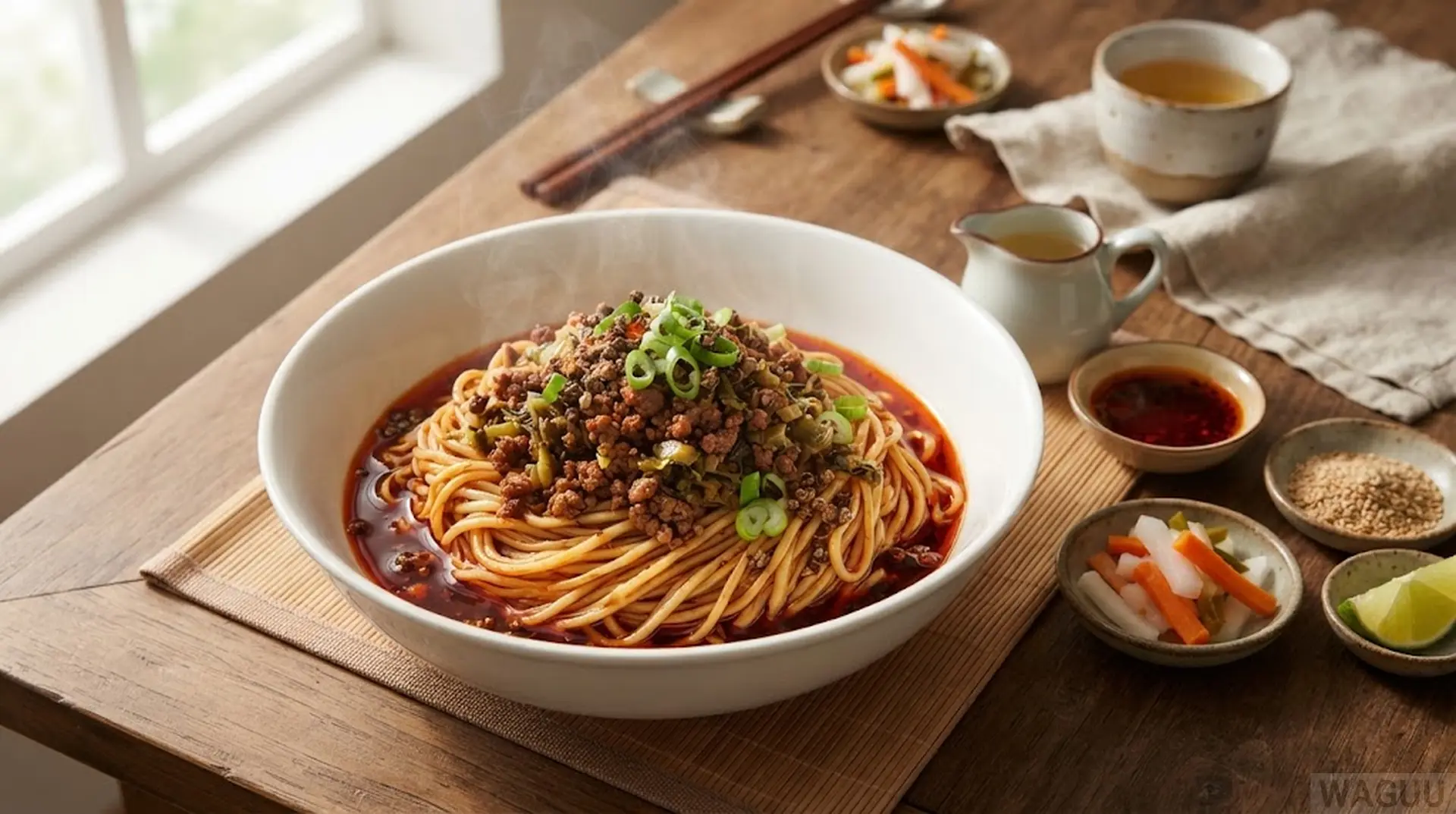
Summary: Sichuan noodles with ground pork, pickled greens, sesame paste and chile oil. The pork fries with the pickles until dry and crumbly; the sauce is mixed straight into the bowl from sesame paste, soy sauce and black rice vinegar, and the cooked noodles are laid on top. Hot chile oil is poured over and ground Sichuan pepper finishes the dish. Total time 45 minutes, base 6 servings.
Cooked this recipe? Share the result with the community.
Category: Pasta, Chinese cuisine
Success rate: not rated yet % of users managed this recipe
Quick overview
- Dish: Dan dan noodles – Sichuan noodles with a spicy sauce and chile oil
- Category: Pasta, Chinese cuisine
- Cuisine: Chinese
- Main ingredient: Dried wheat noodles, 16 oz (2 1/2 oz per portion)
- Guide: 12 most famous Chinese dishes: traditional recipes from Chinese cuisine
- Total time: 45 minutes (25 minutes prep + 20 minutes cooking)
- Difficulty: Medium
- Servings: 6 (Portion weight: 8 oz)
- Key technique: Frying the pork until dry and building the sauce directly in the bowl under the noodles
- Method types: Stir-frying, boiling, pan-frying
- Dietary info & allergens: gluten, soy, sesame
- Great for: A quick dinner, anyone who likes Sichuan heat, a lunchbox, cooking ahead by making the sauce in advance
- Nutrition (per portion): 732 kcal, Protein: 3/4 oz, Fat: 1 1/2 oz, Carbohydrates: 2 1/2 oz
- Storage: 3 days in the fridge, sauce 1 month in the freezer
- Pairing: Jasmine tea, rice beer, homemade limeade
- In short: Pork fried until dry, a thick sauce in the base of the bowl and hot chile oil poured over – three steps that decide whether the noodles are coated or stay pale.
WAGUU says: “Dan dan is not mixed in the pan. The sauce goes into the bottom of the bowl, the hot noodles on top, and the mixing happens at the table – that way the noodles stay hot and the chile oil does not break down.”
Key facts
| Prep time: | 25 minutes |
| Cook time: | 20 minutes |
| Temperature: | Chile oil heated to 300–320 °F (150–320 °F), noodles boiled in plenty of water |
| Servings: | 6 (portion weight 254 g) |
At a glance
Dan dan noodles rest on a thick sauce that clings to the noodles. Sesame paste and pork fried until dry form the base that binds liquid; soy sauce and black rice vinegar bring salt and acidity, and the chile oil ties the flavors together. The oil is heated to 300–320 °F (150–320 °F) so the aromatics of the chile and Sichuan pepper are released into the fat; hotter than that and the chile burns and turns bitter. The noodles are boiled to just done, rinsed only briefly and laid straight onto the sauce, so the whole flavor reaches each bowl individually and nothing is lost in the colander.
Ingredients
Base servings: 6 • Portion weight: 8 oz
| Ingredient | Quantity | Quality |
|---|---|---|
| dried wheat noodles | 15.87 oz | medium thickness |
| ground pork belly | 14.11 oz | freshly ground, around 25 % fat |
| pickled greens (yacai) | 2.82 oz | dried pickled mustard greens, chopped fine |
| sesame paste | 3.53 oz | 100 % sesame, stirred before use |
| soy sauce | 0.25 cups | light, naturally fermented |
| black rice vinegar | 2.03 tbsp | dark, slightly sweet |
| chile oil | 0.25 cups | with pieces of chile, to pour over the noodles |
| peanut oil | 2.03 tbsp | for frying the pork |
| Sichuan pepper | 0.21 oz | whole, toasted and ground |
| garlic | 0.71 oz | fresh, chopped fine |
| scallions | 2.82 oz | fresh, cut on the diagonal |
| granulated sugar | 0.35 oz | to balance the vinegar |
| chicken stock | 0.85 cups | unsalted, to loosen the sauce |
Why you will love this recipe
- On the table in 45 minutes: The sauce takes twenty minutes, the noodles five and assembling the bowls a minute.
- A flavor built in layers: Salty soy, sour black vinegar, sweet sugar, sesame paste and hot chile oil all meet in the bowl.
- Exact quantities for 6 servings: 2 1/2 oz of dried noodles per portion, 2 1/2 oz of pork and 2/3 oz of sesame paste.
- Improvers can manage it: Six phases, five checkpoints and one pan. What separates a great result from an average one is pork fried until dry and chile oil at the right temperature.
Why it works: Dan dan is a sauce that clings to the noodles rather than a soup. Sesame paste is an emulsion of fat and protein that binds water; together with ground pork fried until dry it forms a thick mass that coats every strand once the bowl is mixed. The pork is fried until its water has evaporated – only then is it crumbly and only then does its fat merge with the sesame paste. The chile oil is heated to 300–320 °F (150–320 °F): capsaicin and the aromatics of Sichuan pepper dissolve in fat, so they transfer to the noodles, and above 355 °F (355 °F) the chile burns and the oil turns bitter. Pickled greens add salt and a fermented depth that replaces part of the seasoning, which is why the dish needs no added salt.
Recipe overview
Prep: 25 min | Cook: 20 min | Difficulty: Medium | Servings: 6 | Type: Main course | Origin: Chinese
Detailed method
Overall progress: 0 % complete
Phase 1: Preparing the ingredients – 15 min
Equipment: kitchen scale, board, knife
1. Rinse the pickled greens, drain them and chop them fine. Chop the garlic with a knife and cut the scallions on the diagonal. Toast the Sichuan pepper in a dry skillet half a minute until fragrant and grind it in a mortar. In a bowl, mix the sesame paste with the soy sauce, black rice vinegar, sugar and half the chicken stock until smooth and thick.
Checkpoint: The sauce is smooth, glossy and thick enough to hold on a spoon. No lumps of sesame paste remain and the sugar has dissolved.
Before you move on:
Stir the sesame paste thoroughly before use. On standing the oil separates to the surface; without mixing, the sauce is thin on top and solid at the bottom of the jar.
Phase 2: Frying the pork until dry – 10 min
Equipment: skillet or wok, spatula
2. Heat the peanut oil in the pan and add the ground pork. Break it up and fry it over higher heat four minutes, until it turns pale golden. Add the chopped pickled greens and the garlic and fry another three minutes, until all the water has gone from the meat and it is crumbly with darker edges.
Checkpoint: The pork is crumbly, dark golden and no liquid is left in the pan, only a thin film of fat. Stirring sounds dry rather than bubbling.
Before you move on:
The pork must be fried until dry. Left damp, it thins the sauce in the bowl and the sauce will not coat the noodles; the flavor ends up at the bottom.
Phase 3: Heating the chile oil – 3 min
Equipment: small saucepan, oil thermometer
3. Pour the chile oil into a small saucepan and heat it to 300–320 °F (150–320 °F). Watch the thermometer; the oil must not smoke. Tip half the ground Sichuan pepper into the hot oil, take the pan off the heat and leave it a minute so the aroma opens.
Checkpoint: The oil is deep red and small bubbles form around the pieces of chile, but the oil does not smoke. The aroma is sharp and spiced rather than acrid.
Before you move on:
Never let the chile oil smoke. Above 355 °F (355 °F) the chile burns, the oil turns bitter and that bitterness carries through the whole dish. Keep a thermometer in the pan.
Phase 4: Cooking the noodles – 6 min
Equipment: large pot, colander
4. Bring three quarts of water to a boil in a large pot and add the noodles. Boil them a minute less than the package says, usually four to five minutes. Drain them, rinse briefly in warm water so they do not stick, and leave them to drain.
Checkpoint: The noodles are firm to the bite but not hard in the middle. Lifted with a fork, the strands separate instead of clumping.
Before you move on:
Do not rinse the noodles in cold water until they are completely cool. They should still be warm so that the sauce in the bowl comes together and the chile oil does not separate.
Phase 5: Building the bowls – 3 min
Equipment: six deep bowls, spoon
5. Put a spoonful of the sesame sauce into each bowl and spread it over the base. Lay a portion of hot noodles on top, spoon the fried pork and pickles over them and pour the hot chile oil across. Scatter the remaining ground Sichuan pepper and the scallions over the top.
Checkpoint: The sauce stays in the base of the bowl while the noodles on top are dry and glistening with chile oil. The pork is spread evenly and the scallion is bright green.
Before you move on:
Do not mix the bowl in advance. The noodles are laid on the sauce and the guest mixes it at the table, so the noodles stay hot and the chile oil does not separate.
Phase 6: Serving – 2 min
Equipment: chopsticks, spoon
6. Take the bowls to the table while the noodles are still hot. Give each guest chopsticks and a spoon; the bowl is mixed from the bottom before eating so the sauce combines with the noodles. Serve the rest of the chicken stock in a pitcher so anyone can loosen the sauce to their taste.
Checkpoint: Once mixed, the noodles are evenly coated in dark red sauce and no separated oil is left at the bottom. The taste is salty, sour and hot at the same time.
Equipment needed
| Item | Ideal size | Alternative | Risk |
|---|---|---|---|
| skillet or wok | 11 inches across | a deep cast-iron skillet | a thin base will not dry the pork out |
| large pot for the noodles | 5 quart capacity | two smaller pots for two batches | in a small pot the noodles clump and the water stops boiling |
| oil thermometer | reads to 430 °F | test with a piece of chile in the oil | without measuring, the oil overheats easily and turns bitter |
| mortar and pestle | ceramic, 1 cup | the base of a heavy pan and a rolling pin | ground Sichuan pepper from a packet has already lost its aroma |
| deep bowls | six bowls of 16 oz | deep plates | in a shallow bowl the sauce spreads out and the noodles stay bare |
Shopping list
Nutrition profile
Values per portion (as served, without a side). Calculated from average nutritional values of the ingredients. Portion weight 8 oz. The water used to boil the noodles is not counted in the weight.
| Nutrient | Per 3 1/2 oz | Per portion | For 6 servings |
|---|---|---|---|
| Energy | 288 kcal | 732 kcal | 4391 kcal |
| Fat | 16.6 g | 42.3 g | 253.6 g |
| of which saturated | 4.1 g | 10.6 g | 63.3 g |
| Carbohydrates | 25.2 g | 64.0 g | 383.8 g |
| of which sugars | 6.5 g | 6.5 g | 6.5 g |
| Protein | 9.4 g | 23.9 g | 143.5 g |
| Sodium | 0.49 g | 1.24 g | 7.42 g |
| salt equivalent | 1.22 g | 3.09 g | 18.55 g |
Reference intake of an average adult (2000 kcal). Sodium comes from the pickled greens, the soy sauce and the stock; the dish is not salted further. Salt equivalent is sodium multiplied by 2.5.
WAGUU Pro level
- Pro standard: A tested recipe with exact quantities and visual checkpoints.
- Tip 1: Make the sesame sauce an hour ahead and keep it cool. The flavor settles and the sauce thickens.
- Tip 2: Fry the pork over higher heat and stir it less than you are used to. The longer the water takes to evaporate, the crumblier the meat becomes.
- Tip 3: Taste the chile oil before you use it. Brands vary in heat; with a fierce one, half the amount is enough.
- Tip 4: Boil the noodles in plenty of water and do not stir them with a spoon. Lifting them once with chopsticks is enough to stop them catching.
The science behind it
Dan dan noodles are an example of an emulsion. Sesame paste contains fat and protein; when stirred, the proteins coat droplets of fat and build a network that binds the water from the soy sauce and the stock. That is why the sauce clings to the noodles instead of running to the bottom. Ground pork loses water during frying; only once the surface moisture has gone does the meat pass 285 °F (285 °F) and does the Maillard reaction between amino acids and reducing sugars give it a brown color and a fuller flavor. Capsaicin from the chile and the aromatics of Sichuan pepper, chiefly sanshool, dissolve in fat rather than in water. They are therefore released into the heated oil and transferred to the noodles; in water they would stay locked in the spices. Above 355 °F (355 °F) capsaicin begins to break down and the chile loses part of its heat, while burnt particles add bitterness. Starch from the wheat noodles partly dissolves into the cooking water and leaves a thin film on the surface; a brief rinse keeps that film, which helps the sauce to grip.
Fine dining – professional techniques
- Plating: Twist the noodles into a nest with a fork, spoon the sauce around it and lay the pork on top. Scatter sesame seeds over the plate.
- Texture contrast: Add thin batons of fresh cucumber and pickled vegetables. Crunch balances the thick sauce.
- Temperature contrast: Serve in warmed bowls; on cold porcelain the sauce firms and stops combining with the noodles.
- Aromatic finish: Grate lime zest over the bowl and add a drop of sesame oil. The citrus opens the spices before the first bite.
Sensory radar
- Appearance: Dark red noodles coated in glossy sauce with crumbly brown pork, green scallion and brown Sichuan pepper on top.
- Aroma: Roasted chile and sesame, with fermented greens and garlic underneath.
- Taste: Salty soy, the sourness of black vinegar, the sweetness of sesame paste and a warm chile heat with a tingle at the end.
- Texture: Noodles firm and slippery, pork crumbly and dry, sauce thick and smooth.
Pairing
- Jasmine tea: A floral aroma softens the heat and cleanses the palate.
- Rice beer: Light sweetness and low bitterness suit sharp chile. Serve at 43–46 °F (6–45 °F).
- Homemade limeade: Acidity and fizz refresh after a hot bite.
- Dry Riesling: Higher acidity cuts the sesame paste and lets the fermented greens show.
Variations
- Without meat: Replace the pork with 8 oz of finely chopped smoked tofu and a spoon of extra sesame paste. Lighter and meat free, with chile oil just as assertive.
- Chicken version: Use ground chicken thigh instead of pork belly. Leaner, so add a spoon of peanut oil so the meat does not stick.
- Hotter version: Increase the chile oil to 1/3 cups and add a spoon of pickled chile. The heat rises, but the sweetness of the sesame paste keeps it balanced.
Allergens and dietary information
Contains: gluten (wheat noodles); soy (soy sauce); sesame (sesame paste) • Gluten: yes, in the noodles • Not suitable for: anyone with celiac disease or a soy or sesame allergy
Great for
A quick dinner, anyone who likes Sichuan heat, a lunchbox, cooking ahead by making the sauce in advance, dinner for two to six people.
Substitution guide
- Pickled greens (yacai): chopped pickled cucumber or sauerkraut. Sharper and less fermented.
- Sesame paste: sugar-free peanut butter with a spoon of sesame oil. Sweeter and more pronounced.
- Black rice vinegar: balsamic vinegar diluted with an equal part of water. Sweeter.
- Chile oil: peanut oil heated with 1/3 oz of chile flakes. You decide the heat.
- Ground pork belly: ground beef with 15 % fat. Drier, so add a spoon of sesame paste.
- Chicken stock: vegetable stock with a spoon of soy sauce. The dish loses some depth.
FAQ
Why is the sauce mixed in the bowl?
So that the noodles stay hot and the sauce does not catch in the pan. Tossed in a pan, the noodles would soften and lose their bite; in the bowl they combine at the table.
Do I have to use pickled greens?
They are not essential, but they bring salt and a fermented depth. If you leave them out, add a spoon of soy sauce and a quarter teaspoon of sugar.
How hot is the dish?
It depends on the chile oil. Sixty milliliters gives a sharp but balanced result. For a milder version use half and serve the rest separately in a bowl.
Can the noodles be cooked in advance?
Yes, but rinse them and toss them with a drop of oil. Before serving, warm them in boiling water for ten seconds to bring back their bite.
What if the sauce is too thick?
Loosen it with chicken stock, never with water. Stock carries flavor; water would only dilute the sauce. Add it a spoon at a time and stir.
Is the recipe gluten free?
Not with wheat noodles. Use rice noodles and tamari instead of soy sauce. Sesame paste, pickled greens and pork contain no gluten.
WAGUU Petr advises: cooking for 6 or more?
6–8 people: Make the sauce and the pork in one batch and cook the noodles in two pots so the water comes back to a boil. Build the bowls at the last moment. • 10+ people: Put two bowls of sauce and two of pork on the table and let guests assemble their own. Keep the noodles in hot water and serve them in smaller batches as they cook.
Sides and serving
Storage and reheating
Fridge: 3 days • Freezer: 1 month (sauce and pork separately) • Reheating: Warm the sauce and pork in a pan with a spoon of stock, blanch the noodles in boiling water for ten seconds and rebuild the bowls. In the microwave the noodles soften and the sauce splits at the edges.
Author: WAGUU Petr & Team • Published: 8 Oct 2026 • Updated: 10 Oct 2026
More recipes from this article
Guide: 12 most famous Chinese dishes: traditional recipes from Chinese cuisine
Peking duck – celebratory roast duck with crisp skin, thin pancakes and a sweet sauce
Kung Pao chicken – spicy Sichuan chicken with peanuts, chile and a sweet-savory sauce
Mapo tofu – tofu in a spicy Sichuan sauce with ground meat and Sichuan pepper
Sweet and sour pork – fried pork pieces in the classic sweet and sour sauce
Char siu – Cantonese roast pork with a glossy caramelized crust
Dim sum – small Cantonese dishes, especially steamed dumplings and parcels
Xiaolongbao – delicate Shanghai dumplings filled with pork and hot soup
Chow mein – stir-fried wheat noodles with vegetables, meat or seafood
Yangzhou fried rice – fried rice with egg, shrimp, ham and peas
Hot pot – a shared meal cooked in bubbling broth at the table
Wonton soup – clear broth with filled wonton dumplings and scallions
Other recipes you might like
Why WAGUU?
Recipes on WAGUU are checked for accurate quantities, method and nutrition. In this recipe the amounts match across the ingredient table, the cooking phases, the shopping list and the print view – 16 oz of dried noodles serve six at 2 1/2 oz each, 12 oz of pork gives 2 1/2 oz per portion and 3 1/2 oz of sesame paste 2/3 oz per portion.
Photo gallery from the process
Community photos: Cook it, photograph it and share the result.
Upload your photos in the comments below or send them by email.
Filmed a video following our recipe? Post a link to YouTube, YouTube Shorts, TikTok, Instagram Reels, Facebook Reels, Pinterest, Vimeo or X (Twitter) in the comments – we will gladly publish it and help get your work seen.
Most common mistakes
- Damp pork – it thins the sauce and the noodles stay bare. Fry the pork until it is crumbly and dark golden.
- Burnt chile oil – above 355 °F (355 °F) the chile burns and the oil turns bitter. Heat it to 300–320 °F (150–320 °F) and use a thermometer.
- Sauce mixed in the bowl in advance – the noodles cool and the oil separates. Leave the sauce at the bottom and mix at the table.
- Overcooked noodles – they fall apart in the bowl. Boil them a minute less than the package says.