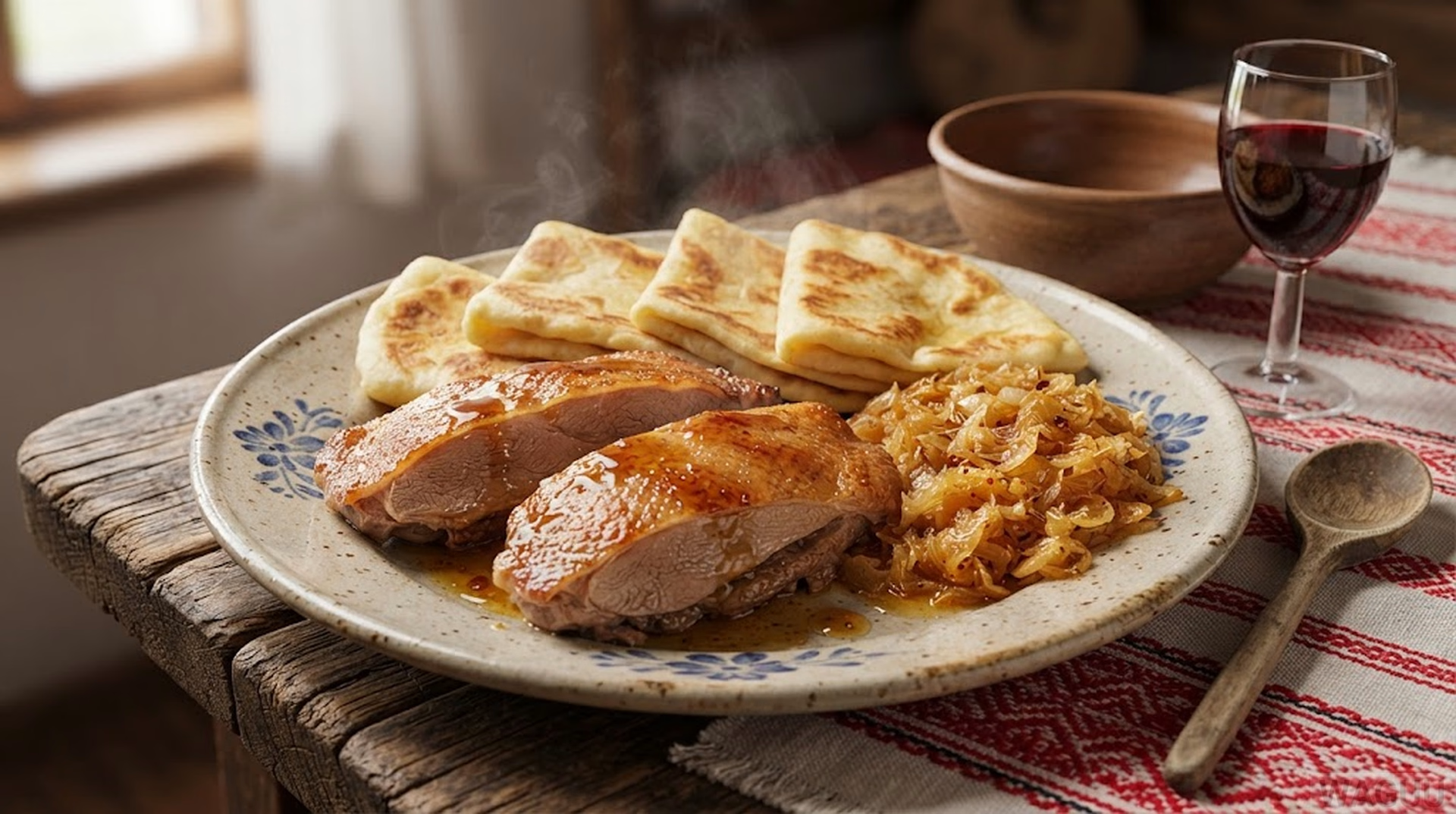
Summary: Slovak roast goose – a whole goose rubbed with caraway and garlic, roasted slowly until the skin is crisp and the meat falls off the bone. Served with potato flatbread (lokše) and braised cabbage. Ready in about 3 hours 30 minutes, serves 6.
Cooked the recipe? Share the result with the community.
Category: American Poultry, American Slovak Cuisine, American Christmas Recipes
Success rate: not rated yet % of users managed this recipe
Quick overview
- Dish: Slovak Roast Goose with Potato Flatbread and Cabbage
- Category: American Poultry, American Slovak Cuisine, American Christmas Recipes
- Cuisine: Slovak
- Main ingredient: Whole goose, about 7¾ lb, free-range
- Guide: 12 Most Famous Slovak Dishes: Traditional Recipes from Slovak Cuisine
- Total time: 210 minutes (30 min prep + 180 min cooking)
- Difficulty: Medium
- Servings: 6 (Portion weight: 15 oz)
- Key technique: Slow roasting, pricking the skin, basting with rendered fat
- Preparation types: Roasting, braising (cabbage), dry-frying (lokše)
- Dietary info & allergens: Contains gluten (lokše). Not suitable for gluten-free, vegetarian or vegan diets.
- Suitable for: Christmas Eve, St. Martin’s Day, festive family gatherings
- Nutrition per serving: 980 kcal, Protein: 62 g, Fat: 65 g, Carbohydrates: 45 g
- Storage: 3 days in the fridge, 3 months in the freezer
- Pairing: Blaufränkisch, Pinot Noir, dark lager
- In short: A festive Slovak bird roasted slowly and served with its own fat and cabbage.
- Last updated: September 22, 2026
WAGUU says: “Roast goose is not a quick dish. It is a slow one – three hours in the oven, and the reward is skin like glass.”
Key facts
| Prep time: | 30 minutes |
| Cook time: | 180 minutes |
| Temperature: | 325 °F (first 2 hours), 400 °F (last 30 min) |
| Servings: | 6 |
At a glance
A whole goose roasted slowly with caraway and garlic. The fat renders out, the skin crisps up, and the meat becomes tender enough to fall off the bone. Served with thin potato flatbreads (lokše) to soak up the juices and braised cabbage on the side.
Ingredients
Base servings: 6 servings • Portion weight: 15 oz
| Ingredient | Amount | Quality |
|---|---|---|
| Whole goose | 7¾ lb | Free-range, giblets removed, room temperature |
| Coarse sea salt | 2 tbsp | For rubbing the skin |
| Caraway seeds | 2 tsp | Lightly crushed |
| Garlic | 6 cloves | Crushed |
| Marjoram, dried | 1 tsp | Rubbed |
| Apples, tart | 2 pc | Quarters, for stuffing the cavity |
| Brown onion | 1 pc | Halved |
| Russet potatoes (for lokše) | 1¾ lb | Peeled, boiled, cooled, riced |
| All-purpose flour (for lokše) | 2½ cups | Plus extra for dusting |
| White cabbage | 2¼ lb | Shredded finely |
| Brown onion (for cabbage) | 1 pc | Finely chopped |
| Goose fat (or pork lard) | 3 tbsp | For the cabbage and lokše |
| Sweet Hungarian paprika | 1 tsp | Fresh, sweet |
| Cider vinegar | 2 tbsp | For the cabbage |
| Granulated sugar | 1 tbsp | For the cabbage |
| Black pepper, freshly ground | 1 tsp | Coarse grind |
Why you will love this recipe
- Festive and traditional: Roast goose is the centerpiece of St. Martin’s Day and Christmas in Slovakia.
- Crisp skin without tricks: Pricking the skin and slow roasting is all you need to get it glassy.
- One bird, three components: The goose, the lokše and the cabbage all come together as a complete meal.
Why it works: Pricking the skin allows the fat under it to render out during roasting. Slow roasting at 325 °F for two hours cooks the meat gently, keeping it moist while the fat drips away into the tray. Finishing at 400 °F for the last 30 minutes crisps the skin without drying the meat. Serving the goose on lokše lets the flatbreads soak up the rendered fat and juices – nothing is wasted.
Recipe overview
Prep: 30 min | Cooking: 180 min | Difficulty: Medium | Servings: 6 | Type: Main course | Origin: Slovak
Detailed method
Total progress: 0 % done
Phase 1: Preparing the goose – 15 min
Equipment: Roasting pan with rack, sharp skewer, paper towels
1. Take the goose out of the fridge 1 hour before cooking. Pat the skin dry with paper towels – inside and out. Prick the skin all over with a sharp skewer, especially on the breast and thighs. Do not pierce the meat, only the skin and fat layer underneath. Rub the whole bird with coarse salt, caraway seeds, marjoram and crushed garlic. Put the apple quarters and halved onion inside the cavity.
VKB: The skin is dry, evenly pricked, and coated in salt and spices. The bird is at room temperature – not cold to the touch.
Before you continue:
Never pierce the meat, only the skin. Piercing the meat lets the juices escape and the goose will be dry.
Phase 2: Slow roasting – 120 min
Equipment: Oven, roasting pan, rack, baster
2. Preheat the oven to 325 °F (fan 300 °F). Place the goose breast-side up on a rack inside a deep roasting pan. Pour 1 cup of water into the pan – this stops the fat from burning. Roast for 2 hours, basting the bird every 30 minutes with the fat from the pan. If the skin is browning too fast, cover loosely with foil.
VKB: The skin is evenly golden. The fat has rendered out – you should have about 2 cups in the pan. A skewer inserted into the thickest part of the thigh releases clear juices.
Before you continue:
Pour off the rendered fat every 40 minutes and keep it. You will need it for the lokše and the cabbage.
Phase 3: Crisping the skin – 30 min
Equipment: Oven, roasting pan
3. Increase the oven temperature to 400 °F (fan 375 °F). Remove the foil if you used any. Roast for another 25–30 minutes until the skin is deep golden brown and crisp. Watch carefully – the last 10 minutes are the difference between crisp and burnt.
VKB: The skin is crisp and crackles when tapped with a fingernail. The color is deep golden-brown, not dark. The thigh juices run clear.
Phase 4: Braising the cabbage – 40 min
Equipment: Large pot or deep pan, wooden spoon
4. While the goose is roasting, heat 2 tbsp of goose fat in a large pot over medium heat. Add the onion and cook for 4 minutes until soft. Add the shredded cabbage, sugar, vinegar, salt, pepper and paprika. Stir well, cover and cook on low for 35 minutes, stirring occasionally. The cabbage should be soft but not mushy and should have a slight tang.
VKB: The cabbage is soft, glossy and slightly sweet. It smells of paprika and goose fat. No pool of liquid at the bottom of the pot.
Phase 5: Making the lokše – 25 min
Equipment: Large bowl, rolling pin, dry griddle or frying pan, pastry brush
5. Mix the riced potatoes with 1 tsp salt and the flour. Knead briefly to a soft dough. Divide into 12 pieces and roll each into a thin round, about 8 inches across. Cook on a dry griddle over medium heat for 1–1.5 minutes per side. Brush each lokša with goose fat and stack under a clean kitchen towel.
VKB: The lokše are soft and pliable with brown blisters. They fold without cracking and smell of goose fat.
Phase 6: Serving – 5 min
Equipment: Warm plates, carving knife, spoon
6. Take the goose out of the oven and rest it, covered loosely with foil, for 15 minutes before carving. Carve the breast, thighs and legs. Arrange the meat on warm plates over a lokša so the bread soaks up the juices. Add a spoon of braised cabbage on the side and drizzle with a little pan juices.
VKB: The meat is tender and separates easily from the bone. The skin is still crisp. The lokša is soaked with juices and the cabbage is warm and tangy.
Required equipment
| Item | Ideal size | Alternative | Risk |
|---|---|---|---|
| Roasting pan with rack | 16 × 12 inches, deep | Shallow roasting pan with a wire rack | A shallow pan overflows with fat and creates smoke |
| Baster or large spoon | Standard | Small ladle | Without basting the skin dries unevenly |
| Griddle or heavy pan | 11-inch, thick base | Cast-iron skillet | A thin pan burns the lokše before they cook through |
Shopping list
Nutritional profile
Values per 1 serving (15 oz, includes lokše and cabbage). Calculated from average nutritional values of the ingredients.
| Nutrient | Per 100 g | Per 1 serving | Per 6 servings |
|---|---|---|---|
| Energy | 233 kcal | 980 kcal | 5880 kcal |
| Fat | 15.5 g | 65 g | 390 g |
| of which saturates | 4.8 g | 20 g | 120 g |
| Carbohydrates | 10.7 g | 45 g | 270 g |
| of which sugars | 2.4 g | 10 g | 60 g |
| Protein | 14.8 g | 62 g | 372 g |
| Salt | 0.6 g | 2.4 g | 14.4 g |
Reference intake of an average adult (8400 kJ / 2000 kcal).
WAGUU Pro level
- Pro standard: Verified recipe with exact proportions and visual checkpoints.
- Tip 1: Dry the goose skin for 24 hours in the fridge, uncovered, before roasting. The drier the skin, the crisper it becomes.
- Tip 2: Keep the rendered goose fat. It is gold – use it for the lokše, the cabbage, and to roast potatoes another day.
- Tip 3: Rest the goose for 15 minutes before carving. This lets the juices redistribute and the meat stays moist.
- Tip 4: If the skin is not crisp enough at the end, use the broiler setting for 3–4 minutes, watching constantly.
Scientific background
Goose is one of the fattiest poultry birds, which is exactly why it roasts so well. The fat layer under the skin melts at about 105 °F, well below the cooking temperature, and renders out slowly during roasting. Pricking the skin creates channels for the fat to escape, which serves two purposes: it lets the skin dry and crisp, and it bastes the meat from the inside out. The Maillard reaction between the proteins in the skin and the sugars in the rendered fat creates the deep golden-brown color and the characteristic roast aroma. The slow roasting phase at 325 °F keeps the meat moist by limiting moisture loss, while the final high-heat phase at 400 °F drives off remaining surface water and creates the crisp skin.
Fine Dining – Professional techniques
- Plate composition: Place one lokša on the plate, top with a slice of goose breast and a spoon of cabbage, then lean a roasted thigh against the cabbage.
- Texture contrast: Add crisp goose crackling shards on top and a few fresh marjoram leaves.
- Temperature contrast: Serve the goose very hot and a small dish of cold apple compote on the side.
- Aromatic additions: A few drops of aged apple cider vinegar over the cabbage sharpen the whole dish.
Sensory radar
- Appearance: Deep golden goose with crisp skin, soft lokša underneath, glossy cabbage on the side.
- Aroma: Roasted goose fat, caraway, garlic and the tang of braised cabbage.
- Taste: Rich, savory and slightly smoky from the caraway. The cabbage adds acidity and sweetness.
- Texture: Crisp skin, tender meat, soft lokša soaked in juices, cabbage with a slight bite.
Pairing
- BEER: A dark lager or a Vienna-style amber lager. The malt sweetness balances the richness.
- WINE: Blaufränkisch or Pinot Noir. Both have enough body to stand up to the goose.
- SOFT DRINK: Cold apple juice or light tea.
Variations of preparation
- With apple stuffing: Add 1 cup of breadcrumbs and a beaten egg to the apples for a richer stuffing.
- With red cabbage: Replace white cabbage with red cabbage and add 1 tbsp of redcurrant jelly to balance the acidity.
Allergens and dietary information
Contains: Gluten (all-purpose flour in lokše) • Gluten: Yes (from lokše) • Not suitable for: Celiac disease, vegetarian diets, vegan diets
Suitable for
Christmas Eve, St. Martin’s Day, festive family gatherings, harvest celebrations.
Substitution catalogue
- Whole goose: Whole duck (about 5½ lb) – reduce cooking time by 45 minutes.
- Caraway seeds: Fennel seeds – slightly sweeter but similar function.
- White cabbage: Sauerkraut – a sharper version, reduce the vinegar.
FAQ
How do I know when the goose is done?
Insert a skewer into the thickest part of the thigh. The juices should run clear, not pink. The internal temperature should be at least 165 °F.
Can I make the goose ahead of time?
Yes. Roast it fully, cool quickly, and refrigerate. Reheat at 350 °F for 20 minutes to crisp the skin. Carve only when serving.
Can I freeze roast goose?
Yes, up to 3 months. Carve the meat off the bone, freeze in portions with a little fat, and reheat gently. The skin will not re-crisp fully.
Why is my goose dry?
Either the oven was too hot (over 340 °F for the slow phase) or the goose was cooked too long. Slow roasting at 325 °F is essential.
WAGUU Petr advises: Cooking for 6 or more?
6–8 people: One 7¾ lb goose serves 6. For 8 people, add a second smaller goose or increase the cabbage and lokše. • 10+ people: Roast two geese in two pans at the same time. Increase the oven time by 10 minutes. Do not overcrowd one pan – the fat needs space.
Sides and serving
Storage and reheating
Fridge: 3 days • Freezer: 3 months (carved, without skin) • Reheating: Oven at 350 °F for 15–20 minutes. Or pan-fry the meat gently with a little goose fat.
Author: WAGUU Petr & Team • Published: 22 Sep 2026
More recipes from this article
Guide: 12 Most Famous Slovak Dishes: Traditional Recipes from Slovak Cuisine
Bryndza Dumplings with Bacon and Crackling
Bryndza Pierogi with Bacon or Sour Cream
Slovak Sauerkraut Soup with Smoked Meat
Slovak Dumplings with Sauerkraut and Bacon
Slovak Potato Pancakes with Garlic and Marjoram
Demikát: Traditional Slovak Bryndza Soup
Slovak Potato Rolls with Poppy Seeds
Bryndza Soup with Potatoes and Bacon
More recipes you might like
Why WAGUU?
WAGUU recipes are checked for accuracy of ingredients, methods and nutritional values.
Photo gallery from the process
Photos from the community: Cook it, photograph it, and share the result.
You can upload photos in the comments below or send them by email.
Have you filmed a video of your version of our recipe? Post a link to YouTube, YouTube Shorts, TikTok, Instagram Reels, Facebook Reels, Pinterest, Vimeo or X (Twitter) in the comments – we will happily feature it and help you and your content get seen.
slovak-roast-goose-with-potato-flatbread-and-cabbage-us@waguu.online
Most common mistakes
- Roasting at too high a temperature from the start – The skin burns before the meat cooks through. Start at 325 °F.
- Not pricking the skin – Without pricking, the fat cannot escape and the skin stays soft.
- Skipping the rest – Cutting the goose straight from the oven lets the juices run out and the meat dries.
- Pouring off all the fat too early – The rendered fat is needed for the lokše and the cabbage. Keep it.