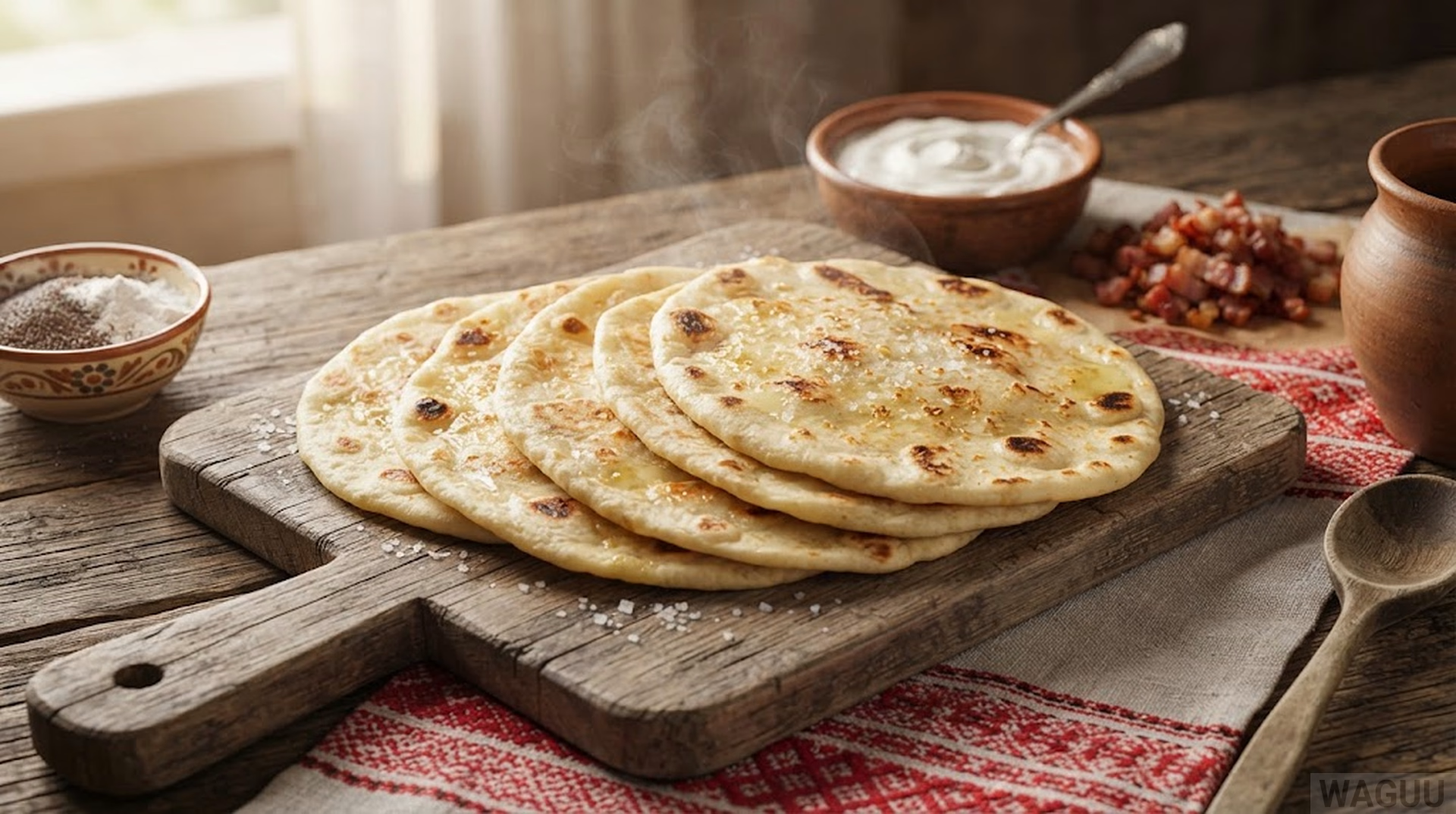
Summary: Lokše – thin, soft potato flatbreads cooked dry on a griddle and brushed with fat. Served sweet with poppy seeds and sugar, or savory with goose fat and crackling. Ready in about 45 minutes, serves 6.
Cooked the recipe? Share the result with the community.
Category: American Side Dishes, American Slovak Cuisine
Success rate: not rated yet % of users managed this recipe
Quick overview
- Dish: Slovak Potato Flatbread (Lokše)
- Category: American Side Dishes, American Slovak Cuisine
- Cuisine: Slovak
- Main ingredient: Russet potatoes, 1¾ lb, starchy, cooked and riced
- Guide: 12 Most Famous Slovak Dishes: Traditional Recipes from Slovak Cuisine
- Total time: 45 minutes (30 min prep + 15 min cooking)
- Difficulty: Easy
- Servings: 6 (Portion weight: 6¾ oz)
- Key technique: Dry griddle cooking, rolling thin dough
- Preparation types: Boiling, dry-frying
- Dietary info & allergens: Contains gluten, eggs (optional), milk (if brushed with butter). Not suitable for gluten-free or vegan diets.
- Suitable for: Quick family meals, sweet or savory snacks, festive goose dinners
- Nutrition per serving: 358 kcal, Protein: 8 g, Fat: 9 g, Carbohydrates: 61 g
- Storage: 3 days in the fridge, 2 months in the freezer
- Pairing: Žinčica (sheep whey), cold milk, tea
- In short: Thin potato flatbreads from a dry pan – the simplest and most versatile Slovak side.
- Last updated: September 22, 2026
WAGUU says: “Lokše are the Slovak answer to a tortilla – made from yesterday’s potatoes, cooked in minutes, eaten straight from the pan.”
Key facts
| Prep time: | 30 minutes |
| Cook time: | 15 minutes |
| Temperature: | Dry griddle, medium heat |
| Servings: | 6 |
At a glance
Lokše are thin, soft flatbreads made from cooked potato mash and flour. They cook dry on a griddle with no oil, which keeps them light and chewy. You can eat them sweet with poppy seeds, or savory with goose fat and crackling.
Ingredients
Base servings: 6 servings • Portion weight: 6¾ oz
| Ingredient | Amount | Quality |
|---|---|---|
| Russet potatoes | 1¾ lb | Peeled, boiled, cooled, riced |
| All-purpose flour | 2½ cups | Plus extra for dusting |
| Fine sea salt | 1 tsp | Fine, not flaky |
| Egg, beaten (optional) | 1 pc | Adds richness and helps binding |
| Pork lard, goose fat or unsalted butter | 3½ tbsp | For brushing after cooking |
| Ground poppy seeds (for sweet version) | 3½ oz | Freshly ground, aromatic |
| Granulated sugar (for sweet version) | ⅓ cup | Fine grain |
Why you will love this recipe
- Two dishes in one: The same base dough becomes a sweet dessert or a savory side. You decide at the pan.
- Uses up leftover potatoes: Cold boiled potatoes are exactly what you want. Lokše were born from leftovers.
- No oil, no frying: The pan stays dry. Lokše cook in their own moisture and stay light.
Why it works: Cooked potatoes contain gelatinized starch, which binds the dough without needing much gluten. That is why lokše can be rolled very thin without tearing. Cooking them on a dry griddle drives off surface moisture and slightly blisters the dough, giving it a soft, pliable texture rather than a crisp one. The fat brushed on after cooking adds flavor and stops the flatbreads drying out.
Recipe overview
Prep: 30 min | Cooking: 15 min | Difficulty: Easy | Servings: 6 | Type: Side dish | Origin: Slovak
Detailed method
Total progress: 0 % done
Phase 1: Preparing the potatoes – 8 min
Equipment: Peeler, saucepan, potato ricer, tray
1. Peel the potatoes, cut into 1-inch chunks and boil in salted water for 15–18 minutes until tender. Drain and steam dry for 2 minutes. Pass through a potato ricer onto a tray and leave to cool completely to room temperature. Cold potatoes are essential – warm mash will make the dough sticky.
VKB: The mash is smooth, dry and completely cool to the touch. No lumps, no visible steam.
Before you continue:
Do not use warm or hot potatoes. Warm mash sticks to your hands and the dough will not roll thin.
Phase 2: Making the dough – 10 min
Equipment: Large bowl, work surface
2. Put the cooled potatoes in a large bowl. Add 1 tsp salt and (if using) the beaten egg. Sift in the flour in three additions, mixing with a wooden spoon between each. Tip the dough onto a lightly floured surface and knead for 1–2 minutes until smooth and supple. Do not overwork.
VKB: The dough is soft, smooth and slightly tacky. When pressed with a finger, the indentation stays. It does not crack at the edges.
Phase 3: Rolling and cooking – 15 min
Equipment: Rolling pin, dry griddle or heavy frying pan, pastry brush
3. Divide the dough into 12 pieces. Roll each piece on a lightly floured surface into a thin round, about 8 inches across and 1/16 inch thick. Heat a dry griddle or heavy frying pan over medium heat – no oil. Cook each lokša for 1–1.5 minutes on each side, until it puffs slightly and small blisters appear. As each one is cooked, brush it with lard, goose fat or butter and stack on a warm plate under a clean kitchen towel.
VKB: The lokša is soft and pliable, with brown blisters on both sides. No dry or burnt patches. It folds easily without cracking.
Phase 4: Sweet filling – 3 min
Equipment: Small bowl, spoon
4. For the sweet version, mix the ground poppy seeds and granulated sugar in a small bowl. Sprinkle generously over the warm lokše, roll them up, and serve immediately. The fat on the surface helps the poppy seed mixture stick.
VKB: The poppy seed mixture is evenly distributed. The rolled lokša holds its shape and the filling does not fall out.
Phase 5: Savory serving – 2 min
Equipment: Warm plate, pastry brush
5. For the savory version, brush the warm lokše with a little more fat, sprinkle with flaky salt, and serve alongside roast goose, duck or pork. They can also be filled with leftover meat and rolled up.
VKB: The lokša is glossy from the fat, soft and still warm. Salt has dissolved into the surface.
Phase 6: Serving – 2 min
Equipment: Warm plates
6. Serve the lokše immediately, while still warm. They do not wait well. If you have made too many, stack them under a towel and reheat briefly on the dry griddle before serving.
VKB: The lokše are soft, warm and pliable. They smell of potato and fat, and fold without cracking.
Required equipment
| Item | Ideal size | Alternative | Risk |
|---|---|---|---|
| Potato ricer | Standard, 9-inch | Fine sieve or masher | Lumps in the mash tear the dough when rolling |
| Griddle or heavy frying pan | 11-inch, thick base | Cast-iron skillet | A thin pan overheats and burns the dough before it cooks through |
| Rolling pin | 18-inch wooden | Wine bottle, clean and floured | Uneven thickness – thin spots burn, thick spots stay raw |
Shopping list
Nutritional profile
Values per 1 serving (sweet version with poppy seeds and sugar, 6¾ oz). Calculated from average nutritional values of the ingredients.
| Nutrient | Per 100 g | Per 1 serving | Per 6 servings |
|---|---|---|---|
| Energy | 188 kcal | 358 kcal | 2148 kcal |
| Fat | 4.8 g | 9.2 g | 55.2 g |
| of which saturates | 1.8 g | 3.5 g | 21 g |
| Carbohydrates | 32.0 g | 61.0 g | 366 g |
| of which sugars | 2.5 g | 4.8 g | 28.8 g |
| Protein | 4.1 g | 7.7 g | 46.2 g |
| Salt | 0.4 g | 0.8 g | 4.8 g |
Reference intake of an average adult (8400 kJ / 2000 kcal).
WAGUU Pro level
- Pro standard: Verified recipe with exact proportions and visual checkpoints.
- Tip 1: Use potatoes boiled the day before. Their starch has retrograded, which makes the dough easier to roll and the lokše more tender.
- Tip 2: Flour the work surface lightly. Too much flour makes the dough dry and the lokše crack when you fold them.
- Tip 3: Cook on a dry, well-heated griddle. If the pan is not hot enough, the lokše dry out and become leathery.
- Tip 4: Stack the cooked lokše under a clean kitchen towel – the trapped steam keeps them soft and pliable.
Scientific background
The tenderness of lokše comes from retrograded potato starch. When boiled potatoes cool, their gelatinized starch molecules reorder into crystalline structures – a process called retrogradation. This makes the mash firmer and less sticky, which allows the dough to be rolled very thin. During dry cooking, the surface of the dough loses moisture quickly and forms a thin skin, while the inside stays soft. Brushing the finished lokša with fat creates a barrier that prevents further moisture loss and keeps the flatbread pliable for longer.
Fine Dining – Professional techniques
- Plate composition: Fold the lokša in half and then in half again, so it forms a triangle. Place it beside the main dish with a spoon of poppy seed filling on the side.
- Texture contrast: Serve one lokša soft and another briefly crisped on the dry pan for a crisp edge.
- Temperature contrast: Serve the lokše hot and the sour cream or yogurt cold on the side.
- Aromatic additions: A little ground cinnamon or grated lemon zest in the poppy seed filling adds a fresh note.
Sensory radar
- Appearance: Thin, pale rounds with scattered brown blisters on both sides.
- Aroma: Warm potato, toasted poppy seeds, and a faint note of lard or butter.
- Taste: Mild, slightly sweet from the potato, with the nutty depth of poppy seeds in the sweet version.
- Texture: Soft, pliable and slightly chewy, with a faint resistance at the blistered spots.
Pairing
- BEER: A light lager or a wheat beer. Both work with the sweet and the savory version.
- WINE: A young white wine – Grüner Veltliner or a dry Riesling.
- SOFT DRINK: Cold milk, žinčica (sheep whey), or a light tea.
Variations of preparation
- Sweet with jam: Replace the poppy seeds with plum jam or apricot jam. Brush with butter and sprinkle with cinnamon sugar.
- Savory filled: Fill the lokša with leftover roast goose, duck or pork, roll up, and warm briefly in the pan.
Allergens and dietary information
Contains: Gluten (all-purpose flour), eggs (if used), milk (if brushed with butter) • Gluten: Yes • Not suitable for: Celiac disease, vegan diets (unless made with no egg and brushed with oil)
Suitable for
Quick family meals, festive goose dinners, sweet snacks, savory side dishes. Good for beginner cooks.
Substitution catalogue
- Lard or goose fat: Unsalted butter or a good-quality rapeseed oil.
- Poppy seeds: Ground walnuts mixed with sugar.
- All-purpose flour: A gluten-free blend for a gluten-free version, but the dough is harder to handle.
FAQ
Can I make lokše ahead of time?
Yes. Cook them, stack them under a towel, and reheat briefly on the dry griddle before serving. They keep for 2 days in the fridge.
Why did my lokše crack when folding?
The dough was too dry or the flatbread overcooked. Add a spoon of water to the dough next time, and brush with more fat after cooking.
Can I freeze lokše?
Yes, up to 2 months. Layer them with parchment paper between each flatbread and reheat directly on a dry griddle.
Do I need a special griddle?
No. A heavy-based frying pan works well. The key is a thick base that holds heat evenly and a dry surface – no oil.
WAGUU Petr advises: Cooking for 6 or more?
6–8 people: Double the dough and keep the cooked lokše stacked under a towel. • 10+ people: Use two pans at once. Have one person rolling while another cooks – this is the traditional Slovak family method.
Sides and serving
Storage and reheating
Fridge: 3 days • Freezer: 2 months (layered with parchment paper) • Reheating: Dry griddle or frying pan, medium heat, 1 minute per side.
Author: WAGUU Petr & Team • Published: 22 Sep 2026
More recipes from this article
Guide: 12 Most Famous Slovak Dishes: Traditional Recipes from Slovak Cuisine
Bryndza Dumplings with Bacon and Crackling
Bryndza Pierogi with Bacon or Sour Cream
Slovak Sauerkraut Soup with Smoked Meat
Slovak Dumplings with Sauerkraut and Bacon
Slovak Potato Pancakes with Garlic and Marjoram
Demikát: Traditional Slovak Bryndza Soup
Slovak Potato Rolls with Poppy Seeds
Slovak Roast Goose with Potato Flatbread and Cabbage
Bryndza Soup with Potatoes and Bacon
More recipes you might like
Why WAGUU?
WAGUU recipes are checked for accuracy of ingredients, methods and nutritional values.
Photo gallery from the process
Photos from the community: Cook it, photograph it, and share the result.
You can upload photos in the comments below or send them by email.
Have you filmed a video of your version of our recipe? Post a link to YouTube, YouTube Shorts, TikTok, Instagram Reels, Facebook Reels, Pinterest, Vimeo or X (Twitter) in the comments – we will happily feature it and help you and your content get seen.
Most common mistakes
- Using warm potatoes – Warm mash sticks to your hands and the dough will not roll thin.
- Adding too much flour – The dough dries out and the lokše crack when folded.
- Overheating the pan – The surface burns before the inside is cooked, leaving a raw center.
- Leaving the cooked lokše uncovered – They dry out and become brittle. Always stack under a towel.