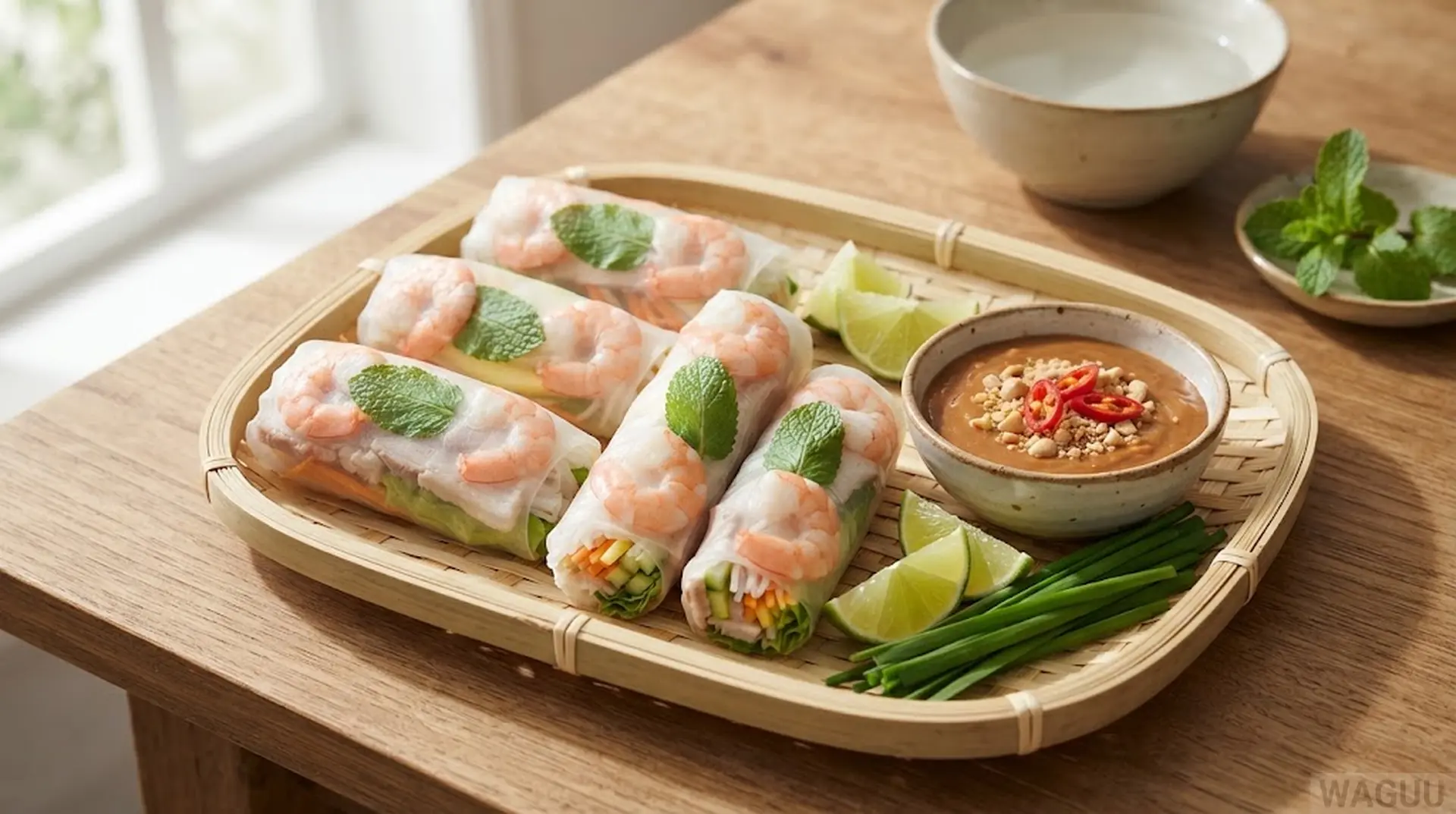
Summary: Fresh summer rolls made with rice paper, filled with cooked shrimp, pork belly, rice noodles, herbs, and crisp vegetables, served with peanut sauce. Total time 55 minutes, makes 12 rolls for 6 servings.
Did you make this recipe? Share your result with the community.
Category: Appetizers · Vietnamese Cuisine
Success rate: not rated yet % of users mastered this recipe
Quick overview
- Dish: Gỏi Cuốn – fresh summer rolls with shrimp, pork, and herbs
- Category: appetizers, vietnamese-cuisine
- Cuisine: Vietnamese
- Main ingredient: Shrimp, 600 g (medium, raw, peeled)
- Guide: 12 most famous Vietnamese dishes: traditional recipes from Vietnamese cuisine
- Total time: 55 minutes (35 min prep + 20 min cooking)
- Difficulty: Medium
- Servings: 6 (Serving weight: 389 g)
- Key technique: Rolling in rice paper soaked in warm water and layering ingredients against the translucent side
- Preparation types: Classic cooking, poaching, cold rolling
- Dietary info & allergens: shellfish (shrimp), fish (fish sauce, hoisin), soy (hoisin), peanuts (peanut sauce, peanuts), gluten (hoisin)
- Suitable for: Appetizer for dinner, party snack, picnic, or light summer dinner.
- Nutrition facts (per 1 serving): 657 kcal, Protein: 37.0 g, Fat: 18.0 g, Carbohydrates: 89.0 g
- Storage: 1 day in refrigerator, 1 month in freezer
- Pairing: Vietnamese lager, dry Riesling, iced jasmine tea
- In short: Rice paper, cooked shrimp, pork belly, rice noodles, herbs, and crisp vegetables, served with peanut sauce. Total time 55 minutes, 12 rolls.
WAGUU says: “Gỏi cuốn is known for being see-through. If you put everything in at once, you get a ball of rice, not a roll.”
Key facts
| Prep time: | 35 minutes |
| Cook time: | 20 minutes |
| Temperature: | Water for soaking paper 95–105°F, water for shrimp and pork 195°F (below boiling) |
| Servings: | 6 |
At a glance
Gỏi cuốn is a cold roll that is neither cooked nor fried. The water temperature for soaking the rice paper and the order of layers matter: shrimp and herbs go on the translucent side, rice and pork in the middle. If you soak the paper in boiling water or roll too loosely, you get a broken or rubbery roll.
Ingredients
Base servings: 6 servings • Serving weight: 389 g
| Ingredient | Amount | Quality |
|---|---|---|
| shrimp | 21 oz | medium, raw, peeled, deveined |
| pork belly | 11 oz | boneless, skin-on, thinly sliced |
| rice paper | 12 pcs | round, 22 cm diameter, thin |
| rice noodles | 6.5 oz | thin 1 mm, made from rice flour |
| lettuce | 5.5 oz | crisp, leaves stripped of thick ribs |
| carrot | 2 pcs | firm, cut into thin matchsticks |
| cucumber | 1 pcs | salad cucumber, seeded, cut into sticks |
| mango | 1 pcs | unripe, firm, cut into thin matchsticks |
| fresh mint | 1.0 oz | fresh, leaves only |
| fresh cilantro | 1.0 oz | stems and leaves, no roots |
| Thai basil | 0.7 oz | fresh, leaves |
| Chinese chives | 1.0 oz | long stems, fresh |
| peanut sauce | 1/2 cups | thick, with peanut pieces |
| hoisin sauce | 1/4 cups | thick, dark |
| fish sauce | 2 tbsp | fermented from anchovies, no sugar |
| cane sugar | 0.5 oz | light, coarse |
| lime | 2 pcs | juicy, for juice and wedges |
| roasted peanuts | 2.0 oz | unsalted, coarsely crushed |
| fresh chili | 2 pcs | red, thinly sliced into rings |
Why you’ll love this recipe
- Nothing is fried: The rolls are just rolled. No grease left in the kitchen and the dish is ready in under an hour.
- Crisp and fresh layer: Lettuce, cucumber, and herbs give the roll a juiciness that fried rolls don’t have.
- Exact ratios for 6 servings: Twelve rolls, two per person, with the right amount of shrimp, pork, and vegetables. Servings recalculate based on diners.
Success guaranteed: Rice paper is soaked only in warm water and only for a few seconds. White dry spots must remain on the paper, which even out during rolling. If the paper is soaked in boiling water or left to soften completely, it sticks and tears. Shrimp and herbs are placed on the bottom layer because they show through and create the roll’s appearance. The amount of filling per roll should be about the size of your palm.
Recipe overview
Prep: 35 min | Cook: 20 min | Difficulty: Medium | Servings: 6 | Type: Appetizer | Origin: Vietnamese
Detailed instructions
Overall process: 0 % done
Phase 1: Cooking the shrimp and pork – 15 min
Equipment: 3-quart pot, colander, bowl of ice water
1. Bring the water in the pot to a boil, reduce it to a bare simmer, and add the shrimp. Cook them briefly until they turn pink and curl into a C shape, then transfer them to the ice water.
2. Add the pork belly slices to the same water and poach them until they are pale throughout. Remove the meat, let it cool, and slice it thinly.
Success criteria: The shrimp are pink, firm, and cold to the touch. The pork is pale throughout with no pink juices, and the slices hold their shape.
Before you move on:
Chill the shrimp in ice water immediately after cooking, or they will soften and fall apart in the roll. Cook them only until pink.
Phase 2: Preparing the filling – 15 min
Equipment: cutting board, grater, bowl, colander
1. Pour boiling water over the rice noodles and let them soften, then rinse them under cold water and let them drain. The noodles must not be wet, or the paper will tear.
2. Grate the carrot and mango into thin matchsticks, cut the cucumber into sticks, and shred the lettuce. Leave the herbs whole; just clean and dry them.
3. Arrange all the ingredients on a large tray in the order they will go onto the paper. There is no time to hunt for ingredients while rolling.
Success criteria: The noodles are cool and dry to the touch, and the vegetables are cut into evenly thick strips. The tray is full and everything is within reach.
Before you move on:
Wet noodles and vegetables will soak the rice paper and tear the roll. Let everything drain and pat the tray dry with a towel.
Phase 3: Peanut sauce – 8 min
Equipment: small bowl, whisk
1. In a bowl, mix the peanut sauce with the hoisin sauce, fish sauce, and palm sugar. Stir until the sugar dissolves and the sauce is smooth.
2. Thin the sauce with two tablespoons of warm water, add the lime juice and chili rings. Taste and adjust the balance of salty, sweet, and sour.
Success criteria: The sauce is smooth, thick as cream, and coats the back of a spoon. The flavor is balanced, with no single component overpowering.
Before you move on:
Peanut sauce thickens as it sits. Before serving, thin it with a tablespoon of warm water and stir again, or it will be too thick for dipping.
Phase 4: Rolling the rolls – 12 min
Equipment: wide bowl of lukewarm water, clean towel, cutting board
1. Dip the rice paper into the lukewarm water for a few seconds and lay it on the towel. The paper is ready when it is soft but still has white dry spots.
2. Place two shrimp and a mint leaf on the lower third of the paper, translucent side down. Add lettuce, noodles, a slice of meat, carrot, mango, and cucumber. Keep the filling in a narrow strip.
3. Fold the bottom edge over the filling, press it down, fold in the sides, and roll tightly to the end. Place the finished roll on the tray seam-side down.
Success criteria: The roll holds its shape, is firm to the touch, and the shrimp and herbs show through the top layer. The paper is not torn anywhere and the seam holds.
Before you move on:
Roll tightly but do not squeeze the filling. A loosely rolled roll will fall apart when dipped, and paper that is too tight will split.
Phase 5: Chilling and drying – 5 min
Equipment: tray, plastic wrap, refrigerator
1. Cover the finished rolls with a damp towel or plastic wrap so the paper does not dry out. Let them sit in the refrigerator for a while; the paper firms up and holds its shape better.
2. Arrange the rolls on the tray in a single layer and separate them so they do not stick together. Stack them only after the paper has firmed up.
Success criteria: The paper is matte, not wet, the rolls do not bend when lifted, and there are no water marks on the tray.
Before you move on:
Uncovered rolls will harden and crack within half an hour. Keep them under a damp towel or plastic wrap until serving.
Phase 6: Serving – 5 min
Equipment: serving platter, sauce bowls
1. Stand the rolls on the platter at an angle so the translucent shrimp side shows. Place a bowl of peanut sauce next to them and sprinkle with crushed peanuts.
2. Add lime wedges, chili rings, and the remaining herbs to a glass of water. Each guest dips their own roll into the sauce.
Success criteria: The rolls are cold, the paper is matte and translucent, and the sauce is thick and smooth. There are no water or oil marks on the platter.
Required equipment
| Tool | Ideal size | Alternative | Risk |
|---|---|---|---|
| wide dipping bowl | 28 cm diameter, 6 cm deep | large shallow plate with water | a small bowl will cause the paper to fold and stick to itself |
| clean cotton towel | 50 x 40 cm | double layer of paper towels | wet paper tears on a damp surface |
| grater or mandoline | adjustable to 2 mm | sharp knife and patience | thick vegetable strips will tear the paper and split the roll |
| serving platter | 30 x 20 cm with a rim | large shallow plate | a platter without a rim will let the rolls slide off the table |
Shopping list
Nutrition profile
Values per 1 serving (without sides). Calculated from average nutritional values of ingredients.
| Nutrient | Per 100 g | Per 1 serving | Per 6 servings |
|---|---|---|---|
| Energy | 707 kJ / 169 kcal | 2749 kJ / 657 kcal | 16495 kJ / 3942 kcal |
| Fat | 4.6 g | 18.0 g | 108.0 g |
| of which saturated | 1.1 g | 6.3 g | 37.8 g |
| Carbohydrates | 22.9 g | 89.0 g | 534.0 g |
| of which sugars | 4.6 g | 4.6 g | 4.6 g |
| Protein | 9.5 g | 37.0 g | 222.0 g |
| Salt | 1.8 g | 1.8 g | 1.8 g |
Reference intake of an average adult (8400 kJ / 2000 kcal).
WAGUU Pro level
- Pro standard: Verified recipe with precise ratios and visual checkpoints.
- Tip 1: Keep the soaking water at 95–104 °F. In cold water the paper stays hard; in boiling water it falls apart.
- Tip 2: Place shrimp on the bottom layer, translucent side down. After rolling, they are visible and the roll holds its shape.
- Tip 3: Keep the filling in a narrow strip about three fingers wide. A wide filling tears during rolling.
- Tip 4: Keep finished rolls under a damp towel. Uncovered, they harden and crack within half an hour.
Scientific background
Rice paper is a thin sheet of pre-cooked rice starch. When soaked in warm water, the starch swells and the paper softens, but only to a point. If left in water too long, the starch dissolves and the paper loses strength. Chilling shrimp in ice water after cooking stops the protein from cooking further, so the meat stays firm and doesn’t fall apart in the roll. Herbs placed directly under the paper release their volatile aromatics only when eaten, which is why the roll smells fresh.
Fine Dining – Professional Techniques
- Plate composition: Stand the rolls on a platter at an angle in two rows and place a bowl of sauce between them. The translucent side with shrimp must be visible from above.
- Texture contrasts: Add a few thin slices of fried shallot to the filling. The crispy layer contrasts with the soft paper and noodles.
- Temperature contrast: Serve the rolls straight from the refrigerator and the sauce at room temperature. A cold roll with warm sauce is the basis of a refreshing impression.
- Aromatic additions: Add a tablespoon of chopped lemongrass and a pinch of ground sesame to the sauce. The aroma opens up and the sauce gains depth.
Sensory radar
- Appearance: Translucent paper showing pink shrimp and green mint leaves, with white noodles and orange mango inside.
- Aroma: First mint and cilantro, then peanut sauce, and finally fresh lime.
- Taste: Sweet from peanut sauce and mango, salty from fish sauce, sour from lime, and fresh from herbs.
- Texture: Paper soft, vegetables crisp, shrimp firm, noodles tender, and peanuts crumbly.
Pairings
- Vietnamese lager: A light pale beer with higher carbonation cleanses the palate from peanut sauce. Serve chilled to 43–46 °F.
- Dry Riesling: The acidity in Riesling pairs with lime and herbs. Sweeter wines overpower the delicate shrimp flavor.
- Iced jasmine tea: Jasmine tea with an ice cube and a mint leaf. The floral aroma accompanies the fresh herbs in the roll.
Variations
- Gỏi cuốn with chicken: Use poached chicken breast cut into thin slices instead of pork belly. The rolls are lighter and suitable for those who don’t eat pork.
- Gỏi cuốn with roasted tofu: Cut tofu into thin slices, brush with soy sauce, and pan-fry until crisp. The rolls are fully meatless but firm.
Allergens and dietary information
Contains: crustaceans (shrimp), fish (fish sauce, hoisin), soy (hoisin), peanuts (peanut sauce, peanuts), gluten (hoisin) • Gluten: yes, trace amounts from hoisin sauce • Not suitable for: individuals with allergies to crustaceans, fish, soy, peanuts, and gluten
Suitable for
Appetizer for dinner, party snack, picnic, or a light summer supper.
Substitution catalog
- shrimp: cooked chicken breast or roasted tofu; rolls will be crustacean-free
- pork belly: boneless chicken thigh or cooked tongue; meat will be leaner
- rice paper: thin wheat or corn paper; flavor will differ and the roll cannot be eaten raw
- mango: pear or apple cut into matchsticks; sweetness will be milder
- peanut sauce: sesame sauce with a tablespoon of water and sugar
FAQ
How long do I soak rice paper?
Just a few seconds in warm water. The paper is ready when it’s soft but still has white dry spots that even out during rolling.
Why do my rolls tear?
The paper was in water too long, or there’s too much filling. Keep the filling in a narrow strip and don’t push it to the edges while rolling.
Can I make the rolls ahead?
Yes, but at most an hour ahead and under a damp towel in the refrigerator. Longer storage soaks the paper and the rolls lose shape.
What can I substitute for peanut sauce?
Sesame sauce thinned with warm water, or hoisin sauce with a tablespoon of vinegar. The flavor will be less nutty, but the rolls can be dipped the same way.
Do I have to cook the shrimp?
Yes. In fresh rolls the shrimp won’t heat through, so briefly poach them below boiling and chill in ice water. Store-bought cooked shrimp just need chilling.
What lettuce to use in the rolls?
Crisp lettuce with tender leaves. Remove thick ribs because they would poke through the paper. Place lettuce between the paper and other ingredients.
WAGUU Petr advises: Cooking for 6 or more?
6–8 people: Prepare all components on trays ahead and roll at the table; guests roll their own. • 10+ people: Prepare shrimp and meat a day ahead and keep them in the refrigerator separate from vegetables. Cut vegetables into matchsticks and store in cold water to keep them crisp. Make a double batch of sauce and keep it in a thermos so it stays fluid.
Sides and serving
Serving: Serve rolls on a platter in a single layer, with a bowl of peanut sauce topped with crushed peanuts. Put herbs in a tall glass with water; they stay fresh and guests can add as they like.
Storage and reheating
Refrigerator: 1 day • Freezer: 1 month • Reheating: Rolls are not reheated; serve cold. The shrimp and meat filling can be reheated separately and rolls rolled again with fresh paper.
Author: WAGUU Petr & Team • Published: 9 Oct 2026 • Updated: 10 Oct 2026
More recipes from the article
Guide: 12 most famous Vietnamese dishes: traditional recipes from Vietnamese cuisine
Phở Bò – beef noodle soup with star anise, cinnamon, and charred ginger
Phở Gà – chicken noodle soup with delicate broth, star anise, and fresh herbs
Bánh Mì – crispy Vietnamese baguette with meat, pâté, and pickled vegetables
Bún Chả – grilled pork slices and patties with rice noodles and sweet-and-sour sauce
Bún Bò Huế – spicy noodle soup from Hue with lemongrass and chili
Cơm Tấm – broken rice with grilled pork, egg, and fish sauce
Cao Lầu – Hoi An specialty with firm rice noodles and crispy chips
Bánh Xèo – crispy rice pancake with turmeric, shrimp, and sprouts
Chả Giò – fried Vietnamese spring rolls with meat, vegetables, and noodles
Cá Kho Tộ – caramelized braised fish in sweet-and-savory sauce
Chè – Vietnamese sweet desserts from beans, tapioca, and coconut milk
More recipes you might like
Why WAGUU?
Recipes on WAGUU are checked for accuracy of ingredients, procedures, and nutritional values.
Photo gallery of the process
Community photos: Cook, snap a photo, and share your result.
You can upload photos in the comments below or send them by email.
Did you film a video of our recipe? Paste a link to YouTube, YouTube Shorts, TikTok, Instagram Reels, Facebook Reels, Pinterest, Vimeo, or X (Twitter) in the comments – we’ll be happy to publish it and help you and your content get noticed.
Most common mistakes
- Paper soaked too long – it sticks together and tears during rolling. Soak for just a few seconds.
- Wet noodles and vegetables – water soaks the paper and the roll falls apart. Drain and dry everything.
- Filling spread over the entire paper – edges can’t be folded. Keep the filling in a narrow strip on the bottom third.
- Uncovered rolls – they harden and crack within half an hour. Keep them under a damp towel.