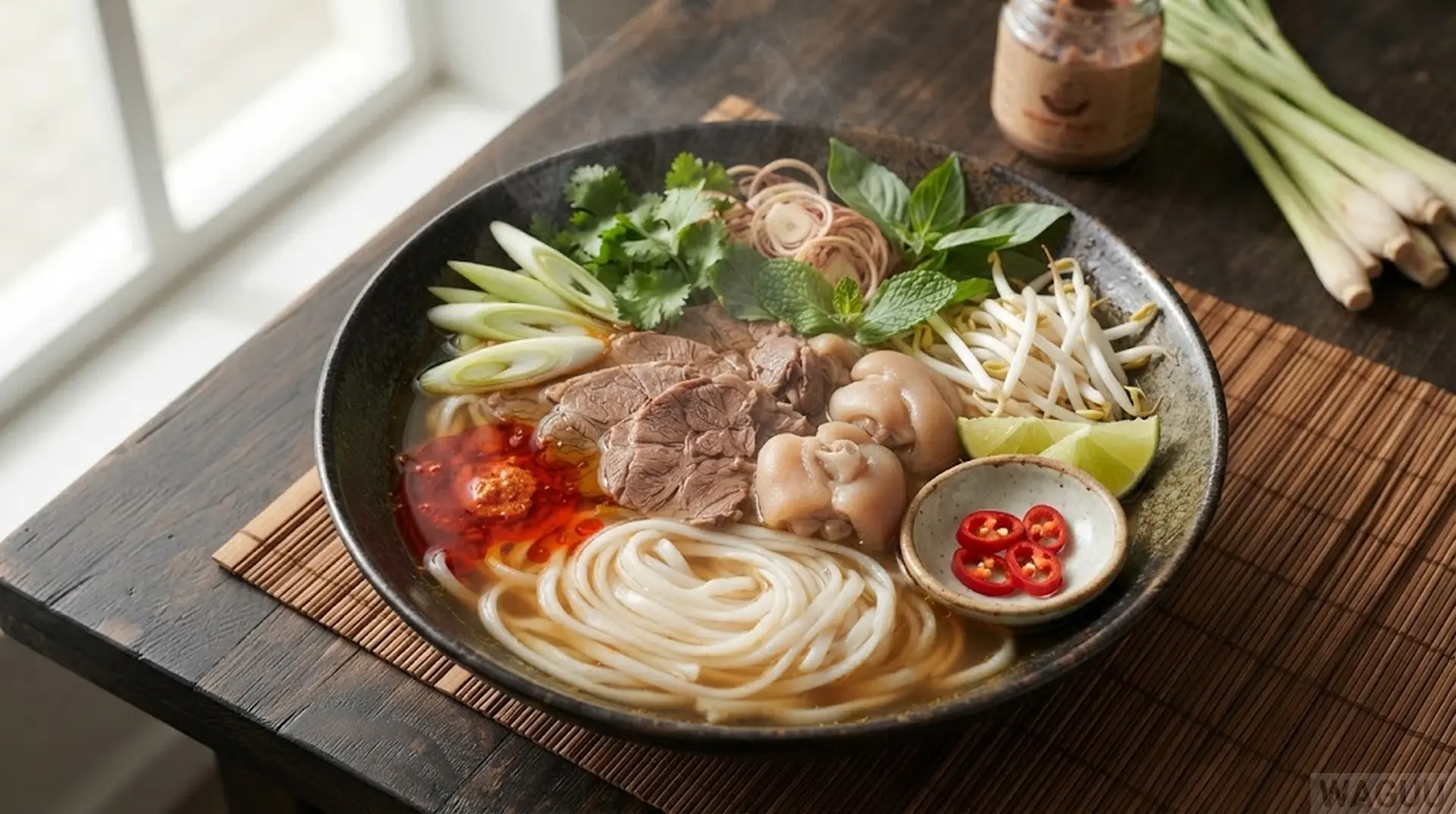
Summary: Spicy noodle soup from the city of Hue with beef broth, lemongrass, chili oil, and shrimp paste, served with rice noodles, beef, and pork hock. Total time 230 minutes, makes 6 servings.
Did you cook this recipe? Share your result with the community.
Category: Soups · Vietnamese Cuisine
Success rate: not rated yet % of users mastered this recipe
Quick overview
- Dish:
- Category: soups, vietnamese-cuisine
- Cuisine: Vietnamese
- Main ingredient: Beef shank, 2 lb (with connective tissue, for simmering)
- Guide: 12 most famous Vietnamese dishes: traditional recipes of Vietnamese cuisine
- Total time: 230 minutes (35 min prep + 195 min cooking)
- Difficulty: Challenging
- Servings: 6 (Serving size: 1.8 lb)
- Key technique: Simmering broth with lemongrass and seasoning with shrimp paste and chili oil at the end
- Preparation types: Classic boiling, poaching (simmering), seasoning with chili oil
- Dietary info & allergens: shellfish (shrimp paste, chili oil), fish (fish sauce), soy (soy sauce), gluten (soy sauce)
- Suitable for: Sunday lunch, a feast for spicy food lovers, a warming meal on a cold day, and a festive table.
- Nutrition facts (per serving): 926 kcal, Protein: 51.7 g, Fat: 41.7 g, Carbohydrates: 81.5 g
- Storage: 3 days in the refrigerator, 2 months in the freezer
- Pairing: Vietnamese lager, dry Riesling, strong green tea
- In short: Beef broth with lemongrass, shrimp paste, and chili oil, rice noodles, beef shank, pork hock, and a handful of herbs. Total time 230 minutes, 6 servings.
WAGUU says: “Bún bò Huế must be spicy and aromatic at the same time. Chili oil is added only to the bowl; in the broth it would overcook and become bitter.”
Key facts
| Prep time: | 35 minutes |
| Cook time: | 195 minutes |
| Temperature: | Broth 198–203 °F (below boiling), lemongrass and spices toasted dry |
| Servings: | 6 |
At a glance
Bún bò Huế is a two-layer soup: a clear beef broth with lemongrass and a sharp chili oil with shrimp paste that is added to the bowl only at the table. The ratio between the sweetness of the broth and the heat of the oil is crucial, as is simmering the shank until it falls apart into strands. Anyone who adds the chili oil to the pot will get a cloudy and bitter soup.
Ingredients
Base servings: 6 servings • Serving size: 1.8 lb
| Ingredient | Amount | Quality |
|---|---|---|
| beef shank | 32 oz | hind, with connective tissue, boneless |
| pork hock | 14 oz | with skin, well cleaned |
| beef marrow bones | 2.2 lb | cut into 2-inch pieces |
| rice noodles | 18 oz | thick 4 mm, made from rice flour |
| lemongrass | 4 stalks | fresh, bruised and cut into chunks |
| ginger | 2.0 oz | fresh, halved and charred |
| onion | 2 pcs | yellow, halved and charred cut-side down |
| shrimp paste | 1.0 oz | fermented, dark purple, thick |
| chili oil | 1/4 cups | with pieces of dried chili, red |
| fish sauce | 1/3 cups | fermented from anchovies, no sugar |
| soy sauce | 1.4 tbsp | dark, naturally fermented |
| cane sugar | 0.9 oz | light, coarse |
| salt | 0.2 oz | fine sea salt |
| scallions | 6 pcs | fresh, sliced diagonally |
| fresh cilantro | 1.5 oz | stems and leaves, no roots |
| Thai basil | 1.0 oz | fresh, leaves |
| fresh mint | 0.7 oz | fresh, leaves only |
| bean sprouts | 7.0 oz | fresh, firm |
| banana blossom | 5.5 oz | fresh, thinly sliced |
| lime | 2 pcs | juicy, cut into wedges |
| fresh chili | 4 pcs | red, thinly sliced into rings |
Why you’ll love this recipe
- Two soups in one bowl: The delicate broth and sharp chili oil are mixed only on the plate. Everyone can adjust the heat to their liking.
- The broth can be made ahead: The shank and hock simmer for three hours, and the broth keeps in the refrigerator for two days. On the day of serving, just reheat.
- Exact ratios for 6 servings: Meat, bones, lemongrass, and chili oil are calculated for six bowls. The number of servings can be recalculated according to the diners.
Success rate: The flavor of bún bò Huế depends on two steps that must not be rushed. Lemongrass is bruised and simmered whole so it releases aroma without disintegrating into the broth. Shrimp paste and chili oil are added separately to the finished bowl because heat diminishes their fragrance and the oil in the pot turns bitter. Beef shank is simmered until it can be pulled apart with two forks; only then does the broth have full flavor.
Recipe overview
Prep: 35 min | Cook: 195 min | Difficulty: Advanced | Servings: 6 | Type: Soup | Origin: Vietnamese
Detailed instructions
Total progress: 0 % done
Phase 1: Blanching bones and charring aromatics – 35 min
Equipment: large 8-quart pot, colander, dry skillet
1. Cover bones with cold water, bring to a boil, and after a few minutes of boiling, drain the water. Rinse the bones with cold water and wash the pot so the broth stays clear.
2. Char halved onion and ginger cut-side down in a dry skillet until dark brown. Bruise lemongrass stalks with a meat mallet and cut into 2-inch pieces.
Success rate: Bones are free of pink foam, cut sides of onion and ginger are dark, and lemongrass smells of lemon when pressed.
Before you move to the next step:
Drain the blanching water completely and wash the pot. If any remains at the bottom, the broth will turn gray and taste off.
Phase 2: Simmering broth with lemongrass – 150 min
Equipment: large 8-quart pot, skimmer, fine-mesh strainer
1. Cover bones, beef shank, and pork hock with cold water, bring to a boil, and reduce to the lowest heat. Add charred onion with ginger and lemongrass pieces.
2. Simmer broth below a boil and for the first two hours skim off foam and fat. Taste the broth: it should be sweet with meat and smell of lemongrass, not of skin.
3. Remove pork hock once tender and let it cool. Continue simmering beef shank until it can be pulled apart with two forks. Then strain the broth.
Success rate: Beef shank falls into shreds under a fork, pork hock is light and springy when cut. Broth is clear, amber-colored, and smells of lemongrass.
Before you move to the next step:
Do not leave lemongrass in the broth for more than three hours; it will start to bitter. After two and a half hours, remove it along with the onion.
Phase 3: Seasoning the broth – 15 min
Equipment: smaller pot, fine strainer, whisk
1. Strain broth through a fine strainer and bring to a boil. Add fish sauce, soy sauce, palm sugar, and salt and stir until sugar dissolves.
2. Taste and adjust saltiness. The broth should be full-flavored and slightly sweet, because shrimp paste and chili oil will add sharpness only in the bowl.
Success rate: Broth is clear and shiny, no fat droplets on the surface. Flavor is balanced and a spicy lemongrass aftertaste lingers.
Before you move to the next step:
Do not oversalt the broth; shrimp paste is salty. Leave room and adjust seasoning in the bowl.
Phase 4: Chili oil and meat preparation – 20 min
Equipment: small skillet, cutting board, sharp knife
1. Warm chili oil in a small skillet, add minced garlic and shrimp paste, and stir until paste dissolves and mixture becomes fragrant. Remove from heat.
2. Slice cooked beef shank across the grain into thin slices, pork hock into thin slices across the skin. Keep meat covered so it does not dry out.
Success rate: Chili oil is dark red, bits of paste at the bottom, and aroma is sharp but not burnt. Meat slices hold shape and glisten.
Before you move to the next step:
Do not burn shrimp paste; in overheated oil it turns bitter and black. Warm it briefly over medium heat.
Phase 5: Noodles and assembling bowls – 15 min
Equipment: large pot, colander, deep bowls
1. Cook rice noodles in boiling water until soft, drain, and rinse with cold water. Rinsed noodles will not stick together in the bowl.
2. Place noodles, beef shank slices, pork hock slices, and a handful of bean sprouts in each bowl. Top with thin banana blossom slices, which will stay crisp.
Success rate: Noodles are translucent and cold, meat sliced to even thickness. Bowls are filled to two-thirds and ready in a row.
Before you move to the next step:
Slice banana blossom just before serving and soak briefly in water with lime. Otherwise it darkens and becomes bitter.
Phase 6: Pouring broth and serving – 5 min
Equipment: ladle, serving tray, small bowls
1. Bring broth to a rolling boil and ladle into bowls to the rim. Add a spoonful of chili oil with shrimp paste to each bowl.
2. Sprinkle with scallions, cilantro, basil, and mint. Place a lime wedge and a small bowl of sliced chili on the side for those who want more heat.
Success rate: A red circle of chili oil spreads on the surface, broth underneath remains clear. Herbs smell fresh and noodles are heated through.
Required equipment
| Tool | Ideal size | Alternative | Risk |
|---|---|---|---|
| large pot | 8-quart capacity, heavy bottom | two 4-quart pots and combine broth | small pot boils dry and bones stay above surface |
| meat mallet | 500 g weight | rolling pin or thick knife handle | unbruised lemongrass releases no aroma and only grass remains in soup |
| fine-mesh strainer | 24 cm diameter, double mesh | coarse strainer lined with cloth | coarse mesh lets sediment through and broth stays cloudy |
| small skillet for chili oil | 18 cm diameter | heavy-bottom saucepan | thin skillet burns paste and oil turns bitter |
Shopping list
Nutrition profile
Values per 1 serving (without sides). Calculated from average nutritional values of ingredients.
| Nutrient | Per 100 g | Per 1 serving | Per 6 servings |
|---|---|---|---|
| Energy | 473 kJ / 113 kcal | 3874 kJ / 926 kcal | 23246 kJ / 5556 kcal |
| Fat | 5.1 g | 41.7 g | 250.2 g |
| of which saturated | 1.7 g | 14.1 g | 84.6 g |
| Carbohydrates | 9.9 g | 81.5 g | 489.0 g |
| of which sugars | 7.1 g | 7.1 g | 7.1 g |
| Protein | 0.22 oz | 1.82 oz | 10.94 oz |
| Salt | 3.6 oz | 3.6 oz | 3.6 oz |
Reference intake of an average adult (8400 kJ / 2000 kcal).
WAGUU Pro level
- Pro standard: Tested recipe with exact ratios and visual checkpoints.
- Tip 1: Bruise the lemongrass with a pestle until it smells. Unbruised stalks release little aroma into the broth.
- Tip 2: Make the chili oil with shrimp paste separately and add it to the bowl by the spoonful. In the pot it would boil down and turn bitter.
- Tip 3: Simmer the shank until it pulls apart with two forks. That is when it holds both flavor and juice.
- Tip 4: Slice the banana blossom thin and soak it briefly in water with lime. It stays white and crisp.
The Science Behind It
Lemongrass contains citral, a volatile compound released when the stalk is bruised and soluble in both fat and water. That is why the stalk is bruised and simmered whole, so the aroma goes into the broth but not the tough fibers. Shrimp paste is made by fermentation and contains free amino acids that add umami and salt. When heated to high heat, bitter compounds form in the paste, so it is warmed briefly over medium heat. Collagen from the shank and hock turns into gelatin at around 195°F, which gives the broth body.
Fine Dining – Professional Techniques
- Plate composition: Twirl the noodles into a low spiral, arrange the shank and hock slices in a circle on top, and put a spoonful of chili oil with shrimp paste in the center. The guest stirs it in themselves.
- Texture contrasts: Add thin slices of banana blossom and a few crispy fried shallots to the bean sprouts. The crisp layer stands up against the soft noodles.
- Temperature contrast: Warm the bowls with hot water and keep the herbs chilled. A hot bowl keeps the broth warm longer and the cold herbs perfume the table.
- Aromatic additions: Add lime, chili, and a bowl of shrimp paste to the tray. The guest adjusts the soup themselves, which is the usual way it is served in the city of Hue.
Sensory Radar
- Appearance: Amber clear broth with a red ring of chili oil, white noodles, dark meat slices, green herbs, and white banana blossom slices.
- Aroma: First lemongrass, then shrimp paste and chili, and at the end fresh mint with cilantro.
- Taste: Salty and full from the beef broth, sharp from the chili oil, and fresh from the herbs. The heat can be dosed by the spoonful of oil.
- Texture: Noodles soft and springy, shank tender, hock firm and bouncy, sprouts crisp.
Pairings
- Vietnamese lager: A light pale beer with higher carbonation cools the chili heat. Serve it chilled to 43–46°F.
- dry Riesling: The acid in Riesling pairs with lemongrass. Sweeter wines would overpower the sharp chili oil.
- strong green tea: Unsweetened green tea with an astringent taste. The tannins refresh the mouth between bites.
Variations
Allergens and Dietary Information
Contains: crustaceans (shrimp paste, chili oil), fish (fish sauce), soy (soy sauce), gluten (soy sauce) • Gluten: yes, trace amounts from soy sauce • Not suitable for: people with allergies to crustaceans, fish, soy, and gluten
Suitable for
Sunday lunch, a feast for lovers of spicy food, a warming meal on a cold day, and a festive table.
Substitution Guide
- beef shank: beef round or boneless beef chuck, simmering time stays the same
- pork hock: pork knuckle or pork shoulder, simmer for a shorter time
- shrimp paste: fermented soybean paste with a tablespoon of fish sauce, the flavor will be milder
- banana blossom: thin slices of daikon or kohlrabi, the crunch stays
- lemongrass: zest of one lime and a tablespoon of lime juice added at the end
FAQ
How is bún bò Huế different from phở?
The flavor is sharper and more spiced. Lemongrass goes into the broth and chili oil with shrimp paste goes into the bowl. Phở is milder and built on star anise and cinnamon.
Where can I buy shrimp paste?
In Asian grocery stores, most often in small jars. The color is dark purple and the paste is thick. If you don’t have it, use fermented soybean paste with a tablespoon of fish sauce.
Why isn’t the chili oil added to the pot?
In the pot, the oil with shrimp paste boils down, loses its aroma, and starts to turn bitter. It is added by the spoonful directly to the bowl, where each person mixes it to their own tolerance.
How long should the shank simmer?
About three hours below a boil. The shank is done when it pulls apart with two forks. Longer boiling breaks down the meat and the broth takes on a connective-tissue taste.
Can I use dried lemongrass?
You can, but the aroma will be weaker. Put the dried lemongrass in a cheesecloth and simmer it in the broth for the same time as fresh. Add lime zest at the end.
How do I cool the soup down for kids?
Pour broth without chili oil into a separate bowl and add only half a teaspoon of shrimp paste, or leave it out. Adults can then add the heat on their own plates.
WAGUU Petr advises: Cooking for 6 or more people?
6–8 people: Simmer the broth in the largest pot you have, and cook the noodles in batches. Make the chili oil in double quantity and keep it warm. • 10+ people: Divide the bones and meat between two pots and combine the finished broths. Cook the noodles in batches and keep the rinsed ones in a colander. Assemble the bowls in two waves so the second half doesn’t get soggy.
Sides and Serving
Serving: The soup is served in a deep bowl with broth poured to the rim. Bring lime, chili rings, a bowl of shrimp paste, and a glass of herbs to the table on a tray. Chili oil is added by the spoonful directly to the bowl.
Storage and Reheating
Refrigerator: 3 days • Freezer: 2 months • Reheating: Reheat the broth below a boil, blanch the noodles separately. Add the chili oil only to the hot bowl, never heat it with the broth.
Author: WAGUU Petr & Team • Published: 9 Oct 2026 • Updated: 10 Oct 2026
More recipes from the article
Guide: 12 most famous Vietnamese dishes: traditional recipes of Vietnamese cuisine
Phở Bò – beef noodle soup with star anise, cinnamon, and charred ginger
Phở Gà – chicken noodle soup with a delicate broth, star anise, and fresh herbs
Bánh Mì – crispy Vietnamese baguette with meat, pâté, and pickled vegetables
Bún Chả – grilled pork slices and patties with rice noodles and sweet-and-sour sauce
Gỏi Cuốn – fresh summer rolls in rice paper with shrimp and herbs
Cơm Tấm – broken rice with grilled pork, egg, and fish sauce
Cao Lầu – a Hoi An specialty with firm rice noodles and crispy chips
Bánh Xèo – crispy rice pancake with turmeric, shrimp, and sprouts
Chả Giò – fried Vietnamese spring rolls with meat, vegetables, and noodles
Cá Kho Tộ – caramelized braised fish in a sweet-and-salty sauce
Chè – Vietnamese sweet desserts from beans, tapioca, and coconut milk
More recipes you might like
Why WAGUU?
WAGUU recipes are checked for accuracy of ingredients, procedures, and nutritional values.
Photo gallery from the process
Photos from the community: Cook it, photograph it, and share the result.
You can upload photos in the comments below or send them by email.
Did you film a video of our recipe? Paste a link to YouTube, YouTube Shorts, TikTok, Instagram Reels, Facebook Reels, Pinterest, Vimeo, or X (Twitter) in the comments – we’ll be happy to publish it and help you and your content get noticed.
Most common mistakes
- Chili oil added to the pot – the broth turns bitter and cloudy. Add it by the spoonful to the bowl.
- Unbruised lemongrass – the aroma stays in the stalk and the soup is just bitter. Bruise the lemongrass with a pestle.
- A rolling boil – the fat disperses into the liquid and the broth turns white. Keep the temperature below a boil.
- Banana blossom sliced ahead – it darkens and turns bitter. Slice it just before serving and keep it in water with lime.