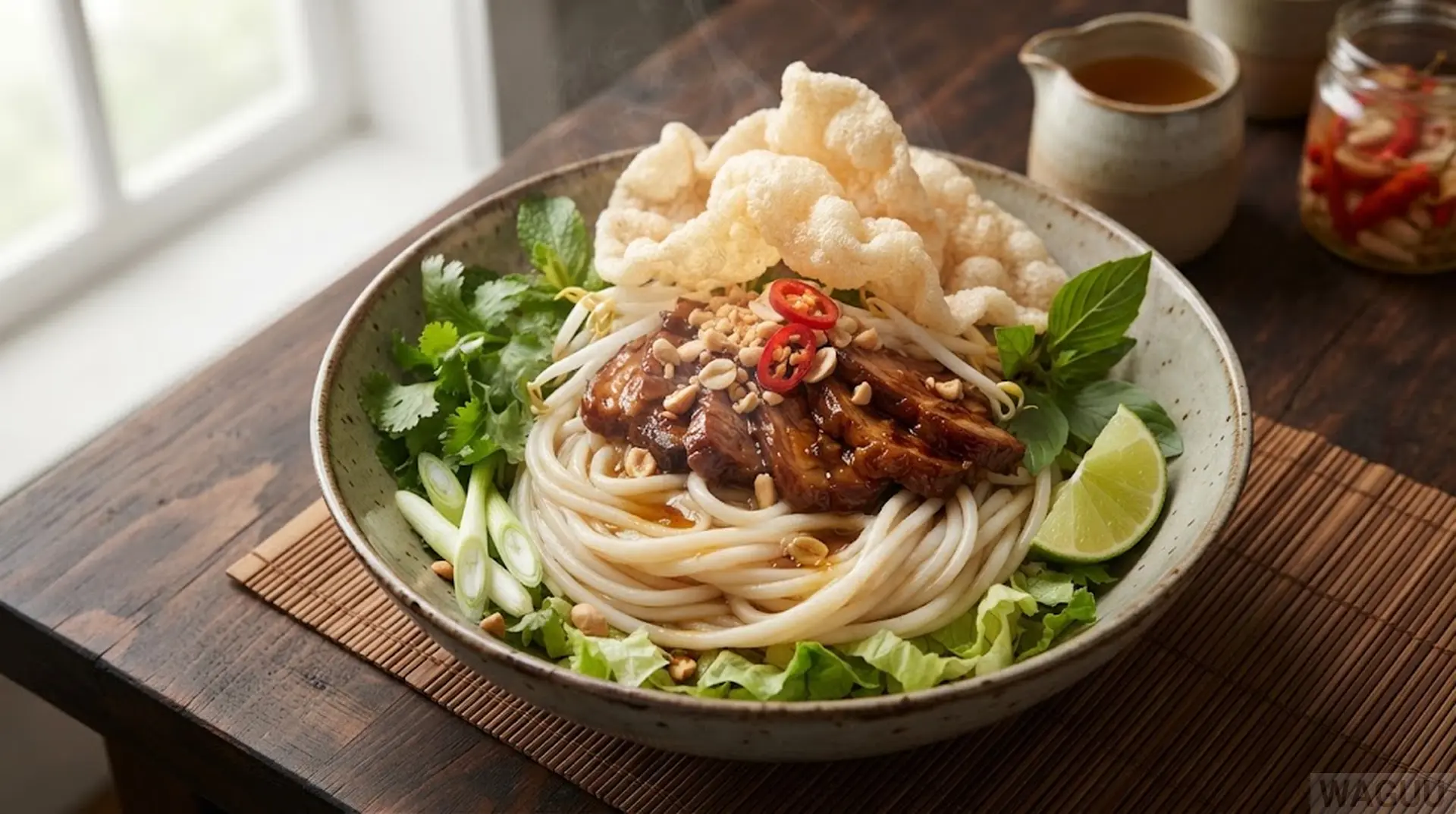
Summary: A specialty from Hoi An with firm rice noodles, sliced braised pork, herbs, crispy fried noodles, and a small amount of broth instead of sauce. Total time 135 minutes, base 6 servings.
Did you cook this recipe? Share your result with the community.
Category: Pasta · Vietnamese Cuisine
Success rate: not rated yet% of users mastered this recipe
Quick overview
- Dish: Cao Lầu – firm rice noodles with braised pork, herbs, and crispy chips
- Category: pasta, vietnamese-cuisine
- Cuisine: Vietnamese
- Main ingredient: Pork shoulder, 2 lb (boneless, sliced 1/4 inch thick)
- Guide: 12 most famous Vietnamese dishes: traditional recipes of Vietnamese cuisine
- Total time: 135 minutes (25 min prep + 110 min cooking)
- Difficulty: Challenging
- Servings: 6 (Serving weight: 19.5 oz)
- Key technique: Braising meat in seasoned water and serving noodles with a small amount of broth instead of sauce
- Preparation types: Braising, frying, classic cooking
- Dietary info & allergens: fish (fish sauce), soy (soy sauce), gluten (soy sauce)
- Suitable for: Festive lunch, multi-course feast, weekend cooking, or dinner for guests.
- Nutritional values (per 1 serving): 755 kcal, Protein: 34.1 g, Fat: 27.2 g, Carbohydrates: 94.4 g
- Storage: 2 days in refrigerator, 1 month in freezer
- Pairing: Vietnamese lager, dry Riesling, iced green tea
- In short: Firm rice noodles, braised pork slices, fresh herbs, crispy fried noodles, and broth instead of sauce. Total time 135 minutes, 6 servings.
WAGUU says: “Cao lầu is not served with sauce, but with broth. Just a few tablespoons are enough to bind the noodles with the meat and keep them from drying out.”
Key facts
| Prep time: | 25 minutes |
| Cook time: | 110 minutes |
| Temperature: | Braise at 203°F, oil for frying at 340–350°F |
| Number of servings: | 6 |
At a glance
Cao lầu differs from other noodle dishes in two ways: the noodles, which are cooked in alkaline water so they stay firm, and the serving method, where a few tablespoons of seasoned broth are poured over instead of sauce. The braising time of the meat and the oil temperature for the crispy noodles are crucial. If you overcook the noodles or add too much broth, you get noodle soup instead of cao lầu.
Ingredients
Base servings: 6 servings • Serving weight: 19.5 oz
| Ingredient | Amount | Quality |
|---|---|---|
| pork shoulder | 32 oz | boneless, with a thin layer of fat |
| cao lầu rice noodles | 18 oz | thick 1/4 inch, firm, made from rice flour |
| thin rice noodles | 4.0 oz | thin 1/16 inch, for frying until crispy |
| fish sauce | 1/4 cups | fermented from anchovies, no sugar |
| soy sauce | 1/4 cups | dark, naturally fermented |
| cane sugar | 1.0 oz | light, coarse |
| garlic | 6 cloves | fresh clove, finely chopped |
| shallot | 4 pieces | red, finely chopped |
| star anise | 2 pieces | whole stars, not ground |
| cinnamon stick | 0.14 oz | thin cassia stick |
| green onion | 4 pieces | fresh, white and green parts |
| lettuce | 7.0 oz | crisp, leaves torn by hand |
| fresh cilantro | 1.5 oz | stem and leaf, without root |
| fresh mint | 1.0 oz | fresh, leaves only |
| Thai basil | 0.7 oz | fresh, leaves |
| bean sprouts | 5.5 oz | fresh, firm |
| roasted peanuts | 2.0 oz | unsalted, coarsely crushed |
| frying oil | 2.1 cups | sunflower, for high temperature |
| lime | 1 pieces | juicy, cut into wedges |
| fresh chili | 2 pieces | red, thinly sliced |
Why you’ll love this recipe
- Broth instead of sauce: Instead of a thick sauce, two tablespoons of seasoned broth are poured over the noodles. The dish is light yet full of flavor.
- Two noodle textures: Firm noodles and crispy fried chips from thin noodles meet in one bowl.
- Exact ratios for 6 servings: Meat, noodles, herbs, and broth are calculated for six bowls. The number of servings recalculates based on diners.
Guaranteed success: Cao lầu relies on two steps: braising the meat slowly below boiling point, and the oil temperature when frying the noodles into chips. Oil at around 340°F puffs the noodles in seconds without burning. The noodles are rinsed in cold water so they don’t stick and stay firm. Only two to three tablespoons of broth are added to keep the noodles loose.
Recipe overview
Prep: 25 min | Cook: 110 min | Difficulty: Challenging | Servings: 6 | Type: Main course | Origin: Vietnamese
Detailed instructions
Total progress: 0 % done
Phase 1: Marinating and seasoned water – 20 min
Equipment: mixing bowl, 4-quart pot, cutting board
1.Slice the pork shoulder across the grain into 5-millimeter-thick pieces and toss them in a bowl with soy sauce, half the fish sauce, sugar, garlic, and shallot.
2.Pour water into the pot, add star anise and cinnamon, and bring to a boil. This water will be used both as the braising liquid and as the broth for serving.
VKB:The meat slices are coated with marinade and smell of soy and garlic. The spiced water smells of star anise and cinnamon.
Before you move to the next step:
Cut the meat across the grain and to an even thickness. Thick slices stay tough after braising, thin ones fall apart.
Phase 2: Braising the meat – 70 min
Equipment: pot with lid, ladle, tongs
1.Add the meat slices to the seasoned water, bring to a boil, then lower the heat so only occasional bubbles break the surface. Cover with the lid.
2.During braising, skim foam and fat from the surface with a ladle. Turn the meat once halfway through so the flavor distributes evenly.
3.Remove the meat when it is tender but still holds its shape. Strain the broth, discard the spices, and season it with the remaining fish sauce.
VKB:The meat can be pulled apart with a spoon, but the slice stays intact. The broth is amber, clear, and smells of star anise, not of skin.
Before you move to the next step:
Do not leave the meat in the broth until it completely falls apart. Remove it as soon as it holds its shape, and season the broth only afterward.
Phase 3: Crispy fried noodles – 12 min
Equipment: deep skillet or deep fryer, thermometer, spider strainer
1.Heat the oil to 170–175 °F. Drop the thin rice noodles into the oil in small handfuls and let them puff up to a light golden color for a few seconds.
2.Immediately remove the noodles with a spider strainer and let them drain on a rack. Do not stack them; they will soften and lose their crispness.
VKB:The noodles are puffy, light golden, and dry to the touch. They snap when pressed between your fingers rather than bending.
Before you move to the next step:
Do not overheat the oil above 180 °F; the noodles will turn bitter in two seconds. Monitor the temperature with a thermometer.
Phase 4: Blanching the thick noodles – 12 min
Equipment: large pot, colander, bowl of cold water
1.Cook the thick rice noodles in boiling water until tender but still firm. Stir them once during cooking so they do not stick to the bottom.
2.Drain the noodles, rinse with cold water, and let them drain again. Rinsing removes surface starch and keeps the noodles separate.
VKB:The noodles are firm to the bite, translucent, and after rinsing can be spread freely with your fingers. No slimy layer remains in the colander.
Before you move to the next step:
Do not leave the noodles in hot water after draining; they will overcook and fall apart in the bowl. Rinse them with cold water.
Phase 5: Assembling the bowls – 5 min
Equipment: deep bowls, tongs, spoon
1.Place a handful of torn lettuce in the bottom of each bowl, then add the thick noodles and slices of braised meat. Add a handful of bean sprouts.
2.Top with a handful of crispy fried noodles and sprinkle with cilantro, mint, and Thai basil. Line up the bowls before pouring in the broth.
VKB:The bowls are filled to two-thirds, the crispy noodles sit on top and are not buried under the meat. The herbs remain fresh.
Before you move to the next step:
Do not put the crispy noodles at the bottom of the bowl. They will soften under the meat and lose the one thing that makes them special: their crunch.
Phase 6: Pouring the broth and serving – 4 min
Equipment: ladle, serving tray
1.Bring the broth to a boil and ladle two to three tablespoons into each bowl. The noodles will mingle with the meat but not sit in liquid.
2.Sprinkle each portion with crushed peanuts and sliced chili, and place a lime wedge on the side. Serve the remaining broth in a pitcher for those who want more liquid.
VKB:The noodles are moist but not floating, the meat is warm, and the crispy noodles on top are still brittle. There is no puddle of broth at the bottom of the bowl.
Required equipment
| Item | Ideal size | Alternative | Risk |
|---|---|---|---|
| deep fryer or deep skillet | 3-quart capacity, with a rack | wok with an oil thermometer | a shallow skillet will not puff the noodles and the oil will splatter |
| oil thermometer | range up to 200 °F | test with a piece of noodle | without temperature control, the noodles will burn or stay hard |
| pot with lid | 4-quart capacity, heavy bottom | Dutch oven with lid in the oven | a thin bottom will make the meat stick and the broth bitter |
| spider strainer | 12-inch diameter | tongs and a colander | a regular spoon will not lift all the noodles from the oil and some will stay and burn |
Shopping list
Nutrition profile
Values per 1 serving (without side dish). Calculated from average nutritional values of ingredients.
| Nutrient | Per 100 g | Per 1 serving | Per 6 servings |
|---|---|---|---|
| Energy | 573 kJ / 137 kcal | 3159 kJ / 755 kcal | 18954 kJ / 4530 kcal |
| Fat | 4.9 g | 27.2 g | 163.2 g |
| of which saturated | 1.4 g | 8.5 g | 51.0 g |
| Carbohydrates | 17.1 g | 94.4 g | 566.4 g |
| of which sugars | 6.8 g | 6.8 g | 6.8 g |
| Protein | 6.2 g | 34.1 g | 204.6 g |
| Salt | 2.4 g | 2.4 g | 2.4 g |
Reference intake for an average adult (8400 kJ / 2000 kcal).
WAGUU Pro level
- Pro standard: Tested recipe with precise ratios and visual checkpoints.
- Tip 1: Use thick rice noodles that hold their shape. Thin noodles overcook and the dish loses its structure.
- Tip 2: Fry the crispy noodles just before serving. After twenty minutes they soften and lose their crunch.
- Tip 3: Ladle only two to three tablespoons of broth per portion. Cao lầu is not a soup; the noodles should stay loose.
- Tip 4: Simmer the meat below a boil. A hard boil shrinks and toughens the slices.
The Science Behind It
Thick rice noodles for cao lầu are made from rice flour with added alkaline water, which changes the starch structure. That is why the noodles stay firm after cooking and do not stick. Thin rice noodles contain only a little water, so oil at around 340 °F puffs them up in seconds. The water inside turns to steam, and the steam forms bubbles within the strands. Frying longer burns the noodles and makes them bitter. Simmering the meat below a boil keeps the connective tissue tender and the meat juicy.
Fine Dining – Professional Techniques
- Plate composition: Twirl the noodles into a low spiral, fan the meat slices over half the bowl, and pile the crispy noodles on the other half. Add the herbs last.
- Texture contrasts: Add a few fried shallots and crushed peanuts to the crispy noodles. The crunchy layer stands up against the soft noodles and juicy meat.
- Temperature contrast: Pour the broth boiling hot, keep the meat warm, and the salad cold. The cold layer at the bottom of the bowl stays crisp even as the broth soaks into the noodles.
- Aromatic accents: Place a spoonful of chopped lemongrass and a few drops of sesame oil at the edge of the bowl. The aroma blooms when you pour in the broth.
Sensory Radar
- Appearance: White firm noodles, dark meat slices, light golden crispy noodles on top, green herbs, and orange peanuts.
- Aroma: First braised meat with star anise, then fresh mint with cilantro, and finally toasted peanuts.
- Taste: Salty from soy and fish sauce, mildly sweet from sugar and spices, fresh from herbs and lime.
- Texture: Noodles firm, meat tender, crispy noodles brittle, vegetables crunchy.
Pairings
- Vietnamese lager: A light pale beer with high carbonation cleanses the palate from the braised meat. Serve it chilled at 43–46 °F.
- dry Riesling: The acidity in Riesling pairs with star anise and cinnamon. Sweeter wines overpower the salty soy sauce.
- iced green tea: Strong green tea with an ice cube and a mint leaf. The tannins refresh the mouth between bites.
Variations
- Cao lầu with crispy pork belly: Roast the belly until crisp first, then slice it. The meat stays juicy and the crackling adds another texture.
- Cao lầu with chicken: Use boneless chicken thighs instead of pork shoulder and simmer them for less time. The dish will be lighter and suits those who do not eat pork.
Allergens and Dietary Information
Contains: fish (fish sauce), soy (soy sauce), gluten (soy sauce) • Gluten: yes, trace amounts from soy sauce • Not suitable for: people with fish, soy, and gluten allergies
Great for
A festive lunch, a multi-course feast, weekend cooking, or dinner for guests.
Substitution Guide
- cao lầu rice noodles: thick rice noodles or udon, texture will be softer
- pork shoulder: pork collar or boneless chicken thigh, reduce the simmering time
- fish sauce: soy sauce with a teaspoon of salt, flavor will be less pronounced
- thin rice noodles for chips: thin glass noodles, they puff up even faster
- star anise: anise and cinnamon in smaller amounts, flavor will be flatter
FAQ
Where can I find noodles for cao lầu?
At Asian grocery stores as thick rice noodles. If you cannot find them, use thick phở noodles. They will be softer, but the flavor of the dish stays the same.
Why is there no sauce in the recipe?
In Hoi An, cao lầu is served with a small amount of seasoned broth. A thick sauce would coat the noodles and the dish would lose its lightness. The broth brings the meat and noodles together.
How do I know the oil is at the right temperature?
Drop one thin noodle into the oil. If it puffs up golden in two seconds, the oil is ready. If it stays hard, the oil is cold; if it darkens, it is too hot.
Can I prepare the meat a day ahead?
Yes, the braised meat and broth keep in the fridge for two days. But make the crispy noodles on the day of serving, or they will soften.
How much broth per portion?
Two to three tablespoons. The noodles should be moist but not swimming in liquid. Serve the rest of the broth in a pitcher so everyone can add more to taste.
What can I use instead of fried noodles?
Crispy fried shallots or thin slices of fried tofu. Toasted peanuts also add crunch, but the texture will be crumbly rather than brittle.
WAGUU Petr advises: Cooking for 6 or more?
6–8 people: Braise the meat a day ahead and keep the broth in the fridge. On the day of serving, cook the noodles in batches and fry the crispy noodles just before serving. • 10+ people: Braise the meat in two pots and combine when done. Fry the crispy noodles in small handfuls and keep them on a rack in a low oven. Assemble the bowls in two waves so the salad does not get soggy.
Sides and Serving
Serving: Cao lầu is served in a deep bowl where the layers are visible: salad at the bottom, noodles in the middle, meat and crispy noodles on top. The broth is poured in at the table with a spoon, and the rest is served in a pitcher. A lime wedge and chili rings go with the bowl.
Storage and Reheating
Fridge: 2 days • Freezer: 1 month • Reheating: Reheat the meat in a little broth in a skillet. Blanch the noodles in boiling water and rinse with cold water. Refry the crispy noodles; reheated in the microwave they turn soft.
Author: WAGUU Petr & Team • Published: 9 Oct 2026 • Updated: 10 Oct 2026
More recipes from the article
Guide: 12 most famous Vietnamese dishes: traditional recipes from Vietnamese cuisine
Phở Bò – beef noodle soup with star anise, cinnamon, and charred ginger
Phở Gà – chicken noodle soup with a delicate broth, star anise, and fresh herbs
Bánh Mì – crispy Vietnamese baguette with meat, pâté, and pickled vegetables
Bún Chả – grilled pork slices and patties with rice noodles and sweet-and-sour sauce
Gỏi Cuốn – fresh summer rolls with rice paper, shrimp, and herbs
Bún Bò Huế – spicy noodle soup from Hue with lemongrass and chili
Cơm Tấm – broken rice with grilled pork, egg, and fish sauce
Bánh Xèo – crispy rice pancake with turmeric, shrimp, and bean sprouts
Chả Giò – fried Vietnamese spring rolls with meat, vegetables, and noodles
Cá Kho Tộ – caramelized braised fish in a sweet-and-salty sauce
Chè – Vietnamese sweet desserts with beans, tapioca, and coconut milk
More recipes you might like
Why WAGUU?
Recipes on WAGUU are checked for accuracy of ingredients, methods, and nutritional values.
Photo Gallery
Community photos: Cook, snap a photo, and share your result.
You can upload photos in the comments below or send them by email.
Did you film a video of our recipe? Paste the link to YouTube, YouTube Shorts, TikTok, Instagram Reels, Facebook Reels, Pinterest, Vimeo, or X (Twitter) in the comments – we will gladly publish it and help you and your content get noticed.
Common Mistakes
- Too much broth – the noodles swim and the dish turns into soup. Pour two to three tablespoons per portion.
- Overheated oil – thin noodles turn bitter in two seconds. Keep the temperature at 340–350 °F.
- Crispy noodles on the bottom – they soften under the meat and lose their crunch. They belong on top.
- Overcooked firm noodles – they lose their shape and stick together in the bowl. Cook them just until tender and rinse with cold water.