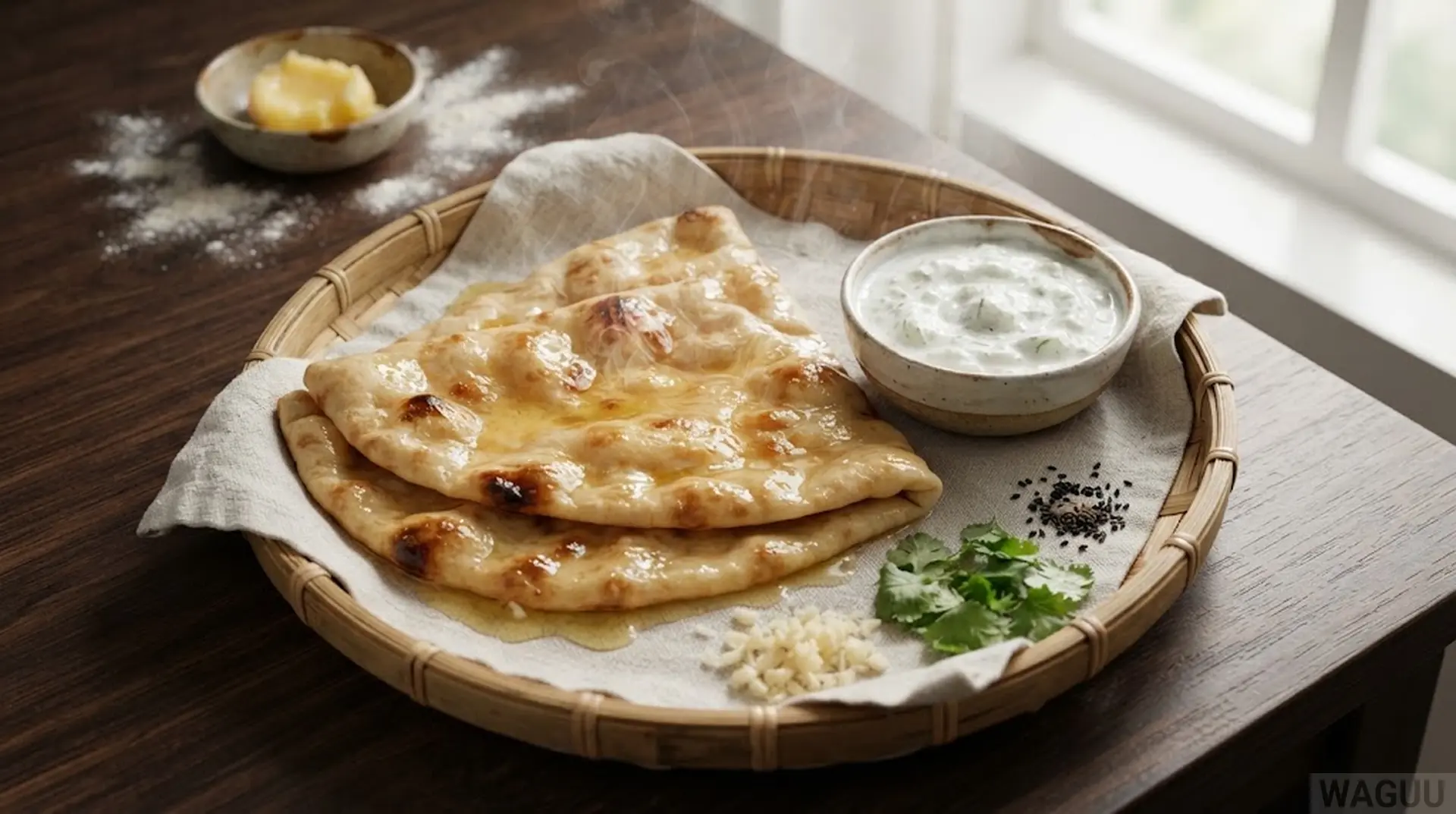
Summary: Dough made from flour, yogurt, and yeast is left to rise until doubled. Portions are rolled into ovals, cooked on a scorching hot griddle until dark spots appear, and brushed with ghee. Total time 120 minutes including rising, makes 6 servings.
Did you make this recipe? Share your result with the community.
Category: Bread and Pastry · Indian Cuisine
Success rate: not rated yet% of users mastered this recipe
Quick overview
- Dish: Naan – traditional Indian flatbread baked at high heat in a tandoor
- Category: breads, indian-cuisine
- Cuisine: Indian
- Main ingredient: All-purpose flour, 500 g (wheat, for dough) (quality specification)
- Guide: 12 most famous Indian dishes: traditional recipes from Indian cuisine
- Total time: 120 minutes (25 min prep + 95 min cooking)
- Difficulty: Easy
- Servings: 6 (Serving weight: 174 g)
- Key technique: Yogurt-based yeast dough and cooking on a hot griddle or in the oven
- Preparation types: Rising, griddle cooking
- Dietary info & allergens: gluten (all-purpose flour); milk (plain yogurt, ghee, milk)
- Suitable for: Family dinner, dinner with friends, festive multi-course table, and meal prep for several days ahead.
- Nutrition facts (per 1 serving): 445, Protein: 11.1 g, Fat: 15.7 g, Carbohydrates: 64.8 g
- Storage: 3 days in the refrigerator, 1 month in the freezer
- Pairing: Indian light lager, dry Riesling, masala chai
- In short: Dough made from flour, yogurt, and yeast is left to rise until doubled. Total time 120 minutes, 6 servings.
WAGUU says: “Naan is cooked on a griddle so hot that the dough doesn’t have time to dry out.”
Key facts
| Prep time: | 25 |
| Cook time: | 95 |
| Temperature: | Griddle 480–535°F, oven 480°F with stone, rising 80–85°F |
| Servings: | 6 |
At a glance
Naan is recognized by its spots: dark brown in places, light in others, soft on the surface and airy inside. The griddle temperature and dough thickness are key – thin naan stays dry, thick naan doesn’t cook through. If the dough isn’t risen enough, you get a flatbread hard as a cracker.
Ingredients
Base servings: 6 servings • Serving weight: 174 g
| Ingredient | Amount | Quality |
|---|---|---|
| all-purpose flour | 18 oz | wheat, all-purpose, sifted |
| plain yogurt | 7.0 oz | full-fat, room temperature |
| dried yeast | 0.2 oz | instant dry |
| sugar | 1 tsp | granulated, for yeast |
| salt | 1 tsp | fine |
| vegetable oil | 2 tbsp | neutral flavor, for dough |
| ghee | 2.0 oz | clarified butter, for brushing flatbreads |
| garlic | 4 cloves | fresh, finely chopped |
| fresh cilantro | 0.9 oz | fresh, chopped |
| cumin seeds | 1 tsp | whole, for sprinkling |
| milk | 3.4 fl oz | whole, lukewarm, for dough |
| water | 3.4 fl oz | lukewarm, for dough |
Why you’ll love this recipe
- Soft even the next day: The yogurt in the dough breaks down gluten, which is why naan stays moist. Reheated in the oven, it tastes almost fresh.
- Baked without a tandoor oven: A cast-iron griddle heated to maximum gives the same spots as a tandoor. Naan also works in an oven with a stone.
- A side that makes itself: The dough rises unattended and the flatbreads are done in two minutes. For dinner, just mix the dough in the afternoon.
Success guaranteed: The yogurt in the dough contains lactic acid, which breaks down gluten and makes the dough more supple. That’s why naan is soft even the next day. Yeast needs warmth and time, so the dough is left to rise until doubled. Salt carries the dough and the butter used for brushing, so the finished naan isn’t salted again. The dark spots on the surface come from rapid charring of a thin layer of dough at high heat and carry a flavor that oven baking can’t provide.
Recipe overview
Prep: 25 min | Cook: 95 min (including rising) | Difficulty: Easy | Servings: 6 | Type: Side | Origin: Indian
Detailed instructions
Overall progress: 0 % done
Phase 1: Making the dough – 15 min
Equipment: bowl, whisk, kitchen towel
1. Stir the yeast and sugar into the lukewarm milk and let them work for five minutes. Foam should appear on the surface, meaning the yeast is alive.
2. Mix the flour with salt, add the yogurt, oil, and the proofed yeast with milk. Add water by tablespoons and knead the dough until it’s smooth and elastic.
VKB: The dough is smooth, elastic, and doesn’t stick to your hands. When pressed, it slowly springs back.
Before you move on:
Hot milk kills the yeast and the dough won’t rise. The milk should be lukewarm, as when you can hold it on your wrist.
Phase 2: Letting the dough rise – 75 min
Equipment: bowl, kitchen towel, warm place
1. Cover the dough with a towel and put it in a warm, draft-free place. Let it rise until it doubles in volume.
2. Briefly knead the risen dough to knock out large bubbles. Then divide it into equal portions and let them rest for a while.
VKB: The dough has doubled in volume and sounds hollow when tapped. After kneading, it’s smooth again and holds a ball shape.
Before you move on:
Dough in a draft rises unevenly and the flatbreads puff up inconsistently. Find a draft-free spot and don’t lift the towel.
Phase 3: Rolling the flatbreads – 10 min
Equipment: rolling pin, cutting board, kitchen towel
1. Roll each piece into an oval about 1/8 to 1/6 inch thick. Use only a light dusting of flour so the flatbread doesn’t dry out.
2. Gently pull one end of the oval into a point to create the classic teardrop shape. Cover the rolled flatbreads with a towel to keep them from drying out.
VKB: The flatbread is evenly thin, springs back when pressed, and holds the teardrop shape. It folds without cracking.
Before you move to the next step:
A thick flatbread won’t cook through and stays heavy inside. A thin one burns. Keep the thickness between 1/8 and 1/6 inch.
Phase 4: Cooking on the stovetop – 12 min
Equipment: cast-iron griddle or skillet, tongs
1. Heat the griddle dry until it’s almost smoking. Place the flatbread on the griddle and cook until bubbles appear on the surface.
2. Flip it and cook the other side until dark spots form. Press the flatbread against the griddle so the top layer cooks through as well.
VKB: The surface has dark spots and bubbles, the flatbread is soft and pliable. It sounds hollow when tapped, indicating air inside.
Before you move to the next step:
On a poorly heated griddle, the flatbread stays pale and tough. Heat the griddle long enough and cook the flatbreads one at a time.
Phase 5: Brushing and seasoning – 6 min
Equipment: brush or spoon, small bowl
1. Melt the ghee and mix with minced garlic. Brush the hot flatbread immediately with ghee so it soaks into the surface and keeps the flatbread soft.
2. Sprinkle the flatbread with chopped cilantro and cumin seeds. Always brush right after removing from the griddle, not after it cools.
VKB: The surface of the flatbread is shiny, the ghee has soaked in and doesn’t pool on top. The garlic is evenly distributed and the cilantro sticks.
Before you move to the next step:
A cooled flatbread won’t absorb ghee and stays greasy on the surface. Brush it while still hot and keep it wrapped in a towel.
Phase 6: Keeping warm and serving – 5 min
Equipment: bowl, clean towel
1. Stack the finished flatbreads in a clean towel and cover them to keep them soft. The towel holds moisture and prevents the naan from hardening.
2. Serve the naan in a basket lined with a towel. Offer it with curry, dal, or grilled meat.
VKB: The flatbreads are soft, pliable, and warm. After ten minutes in the towel, they can still be folded without breaking.
Required equipment
| Tools | Ideal size | Alternative | Risk |
|---|---|---|---|
| cast-iron griddle or skillet | 12-inch diameter, thick bottom | oven with baking stone preheated to 480°F | a thin pan warps and the flatbread cooks only in the center |
| rolling pin | 16-inch length | stretching dough by hand | a thick dough won’t cook through and stays heavy inside |
| pastry brush | silicone, 2-inch width | spoon and quick motion | with a spoon, ghee runs off the edges and the flatbread absorbs unevenly |
| clean cotton towel | 24 by 24 inches | sealable bowl with lid | flatbreads without a towel dry out within five minutes |
Shopping list
Nutrition facts
Values per 1 serving (without side dish). Calculated from average nutritional values of ingredients.
| Nutrient | Per 100 g | Per 1 serving | Per 6 servings |
|---|---|---|---|
| Energy | 1071 kJ / 256 kcal | 1862 kJ / 445 kcal | 11171 kJ / 2670 kcal |
| Fat | 9.0 g | 15.7 g | 94.2 g |
| of which saturated | 4.0 g | 7.0 g | 41.8 g |
| Carbohydrates | 37.2 g | 64.8 g | 388.8 g |
| of which sugars | 2.4 g | 4.1 g | 24.6 g |
| Protein | 6.4 g | 11.1 g | 66.6 g |
| Salt | 0.5 g | 0.9 g | 5.2 g |
Reference intake of an average adult (8400 kJ / 2000 kcal).
WAGUU Pro level
- Pro standard: Verified recipe with precise ratios and visual checkpoints.
- Tip 1: Verified recipe with precise ratios and visual checkpoints.
- Tip 2: The dough is smooth, elastic, and doesn’t stick to your hands. It slowly springs back when pressed. Hot milk kills the yeast and the dough won’t rise. The milk should be lukewarm, like you can hold it on your wrist.
- Tip 3: The dough has doubled in volume and sounds hollow when tapped. After kneading, it’s smooth again and holds a ball shape. Dough in a draft rises unevenly and the flatbreads puff unevenly. Find a draft-free spot and don’t lift the towel.
- Tip 4: Prepare the ingredients on the counter in small bowls beforehand. Indian cooking relies on spices added in precise order, and there’s no time to measure during cooking.
Scientific background
At griddle temperatures above 480°F, water on the dough surface turns to steam and the dough puffs rapidly. Bubbles and dark spots form on the surface. Lactic acid in yogurt partially breaks down gluten, making the dough more stretchable and preventing tears during rolling. Ghee brushed on seals the surface and keeps moisture inside the flatbreads.
Fine Dining – Professional techniques
- Plate composition: Fold the flatbread into quarters and stand it in a towel-lined basket. The folded flatbread holds heat longer.
- Texture contrasts: Brush with garlic ghee at the table. The aroma releases from the heat of the flatbread and guests smell it before taking the first piece.
- Temperature contrast: Sprinkle the flatbread with cilantro and cumin seeds. The green color on the golden-brown surface is the visual center of the side dish.
- Aromatic additions: Serve it in a basket with pickled onions and yogurt. The acidity and coolness balance the richness of the ghee on the surface.
Sensory radar
- Appearance: The flatbread has a teardrop shape, dark spots and bubbles on the surface, shines with ghee, and is sprinkled with green cilantro.
- Aroma: Warm yeast from baking, then garlic on ghee, and finally fresh cilantro.
- Taste: Mild acidity from yogurt, sweet wheat flavor, and a finish of garlic and cilantro.
- Texture: Surface soft and slightly oily, inside airy and pliable. The flatbread can be folded without breaking.
Pairings
- Indian light lager: A crisp lager with high carbonation cleanses the palate between bites of rich flatbread and curry. Serve at 41–45 °F.
- Dry Riesling: Riesling with bright acidity stands up to the garlic and ghee on the flatbread’s surface.
- Masala chai: Masala chai with milk, ginger, and cardamom. It suits warm flatbread better than a cold soda.
Variations
- Garlic and cilantro naan:: Chopped garlic and cilantro are pressed into the dough before baking. The aroma is more pronounced, and the bread pairs well with meat dishes.
- Yeast-free naan:: The dough is leavened with baking soda and yogurt and doesn’t need to rise. The bread is ready in half an hour and stays soft the next day.
Allergens and Dietary Information
Contains: gluten (all-purpose flour); milk (plain yogurt, ghee, milk) • Gluten: no, the recipe contains gluten (wheat flour) • Not suitable for: individuals with celiac disease, gluten allergy, and milk allergy
Suitable for
Family dinner, dinner with friends, a festive multi-course table, and meal prep for several days ahead.
Substitution Guide
- all-purpose flour: whole wheat flour (dough will be denser)
FAQ
Why did my naan turn out hard?
The dough didn’t rise enough, or the flatbread baked too long at low heat. The griddle must be almost smoking, and the flatbread bakes quickly.
Do I need a cast-iron griddle?
No, but a thick bottom is important. Use a heavy-bottomed nonstick skillet or a baking sheet with a baking stone in the oven at 480 °F.
What can I brush on naan instead of ghee?
Melted butter or vegetable oil with garlic. However, ghee withstands higher heat and doesn’t give the flatbread a milky aftertaste.
Can I make the dough a day ahead?
Yes, leave it in the refrigerator overnight. Take it out two hours before baking so it relaxes and comes to room temperature.
Is naan suitable for a gluten-free diet?
No, it’s based on wheat flour. A gluten-free version needs a blend of gluten-free flours with added xanthan gum.
What to serve with naan?
With curry, dal, butter chicken, or grilled meat. Tear the flatbread by hand and scoop up the sauce.
WAGUU Petr’s tip: Cooking for 6 or more?
6–8 people: Make the masala (fried spice base) in double batch and refrigerate half. When cooking for a crowd, use two pots instead of one large one—spices don’t roast evenly in too thick a layer. • 10+ people: A grill or a cast-iron skillet heated in the oven to maximum can replace a tandoor. Prepare the naan dough and chicken marinade the day before and keep them in the refrigerator—flavor and texture will be better.
Sides and Serving
Serving: Serve naan immediately after baking, brushed with ghee and sprinkled with cilantro. It goes well with curry, dal, and meat dishes, which you scoop up with the flatbread.
Storage and Reheating
Refrigerator: 3 days • Freezer: 1 month • Reheating: Refrigerator: 3 days • Freezer: 1 month • Reheating: in the oven at 350 °F for three minutes; in the microwave it becomes soft
Author: WAGUU Petr & Team • Published: 9 Oct 2026 • Updated: 10 Oct 2026
More recipes from the article
Guide: 12 Most Famous Indian Dishes: Traditional Recipes from Indian Cuisine
Butter Chicken – chicken in a mild creamy tomato sauce with butter and aromatic spices
Chicken Tikka Masala – pieces of marinated chicken in a spiced tomato-cream sauce
Tandoori Chicken – chicken marinated in yogurt and spices and cooked at high heat
Biryani – aromatic layered rice with meat, saffron, and a blend of spices
Palak Paneer – Indian paneer cheese in a mildly spiced spinach base
Palak Paneer – Indian paneer cheese in a mildly spiced spinach base
Chana Masala – chickpeas simmered in a tangy sauce of tomatoes, onions, and aromatic spices
Dal Tadka – lentils tempered with fried spices, garlic, onion, and chili
Masala Dosa – thin crispy fermented crepe made from rice and lentils with spiced potatoes
Samosa – fried triangular pastries filled with potatoes, peas, and spices
Chole Bhature – spiced chickpeas with large fried leavened bhature breads
More recipes you might like
Why WAGUU?
WAGUU recipes are checked for accuracy of ingredients, methods, and nutritional values.
Photo Gallery from the Process
Community photos: Cook, snap a photo, and share your result.
You can upload photos in the comments below or send them by email.
Did you film a video of making our recipe? Paste the link to YouTube, YouTube Shorts, TikTok, Instagram Reels, Facebook Reels, Pinterest, Vimeo, or X (Twitter) in the comments—we’ll be happy to publish it and help get you and your content noticed.
Common Mistakes
- Mixing the dough – Hot milk kills the yeast and the dough won’t rise. The milk should be lukewarm, like when you can hold it on your wrist.
- Letting the dough rise – Dough in a draft rises unevenly and the flatbreads puff up inconsistently. Find a draft-free spot and don’t lift the towel.
- Rolling the flatbreads – A thick flatbread won’t cook through and stays heavy inside. A thin one burns. Keep the thickness between three and four millimeters.
- Cooking on the griddle – On a griddle that’s not hot enough, the flatbread stays pale and tough. Heat the griddle long enough and cook the flatbreads one at a time.