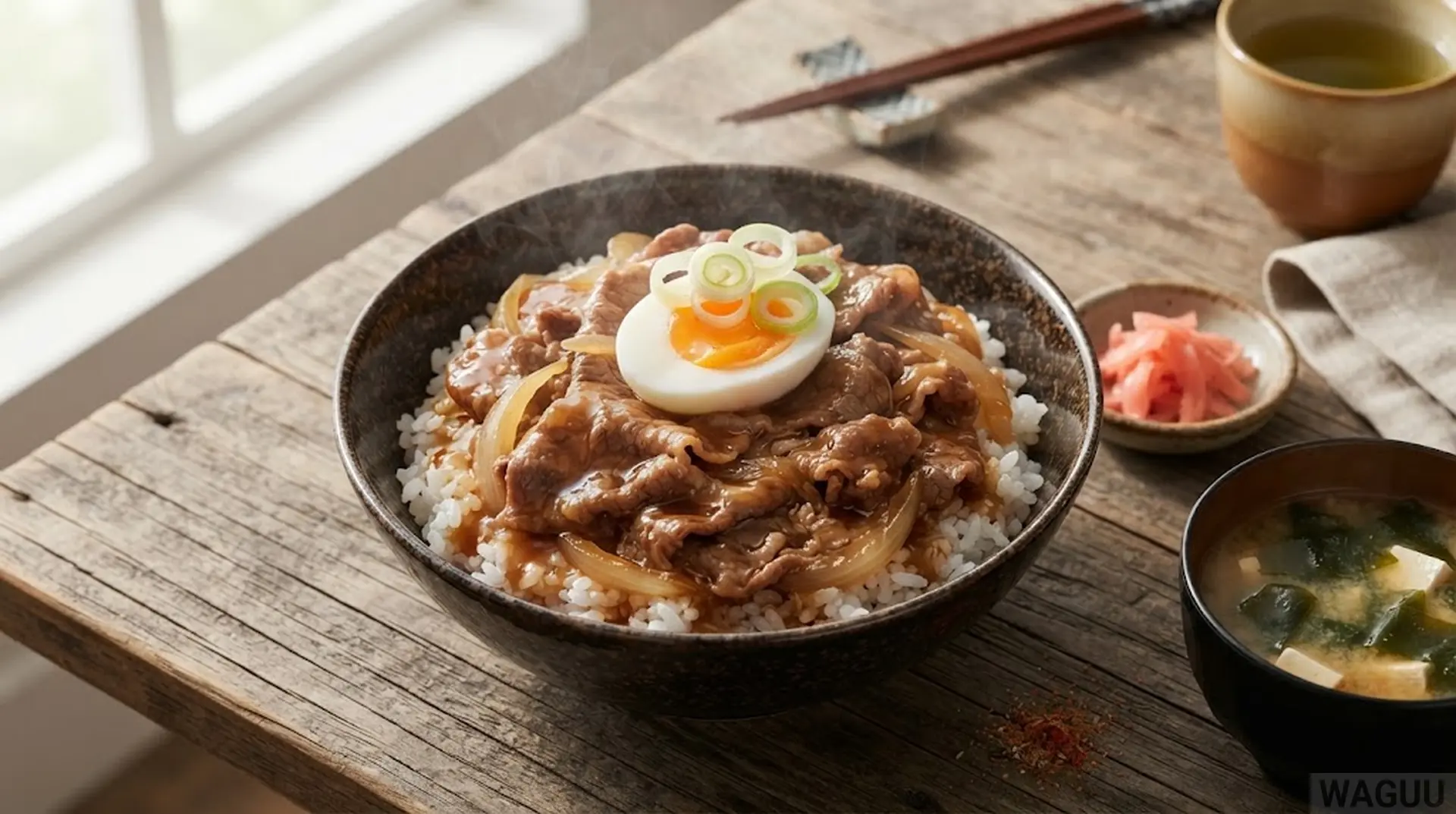
Summary: Gyudon made with thinly sliced beef top round simmered with onion in a sauce of soy sauce, mirin, and sake. The beef is added to the boiling sauce in layers and must not cook long, or it will toughen. The sauce is reduced slightly before serving so the flavors meld. The finished mixture is poured over a bowl of hot rice. Total time 55 minutes, makes 6 servings.
Did you make this recipe? Share your result with the community.
Categories: beef, japanese cuisine
Success rate: not rated yet% of users mastered this recipe
Quick overview
- Dish: Gyudon – a bowl of rice topped with thinly sliced beef and onion simmered in a sweet-savory sauce
- Categories: beef, japanese cuisine
- Cuisine: Japanese
- Main ingredient: Beef top round, 2 lb (sliced thin) (quality specification)
- Guide: 12 most famous Japanese dishes: traditional recipes of Japanese cuisine
- Total time: 55 minutes (20 min prep + 35 min cooking)
- Difficulty: Easy
- Servings: 6 (Serving size: 1 lb)
- Key technique: Simmering thin slices of beef in a sweet-savory broth with onion and pouring over hot rice
- Preparation types: Simmering, classic cooking
- Dietary info & allergens: soy (soy sauce), gluten (soy sauce, sake), egg (egg)
- Suitable for: Quick weekday lunch, family dinner, one-bowl meal, work lunch, homemade version of Japanese chain restaurant dishes.
- Nutrition facts (per serving): 725 calories, Protein: 37.0 g, Fat: 21.0 g, Carbohydrates: 96.0 g
- Storage: 2 days in refrigerator, 2 months in freezer
- Pairing: Japanese light lager, dry red wine, sencha green tea
- In short: Gyudon made from thin slices of beef ribeye simmered with onion in a sauce of soy sauce, mirin, and sake. Total time 55 minutes, 6 servings.
WAGUU says: “Thin slices of beef are not boiled but steeped. If you let them boil in the sauce, they will toughen in ten minutes and the sauce will become bitter.”
Key facts
| Prep time: | 20 minutes |
| Cook time: | 35 minutes |
| Temperature: | Sauce 200°F, beef steeped below boiling point, rice served at 160°F |
| Servings: | 6 |
At a glance
Gyudon is a dish that comes together in one pan and is ready before the rice. The thickness of the slices and timing are key. Slices cut to 2–3 millimeters warm through in a few seconds; thicker slices would need longer simmering and lose their juices. The onion is first softened in the sauce because the sugar from mirin needs time to meld with the onion’s flavor. The beef is added last and layered on top, so it warms through as a whole in the boiling sauce. The sauce is never boiled hard, otherwise the saltiness of the soy sauce intensifies and bitterness appears before serving.
Ingredients
Base servings: 6 servings • Serving size: 1 lb
| Ingredient | Amount | Quality |
|---|---|---|
| beef top round | 32 oz | sliced 2–3 mm thick, against the grain |
| onion | 3 pcs | medium, yellow, 12 oz |
| jasmine rice | 32 oz | long-grain, pre-cooked |
| dashi stock | 30.4 tbsp | from seaweed and dried fish |
| soy sauce | 1/2 cups | naturally fermented |
| mirin | 6 tbsp | sweet rice cooking wine |
| sake | 1/4 cups | dry, for cooking |
| cane sugar | 0.7 oz | fine, light |
| fine sea salt | 0.11 oz | to taste |
| egg | 3 pcs | fresh, soft-boiled |
| green onion | 4 pcs | fresh, thinly sliced |
| pickled ginger | 2.0 oz | thin slices, sweet-sour brine |
| shichimi togarashi | 0.11 oz | Japanese seven-spice blend |
Why you’ll love this recipe
- Ready in 55 minutes: One pan, one sauce, and rice from a pot. The beef is added at the end and is done in a few minutes.
- Sauce that soaks into the rice: The sauce is reduced slightly and poured over the rice. The flavor of the beef reaches the bottom of the bowl.
- Exact ratios for 6 servings: Five ounces of beef per bowl, half an onion per serving, and sauce measured with a ladle. Everything scales with the number of diners.
Guaranteed success: Beef top round consists of long, firm muscle fibers. When the meat is sliced thinly against the grain, the fibers are shortened and need only a short time to become tender. When simmered in a sauce of soy sauce and mirin, salt and sugar penetrate the meat. The salt partially draws water from the surface of the meat, and the sugar binds it, so the meat stays moist. If the meat cooks too long, the proteins contract, squeeze out water, and the meat toughens even with a thin cut. The onion in the sauce acts as a source of sweetness. During simmering, sugars are released, the sauce thickens, and it becomes glossy. The rice in the bowl has a second job: it absorbs some of the sauce and softens, so the flavor of the beef reaches the bottom of the bowl.
Recipe overview
Prep: 20 min | Cook: 35 min | Difficulty: Easy | Servings: 6 | Type: Main dish | Origin: Japanese
Detailed instructions
Total progress: 0 % done
Phase 1: Prep ingredients – 12 min
Appliances: refrigerator, sharp knife
1. Put the beef top round in the freezer for a quarter hour so it firms up slightly and is easier to slice thinly. Then cut it with a long stroke of the knife against the grain into slices 2–3 millimeters thick.
2. Cut the onion in half and slice it into thin half-moons. Slice the green onion into rings and leave the pickled ginger in a small bowl.
VKB: The meat slices are evenly thick, translucent when held in the palm, and hold their shape. The onion is cut into evenly thick half-moons. There is no juice on the cutting board.
Before you move to the next step:
Do not cut the meat with the grain or into thick slices. A thick slice must simmer longer, squeezes out water, and toughens.
Phase 2: Cooking rice – 18 min
Appliances: heavy-bottomed pot, lid
1. Rinse the rice under cold water until the water runs clear, and let it drain. Put the rice in a heavy-bottomed pot and add water in the ratio you are used to.
2. Bring the rice to a boil, then reduce the heat to low and cook covered until the water is absorbed. Remove the pot from the heat and let the rice rest covered so the steam inside equalizes.
VKB:No bubbling sound comes from the pot, and the rice is scattering. A grain gives way when pressed but does not fall apart. The lid is dry, with no new droplets.
Before you move to the next step:
Do not lift the lid during cooking. Every peek releases steam and the grains inside stay hard.
Phase 3: Sweet-Savory Sauce – 8 min
Equipment: wide skillet
1. Pour the dashi stock into a wide skillet, add the soy sauce, mirin, sake, and cane sugar. Bring the mixture to a boil and let the sugar dissolve.
2. Add the sliced onion to the boiling sauce and simmer until it softens and turns translucent. The onion should move freely in the liquid.
VKB: The sauce is clear, dark amber, and smells of dashi and soy sauce. The onion is soft, translucent at the edges, and holds its half-moon shape.
Before you move to the next step:
Do not boil the sauce hard or for long. The saltiness of soy sauce intensifies with cooking, and the sugar starts to scorch at the bottom.
Phase 4: Poaching the Beef – 8 min
Equipment: wide skillet, chopsticks
1. Add the beef slices to the boiling sauce in layers, stirring between layers with chopsticks so they do not stick together. The beef should heat through in the boiling sauce, not cook for long.
2. As soon as the slices change color all over, lower the heat and leave them in the sauce only briefly. Finally, reduce the sauce slightly so the flavors come together.
VKB: The beef slices are evenly heated through, hold their shape, and are not tough. The sauce is glossy and slightly thick, coating a spoon with a thin film. The juices in the pan are clear, not cloudy.
Before you move to the next step:
Do not leave the beef boiling in the sauce. After a few minutes the proteins contract, the beef releases water, and it toughens.
Phase 5: Assembling the Bowls and Serving – 5 min
Equipment: deep bowls, ladle
1. Mound the hot rice into warmed deep bowls in a gentle cone. Place the beef and onion on top and pour the sauce around the edge of the bowl so it runs down to the rice.
2. Top the bowl with a halved soft-boiled egg, scallion rings, and pickled ginger slices. Finally, add a pinch of shichimi togarashi and serve immediately.
VKB: The broth has soaked into the top layer of rice and colored it brown, while the rice below stays white. The beef on top is glossy, the yolk is runny, and the scallion is crisp.
Required Equipment
| Tool | Ideal Size | Alternative | Risk |
|---|---|---|---|
| wide skillet | 28 cm diameter, 6 cm deep | two smaller skillets and cooking in two batches | a small skillet will not hold the beef in a single layer and the slices will stick together |
| sharp long knife | 24 cm blade, smooth | electric meat slicer | a serrated blade tears the meat and the slices are not evenly thick |
| heavy-bottomed pot | 3 L capacity, tight-fitting lid | rice cooker with the appropriate setting | a thin bottom will burn the rice at the bottom before the water is absorbed |
| deep bowls | 700 ml capacity, ceramic | deep plates | a shallow plate will not hold the sauce and the rice will scatter |
| chopsticks | wooden, 30 cm | two forks | metal chopsticks get hot in the boiling sauce and burn your fingers |
Shopping List
Nutrition Profile
Values per 1 serving (without sides). Calculated from average nutrient values of ingredients.
| Nutrient | Per 100 g | Per 1 serving | Per 6 servings |
|---|---|---|---|
| Energy | 644 kJ / 154 kcal | 3033 kJ / 725 kcal | 18200 kJ / 4350 kcal |
| Fat | 4.5 g | 21.0 g | 126.0 g |
| of which saturated | 1.7 g | 7.8 g | 46.8 g |
| Carbohydrates | 20.4 g | 96.0 g | 576.0 g |
| of which sugars | 1.6 g | 7.4 g | 44.4 g |
| Protein | 7.9 g | 37.0 g | 222.0 g |
| Salt | 0.4 g | 2.0 g | 12.0 g |
Reference intake of an average adult (8400 kJ / 2000 kcal).
WAGUU Pro Level
- Pro standard: Tested recipe with precise ratios and visual checkpoints.
- Tip 1: Tested recipe with precise ratios and visual checkpoints.
- Tip 2: Slice the beef 2 to 3 mm thick against the grain. Thicker slices need longer simmering and lose their juices.
- Tip 3: Add the beef to the boiling sauce in layers, stirring between layers with chopsticks. Stacking prevents the slices from sticking together into a block.
- Tip 4: Let the sauce reduce slightly before serving, but do not boil it hard. The saltiness of soy sauce intensifies with cooking and the sauce will taste sharp at the end.
Scientific Background
Beef ribeye is made of long muscle fibers. When sliced thinly against the grain, the fibers are shortened and need only a short time to become tender. In a sauce of soy sauce and mirin, salt partially draws water from the surface of the meat and sugar binds it, so the meat stays moist. During long cooking, proteins contract and squeeze out water, making the meat tough even though it is thinly sliced. Onion acts as a source of sweetness in the sauce; during simmering, sugars are released and the sauce becomes glossy.
Fine Dining – Professional Techniques
- Plate composition: Mound the rice in a bowl in a gentle cone and place the beef and onion on top. Pour the sauce around the edge of the bowl so it runs down to the rice.
- Texture contrasts: Let the onion reduce slightly in the sauce so it is soft and sweet. Add crisp scallions only on the plate as a fresh contrast.
- Temperature contrast: The bowl is served very hot, so warm it with hot water. Cold ceramic will drop the temperature of the sauce and the rice will harden.
- Aromatic additions: Place a halved soft-boiled egg on the beef and sprinkle with a pinch of Japanese shichimi togarashi. The yolk runs into the sauce and rounds out the flavor.
Sensory Radar
- Appearance: In the bowl, white rice is visible under brown broth with beef slices and onion half-moons. On top sits a halved egg with an orange yolk and green scallion rings.
- Aroma: Aroma of soy sauce and mirin, followed by simmered beef and a fresh note of scallion.
- Taste: Sweet and salty sauce, followed by full beef flavor and gentle sweetness of onion. The yolk rounds out the taste.
- Texture: The beef slices are tender and juicy, the onion soft and sweet. The rice beneath is soft and soaked with sauce.
Pairing
- Japanese light lager: Carbonation and mild bitterness cut through the fat of the beef. Serve chilled at 45–45°F.
- Dry red wine: Pinot Noir with lower tannins. Tannins bind with the meat’s proteins and the flavor balances out.
- Sencha green tea: Warm, but not boiling. The tea’s bitterness balances the sweetness of the mirin.
Variations
- Gyudon with egg:: Top the finished bowl with a soft-boiled egg or a raw egg beaten into the broth. The yolk runs into the sauce and the flavor becomes creamier.
- Gyudon with vegetables:: Add carrot strips and peas to the onion. Simmer them before adding the meat so the vegetables stay firm and the sauce gets a fresh note.
Allergens and dietary information
Contains: soy (soy sauce), gluten (soy sauce, sake), egg (egg) • Gluten: yes, in soy sauce and sake • Not suitable for: people with celiac disease, soy allergy, or egg allergy
Suitable for
Quick weekday lunch, family dinner, one-bowl meal, work lunch, homemade version of Japanese chain restaurant dishes.
Substitution guide
- Mirin:: dry white wine with a teaspoon of sugar. The flavor will be sharper, but the sweet-salty balance stays even.
FAQ
How do I slice beef thinly?
Put the meat in the freezer for fifteen minutes until it firms up slightly, then cut it with a long stroke of the knife against the grain into slices two to three millimeters thick. Firm meat holds its shape and the slices don’t tear.
Why is the meat added only to boiling sauce?
In cold sauce the meat stews and releases water, which dilutes the flavor of the sauce. In boiling sauce the slices heat through in a few dozen seconds and stay tender.
Can I make gyudon ahead?
Prepare the sauce with onion ahead and reheat it, add the meat only when serving. The finished bowl keeps in the fridge for two days, but the rice hardens and the sauce soaks in.
What can I use instead of mirin and sake?
Replace mirin with dry white wine and a teaspoon of sugar, sake with dry white wine or water with a drop of rice vinegar. The sweet-salty balance stays even.
What rice works best?
Short-grain or jasmine rice, which holds together after cooking and soaks up the sauce. Long-grain rice falls apart in the hot sauce.
Can I use other meat?
Yes, beef shank or peeled shoulder also work. The tougher the meat, the thinner the slices and the shorter the time in the sauce so it stays tender.
WAGUU Petr’s tip: Cooking for 6 or more?
6–8 people: Prepare the sauce with onion ahead and keep it warm. Add the meat in batches as guests eat so it’s always freshly heated. • 10+ people: Choose the vegetable variation; peas and carrots stretch the batch. Slice the meat thinner and add it to the sauce in smaller batches.
Sides and serving
Serving: Serve in a warmed deep bowl with egg, scallions, and pickled ginger. A bowl of miso soup and pickled vegetables go with it.
Storage and reheating
Fridge: 2 days • Freezer: 2 months • Reheating: Fridge: 2 days • Freezer: 2 months • Reheating: Reheat the sauce with meat in a pan over medium heat and steam the rice. In the microwave the meat toughens.
Author: WAGUU Petr & Team • Published: 7 Oct 2026 • Updated: 10 Oct 2026
More recipes from the article
Guide: 12 most famous Japanese dishes: traditional recipes from Japanese cuisine
Ramen – noodle soup with a rich broth, meat, egg, vegetables, and other typical toppings
Tempura – lightly battered and fried seafood or vegetables in a thin, crispy batter
Tonkatsu – fried breaded pork cutlet served with finely shredded cabbage and tonkatsu sauce
Takoyaki – round fried batter balls filled with octopus, typical of Osaka
Katsudon – bowl of rice with breaded pork cutlet tonkatsu, egg, and onion in seasoned broth
More recipes you might like
Why WAGUU?
WAGUU recipes are checked for accuracy of ingredients, methods, and nutritional values.
Photo gallery from the process
Photos from the community: Cook, take a photo, and share the result.
You can upload photos in the comments below or send them by email.
Did you film a video of our recipe? Paste a link to YouTube, YouTube Shorts, TikTok, Instagram Reels, Facebook Reels, Pinterest, Vimeo, or X (Twitter) in the comments – we’ll be happy to publish it and help get you and your content noticed.
Most common mistakes
- Thick slices of meat – the meat has to simmer longer, loses its juice, and toughens. Cut slices two to three millimeters thick and always against the grain.
- Meat added to cold sauce – the meat stews in the sauce and releases water, diluting the flavor. The sauce must be boiling before adding the meat.
- Vigorous boiling of the sauce – the saltiness of the soy sauce intensifies and bitterness appears. Keep it at a gentle simmer and cook the sauce only briefly.
- Cold rice – cold rice soaks up the sauce slowly and the bowl stays dry. Serve the rice straight from the pot, still hot.