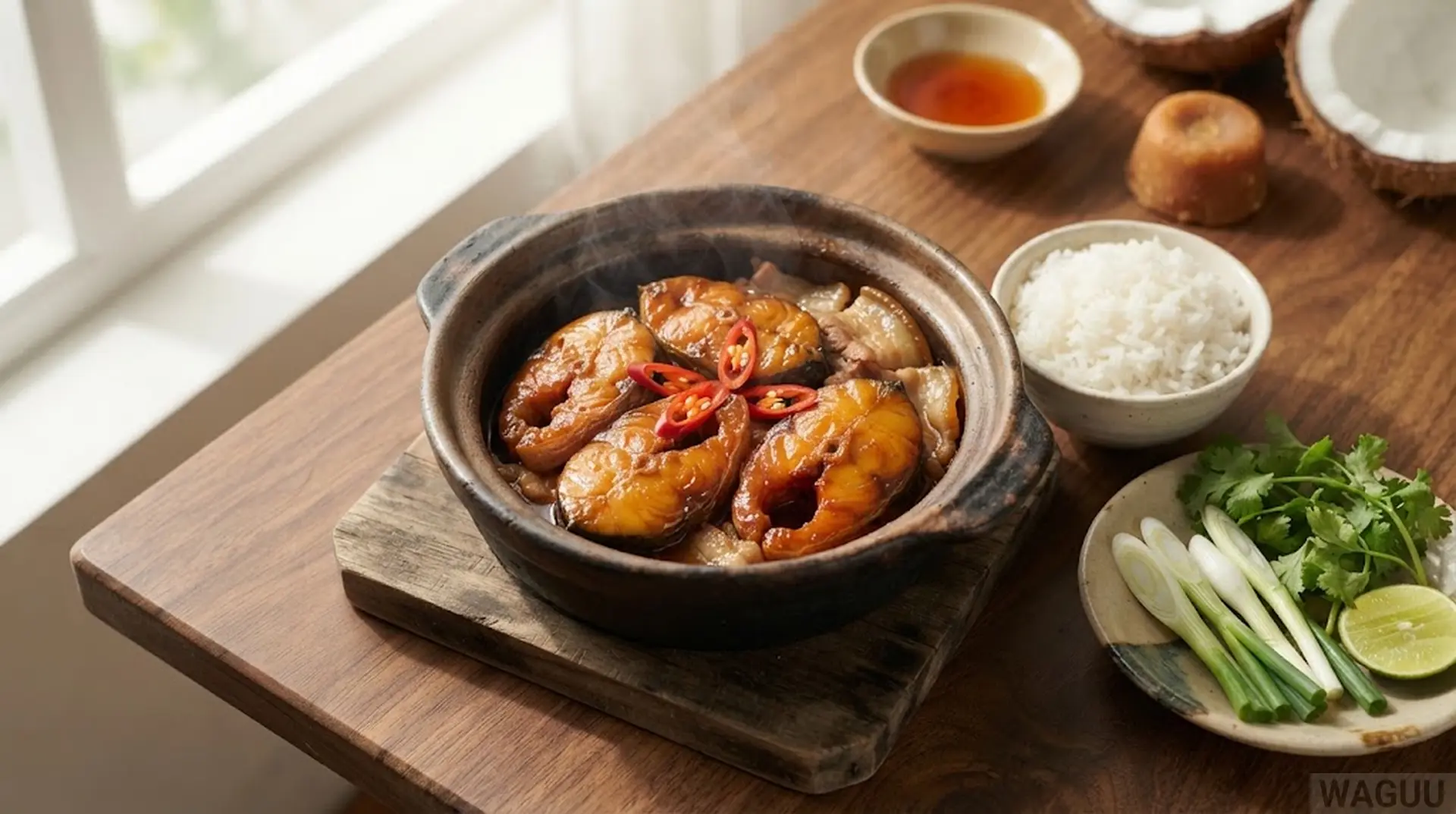
Summary: Catfish simmered in a clay pot in a caramel sauce of fish sauce, palm sugar, and coconut water, seasoned with garlic, shallots, and chile, served with jasmine rice. Total time 105 minutes, makes 6 servings.
Did you make this recipe? Share your result with the community.
Category: Fish and Seafood · Vietnamese Cuisine
Success rate: not rated yet% of users nailed this recipe
Quick overview
- Dish:
- Category: fish-and-seafood, vietnamese-cuisine
- Cuisine: Vietnamese
- Main ingredient: Catfish, 2.6 lb (gutted, skinless, cut into 1.5-inch pieces)
- Guide: 12 most famous Vietnamese dishes: traditional recipes from Vietnamese cuisine
- Total time: 105 minutes (25 min prep + 80 min cooking)
- Difficulty: Medium
- Servings: 6 (Serving weight: 14.9 oz)
- Key technique: Making caramel from palm sugar and slow-simmering the fish in a clay pot
- Cooking methods: Simmering,
- Dietary info & allergens: fish (fish sauce, catfish), soy (soy sauce), peanuts (not palm sugar, peanuts only as a serving garnish)
- Great for: A family dinner, meal prep for several days, a packed lunch, or a feast with rice.
- Nutrition (per 1 serving): 805 kcal, Protein: 52.0 g, Fat: 24.7 g, Carbs: 94.0 g
- Storage: 4 days in the fridge, 1 month in the freezer
- Pairing: Vietnamese lager, dry Riesling, jasmine tea
- In short: Catfish pieces simmered in a caramel of palm sugar and fish sauce with coconut water, garlic, and chile. Total time 105 minutes, 6 servings.
WAGUU says: “Cá kho is not cooked quickly. The caramel and fish sauce must reduce into a syrup that coats the fish, not into a soup.”
Key facts
| Prep time: | 25 minutes |
| Cook time: | 80 minutes |
| Temperature: | Caramel at 340 °F, simmer at 198–203 °F (below boiling) |
| Servings: | 6 |
At a glance
Cá kho tộ is a dish made from few ingredients, and its flavor comes from long simmering. What matters is the caramel, which must not burn, and the fact that the fish sits in a single layer in the pot. Anyone who scorches the caramel or flips the fish with a fork ends up with a bitter or broken sauce. It is served in the clay pot it simmered in, with jasmine rice.
Ingredients
Base servings: 6 servings • Serving weight: 14.9 oz
| Ingredient | Amount | Quality |
|---|---|---|
| catfish | 2.6 lb | gutted, skinless, cut into 1.5-inch pieces |
| pork belly | 5.5 oz | skin-on, thinly sliced |
| coconut water | 27.1 tbsp | pure, unsweetened, from a young coconut |
| fish sauce | 3.4 fl oz | anchovy-fermented, unsweetened |
| palm sugar | 3.0 oz | dark, coarse, for the caramel |
| soy sauce | 1.4 tbsp | dark, naturally fermented |
| garlic | 8 cloves | fresh, finely minced |
| shallots | 4 whole | red, finely chopped |
| ginger | 1.0 oz | fresh, thinly sliced |
| fresh chile | 3 whole | red, thinly sliced into rings |
| ground black pepper | 0.14 oz | freshly ground |
| salt | 0.11 oz | fine sea salt |
| sunflower oil | 2 tbsp | neutral flavor |
| scallions | 4 whole | fresh, sliced on the bias |
| fresh cilantro | 1.0 oz | stems and leaves, roots removed |
| jasmine rice | 16 oz | long-grain, fragrant, free of dust |
| lime | 1 whole | juicy, cut into wedges |
Why you’ll love this recipe
- The flavor deepens the next day: Both the sauce and the fish are best after resting in the fridge. The dish can be made ahead and simply reheated.
- Few ingredients, long simmer: Caramel, fish sauce, coconut water, and garlic. Time and a clay pot do the rest.
- Exact ratios for 6 servings: The fish, caramel, and coconut water are calculated for six servings including rice. The serving count recalculates based on your diners.
How it works: The flavor of cá kho tộ comes from caramelizing sugar and evaporating water. The caramel is made in a dry pan until dark amber and must be stopped with fish sauce, or it will burn. The fish must not be flipped with a fork, only with tongs or by moving the pot. Coconut water replaces part of the liquid, which keeps the sauce from turning out just salty. A clay pot holds heat and spreads it evenly, so the sauce does not scorch at the bottom.
Recipe overview
Prep: 25 min | Cook: 80 min | Difficulty: Medium | Servings: 6 | Type: Main dish | Origin: Vietnamese
Detailed instructions
Overall progress: 0 % done
Phase 1: Preparing the fish and aromatics – 25 min
Equipment: cutting board, sharp knife, bowl
1. Pat the catfish dry with paper towels and cut it into pieces four centimeters long. Place the pieces on the cutting board skin-side down and put them in the fridge.
2.Finely chop the garlic and shallots, slice the ginger into thin strips, and cut the chiles into rings. Slice the pork belly thinly and pat it dry.
VKB:The fish pieces are the same size and dry to the touch. The aromatics are cut to the same size and ready in bowls.
Before you move to the next step:
Do not rinse the fish under running water. Dry it with a paper towel, otherwise it will fall apart during braising and the sauce will stay watery.
Phase 2: Palm Sugar Caramel – 10 min
Equipment: clay pot or heavy-bottomed saucepan, wooden spoon
1. Add the palm sugar to the pot and heat over medium heat until it melts and darkens to an amber color. Stir with a wooden spoon so the sugar doesn’t burn at the bottom.
2. Once the caramel darkens, pour in the fish sauce and soy sauce. The mixture will sizzle and thicken; stir until the caramel dissolves.
3. Pour in the coconut water and bring the sauce to a boil. Taste: it should be salty, sweet, and slightly caramelized, not bitter.
VKB: The caramel is dark amber and smooth, with no sugar crystals. The sauce is clear and glossy, coating the spoon with a thin film.
Before you move to the next step:
Never let the caramel turn black. Burnt sugar gives the sauce a bitter taste that can’t be fixed. As soon as it turns amber, stop the cooking with the sauce.
Phase 3: Sautéing the Base – 8 min
Equipment: skillet, spatula
1. Heat oil in a skillet and sauté the pork belly slices until golden and the fat renders. Remove and set aside.
2. In the same fat, sauté the garlic, shallots, and ginger until fragrant. Add them to the pot with the caramel sauce and stir.
VKB: The pork belly slices are golden at the edges and light in the center. The aromatics smell of garlic and ginger, not burnt.
Before you move to the next step:
Do not let the garlic turn brown. Burnt garlic becomes bitter and gives the sauce an unpleasant aftertaste that you can’t mask.
Phase 4: Braising the Fish – 45 min
Equipment: clay pot with lid, tongs, spoon
1. Place the fish pieces in the pot in a single layer, skin side up. Pour the sauce over them so they are two-thirds submerged.
2. Bring the sauce to a boil, reduce the heat to below a simmer, and cover the pot with a lid. During braising, spoon the sauce over the top pieces of fish.
3. Halfway through braising, add the sautéed pork belly slices and chile rings. Do not flip the fish; just gently swirl the pot so the sauce reaches all pieces.
VKB: The fish pieces hold their shape, the meat can be flaked with a spoon, and the sauce has thickened to a syrup that is glossy and doesn’t run off the spoon.
Before you move to the next step:
Never flip the fish with a fork or spoon. It would fall apart and cloud the sauce. Just swirl the pot or move the pieces with tongs.
Phase 5: Reducing the Sauce and Cooking Rice – 25 min
Equipment: rice pot, ladle, lid
1. Remove the lid and let the sauce reduce slowly until thickened. During reduction, baste the fish so the surface doesn’t dry out.
2. Rinse the jasmine rice, add water in a 1:1.5 ratio, and cook covered over the lowest heat. After cooking, let it rest and fluff with a fork.
VKB: The sauce is thick and glossy, clinging to the fish. The rice is fluffy, grains separate, and there are no wet spots at the bottom of the pot.
Before you move to the next step:
Do not let the sauce reduce to dryness. When it starts to pull like syrup, remove the pot from the heat. Burnt caramel is bitter and can’t be fixed.
Phase 6: Serving in the Pot – 5 min
Equipment: serving platter, rice bowls, spoons
1. Place the pot with the fish on a wooden trivet and bring it to the table. Spoon the sauce over the fish pieces so they shine.
2. Serve the rice in separate bowls, sprinkle with scallions and cilantro, and place a lime wedge next to the pot. Everyone helps themselves to the sauce with a spoon.
VKB: The fish is hot, the sauce thick and glossy, the rice fluffy and white. There is no layer of burnt caramel at the bottom of the pot.
Required Equipment
| Utensil | Ideal Size | Alternative | Risk |
|---|---|---|---|
| clay pot | 2 L capacity, with lid | heavy-bottomed saucepan with a wide base | thin-walled pot will burn the caramel at the bottom and the sauce will become bitter |
| meat tongs | 30 cm length | two spoons | a fork will break the fish pieces and cloud the sauce |
| wooden spoon | flat, 30 cm length | high-heat silicone spatula | a metal spoon will burn the caramel and leave stuck bits on the bottom |
| basting spoon | deep, with a long handle | small ladle | a large ladle will splash the sauce and overturn the fish |
Shopping List
Nutrition Profile
Values per 1 serving (without side dish). Calculated from average nutritional values of ingredients.
| Nutrient | Per 100 g | Per 1 serving | Per 6 servings |
|---|---|---|---|
| Energy | 799 kJ / 191 kcal | 3368 kJ / 805 kcal | 20210 kJ / 4826 kcal |
| Fat | 5.9 g | 24.7 g | 148.2 g |
| of which saturated | 2.0 g | 8.6 g | 51.6 g |
| Carbohydrates | 22.3 g | 94.0 g | 564.0 g |
| of which sugars | 12.4 g | 12.4 g | 12.4 g |
| Protein | 12.3 g | 52.0 g | 312.0 g |
| Salt | 3.8 g | 3.8 g | 3.8 g |
Reference intake of an average adult (8400 kJ / 2000 kcal).
WAGUU Pro Level
- Pro standard: Verified recipe with precise ratios and visual checkpoints.
- Tip 1: Make the caramel in a dry pan without water and stir with a wooden spoon. The sugar melts evenly and doesn’t burn.
- Tip 2: Lay the fish in the pot skin side up. The skin holds each piece together and protects the flesh from overcooking.
- Tip 3: While simmering, just spoon the sauce over the fish. Every flip breaks the pieces and clouds the sauce.
- Tip 4:
The Science Behind It
Sugar caramelization starts around 340°F. The sugar breaks down into brown compounds with a bittersweet taste that give the sauce its color and depth. Adding fish sauce drops the temperature sharply and stops the caramelization. Fish sauce contains free amino acids and salt that bind with the caramel to create a thick, glossy sauce. Fish proteins coagulate slowly around 195°F, which keeps the fish moist and intact. Coconut water contains minerals and a mild sweetness that balances the saltiness of the sauce.
Fine Dining – Professional Techniques
- Plating: Pack the rice into a small bowl and invert it onto the plate. Place a piece of fish next to it and spoon the sauce over so it runs down only one side of the rice.
- Texture Contrasts: Add a few crispy fried shallots and thin cucumber slices to the fish. The crunchy layer stands up to the soft flesh and thick sauce.
- Temperature Contrast: Serve the fish hot straight from the pot and the cucumber cold from the fridge. Warm sauce and cool cucumber in one bite is the foundation of the flavor.
- Aromatic Additions: Put cilantro, scallions, and a lime wedge on the edge of the plate. The acid from the lime at the end of the bite cleanses the caramel flavor.
Sensory Radar
- Appearance: Dark amber fish pieces in a thick, glossy sauce, white jasmine rice, green scallions, and red chili rings.
- Aroma: First caramel with fish sauce, then garlic and ginger, and finally fresh cilantro with lime.
- Taste: Salty from fish sauce, sweet from caramel, deep from coconut water, and spicy from chili.
- Texture: Fish soft and moist, sauce thick and sticky, rice fluffy, herbs crisp.
Pairings
- Vietnamese Lager: A light, crisp beer with high carbonation cleanses the palate from the sweet sauce. Serve it chilled to 43–46°F.
- Dry Riesling: The acid in Riesling pairs with the caramel sweetness of the sauce. Sweeter wines would double the caramel and make the taste heavy.
- Jasmine Tea: Unsweetened jasmine tea with floral aroma. It complements jasmine rice and lets the cilantro shine.
Variations
Allergens and Dietary Information
Contains: fish (fish sauce, catfish), soy (soy sauce) • Gluten: yes, trace amounts from soy sauce • Not suitable for: people with fish, soy, and gluten allergies
Suitable for
Family dinner, make-ahead meals, lunchbox, and a feast with rice.
Substitution Guide
- catfish: pangasius, carp, or salmon; for salmon, cut the simmering time in half
- pork belly: pork shoulder or boneless chicken thigh; cooking time remains the same
- coconut water: water with a tablespoon of coconut milk; the flavor will be milder
- palm sugar: dark brown sugar or maple syrup; the caramel will be less aromatic
- fish sauce: soy sauce with a teaspoon of salt; umami will be weaker
FAQ
Why is my sauce bitter?
The caramel burned. You must pull the sugar off the heat the moment it turns amber. If it turns black, it’s burnt and the bitterness can’t be removed.
What fish to use if I don’t have catfish?
Pangasius, carp, or canned tuna. Firm white fish with tight flesh holds its shape. Salmon works too, but simmer it for less time.
Do I need a clay pot?
No, but a heavy-bottomed pot holds heat evenly and keeps the sauce from burning. If you only have a thin saucepan, simmer at lower heat and stir more often.
How long does cá kho tộ keep in the fridge?
Four days, and the flavor deepens each day. The sauce with fish sauce and caramel doesn’t spoil quickly. It’s best the next day.
What can I use instead of coconut water?
Water with a tablespoon of coconut milk or just water with a tablespoon of sugar. The flavor will be flatter, but the sauce will thicken the same. Coconut water adds a mild sweetness and mineral taste.
How much rice per serving?
Seventy to eighty grams of dry jasmine rice per serving. After cooking, the volume roughly doubles. Serve with a piece of fish and two tablespoons of sauce.
WAGUU Petr advises: Cooking for 6 or more?
6–8 people: Make the caramel in a wide pot and simmer the fish in a single layer. Cook rice in batches and keep it warm in the oven. • 10+ people: Make the caramel and sauce in double batches and divide between two pots. Simmer the fish in two layers in batches, or use two pots. Pull the sauce off the heat before serving so it doesn’t burn.
Sides and Serving
Serving: Cá kho tộ is served in a clay pot on a wooden trivet. Rice goes in separate bowls, and the sauce is spooned directly from the pot. Put cilantro, scallions, lime wedges, and a bowl of chili on the table for those who want more heat.
Storage and Reheating
Fridge: 4 days • Freezer: 1 month • Reheating: Reheat the fish in a covered pot over low heat. Do not bring the sauce to a rapid boil; the caramel would burn and turn bitter.
Author: WAGUU Petr & Team • Published: 9 Oct 2026 • Updated: 10 Oct 2026
More recipes from the article
Guide: 12 Most Famous Vietnamese Dishes: Traditional Recipes from Vietnamese Cuisine
Phở Bò – Beef Noodle Soup with Star Anise, Cinnamon, and Charred Ginger
Phở Gà – Chicken Noodle Soup with Light Broth, Star Anise, and Fresh Herbs
Bánh Mì – Crispy Vietnamese Baguette with Meat, Pâté, and Pickled Vegetables
Bún Chả – Grilled Pork Slices and Patties with Rice Noodles and Sweet-and-Sour Sauce
Gỏi Cuốn – Fresh Summer Rolls with Rice Paper, Shrimp, and Herbs
Bún Bò Huế – Spicy Noodle Soup from Hue with Lemongrass and Chili
Cơm Tấm – Broken Rice with Grilled Pork, Egg, and Fish Sauce
Cao Lầu – Hoi An Specialty with Firm Rice Noodles and Crispy Chips
Bánh Xèo – Crispy Rice Pancake with Turmeric, Shrimp, and Bean Sprouts
Chả Giò – Fried Vietnamese Spring Rolls with Meat, Vegetables, and Noodles
Chè – Vietnamese Sweet Desserts with Beans, Tapioca, and Coconut Milk
More recipes you might like
Why WAGUU?
WAGUU recipes are checked for accuracy of ingredients, methods, and nutritional values.
Photo Gallery from the Process
Community photos: Cook, snap a photo, and share your result.
You can upload photos in the comments below or send them by email.
Did you film a video of our recipe? Paste the link to YouTube, YouTube Shorts, TikTok, Instagram Reels, Facebook Reels, Pinterest, Vimeo, or X (Twitter) in the comments – we’ll be happy to publish it and help you and your content get noticed.
Common Mistakes
- Burnt caramel – the sugar must stay amber. Blackened sugar gives the sauce a bitterness you can’t remove.
- Flipping fish with a fork – pieces break and the sauce clouds. Just swirl the pot or use tongs.
- Fish in two layers – the bottom pieces overcook and the top ones stay tough. Simmer in a single layer.
- Boiling the sauce dry – the caramel burns. Take the pot off the heat when the sauce starts to pull like syrup.