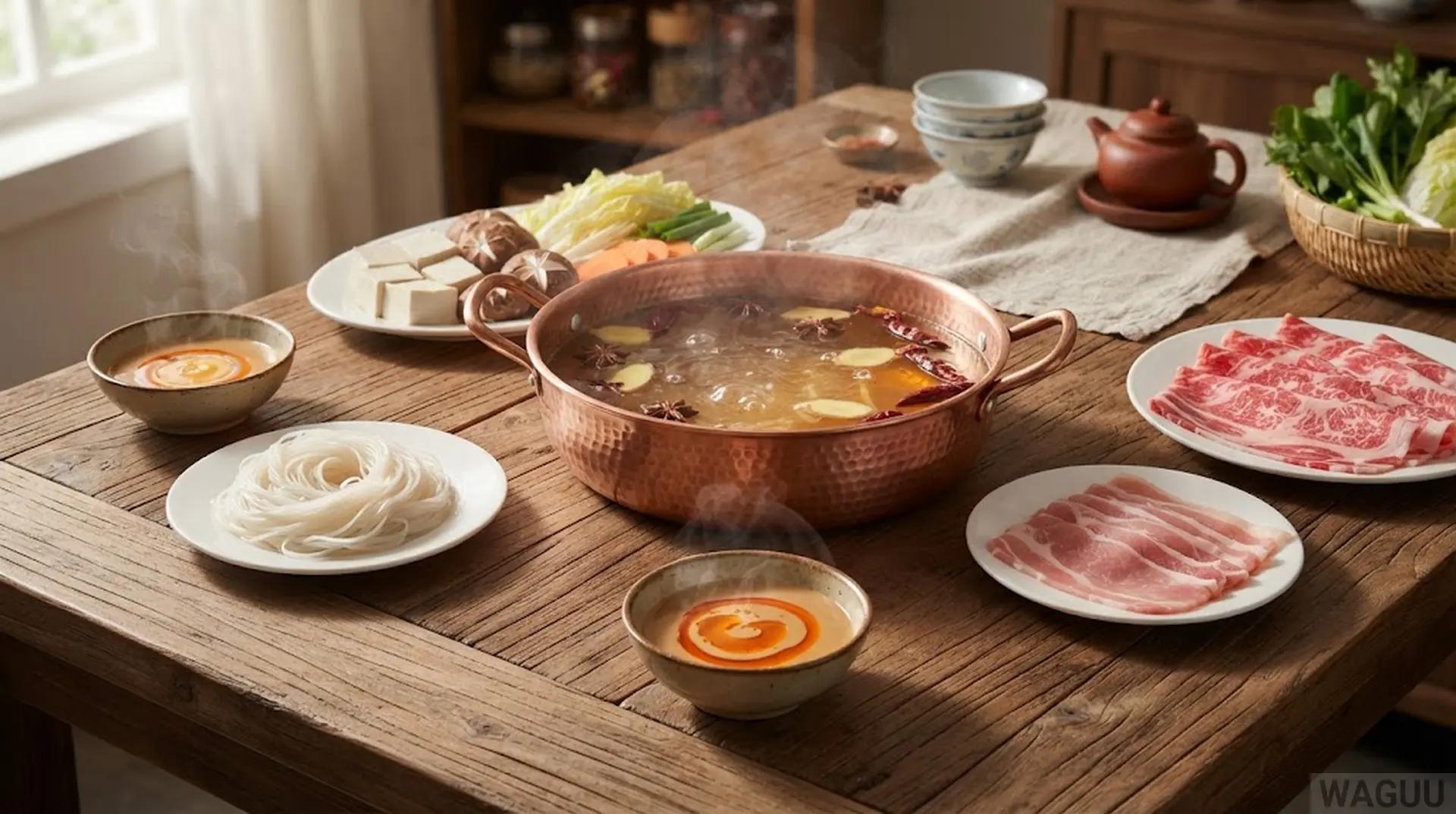
Summary: Hot pot, the Chinese shared meal: a pan of simmering broth flavored with star anise, Sichuan pepper, ginger and soy sauce stands in the middle of the table. Guests drop thin slices of beef and pork, tofu, mushrooms, vegetables and rice noodles into it and eat what they cook, dipping each piece in their own bowl of sesame paste and chile oil. Total time 60 minutes plus the cooking at the table, base 6 servings.
Cooked this recipe? Share the result with the community.
Category: Soups, Chinese cuisine, Party food
Success rate: not rated yet % of users managed this recipe
Quick overview
- Dish: Hot pot – a shared meal cooked in bubbling broth at the table
- Category: Soups, Chinese cuisine, Party food
- Cuisine: Chinese
- Main ingredient: Beef topside, 16 oz (3 1/2 oz per portion) plus boneless pork neck, 12 oz
- Guide: 12 most famous Chinese dishes: traditional recipes from Chinese cuisine
- Total time: 60 minutes (45 minutes prep + 15 minutes cooking) plus the time at the table
- Difficulty: Easy
- Servings: 6 (Portion weight: 28 oz including broth)
- Key technique: Cooking thin slices of raw ingredients in simmering flavored broth at the table
- Method types: Simmering, poaching, building the broth base
- Dietary info & allergens: soy, sesame
- Great for: A shared dinner with friends, a celebration, a cold evening, New Year’s Eve, dinner for ten people
- Nutrition (per portion): 795 kcal, Protein: 1 3/4 oz, Fat: 1 1/2 oz, Carbohydrates: 2 oz
- Storage: 2 days in the fridge, broth 1 month in the freezer
- Pairing: Jasmine tea, light lager, dry rosé
- In short: A well-seasoned broth, slices cut thin and the order in which the ingredients go in – three things that decide whether the broth stays clear or turns cloudy.
WAGUU says: “Hot pot is not a soup, it is a way of eating. The broth simmers throughout the meal and the guests add ingredients in the order that keeps both flavor and heat right.”
Key facts
| Prep time: | 45 minutes |
| Cook time: | 15 minutes plus the time at the table |
| Temperature: | Broth held between 200 and 212 °F (95 and 210 °F), meat slices cook in 20 to 30 seconds |
| Servings: | 6 (portion weight 791 g including broth) |
At a glance
Hot pot depends on two things: the flavor of the broth and the order in which ingredients enter it. The broth is first heated with ginger, star anise and Sichuan pepper so that the aromatic compounds move into the water. Meat is cut into slices a sixteenth of an inch thick, which heat through in twenty to thirty seconds; a thicker slice would stay raw in the middle. Ingredients that release starch, such as noodles and tofu, go in last so they do not cloud the broth. At the table the broth is kept just below a rolling boil, because a hard boil breaks the meat slices apart and evaporates the broth.
Ingredients
Base servings: 6 • Portion weight: 28 oz
| Ingredient | Quantity | Quality |
|---|---|---|
| beef topside | 21.16 oz | sliced 2 mm thick, slightly chilled |
| boneless pork neck | 14.11 oz | also sliced thin, membrane removed |
| firm tofu | 10.58 oz | vacuum packed, cut into three-quarter inch cubes |
| shiitake mushrooms | 7.05 oz | fresh, stalks removed, caps sliced |
| napa cabbage | 14.11 oz | firm, cut into wide ribbons |
| carrot | 5.29 oz | cut into thin rounds |
| scallions | 3.53 oz | fresh, cut on the diagonal |
| rice noodles | 10.58 oz | dried, thin, soaked in cold water |
| chicken stock | 8.45 cups | unsalted, homemade or from a cube |
| sesame paste | 2.12 oz | 100 % sesame, for the dip |
| soy sauce | 0.25 cups | light, in the broth and the dip |
| Shaoxing rice wine | 3.38 tbsp | dry, lifts the smell of the meat |
| star anise | 0.11 oz | whole, into the broth |
| Sichuan pepper | 0.18 oz | whole, toasted and ground |
| ginger | 1.06 oz | fresh, sliced |
| garlic | 0.88 oz | fresh, sliced |
| chile oil | 2.71 tbsp | with pieces of chile, for the dip |
| sesame oil | 1.35 tbsp | toasted, for the dip |
Why you will love this recipe
- Everyone cooks what they like: Each guest decides how much meat, vegetable or tofu to eat. Nobody is served something they would rather skip.
- A flavor that develops: The broth changes through the evening as juices from meat, mushrooms and vegetables move into it.
- Exact quantities for 6 servings: 3 1/2 oz of beef per portion, 8 cups of broth and 10 oz of noodles for the whole batch.
- Beginners can manage it: Six phases, five checkpoints and one pan in the middle of the table. What separates a great result from an average one is cutting the meat thin and holding the broth at the right temperature.
Why it works: A thin slice of meat heats through in twenty to thirty seconds because heat reaches it from both sides. Meat proteins contract between 140 and 158 °F (60 and 160 °F); left in hot liquid longer, the slice squeezes out water and firms up. Broth transfers heat far faster than air, which is why hot pot is quicker than grilling in a pan. Aromatic compounds from star anise, ginger and Sichuan pepper are partly water soluble and partly fat soluble, so only some of them move into the broth; the rest arrive through the dip of sesame paste and chile oil, which carry fat. Tofu and noodles go in at the end because the starch and protein they release clouds the broth.
Recipe overview
Prep: 45 min | Cook: 15 min | Difficulty: Easy | Servings: 6 | Type: Main course | Origin: Chinese
Detailed method
Overall progress: 0 % complete
Phase 1: Slicing the meat and vegetables – 30 min
Equipment: freezer, board, sharp knife
1. Put the beef topside and the pork neck in the freezer thirty minutes so they firm up and can be sliced thin. Then cut them across the grain into slices a sixteenth of an inch thick. Cut the tofu into three-quarter inch cubes, the mushrooms into slices, the napa cabbage into wide ribbons, the carrot into thin rounds and the scallions on the diagonal. Soak the rice noodles in cold water. Arrange everything on large plates and put them on the table.
Checkpoint: The meat slices let light through when held up and keep their shape. The vegetables are cut to even sizes and the noodles are pliable rather than broken.
Before you move on:
Do not wash the meat. Water on the surface would end up in the broth and cloud it. Pat it dry with paper towels and slice it while it is chilled.
Phase 2: The broth base – 10 min
Equipment: hot pot pan or a wide casserole
2. Pour the chicken stock into the pan and add the sliced ginger, garlic, star anise, ground Sichuan pepper, soy sauce and Shaoxing wine. Bring it to a boil and simmer gently ten minutes, so the spices open up. Then lift out the ginger and the star anise so the broth does not turn bitter.
Checkpoint: The broth is clear, light brown and smells of anise and ginger. Taste it: full flavor, but not over-salted.
Before you move on:
Do not salt the broth in advance. Salt from the meat, the mushrooms and the soy sauce arrives during the meal, so a broth seasoned now can be too salty by the end.
Phase 3: Dipping sauces – 5 min
Equipment: six small bowls, whisk
3. Mix the sesame paste with the remaining soy sauce and the sesame oil into a smooth, thick sauce; loosen it with a spoon of broth if needed. Divide it between six small bowls and put a teaspoon of chile oil on top of each. Set a bowl at every place at the table.
Checkpoint: The dip is thick, glossy and holds on a spoon; the chile oil stays on the surface as an orange layer rather than mixing in.
Before you move on:
Stir the sesame paste before you use it. On standing, the oil separates to the surface; without mixing, the dip is thin on top and solid underneath.
Phase 4: Setting up at the table – 5 min
Equipment: portable burner, extension cord, ladle
4. Move the pan onto a portable burner in the middle of the table, plug it in and hold the broth just below a rolling boil. Arrange the plates of ingredients around the pan, set a bowl of dip, chopsticks and a small ladle at every place. Put out a bowl for scraps and empty plates for cooked food.
Checkpoint: The broth bubbles gently rather than boiling hard. Every ingredient is within reach and each place has its own dip, chopsticks and ladle.
Before you move on:
A hard boil evaporates the broth quickly and breaks the meat slices apart. Keep it at a gentle simmer and top it up with boiling water, never cold.
Phase 5: Cooking at the table – 10 min
Equipment: chopsticks, ladle, slotted spoon
5. Begin with the meat: pick up slices with chopsticks and lower them into the simmering broth for twenty to thirty seconds, until they turn gray. Dip each piece in your own bowl. Then add the mushrooms, carrot and napa cabbage and cook them two minutes. Finish with the tofu and the soaked rice noodles, which need only a minute or two to heat through.
Checkpoint: The meat is gray and juicy after twenty to thirty seconds, never tough. The vegetables are bright, the noodles soft but whole, and the broth stays mostly clear.
Before you move on:
Do not leave meat in the broth for a minute or more. The proteins contract, water is pushed out and the slice turns tough; twenty to thirty seconds is enough.
Phase 6: The broth to finish – 5 min
Equipment: ladle, soup bowls
6. When the main ingredients are eaten, taste the broth: over the evening it has picked up the flavor of the meat, mushrooms and vegetables. Adjust it with a little soy sauce and ladle it into bowls as a soup. Add scallion and a drop of sesame oil to each bowl.
Checkpoint: The broth is darker than at the start but still clear and free of cloudiness. The flavor is full and balanced and the scallion on the surface stays bright green.
Equipment needed
| Item | Ideal size | Alternative | Risk |
|---|---|---|---|
| hot pot pan | 4 quart, wide and shallow | a wide casserole or an electric slow cooker | a deep narrow pan makes ingredients hard to find with chopsticks |
| portable burner | 1500 W with a control dial | an induction plate on an extension cord | without a control dial the broth boils hard and evaporates |
| slotted spoon | 5 inches, with a handle | a ladle with a perforated base | without one, cooked pieces are hunted with chopsticks and overcook |
| sharp slicing knife | 8 inch blade, thin | a fillet knife or an electric slicer | a thick slice heats through slowly and stays raw inside |
| dipping bowls | six bowls of 4 oz | small dessert bowls | a shared bowl spreads flavors between guests and cools the dip |
Shopping list
Nutrition profile
Values per portion (including a share of the broth). Calculated from average nutritional values of the ingredients. Portion weight 28 oz. The broth is topped up with boiling water at the table, so its share per portion rises through the evening and the values fall slightly.
| Nutrient | Per 3 1/2 oz | Per portion | For 6 servings |
|---|---|---|---|
| Energy | 101 kcal | 795 kcal | 4770 kcal |
| Fat | 5.2 g | 40.9 g | 245.6 g |
| of which saturated | 1.3 g | 10.6 g | 63.8 g |
| Carbohydrates | 7.1 g | 56.4 g | 338.3 g |
| of which sugars | 6.2 g | 6.2 g | 6.2 g |
| Protein | 6.4 g | 50.2 g | 301.5 g |
| Sodium | 0.16 g | 1.26 g | 7.59 g |
| salt equivalent | 0.40 g | 3.16 g | 18.97 g |
Reference intake of an average adult (2000 kcal). Sodium comes mainly from the broth and the soy sauce; with an unsalted homemade stock, halve the soy sauce and season at the table. Salt equivalent is sodium multiplied by 2.5.
WAGUU Pro level
- Pro standard: A tested recipe with exact quantities and visual checkpoints.
- Tip 1: Put the meat in the freezer thirty minutes and slice it while it is firm. The slices come out an even thickness and heat through in the same time.
- Tip 2: Keep two ladles at the table: one for the broth and a slotted one for cooked pieces. It saves hunting for food with chopsticks.
- Tip 3: Never salt the broth in advance. Salt arrives from the meat and mushrooms, and by the end of the meal a broth seasoned early can be too salty to drink.
- Tip 4: Strain the leftover broth and use it as the base of a soup the next day. In the fridge it sets to a jelly, because it holds collagen from the meat.
The science behind it
Hot pot uses two pieces of physics. The first is fast heat transfer: simmering broth at close to 212 °F (210 °F) warms a thin slice of meat from both sides and heats it through in twenty to thirty seconds. A slice a centimeter thick would take several minutes, and the outside would contract and toughen in the meantime. The second is solubility. Some aromatic compounds from star anise, ginger and Sichuan pepper dissolve in water, others only in fat; only part of them therefore reaches the broth, and the rest of the aroma arrives through the dip of sesame paste and chile oil, which carry fat. Meat proteins contract between 140 and 158 °F (60 and 160 °F) and push out water; cooked longer, the slice dries and turns firm. Tofu and rice noodles go in last because they release starch and protein that cloud the broth.
Fine dining – professional techniques
- Plating: Lay cooked pieces on a warm plate in groups – meat, mushrooms, vegetables – so that each texture stays distinct and each guest can choose.
- Texture contrast: Add fresh cilantro and chopped scallion at the table; they never meet the heat and stay crunchy.
- Temperature contrast: Serve the dip at room temperature rather than from the fridge. A cold dip firms the fat in the sesame paste.
- Aromatic finish: Stir a spoon of pickled garlic and a pinch of ground Sichuan pepper into the dip. The tingle meets the warmth of the chile oil.
Sensory radar
- Appearance: A gently bubbling pan of broth in the middle of the table, plates of red meat, white tofu, brown mushrooms and bright vegetables around it, and orange chile oil floating on the dips.
- Aroma: Anise and ginger from the broth, sesame paste in the dip and a faint smoky note from the chile oil.
- Taste: Savory, spiced broth, sweetness from mushrooms and vegetables and a warm heat with a tingle at the end.
- Texture: Meat tender and juicy, mushrooms springy, napa cabbage crunchy, noodles soft and slippery.
Pairing
- Jasmine tea: A warm floral drink cleanses the palate between bites; keep it going all evening.
- Light lager: Hop bitterness cuts the fat of the meat and the sesame paste. Serve at 43–46 °F (6–45 °F).
- Dry rosé: Fruit acidity balances the heat and carries no tannins to clash with the chile.
- Homemade limeade: Acidity and fizz refresh after a spicy bite and suit kids and drivers.
Variations
- Two broths in one pan: Use a divided pan, filling one half with a spicy broth of chile and Sichuan pepper and the other with a mild mushroom broth. Each guest then eats to their own tolerance.
- Seafood instead of meat: Replace the beef and pork with 16 oz of shrimp, 12 oz of mussels and 10 oz of fish pieces. The broth simmers for less time and fish goes in for twenty seconds.
- Meat-free version: Swap the meat for extra mushrooms, tofu and seitan and add 10 oz more vegetables. Make the broth with vegetable stock and sharpen it with two spoons of soy paste.
Allergens and dietary information
Contains: soy (tofu, soy sauce); sesame (sesame paste, sesame oil) • Gluten: only if the soy sauce, rice wine or stock contains wheat; check the labels • Not suitable for: anyone with a soy or sesame allergy
Great for
A shared dinner with friends, a celebration, a cold evening, New Year’s Eve, dinner for ten people, a table where everyone chooses what they eat.
Substitution guide
- Beef topside: ribeye or sirloin. Ribeye is more tender but pricier and loses more flavor to the broth.
- Pork neck: pork leg or chicken thighs. Leg is leaner, chicken cooks faster.
- Napa cabbage: Chinese cabbage or bok choy. Napa is sweeter and softer, bok choy crunchier.
- Rice noodles: thin wheat noodles or glass noodles made from mung bean. Glass noodles cook in half a minute.
- Sesame paste: sugar-free peanut butter with a spoon of sesame oil. Stronger flavor.
- Chicken stock: beef stock with star anise and cinnamon. Darker and more powerful.
FAQ
How thin should the meat be sliced?
A sixteenth of an inch. Such a slice heats through in twenty to thirty seconds in simmering broth. A thicker slice stays raw inside or overcooks and toughens.
Can I use an induction hob on the table?
Yes, if the pan is induction-ready. Put the hob in the middle of the table and use a fused extension cord. Keep the setting medium so the broth only simmers.
Why does the broth turn cloudy?
Most often because of noodles and tofu, which release starch and protein. Add them at the end of the evening, once the other ingredients have been eaten.
How much broth do I need?
Two quarts for six people. Some evaporates during the meal, so keep a kettle of boiling water at the table and top up as needed – never with cold water.
What should I do with the leftover broth?
Strain it, cool it and keep it in the fridge. Use it the next day as the base of a noodle soup; in the cold it sets to a jelly, because it holds collagen from the meat and mushrooms.
Is hot pot gluten free?
Usually yes. Use tamari instead of soy sauce and rice noodles instead of wheat noodles. Meat, vegetables, mushrooms and tofu contain no gluten.
WAGUU Petr advises: cooking for 6 or more?
6–8 people: Prepare 10 cups of broth and 28 oz of meat. Arrange the ingredients on two sets of plates so nothing has to be replenished mid-meal. • 10+ people: Use two pans on two burners, one spicy and one mild. Slice the meat a day ahead and keep it in the fridge under plastic; make the dip in double quantity and divide it between eight bowls.
Sides and serving
Storage and reheating
Fridge: 2 days (broth 3 days) • Freezer: 1 month • Reheating: Bring the broth to a boil and simmer it two minutes, then add fresh meat and vegetables. Ingredients that have already been cooked should not be reheated, as they lose their texture. Warm strained broth gently in a pan.
Author: WAGUU Petr & Team • Published: 8 Oct 2026 • Updated: 10 Oct 2026
More recipes from this article
Guide: 12 most famous Chinese dishes: traditional recipes from Chinese cuisine
Peking duck – celebratory roast duck with crisp skin, thin pancakes and a sweet sauce
Kung Pao chicken – spicy Sichuan chicken with peanuts, chile and a sweet-savory sauce
Mapo tofu – tofu in a spicy Sichuan sauce with ground meat and Sichuan pepper
Sweet and sour pork – fried pork pieces in the classic sweet and sour sauce
Char siu – Cantonese roast pork with a glossy caramelized crust
Dim sum – small Cantonese dishes, especially steamed dumplings and parcels
Xiaolongbao – delicate Shanghai dumplings filled with pork and hot soup
Chow mein – stir-fried wheat noodles with vegetables, meat or seafood
Yangzhou fried rice – fried rice with egg, shrimp, ham and peas
Dan dan noodles – Sichuan noodles with a spicy sauce and chile oil
Wonton soup – clear broth with filled wonton dumplings and scallions
Other recipes you might like
Why WAGUU?
Recipes on WAGUU are checked for accurate quantities, method and nutrition. In this recipe the amounts match across the ingredient table, the cooking phases, the shopping list and the print view – 16 oz of beef serves six at 3 1/2 oz each, 8 cups of broth gives 1 1/2 cups per portion and 10 oz of rice noodles 1 3/4 oz per portion.
Photo gallery from the process
Community photos: Cook it, photograph it and share the result.
Upload your photos in the comments below or send them by email.
Filmed a video following our recipe? Post a link to YouTube, YouTube Shorts, TikTok, Instagram Reels, Facebook Reels, Pinterest, Vimeo or X (Twitter) in the comments – we will gladly publish it and help get your work seen.
Most common mistakes
- Thick slices of meat – they stay raw inside or overcook and toughen. Chill the meat and slice it a sixteenth of an inch thick.
- A hard boil – the slices break up and the broth evaporates. Keep it at a gentle simmer and top up with boiling water.
- Everything into the pan at once – the broth clouds and the ingredients overcook. Add them in groups according to cooking time.
- One shared bowl of dip – flavors mix and the dip warms up. Every guest needs their own bowl.