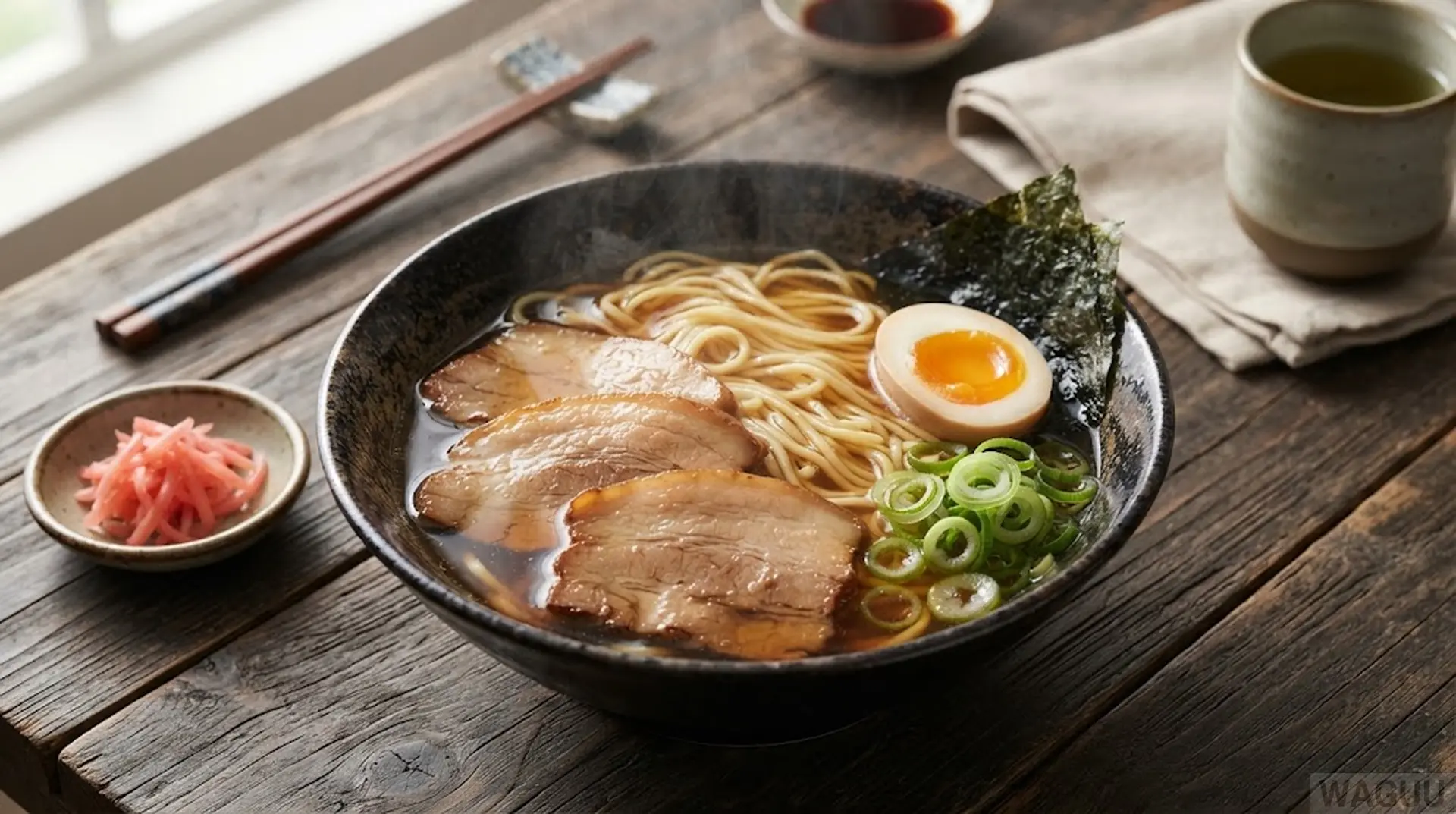
Summary: Pork bone and vegetable broth ramen, finished with soy sauce and miso paste. Pork belly is simmered in seasoned liquid and sliced thin. Eggs are cooked so the yolk stays soft, then marinated in the same sauce as the meat. Noodles are cooked separately and added to the bowl just before serving. Total time 145 minutes, makes 6 servings.
Did you make this recipe? Share your result with the community.
Category: soups, japanese-cuisine
Success rate: not rated yet % of users nailed this recipe
Quick overview
- Dish: Ramen – noodle soup with rich broth, meat, egg, vegetables, and other typical toppings
- Category: soups, japanese-cuisine
- Cuisine: Japanese
- Main ingredient: Pork belly, 2 lb (in one piece, skin on) (quality specification)
- Guide: 12 most famous Japanese dishes: traditional recipes from Japanese cuisine
- Total time: 145 minutes (30 min prep + 115 min cooking)
- Difficulty: Medium
- Servings: 6 (Serving weight: 22.6 oz)
- Key technique: Two-stage broth from bones and vegetables, and eggs cooked to a soft-set yolk in precisely timed intervals
- Cooking methods: Classic cooking, simmering
- Dietary info & allergens: gluten (wheat noodles, soy sauce), eggs (eggs, noodles), soy (soy sauce, miso), fish (dashi)
- Great for: A hearty lunch on a cold day, weekend cooking for six, family dinner, a meal after a day in the mountains, a homemade version of Osaka street soup.
- Nutrition (per 1 serving): 855, Protein: 41.0 g, Fat: 45.5 g, Carbs: 72.0 g
- Storage: 3 days in the fridge, 2 months in the freezer
- Pairing: Japanese light lager, dry rosé, cold mugi barley tea
- In short: Ramen with a broth made from pork bones and vegetables, finished with soy sauce and miso paste. Total time 145 minutes, 6 servings.
WAGUU says: “Broth and noodles are cooked separately. When you throw the noodles into the broth, their starch clouds the broth and you lose the flavor you spent two hours building.”
Key facts
| Prep time: | 30 minutes |
| Cook time: | 115 minutes |
| Temperature: | Broth 195–205 °F, pork belly simmered at 205 °F, eggs boiled in rolling water 6.5 minutes |
| Servings: | 6 |
At a glance
Ramen stands on two things: a broth simmered slowly from bones and vegetables, and noodles cooked separately and served immediately. Starch from the noodles clouds the broth and changes its flavor, so the two are combined only in the bowl. Pork belly is first seared, then simmered in seasoned liquid, so it holds its shape and doesn’t fall apart when sliced. Eggs are cooked for a precise time and chilled immediately, otherwise the yolk turns green and firm.
Ingredients
Base servings: 6 servings • Serving weight: 22.6 oz
| Ingredient | Amount | Quality |
|---|---|---|
| pork belly | 32 oz | in one piece, skin on, evenly marbled |
| pork bones | 2.6 lb | joint and back bones, trimmed of meat scraps |
| water for broth | 12.7 cups | soft, cold |
| ramen noodles | 25 oz | wheat, medium-thick, 6 servings |
| eggs | 6 pcs | fresh, room temperature, size M |
| onion | 2 pcs | medium, yellow |
| carrot | 2 pcs | medium, firm |
| fresh ginger | 1.5 oz | plump, juicy rhizome |
| garlic | 4 cloves | fresh, firm |
| green onion | 6 pcs | fresh, with firm stalks |
| miso paste | 1.5 oz | red, fermented, no added coloring |
| soy sauce | 2.7 tbsp | naturally fermented |
| mirin | 2.7 tbsp | sweet rice cooking wine |
| fine sea salt | 0.14 oz | for the broth |
| sesame oil | 1 tbsp | toasted, dark |
| nori sheets | 3 pcs | toasted, for garnish |
Why you’ll love this recipe
- Broth with body: Bones and vegetables are simmered gently until the broth gains depth. No bouillon cubes; flavor comes from bones and vegetables.
- Eggs with soft yolk: Precise timing and immediate chilling determine whether the yolk stays creamy. Eggs are marinated in the same sauce as the meat.
- Exact ratios for 6 servings: Two pounds of pork belly, six servings of noodles, and broth topped up as needed. Everything scales with the number of diners.
Success guaranteed: Bone broth is simmered gently, not at a rolling boil. At a hard boil, fat and proteins disperse into the liquid, the broth turns milky and loses its clean flavor. Collagen from bones and connective tissue converts to gelatin at around 195 °F, giving the broth a full mouthfeel. Soy sauce is added only at the end: long cooking loses its fresh saltiness and leaves a flat taste. Miso paste is never boiled in hot broth because high heat suppresses aromatic compounds created by fermentation. Eggs are cooked for a precise time because egg yolk proteins set between 149 and 158 °F. If eggs stay in hot water or aren’t chilled, heat penetrates to the center and the yolk firms up.
Recipe overview
Prep: 30 min min | Cook: 115 min min | Difficulty: Medium | Servings: 6 | Type: Main dish | Origin: Japanese
Detailed instructions
Total progress: 0 % done
Phase 1: Prepare the base – 15 min
Equipment: none
1. Rinse pork bones under cold water and place them in a large pot. Cover with cold water, set over medium heat, and bring to a boil. Once foam starts to form on the surface, drain the water and rinse the bones – this removes cloudiness and odors.
2. Halve the onion and sear the cut side in a dry pan until dark brown. Cut carrot into thick rounds, slice ginger thin, and lightly crush garlic with the flat of a knife. Set everything next to the prepared bones.
VKB: Bones are clean, no blood remnants, rinsing water is clear. Onion cut sides are dark brown to black, but not charred.
Before you move to the next step:
Do not let the bones boil in the first water. Proteins from blood and bone marrow coagulate in boiling water and the broth turns cloudy and smells off. Drain the water right after the first boil.
Phase 2: Simmering the broth – 50 min
Equipment: large pot, stove, skimmer
1. Cover the bones with cold water, bring to a boil, then immediately reduce heat to low. Let the broth simmer until barely visible bubbles form on the surface. Skim off foam and fat with a skimmer.
2. Add the charred onion, carrot, ginger, and garlic and continue simmering. Do not stir the broth and do not cover the pot during simmering to keep the temperature below a rolling boil.
VKB: The surface only shimmers, it does not boil. The broth is clear, golden brown, with a thin layer of fat on top that you have skimmed. The aroma is full and clean, without a sharp smell.
Before you move to the next step:
Never bring the broth to a rolling boil. Dispersed fat will create a milky cloudiness that cannot be removed, and the flavor will stay flat.
Phase 3: Braising pork belly – 20 min
Equipment: deep skillet, kitchen thermometer
1. Pat the pork belly dry with a paper towel and place it skin-side down in a hot deep skillet. Let it sear until the skin turns golden brown and releases fat, then flip and sear the other side.
2. Pour a ladle of broth into the skillet, add soy sauce and mirin, cover, and braise until the meat is tender to the touch. Remove the meat and let it rest on a cutting board; pour the pan juices back into the main broth.
VKB: The skin is golden brown and crisp on the surface; the meat yields when pressed with a finger and springs back. Clear juices run out when cut, not pink.
Before you move to the next step:
Do not pierce the meat with a fork or press it with a spatula. Juices will run into the pan, the meat will dry out, and the slices will fall apart when cut.
Phase 4: Eggs and toppings – 12 min
Equipment: saucepan, bowl with ice water, small bowl
1. Let the eggs come to room temperature. Boil them in boiling water for an exact time, then immediately transfer to ice water and let cool. Peel the cooled eggs under running water and cut them in half lengthwise.
2. Place the peeled and halved eggs in a bowl and pour over the remaining soy sauce mixed with a little broth. Let them marinate while you prepare the noodles. Slice the scallions thinly on the bias and cut the nori into strips.
VKB: The white is firm and holds its shape; the yolk is orange and creamy when cut, not crumbly and not green at the edges. The egg surface is lightly browned after marinating.
Before you move to the next step:
Do not leave the eggs in the drained pot or under a lid after removing from the heat. Trapped heat will overcook the yolk to firm within minutes.
Phase 5: Cooking noodles – 8 min
Equipment: large pot, colander, tongs
1. Bring plenty of water to a boil in a wide pot and salt it lightly. Cook the noodles in a single layer so they do not stick together, and stir gently to avoid breaking them.
2. Drain the cooked noodles immediately and rinse with hot water to remove surface starch. Divide among warmed bowls and do not let them sit in water.
VKB: The noodles are springy, offer a slight resistance when bitten, and are not raw in the center. The draining water is slightly cloudy but not thick.
Before you move to the next step:
Do not rinse the noodles with cold water; they will lose heat and springiness. Transfer to hot water immediately and drain thoroughly, otherwise they will dilute the broth in the bowl.
Phase 6: Assembling and serving – 10 min
Equipment: warmed bowls, ladle
1. Put the miso paste in a ladle, dip it into the broth pot, and whisk the paste in the ladle with some broth. Return the mixture to the pot and remove the pot from the heat. Do not boil the broth further.
2. Slice the pork belly thinly against the grain. Place meat slices, half an egg, scallion rings, and nori strips in each bowl of noodles. Pour the broth along the edge of the bowl and finish with a few drops of sesame oil.
VKB: The broth is clear and shiny, with a thin layer of fat glistening on top. The noodles hold their shape and do not float apart. The meat does not fall apart when picked up with chopsticks, and the egg holds together.
Required equipment
| Utensil | Ideal size | Alternative | Risk |
|---|---|---|---|
| large pot | 6 qt capacity, thick bottom | two smaller pots and combine broth | a small pot cannot hold temperature and the broth will boil rapidly during simmering |
| kitchen thermometer | probe, up to 400 °F | check by shimmering surface and bubble size | without measurement, the broth easily comes to a rolling boil |
| skimmer | perforated, with fine holes | small strainer | skimming fat with a regular spoon stirs up the surface and cloudiness returns |
| egg saucepan | 2 qt capacity, wider bottom | deeper skillet with lid | a tight saucepan will crush the eggs and crack the shells |
| colander | fine mesh, with handle | sink strainer | a coarse colander will tear the noodles and they will fall apart in the bowl |
Shopping list
Nutrition profile
Values per 1 serving (without side dish). Calculated from average nutritional values of ingredients.
| Nutrient | Per 100 g | Per 1 serving | Per 6 servings |
|---|---|---|---|
| Energy | 561 kJ / 134 kcal | 3577 kJ / 855 kcal | 21464 kJ / 5130 kcal |
| Fat | 7.1 g | 45.5 g | 273.0 g |
| of which saturated | 2.5 g | 15.8 g | 94.8 g |
| Carbohydrates | 11.2 g | 72.0 g | 432.0 g |
| of which sugars | 1.0 g | 6.4 g | 38.4 g |
| Protein | 6.4 g | 41.0 g | 246.0 g |
| Salt | 0.4 g | 2.8 g | 16.8 g |
Reference intake of an average adult (8400 kJ / 2000 kcal).
WAGUU Pro level
- Pro standard: Verified recipe with precise ratios and visual checkpoints.
- Tip 1: Verified recipe with precise ratios and visual checkpoints.
- Tip 2: Never bring the broth to a rolling boil. Keep the thermometer between 194 and 203 °F; above this range, fat disperses into the liquid and the broth becomes milky.
- Tip 3: Transfer the eggs to ice water immediately after removing from the pot. Heat in the shell continues even after removal, which is why the yolk often overcooks to firm.
- Tip 4: Cook the noodles in plenty of water and season with only a little salt. Starch that remains in the water will not get into the broth, so it stays clear.
The Science Behind It
The broth gets its body from collagen. Connective tissue and bones contain collagen, which converts to gelatin at around 195°F (90°C). Gelatin binds with water and creates a full, slightly sticky mouthfeel. During a rolling boil, fat disperses into tiny droplets that reflect light and cloud the broth. Flavor also develops through reactions between amino acids and sugars during a long, gentle simmer, creating aromatic compounds. Soy sauce is a fermented mixture where aroma develops over long fermentation. When boiled, these compounds evaporate and only saltiness remains, so soy sauce and miso are added at the end. Miso paste is also thick and can easily scorch at the bottom of a pot where the temperature exceeds boiling. For eggs, timing is everything: the white sets at 145–150°F (62–65°C), the yolk between 150–160°F (65–70°C). That’s why eggs are cooked briefly and then chilled immediately—residual heat in the shell would otherwise overcook the yolk.
Fine Dining – Professional Techniques
- Plating composition: Warm the bowl with hot water, pour it out, then assemble. Place noodles at the bottom, lay meat and egg on top, and pour broth along the edge of the bowl.
- Texture contrasts: Along with the soft pork belly, add a few thin slices of pickled bamboo shoots. The crunchy element provides contrast against the soft meat and noodles.
- Temperature contrast: Serve the egg halved with the cut side up so the soft yolk is visible. The warm broth gently heats the yolk and its flavor melds with the soup.
- Aromatic additions: Finish with a teaspoon of toasted sesame oil. The aroma releases with the heat of the broth and rises to the nose before the first bite.
Sensory Radar
- Appearance: Clear, golden-brown broth with a thin layer of fat on the surface. Light yellow noodles coiled at the bottom. Slices of pork belly with a pink edge, egg with white and orange yolk in cross-section, green onion on top.
- Aroma: Deep aroma of simmered bones and soy sauce, followed by fresh green onion and a hint of toasted sesame.
- Taste: Salty and full-bodied broth, gentle sweetness from mirin, then the flavor of pork. The egg yolk softens and rounds out the taste.
- Texture: Springy noodles with a slight resistance when bitten. Tender meat that shreds into fibers. Creamy yolk, firm white. Crunchy green onion.
Pairings
- Japanese light lager: Carbonation and mild bitterness cut through the fat of the pork belly. Serve chilled at 43–46°F (6–8°C).
- Dry rosé wine: A lighter rosé with higher acidity pairs with the saltiness of soy sauce and balances the flavor.
- Cold barley tea (mugi-cha): Roasted flavor without sweetness cleanses the palate between bites. A non-alcoholic option for spicy chili oil.
Variations
- Miso ramen:: The broth base stays the same, but replace soy sauce with a larger amount of miso paste mixed off the heat. The soup has a thicker body and sweeter taste.
- Chicken ramen:: Replace pork belly with boneless chicken thigh and cook for a shorter time. Simmer the broth from chicken bones; it will be lighter and paler.
Allergens and Dietary Information
Contains: gluten (wheat noodles, soy sauce), eggs (egg, noodles), soy (soy sauce, miso), fish (dashi) • Gluten: yes, in wheat noodles and soy sauce • Not suitable for: individuals with celiac disease, lactose intolerance, egg, soy, or fish allergies
Suitable For
A hearty lunch on a cold day, weekend cooking for six, a family dinner, a meal after a day in the mountains, a homemade version of Osaka street food.
Substitution Guide
- Mirin:: dry white wine with a teaspoon of sugar. The flavor is sharper and less sweet, but the broth stays balanced.
FAQ
Why are noodles cooked separately?
Starch from the noodles releases into the water and would cloud the clear broth. So cook noodles in a separate pot and add them to the bowl just before serving.
How long to cook eggs for a soft yolk?
Cook room-temperature eggs in boiling water for a short, precise time, then transfer immediately to ice water. Chilling stops the cooking and keeps the yolk creamy.
Can I make the broth ahead?
Yes, the broth keeps in the refrigerator for three days and in the freezer for two months. Reheat to 195°F (90°C) and stir in miso paste just before serving, never before boiling.
What can I use instead of mirin?
Dry white wine with a teaspoon of sugar per 100 milliliters (about 3.4 fl oz). The flavor will be sharper, but the sweet-salty balance remains.
Why shouldn’t the broth boil vigorously?
A rolling boil disperses fat into tiny droplets that reflect light, giving the broth a milky cloudiness. The flavor loses clarity and feels flat on the tongue.
How do I slice meat thinly?
Let the meat cool after braising, preferably in the refrigerator until slightly firm. Then slice with a long stroke against the grain. Cold meat holds its shape and the slices don’t tear.
WAGUU Petr’s tip: Cooking for 6 or more?
6–8 people: Make the broth in one pot and cook noodles in two batches so the water doesn’t get too cloudy. Warm bowls with hot water and pour it out just before assembling. • 10+ people: Choose the chicken version; it cooks faster and fits in larger quantities in the pot. Serve noodles in two waves and keep the broth at 195°F (90°C).
Sides and Serving
Serving: Serve in a warmed deep bowl with noodles at the bottom. Ramen is accompanied by pickled ginger, chili oil, and a small bowl of rice. Eat the noodles as soon as possible; they soften in the broth.
Storage and Reheating
Refrigerator: 3 days • Freezer: 2 months • Reheating: Refrigerator: 3 days • Freezer: 2 months • Reheating: Heat broth to 195°F (90°C), always cook noodles fresh. Reheat meat and egg in a colander over steam; in the microwave the yolk will harden.
Author: WAGUU Petr & Team • Published: 7 Oct 2026 • Updated: 10 Oct 2026
More Recipes from the Article
Guide: 12 Most Famous Japanese Dishes: Traditional Recipes of Japanese Cuisine
Tempura – lightly battered and fried seafood or vegetables in a thin, crispy batter
Tonkatsu – breaded and fried pork cutlet served with finely shredded cabbage and tonkatsu sauce
Takoyaki – round fried batter balls filled with octopus, typical of Osaka
Katsudon – bowl of rice with breaded pork cutlet (tonkatsu), egg, and onion in seasoned broth
Gyudon – bowl of rice topped with thin slices of beef and onion simmered in a sweet-savory sauce
More Recipes You Might Like
Why WAGUU?
WAGUU recipes are checked for accuracy of ingredients, procedures, and nutritional values.
Photo Gallery from the Process
Community photos: Cook, take a photo, and share your result.
You can upload photos in the comments below or send them by email.
Did you film a video of our recipe? Post a link to YouTube, YouTube Shorts, TikTok, Instagram Reels, Facebook Reels, Pinterest, Vimeo, or X (Twitter) in the comments – we’ll be happy to publish it and help you and your content get noticed.
Most Common Mistakes
- Broth at a rolling boil – fat disperses into the liquid, the broth becomes milky and tastes flat. Keep the temperature between 195–203°F (90–95°C) and let the broth gently simmer.
- Soy sauce added at the beginning – long boiling loses its fresh saltiness and leaves a flat taste. Add it only at the last stage, just before serving.
- Miso paste added to boiling broth – high temperature suppresses aromatic compounds from fermentation and the soup loses depth. Mix miso in a ladle of broth and return to the pot off the heat.
- Noodles cooked in advance – noodles soften, stick together, and fall apart in the bowl when served. Cook them just before serving and immediately divide into warmed bowls.