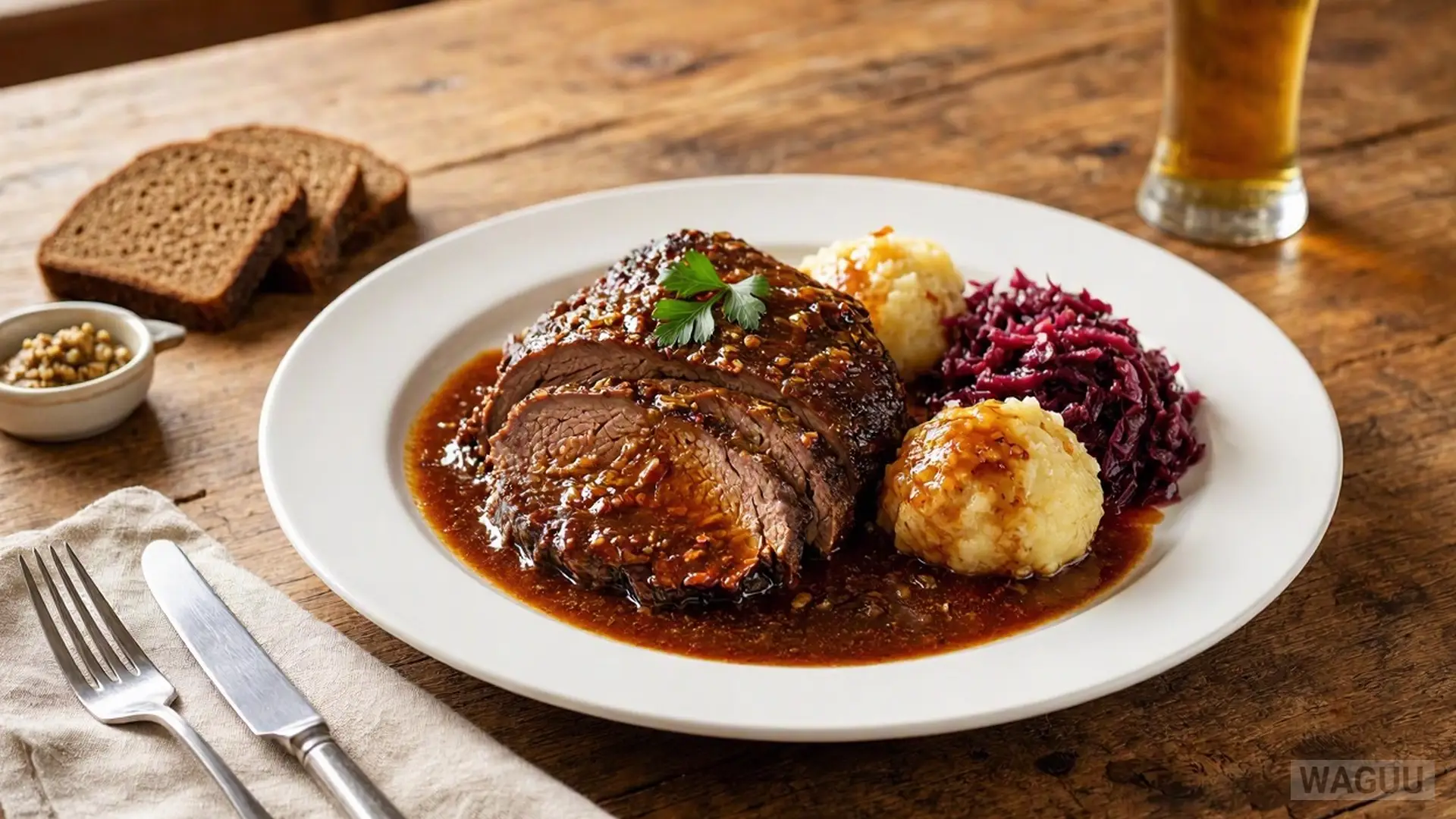
Summary: Traditional German Sauerbraten featuring beef topside marinated for days in a spiced vinegar and wine brine, slow-braised until tender, and finished with a rich gingerbread-thickened gravy. Preparation time is 45 minutes of active work plus 5 days of marinating and 3 hours of cooking, designed to yield 6 portions.
Did you cook this recipe? Share the result with the community.
Category: Beef, German cuisine
Success rate: 98% of users successfully made this recipe
Quick overview
- Dish: Sauerbraten
- Category: Beef, German cuisine
- Cuisine: German
- Main ingredient: Beef topside, 1,500 g (aged quality specification)
- Guide: 12 most popular German dishes: favourite recipes of German cuisine
- Total time: 180 minutes (45 min prep + 135 min cooking, excluding 5 days marinating)
- Difficulty: Advanced
- Portions: 6 portions (Portion weight: 320 g)
- Key technique: Acidic marinating and slow braising
- Preparation types: Marinating, searing, braising
- Dietary info & Allergens: Contains gluten, milk, celery, sulphites
- Suitable for: Festive dinners, Sunday lunches
- Nutritional values (per 1 portion): 485.5 kcal, Protein: 42.5 g, Fat: 18.2 g, Carbohydrates: 36.4 g
- Storage: 3 days in the fridge, 3 months in the freezer
- Pairing: Dark lager, dry red wine, sparkling water with lemon
- In short: A magnificent German classic where days of marinating yield meltingly tender beef in a sweet and sour spiced gravy.
- Last updated: 21 September 2026
WAGUU says: “The secret to an authentic Sauerbraten lies in the patient, multi-day acidic bath that breaks down connective tissue while infusing the meat with aromatic depth.”
How to take it further: Add crushed juniper berries to the marinade and stir a spoonful of blackcurrant jam into the finished sauce just before serving.
Key facts
| Prep time: | 45 minutes |
| Cooking time: | 135 minutes |
| Temperature: | 160 °C |
| Number of portions: | 6 portions |
In a nutshell
Experience the pinnacle of traditional European comfort food with this authentic Sauerbraten recipe. Tender beef topside is steeped for five days in a robust blend of red wine vinegar, red wine, root vegetables, and warm spices, then braised to perfection. The cooking juices are enriched with crushed gingerbread for a signature velvety texture that balances sweet, sour, and savory notes.
Ingredients
Base portions: 6 portions • Portion weight: 320 g
| Ingredient | Amount | Quality |
|---|---|---|
| Beef topside | 1500 g | Trimmed, high quality |
| Red wine vinegar | 300 ml | Wine vinegar |
| Dry red wine | 400 ml | Full-bodied |
| Water for marinade | 300 ml | Clean tap water |
| Carrots | 200 g | Fresh, peeled |
| Celeriac | 150 g | Fresh, peeled |
| Onions | 250 g | Yellow onions, peeled |
| Black peppercorns | 5 g | Whole grains |
| Bay leaves | 3 pcs | Dried leaves |
| Cloves | 2 g | Whole cloves |
| Rapeseed oil | 40 ml | High smoke point |
| Beef stock | 500 ml | Rich homemade stock |
| Gingerbread biscuits | 50 g | Traditional spice gingerbread |
| Table salt | 15 g | Fine sea salt |
Why you will love this recipe
- Unmatched tenderness: The 5-day acidic marinade naturally breaks down tough muscle fibers, resulting in fork-tender beef.
- Complex flavor profile: A harmonious blend of sweet, sour, and spiced notes creates a deeply satisfying culinary experience.
- Velvety sauce: Crushed traditional gingerbread provides a natural thickening agent and a subtle spiced warmth to the gravy.
Why it works: Long marination combined with slow braising transforms lean beef topside into a succulent masterpiece.
Recipe overview
Prep: 45 min | Cooking: 135 min | Difficulty: Advanced | Portions: 6 portions | Type: Main dish | Origin: German
Detailed instructions
Overall progress: 0% complete
Phase 1: Preparing the Marinade and Steeping – 30 min
Appliances: Hob
1. In a saucepan over medium heat, combine 300 ml of red wine vinegar, 400 ml of dry red wine, 300 ml of water for marinade, 200 g of peeled carrots, 150 g of peeled celeriac, 250 g of peeled yellow onions, 5 g of whole black peppercorns, 3 pcs of dried bay leaves, and 2 g of whole cloves. Bring the mixture to a gentle boil, then simmer for 15 minutes to extract the aromatic flavors. Remove from heat and allow the marinade to cool completely to room temperature (20 °C).
Visual check point (VKB): Marinade temperature drops to 20 °C and vegetable pieces are softened slightly.
Before moving to the next step:
Ensure the marinade is completely cooled before pouring it over the raw beef to prevent partial cooking of the surface.
Phase 2: Marinating the Beef – 15 min
Appliances: Refrigerator
2. Place 1,500 g of trimmed beef topside into a deep non-reactive container. Pour the cooled marinade and vegetables over the meat, ensuring the beef is fully submerged. Cover the container tightly and place it in the refrigerator at 4 °C. Let the beef marinate for 5 days, turning the meat once every day to ensure even flavor distribution and penetration.
VKB: Meat surface turns pale greyish-pink and absorbs aromatic vinegar aromas.
Before moving to the next step:
Remove the meat from the marinade, strain the vegetables and liquid, keeping both separated for searing and braising.
Phase 3: Searing the Beef and Vegetables – 20 min
Appliances: Hob, Oven
3. Preheat the oven to 160 °C. Pat the marinated beef completely dry with paper towels and season evenly with 15 g of fine sea salt. Heat 40 ml of rapeseed oil in a heavy-bottomed roasting pan over high heat on the hob. Sear the beef on all sides for 8 minutes until a rich brown crust develops. Remove the beef and set it aside. In the remaining fat in the pan, add the strained vegetables from the marinade and sauté them for 7 minutes until lightly caramelized.
VKB: Deep brown crust on the meat and golden-brown roasted vegetables.
Before moving to the next step:
Return the seared beef to the roasting pan resting on top of the caramelized vegetables before adding liquids.
Phase 4: Slow Braising in the Oven – 100 min
Appliances: Oven
4. Pour 500 ml of beef stock and 200 ml of the strained liquid marinade into the roasting pan around the beef. Cover the roasting pan securely with a tight-fitting lid or double layer of aluminium foil. Place the pan into the preheated oven at 160 °C and braise for 1 hour and 40 minutes, turning the meat once halfway through the cooking time to ensure even heat penetration and tenderness.
VKB: Meat offers virtually no resistance when pierced with a testing fork.
Before moving to the next step:
Transfer the cooked beef to a warm plate and cover with foil to rest while finishing the sauce.
Phase 5: Finishing the Gravy – 15 min
Appliances: Hob, Immersion blender
5. Strain the remaining braising liquid and vegetables through a fine sieve into a clean saucepan, pressing the vegetables to extract maximum flavor. Place the saucepan on the hob over medium heat. Finely crumble 50 g of gingerbread biscuits and whisk them directly into the hot sauce. Simmer gently for 10 minutes, stirring frequently, until the gingerbread dissolves completely and thickens the gravy to a glossy, velvety consistency.
VKB: Sauce coats the back of a spoon smoothly without lumps.
Required equipment
| Utensil | Ideal size | Alternative | Risk |
|---|---|---|---|
| Saucepan | 3 l capacity | Stockpot | Boiling over if heat is too high |
| Roasting pan | 4 l with lid | Dutch oven | Inadequate sealing leading to dryness |
| Fine sieve | 20 cm diameter | Food mill | Lumpy sauce if straining is skipped |
Shopping list
Nutritional profile
Values per 1 portion (excluding side dishes). Calculated from average nutritional values of ingredients.
| Nutrient | Per 100 g | Per 1 portion | Per 6 portions |
|---|---|---|---|
| Energy | 151.7 kcal | 485.5 kcal | 2913.0 kcal |
| Fat | 5.7 g | 18.2 g | 109.2 g |
| of which saturates | 1.4 g | 4.5 g | 27.0 g |
| Carbohydrates | 11.4 g | 36.4 g | 218.4 g |
| of which sugars | 4.5 g | 14.4 g | 86.4 g |
| Protein | 13.3 g | 42.5 g | 255.0 g |
| Salt | 0.9 g | 2.9 g | 17.4 g |
Reference intake of an average adult (8400 kJ / 2000 kcal).
WAGUU Pro Level
- Pro standard: Verified recipe with precise ratios and visual control points.
- Tip 1: Always use a glass or ceramic container for marinating to prevent the vinegar from reacting with metal surfaces.
- Tip 2: Strain the vegetables thoroughly through a fine sieve to ensure a silky, lump-free sauce texture.
- Tip 3: Searing the meat over high heat locks in the juices before the long braising process begins.
- Tip 4: Let the cooked meat rest covered for 10 minutes before slicing to retain its natural moisture.
Scientific background
The prolonged marinating process in an acidic solution of red wine vinegar lowers the pH of the meat, activating enzymes that tenderize tough collagen fibers. During braising, moist heat hydrolyzes collagen into gelatin, yielding succulent meat. Meanwhile, starch from the crushed gingerbread thickens the sauce through gelatinization while providing balancing sweetness and complex aromatic compounds.
Fine Dining – Professional techniques
- Plate composition: Fan precise slices of Sauerbraten neatly across the center of a warm plate, pooling the glossy gingerbread gravy alongside.
- Textural contrasts: Pair the meltingly tender braised beef with crisp buttered red cabbage and pillowy potato dumplings.
- Temperature contrast: Serve piping hot gravy over freshly carved warm beef on pre-warmed porcelain plates.
- Aromatic garnishes: Garnish with finely julienned orange zest and freshly chopped flat-leaf parsley for a vibrant pop of color and citrus lift.
Sensory radar
- Appearance: Deep mahogany sliced beef coated in a glossy, dark spiced gravy.
- Aroma: Robust wine vinegar pungency balanced by warm cloves, bay leaves, and sweet gingerbread.
- Taste: Complex harmony of sweet, sour, and savory umami notes with a lingering spiced finish.
- Texture: Exceptionally tender, fork-yielding meat complemented by a smooth, velvety sauce.
Pairing
- BEER: Traditional German dark lager or doppelbock.
- WINE: Full-bodied dry red wine such as Spätburgunder or Dornfelder.
- NON-ALCOHOLIC: Sparkling mineral water with a slice of fresh lemon.
Various preparation variants
- Rhineland style: Incorporates raisins into the gravy during the final simmering phase for a touch of fruity sweetness.
- Franconian style: Utilizes dark beer in place of red wine for the marinade and sauce base, adding a deeper malt character.
Allergens and dietary information
Contains: Gluten, milk, celery, sulphites • Gluten: Contains gluten from gingerbread • Not suitable for: Coeliacs, individuals with dairy or celery allergies
Suitable for
Festive dinners, traditional Sunday lunches, celebratory gatherings.
Substitution catalog
- Red wine vinegar: Apple cider vinegar
- Gingerbread biscuits: Dark rye bread crust combined with a pinch of gingerbread spice
FAQ
Can I marinate the beef for less than 5 days?
While 3 days is acceptable for smaller cuts, 5 days ensures optimal flavor penetration and tenderness for standard beef topside.
Why use gingerbread in the sauce?
Gingerbread acts as a traditional thickener while adding warm spices and subtle sweetness that balance the sour vinegar marinade.
Can I freeze cooked Sauerbraten?
Yes, sliced beef immersed in its gravy freezes exceptionally well for up to 3 months when stored in an airtight container.
What cut of beef is best?
Beef topside, silverside, or rump roast are ideal lean cuts that soften remarkably during long, slow braising.
WAGUU Petr advises: Cooking for 12 or more people?
12–16 people: Double all ingredient quantities and use two separate roasting pans to ensure the meat sears properly without crowding. • 20+ people: Prepare in two separate batches across two days to maintain precise temperature control and sauce quality.
Sides and Serving
- Potato dumplings – Soft, pillowy dumplings ideal for soaking up the rich gravy (not included in the recipe)
- Braised red cabbage – Sweet and spiced red cabbage providing essential tart contrast (not included in the recipe)
Serving: Slice the warm beef across the grain into thick portions, arrange on pre-warmed plates, and generously ladle the velvety gingerbread gravy over top.
Storage and reheating
Fridge: 3 days • Freezer: 3 months • Reheating: Reheat gently in a covered saucepan over medium-low heat with a splash of beef stock until piping hot.
Author: WAGUU Petr & Team • Published: 21 Sep 2026 • Updated: 30 Oct 2026
More Recipes from This Article
Guide: 12 most popular German dishes: favourite recipes of German cuisine
Other recipes you might be interested in
Why WAGUU?
Recipes on WAGUU undergo checks for the accuracy of ingredients, procedures, and nutritional values.
Process photo gallery
Community photos: Cook, take a photo, and share the result.
You can upload photos in the comments below or send them via email.
Did you record a video guide for our recipe? Insert a link to YouTube, YouTube Shorts, TikTok, Instagram Reels, Facebook Reels, Pinterest, Vimeo, or X (Twitter) in the comment – we’d be happy to publish it and help promote you and your content.
Common mistakes
- Using a metal container for marinating – Acidic vinegar reacts with metal, imparting a metallic taste to the beef.
- Skipping the marinating time – Rushing the multi-day steeping process prevents the meat from becoming properly tender and flavorful.
- Adding gingerbread too late – Failing to simmer the crushed gingerbread long enough leaves lumps and prevents proper sauce thickening.
- Cooking at too high a temperature – Boiling instead of gentle braising causes the beef to toughen rather than soften.