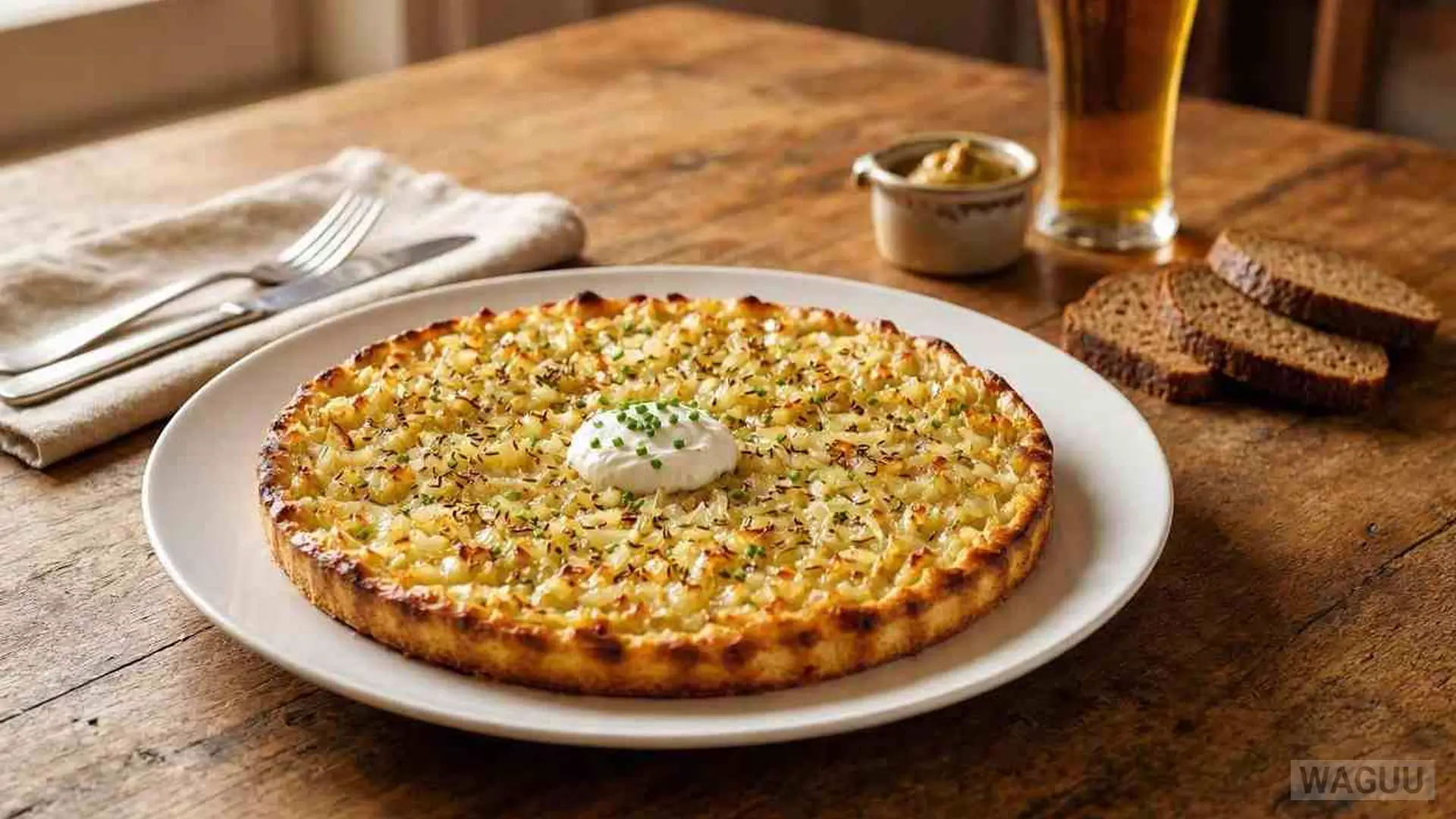
Summary: Traditional German onion tart featuring a crisp yeast dough crust, a generous mountain of slowly caramelised onions infused with smoked bacon, and a rich, creamy sour cream and egg custard. Baked to golden perfection, this comforting classic takes 120 minutes in total, combining simple preparation techniques with deeply savoury flavours for 6 generous portions.
Did you cook this recipe? Share the result with the community.
Category: Bread and pastry, German cuisine
Success rate: 98.4% of users successfully made this recipe
Quick overview
- Dish: Zwiebelkuchen
- Category: Bread and pastry, German cuisine
- Cuisine: German
- Main ingredient: Brown onions, 1,200 g (peeled and sliced)
- Guide: 12 most popular German dishes: favourite recipes of German cuisine
- Total time: 120 minutes (45 min prep + 75 min cooking)
- Difficulty: Medium
- Portions: 6 portions (Portion weight: 220.0 g)
- Key technique: Slow onion sweating, yeast dough mixing, custard binding
- Preparation types: Kneading, sautéing, baking
- Dietary info & Allergens: Contains gluten, milk, eggs, sulphites
- Suitable for: Family dinner, autumn celebrations, wine pairing events
- Nutritional values (per 1 portion): 373.6 kcal, Protein: 11.2 g, Fat: 16.5 g, Carbohydrates: 44.5 g
- Storage: 3 days in the fridge, 2 months in the freezer
- Pairing: Dry white wine (Riesling), alcohol-free apple spritzer
- In short: A savoury German tart combining tender yeast dough, caramelised bacon-infused onions, and rich sour cream custard.
- Last updated: 21 September 2026
WAGUU says: “Slowly sweating the onions without browning them is the secret to unlocking their natural sweetness and achieving an authentic Zwiebelkuchen texture.”
How to take it further: Add a pinch of caraway seeds to the dough or sprinkle freshly grated mature Cheddar over the custard before baking.
Key facts
| Prep time: | 45 minutes |
| Cooking time: | 75 minutes |
| Temperature: | 190 °C |
| Number of portions: | 6 portions |
In a nutshell
Experience the comforting flavours of traditional German baking with this authentic Zwiebelkuchen. Built on a foundation of pillowy yeast dough, it overflows with sweet, slow-cooked onions, savoury smoked bacon, and a velvety sour cream custard that binds everything together into a golden autumn masterpiece.
Ingredients
Base portions: 6 portions • Portion weight: 220.0 g
| Ingredient | Amount | Quality |
|---|---|---|
| Plain flour | 300 g | High protein baking flour |
| Dried yeast | 7 g | Active dry yeast |
| Caster sugar | 5 g | Fine white sugar |
| Lukewarm water | 150 ml | Filtered tap water at 37 °C |
| Unsalted butter (for dough) | 40 g | Melted and cooled |
| Fine salt (for dough) | 5 g | Sea salt |
| Brown onions | 1200 g | Peeled and thinly sliced |
| Smoked bacon | 150 g | Diced smoked streaky bacon |
| Rapeseed oil | 20 ml | Cold-pressed cooking oil |
| Plain flour (for onion dusting) | 20 g | Standard wheat flour |
| Sour cream | 200 g | Full-fat sour cream (18% fat) |
| Free-range eggs | 3 pcs | Medium eggs (approx. 180 g total) |
| Fine salt (for filling) | 6 g | Sea salt |
| Ground caraway seeds | 3 g | Freshly ground aromatic caraway |
| Freshly ground black pepper | 2 g | Coarse black pepper |
Why you will love this recipe
- Authentic taste: Delivers the genuine rustic flavours of traditional German bakeries right in your kitchen.
- Perfect textures: Combines a crisp, golden yeast crust with ultra-tender caramelised onions and creamy custard.
- Crowd pleaser: Yields generous portions that make an unforgettable centrepiece for autumn gatherings.
Why it works: Slow-sweating the large volume of onions removes excess moisture and concentrates natural sugars, while the sour cream and egg custard locks in moisture and sets into a rich, velvety filling.
Recipe overview
Prep: 45 min | Cooking: 75 min | Difficulty: Medium | Portions: 6 | Type: Savoury tart | Origin: Germany
Detailed instructions
Overall progress: 0% complete
Phase 1: Preparing and proving the yeast dough – 45 min
Appliances: Oven (for proving)
1. In a large mixing bowl, combine 300 g plain flour, 7 g dried yeast, and 5 g caster sugar. Add 150 ml lukewarm water at 37 °C, 40 g melted and cooled unsalted butter, and 5 g fine salt. Knead vigorously by hand for 10 minutes until a smooth, elastic dough forms that pulls away from the sides of the bowl. Cover the bowl with a clean kitchen towel and let it prove in a warm spot at 24 °C for 35 minutes until doubled in volume.
Visual check point (VKB): The dough must feel springy to the touch, hold an indentation when pressed lightly with a finger, and show visible air bubbles.
Before moving to the next step:
Ensure the yeast dough has fully doubled in size and the water temperature did not exceed 40 °C during mixing, otherwise the yeast will be deactivated.
Phase 2: Sautéing the bacon and onions – 30 min
Appliances: Hob
2. Place a large frying pan over medium heat at 180 °C. Add 150 g diced smoked streaky bacon and fry for 5 minutes until rendered and crisp. Add 20 ml rapeseed oil and 1,200 g peeled and thinly sliced brown onions to the pan. Cook the onions slowly over medium-low heat, stirring frequently for 20 minutes until they soften completely and turn translucent without browning. Dust with 20 g plain flour, stir well to absorb excess moisture, and remove the pan from the heat to cool down for 5 minutes.
VKB: The onions must be thoroughly softened, reduced in volume by half, and completely coated with the flour without any dry lumps remaining.
Before moving to the next step:
Allow the cooked onion and bacon mixture to cool slightly so that it does not curdle the eggs when mixed in the next stage.
Phase 3: Mixing the sour cream custard – 10 min
Appliances: None
3. In a spacious mixing bowl, whisk together 200 g full-fat sour cream and 3 medium free-range eggs until smooth. Season the mixture with 6 g fine salt, 3 g ground caraway seeds, and 2 g freshly ground black pepper. Add the slightly cooled onion and bacon mixture from Phase 2 into the bowl and stir gently with a spatula until all components are evenly distributed into a rich, cohesive filling.
VKB: The custard must be glossy, uniform in colour, and thick enough to coat the back of a spoon without separating.
Before moving to the next step:
Check seasoning and consistency; the filling should be well-seasoned to adequately flavour the bland yeast dough crust.
Phase 4: Shaping the dough and assembling the tart – 15 min
Appliances: None
4. Preheat your oven to 190 °C conventional heat. Grease a 28 cm round baking tin with a little oil. Punch down the proved yeast dough from Phase 1, turn it out onto a lightly floured work surface, and roll it out into a 32 cm circle using a rolling pin. Transfer the dough circle carefully into the prepared baking tin, pressing it firmly into the bottom and up the sides to form a 2 cm rim. Pour the onion and sour cream filling evenly onto the dough base and spread it out smoothly with a spatula.
VKB: The dough crust must cover the base and sides without any tears, and the filling must be level across the entire tin.
Before moving to the next step:
Ensure the oven has fully reached 190 °C before placing the tart inside to guarantee an immediate rise in the crust.
Phase 5: Baking the Zwiebelkuchen – 35 min
Appliances: Oven
5. Place the filled baking tin on the middle rack of the preheated oven at 190 °C and bake for 35 minutes. Monitor the browning of the edges and the top custard during the final 10 minutes to prevent over-darkening. Once baked, remove the tin from the oven and let the Zwiebelkuchen rest at room temperature for 15 minutes before slicing.
VKB: The crust edges must be deep golden brown and crisp, and the custard centre must be completely set with a light golden hue on top.
Required equipment
| Utensil | Ideal size | Alternative | Risk |
|---|---|---|---|
| Mixing bowl | 3-litre capacity | Large ceramic bowl | Too small for kneading dough |
| Frying pan | 28 cm diameter | Deep sauté pan | Overflowing onions during cooking |
| Round baking tin | 28 cm diameter | Springform cake tin | Leakage of custard if not tight |
Shopping list
Nutritional profile
Values per 1 portion (excluding side dishes). Calculated from average nutritional values of ingredients.
| Nutrient | Per 100 g | Per 1 portion | Per 6 portions |
|---|---|---|---|
| Energy | 169.8 kcal | 373.6 kcal | 2241.6 kcal |
| Fat | 7.5 g | 16.5 g | 99.0 g |
| of which saturates | 3.6 g | 8.0 g | 48.0 g |
| Carbohydrates | 20.2 g | 44.5 g | 267.0 g |
| of which sugars | 5.5 g | 12.0 g | 72.0 g |
| Protein | 5.1 g | 11.2 g | 67.2 g |
| Salt | 0.9 g | 2.0 g | 12.0 g |
Reference intake of an average adult (8400 kJ / 2000 kcal).
WAGUU Pro Level
- Pro standard: Verified recipe with precise ratios and visual control points.
- Tip 1: Slice the onions uniformly to ensure even cooking and prevent uneven moisture pockets in the tart.
- Tip 2: Use high-protein flour for the yeast dough to build a sturdy structure capable of holding the heavy onion filling.
- Tip 3: Dusting the sautéed onions with a small amount of flour acts as a binding agent that absorbs excess onion juices during baking.
- Tip 4: Let the baked tart rest for 15 minutes before cutting to allow the dairy proteins in the custard to set firmly.
Scientific background
Slowly cooking onions induces the breakdown of complex carbohydrates into simple reducing sugars, triggering non-enzymatic Maillard reactions and caramelisation that generate rich aromatic compounds. Simultaneously, heat denatures egg proteins in the custard, forming a three-dimensional gel network that traps moisture from the sour cream and onions.
Fine Dining – Professional techniques
- Plate composition: Serve neat triangular wedges on warmed matte black ceramic plates to highlight the golden crust.
- Textural contrasts: Pair the soft, yielding custard filling with a crisp, flaky yeast crust edge.
- Temperature contrast: Serve the tart warm at 55 °C alongside a chilled glass of dry Riesling.
- Aromatic garnishes: Garnish with freshly micro-planed caraway dust and finely chopped chives.
Sensory radar
- Appearance: Golden-brown pastry rim framing a glossy, amber-hued onion and custard filling.
- Aroma: Rich caramelised onion fragrance accented by smoky bacon and warm caraway notes.
- Taste: Deeply savoury onion sweetness balanced by creamy sour cream and a hint of smoked pork.
- Texture: Tender, melt-in-the-mouth onion custard resting upon a sturdy, crisp yeast dough base.
Pairing
- BEER: Crisp German Pilsner with a clean hop bitterness.
- WINE: Dry German Riesling with vibrant acidity.
- NON-ALCOHOLIC: Chilled cloudy apple spritzer with sparkling water.
Various preparation variants
- Shortcrust pastry variant: Replace the yeast dough with a savoury butter shortcrust pastry for a crumbly, tart-like texture.
- Vegetarian variant: Omit the smoked bacon and use smoked paprika powder to replicate the savoury depth without meat.
Allergens and dietary information
Contains: Gluten, milk, eggs, sulphites • Gluten: Contains wheat flour • Not suitable for: Vegans and individuals with lactose intolerance.
Suitable for
Family dinners, autumn celebrations, traditional gatherings, and wine-tasting events.
Substitution catalog
- Sour cream: Crème fraîche or full-fat Greek yoghurt
- Smoked bacon: Smoked pancetta or diced ham
FAQ
Can I use fresh yeast instead of dried yeast?
Yes, substitute the 7 g of dried yeast with 20 g of fresh baker’s yeast dissolved in the lukewarm water.
Why do my onions release too much water during baking?
Ensure you sweat the onions long enough on the hob and dust them with flour to absorb excess moisture before adding the custard.
Can I freeze baked Zwiebelkuchen?
Yes, slice the cooled tart, wrap individual portions tightly in foil, and freeze for up to 2 months.
How should I reheat leftovers?
Reheat individual slices in an oven preheated to 180 °C for 10 minutes to restore the crispness of the crust.
WAGUU Petr advises: Cooking for 12 or more people?
12–16 people: Double all ingredient quantities and bake two separate 28 cm tins simultaneously in a fan-forced oven. • 20+ people: Scale the recipe by a factor of 3.5, prepare three baking tins, and rotate their shelf positions halfway through the baking time.
Sides and Serving
- Crisp green salad with herb vinaigrette – adds refreshing acidity (not included in the recipe)
- Pickled gherkins – provides a tangy contrast to the rich onion tart (not included in the recipe)
Serving: Serve warm in triangular slices directly from the baking tin.
Storage and reheating
Fridge: 3 days days • Freezer: 2 months months • Reheating: Reheat in a preheated oven at 180 °C for 10 minutes.
Author: WAGUU Petr & Team • Published: 21 Sep 2026 • Updated: 30 Oct 2026
More Recipes from This Article
Guide: 12 most popular German dishes: favourite recipes of German cuisine
Other recipes you might be interested in
Why WAGUU?
Recipes on WAGUU undergo checks for the accuracy of ingredients, procedures, and nutritional values.
Process photo gallery
Community photos: Cook, take a photo, and share the result.
You can upload photos in the comments below or send them via email.
Did you record a video guide for our recipe? Insert a link to YouTube, YouTube Shorts, TikTok, Instagram Reels, Facebook Reels, Pinterest, Vimeo, or X (Twitter) in the comment – we’d be happy to publish it and help promote you and your content.
Common mistakes
- Browning the onions too quickly – high heat burns the natural sugars and creates a bitter taste instead of sweet caramelisation.
- Skipping the flour dusting on onions – failing to add flour leaves excess moisture in the filling, resulting in a soggy dough base.
- Under-proving the yeast dough – rushing the proving time leads to a dense, heavy crust that fails to support the rich filling.
- Slicing the tart immediately – cutting the Zwiebelkuchen straight out of the oven prevents the custard from setting, causing the slices to collapse.