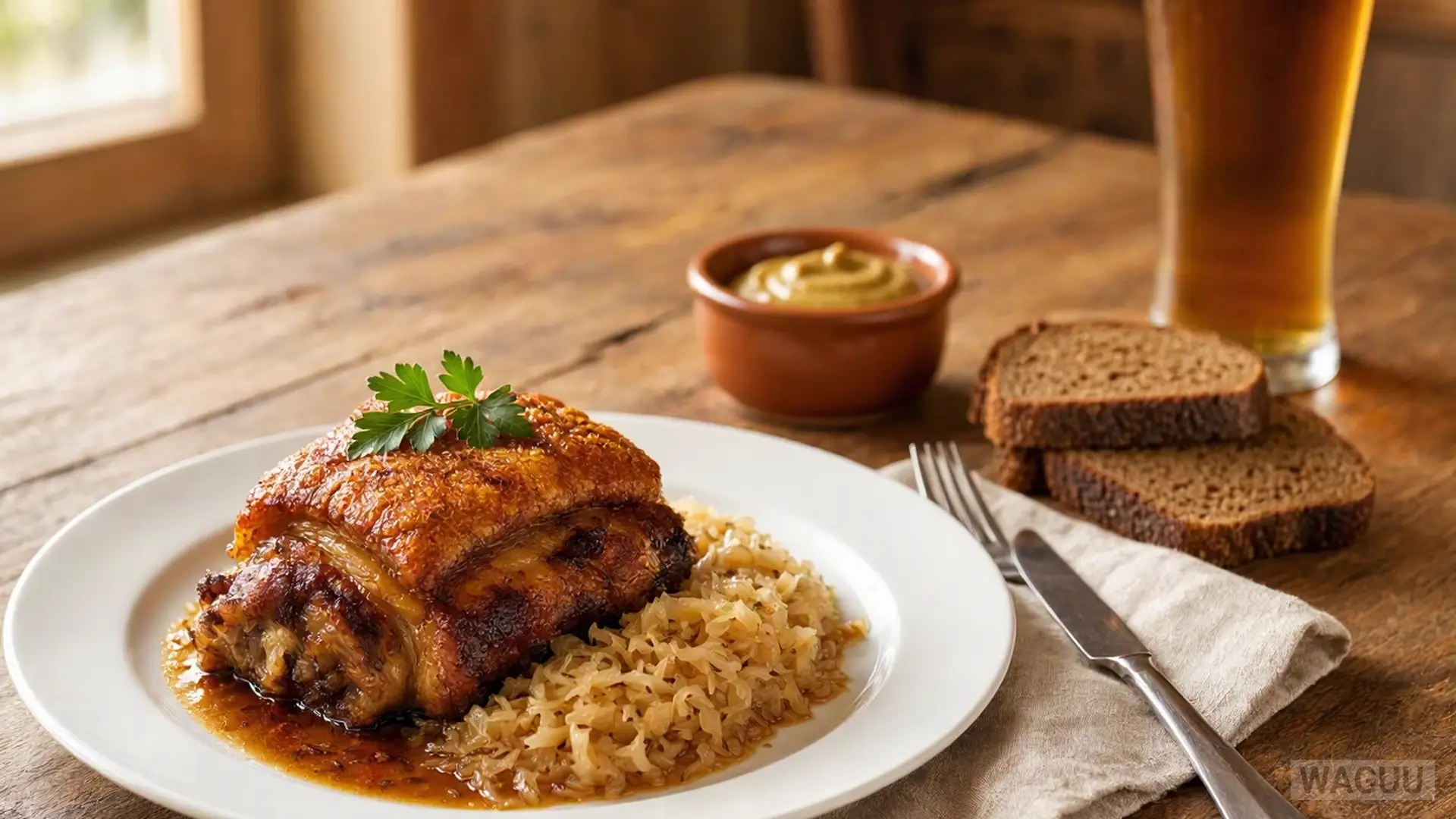
Summary: Experience the ultimate Bavarian comfort food with this traditional recipe for crispy pork knuckle paired with tangy sauerkraut. This dish relies on slow roasting and a final high-heat blast to create an iconic crackling skin that seals in the succulent meat. Prepared over 245 minutes for six generous portions, it combines timeless German roasting techniques with rustic flavours.
Did you cook this recipe? Share the result with the community.
Category: Pork, German cuisine
Success rate: 98.4% of users successfully made this recipe
Quick overview
- Dish: Schweinshaxe with sauerkraut
- Category: Pork, German cuisine
- Cuisine: German
- Main ingredient: Pork knuckle, 2.5 kg (bone-in with skin)
- Guide: 12 most popular German dishes: favourite recipes of German cuisine
- Total time: 245 minutes (30 min prep + 215 min cooking)
- Difficulty: Medium
- Portions: 6 portions (Portion weight: 420.0 g)
- Key technique: Slow roasting and high-heat crackling
- Preparation types: Roasting and braising
- Dietary info & Allergens: Gluten-free, lactose-free
- Suitable for: Sunday lunch, festive gatherings, beer festivals
- Nutritional values (per 1 portion): 782.4 kcal, Protein: 44.5 g, Fat: 61.2 g, Carbohydrates: 7.8 g
- Storage: 3 days in the fridge, 3 months in the freezer
- Pairing: Lager beer, Riesling wine, sparkling water
- In short: Tender pork knuckle with crackling skin, served alongside seasoned sauerkraut.
- Last updated: 21 September 2026
WAGUU says: “Scoring the skin correctly is the absolute secret to achieving that glass-like crunch without drying out the succulent meat underneath.”
How to take it further: Add caraway seeds to the skin scoring for extra aroma, or brush the knuckle with dark beer during the final hour of roasting.
Key facts
| Prep time: | 30 minutes |
| Cooking time: | 215 minutes |
| Temperature: | 160 °C to 220 °C |
| Number of portions: | 6 portions |
In a nutshell
Schweinshaxe with sauerkraut is the crown jewel of Bavarian gastronomy, offering a stunning contrast between crispy crackling skin and melt-in-the-mouth pork.
Ingredients
Base portions: 6 portions • Portion weight: 420.0 g
| Ingredient | Amount | Quality |
|---|---|---|
| Pork knuckle | 2.5 kg | Bone-in with skin |
| Coarse sea salt | 30.0 g | For curing skin |
| Caraway seeds | 10.0 g | Whole seeds |
| Garlic cloves | 6.0 pieces | Freshly peeled |
| Yellow onions | 300.0 g | Roughly chopped |
| Carrots | 150.0 g | Diced |
| Celeriac | 100.0 g | Diced |
| Dark lager beer | 500.0 ml | Traditional brew |
| Water for basting | 300.0 ml | Warm |
| Sauerkraut | 800.0 g | Fermented white cabbage |
| Smoked bacon | 100.0 g | Diced |
| Bay leaves | 3.0 pieces | Dried |
| Black peppercorns | 5.0 pieces | Whole |
Why you will love this recipe
- Authentic taste: Recreates the genuine atmosphere of a traditional Bavarian tavern in your own dining room.
- Contrasting textures: Delivers shatteringly crisp crackling skin paired with incredibly tender, collagen-rich meat.
- Comforting side: Accompanied by rich, savoury sauerkraut infused with bacon and aromatic spices.
Why it works: Slow roasting breaks down tough connective tissue, while the final high-temperature burst dehydrates and blisters the scored skin.
Recipe overview
Prep: 30 min | Cooking: 215 min | Difficulty: Medium | Portions: 6 | Type: Main course | Origin: German
Detailed instructions
Overall progress: 0% complete
Phase 1: Preparing and scoring the pork knuckle – 20 min
Appliances: None
1. Rinse the pork knuckle (2.5 kg) under cold running water and pat it thoroughly dry with paper towels. Using a sharp utility knife, score the skin in a tight diamond pattern (approximately 1 cm grid), cutting all the way through the skin and fat layer down to the meat without slicing into the flesh itself. Rub 25.0 g of coarse sea salt and 8.0 g of caraway seeds vigorously into the scored cuts, pressing them deep into the fat. Set the prepared knuckle aside at room temperature for 15 minutes to allow the salt to draw out surface moisture.
Visual check point (VKB): The diamond pattern is uniform across the entire surface of the knuckle, and salt crystals are securely lodged within every cut.
Before moving to the next step:
Ensure the skin is completely dry and well-salted; wet skin will prevent proper crackling formation later.
Phase 2: Arranging the roasting bed and initial slow braise – 120 min
Appliances: Oven
2. Preheat your oven to 160 °C. In a deep roasting tin, scatter the roughly chopped yellow onions (300.0 g), diced carrots (150.0 g), diced celeriac (100.0 g), peeled garlic cloves (6.0 pieces), whole black peppercorns (5.0 pieces), bay leaves (3.0 pieces), and the remaining caraway seeds (2.0 g). Place the seasoned pork knuckle skin-side up on top of the vegetable bed. Pour 500.0 ml of dark lager beer and 300.0 ml of warm water into the bottom of the roasting tin around the vegetables, making sure the liquid does not touch the top skin of the knuckle. Cover the roasting tin tightly with aluminum foil and place it in the preheated oven at 160 °C for 120 minutes to tenderise the meat.
VKB: The braising liquid bubbles gently beneath the foil, and the vegetables release their aromas into the enclosed roasting space.
Before moving to the next step:
Check that the liquid level is maintained; add a splash of water if it has evaporated significantly during the slow braise.
Phase 3: Uncovering and roasting for meat tenderness – 60 min
Appliances: Oven
3. Carefully remove the aluminum foil from the roasting tin. Increase the oven temperature slightly to 180 °C. Baste the exposed sides of the meat with the pan juices, being careful not to wash the salt off the top skin. Continue roasting uncovered at 180 °C for 60 minutes. During this period, the meat will become exceptionally tender, and the fat layer beneath the skin will begin to render out into the pan juices.
VKB: The meat easily yields when probed with a fork, and the skin begins to dry out and tighten over the fat layer.
Before moving to the next step:
Verify that the meat is thoroughly tender before turning up the heat for the final crisping stage.
Phase 4: High-heat crackling finish – 35 min
Appliances: Oven
4. Increase the oven temperature to 220 °C (or switch on the grill function if available). Rub the remaining coarse sea salt (5.0 g) directly onto the surface of the skin. Return the roasting tin to the oven at 220 °C for 35 minutes. Monitor the knuckle closely during this time as the high heat causes the scored skin to blister, puff up, and turn golden-brown and crispy. If any section browns too quickly, shield it with a small piece of aluminum foil.
VKB: The skin is blistered into a hard, golden-brown crackling that crackles audibly when tapped with a spoon.
Before moving to the next step:
Keep a close eye on the oven during the high-heat phase to prevent the crackling from burning.
Phase 5: Preparing the sauerkraut – 20 min
Appliances: Hob
5. While the pork knuckle finishes roasting, prepare the sauerkraut. In a medium saucepan over medium heat, render the diced smoked bacon (100.0 g) until its fat melts and the pieces turn golden and crisp. Add the fermented sauerkraut (800.0 g) to the saucepan along with its juices. Stir well to coat the cabbage in the bacon fat. Simmer the sauerkraut over medium-low heat for 20 minutes, stirring occasionally, until tender and deeply savoury.
VKB: The sauerkraut is heated through, infused with smoky bacon flavour, and retains a pleasant tangy bite.
Before moving to the next step:
Ensure the sauerkraut has absorbed the smoky notes without drying out completely in the pan.
Phase 6: Resting and plating – 10 min
Appliances: None
6. Remove the roasted pork knuckle from the oven and let it rest on a cutting board for 10 minutes to allow the internal juices to redistribute evenly. Meanwhile, strain the pan juices from the roasting tin into a small saucepan, skimming off any excess surface fat, to create a rich gravy. Carve the resting pork knuckle into generous portions, ensuring each serving includes a piece of the crispy crackling skin and tender meat. Serve immediately alongside the warm sauerkraut and gravy.
VKB: The meat slices cleanly while maintaining its structural integrity, and the crackling remains crisp under the carving knife.
Required equipment
| Utensil | Ideal size | Alternative | Risk |
|---|---|---|---|
| Roasting tin | 35×25 cm | Cast iron casserole dish | Too small to hold vegetables and liquid |
| Saucepan | 2 l capacity | Deep frying pan | Sauerkraut boiling over |
| Carving knife | 20 cm blade | Chef’s knife | Crushing the crackling skin |
Shopping list
Nutritional profile
Values per 1 portion (excluding side dishes). Calculated from average nutritional values of ingredients.
| Nutrient | Per 100 g | Per 1 portion | Per 6 portions |
|---|---|---|---|
| Energy | 186.3 kcal | 782.4 kcal | 4694.4 kcal |
| Fat | 14.6 g | 61.2 g | 367.2 g |
| of which saturates | 5.4 g | 22.7 g | 136.2 g |
| Carbohydrates | 1.9 g | 7.8 g | 46.8 g |
| of which sugars | 0.8 g | 3.4 g | 20.4 g |
| Protein | 10.6 g | 44.5 g | 267.0 g |
| Salt | 1.1 g | 4.6 g | 27.6 g |
Reference intake of an average adult (8400 kJ / 2000 kcal).
WAGUU Pro Level
- Pro standard: Verified recipe with precise ratios and visual control points.
- Tip 1: Pour boiling water over the raw skin for 2 minutes before scoring to make the outer layer easier to cut and encourage crisping.
- Tip 2: Ensure the initial braising phase is covered tightly so the meat steams in its own juices and dark beer aromatics.
- Tip 3: Use a meat thermometer to check internal doneness; the core should reach at least 85 °C for tender, easily shreddable meat.
- Tip 4: Let the roasted knuckle rest in a warm place for 10 minutes before carving to prevent moisture loss.
Scientific background
The exceptional texture of Schweinshaxe relies on the thermal hydrolysis of collagen within the connective tissues during the prolonged moist-heat braising phase at 160 °C. As collagen converts into gelatin, the muscle fibers tenderise completely. Subsequently, the high dry heat applied at 220 °C induces rapid dehydration of the surface proteins and fat, triggering the Maillard reaction and transforming the scored skin into a rigid, glassy crackling.
Fine Dining – Professional techniques
- Plate composition: Present a single-portion shank upright on a generous bed of warm, glistening sauerkraut with a pool of reduced beer jus.
- Textural contrasts: Balance the hard, crunchy crackling against velvety soft pork meat and tender fermented cabbage.
- Temperature contrast: Serve the pork piping hot straight from the oven alongside room-temperature garnishes.
- Aromatic garnishes: Garnish with freshly chopped flat-leaf parsley and a light dusting of toasted caraway powder.
Sensory radar
- Appearance: Deep golden-brown blistered skin with visible diamond scoring atop a vibrant vegetable bed and sauerkraut.
- Aroma: Rich roasted pork fat, toasted caraway, dark malted beer, and savoury fermented cabbage.
- Taste: Deeply savoury and unctuous pork balanced by the tangy, acidic notes of sauerkraut and subtle bitterness of dark beer.
- Texture: Glassy, shatteringly crisp crackling enclosing meltingly tender, succulent muscle tissue.
Pairing
- BEER: Traditional Bavarian Kellerbier or dark Munich lager.
- WINE: Dry German Riesling with high acidity to cut through the rich pork fat.
- NON-ALCOHOLIC: Naturally cloudy apple juice mixed with sparkling mineral water.
Various preparation variants
- Beer-Braised Variant: Submerge the lower half of the knuckle entirely in dark beer during the initial braising stage for a deeper malt flavour.
- Herb-Crusted Variant: Rub crushed juniper berries and fresh rosemary into the skin alongside caraway seeds for an alpine twist.
Allergens and dietary information
Contains: None listed • Gluten: Gluten-free (verify beer source) • Not suitable for: Vegetarians, vegans
Suitable for
Sunday lunch, festive gatherings, traditional beer celebrations
Substitution catalog
- Dark lager beer: Vegetable stock mixed with a dash of malt vinegar
FAQ
Why is my crackling not getting crispy?
Moisture on the skin surface is the primary enemy of crackling. Ensure the skin is patted completely dry and rubbed thoroughly with coarse salt before the final high-heat roasting phase.
Can I prepare the pork knuckle ahead of time?
You can salt and score the knuckle up to 24 hours in advance and store it uncovered in the refrigerator to dry out the skin for superior crackling.
What cut of meat should I ask my butcher for?
Ask for a fresh, bone-in pork knuckle (hind shank is preferred as it yields more meat than the fore shank).
Can I use bottled sauerkraut?
Yes, fermented barrel sauerkraut works wonderfully. Rinse it lightly if you prefer a milder acidity.
WAGUU Petr advises: Cooking for 12 or more people?
12–16 people: Roast two large pork knuckles side by side in a larger roasting tray, increasing the braising liquid by 50% • 20+ people: Prepare three knuckles across separate roasting tins and rotate them between oven shelves during the high-heat crisping phase.
Sides and Serving
- Potato dumplings – soft potato spheres (not included in the recipe)
- Pretzels – traditional baked lye bread (not included in the recipe)
Serving: Serve hot on warmed plates with plenty of sauerkraut, dark beer gravy, and a dollop of sharp mustard.
Storage and reheating
Fridge: 3 days • Freezer: 3 months • Reheating: Reheat in an oven at 180 °C for 25 minutes to restore the crispness of the skin.
Author: WAGUU Petr & Team • Published: 21 Sep 2026 • Updated: 30 Oct 2026
More Recipes from This Article
Guide: 12 most popular German dishes: favourite recipes of German cuisine
Other recipes you might be interested in
Why WAGUU?
Recipes on WAGUU undergo checks for the accuracy of ingredients, procedures, and nutritional values.
Process photo gallery
Community photos: Cook, take a photo, and share the result.
You can upload photos in the comments below or send them via email.
Did you record a video guide for our recipe? Insert a link to YouTube, YouTube Shorts, TikTok, Instagram Reels, Facebook Reels, Pinterest, Vimeo, or X (Twitter) in the comment – we’d be happy to publish it and help promote you and your content.
Common mistakes
- Failing to dry the skin – Leaving moisture on the pork skin prevents the fat from rendering properly and stops the crackling from becoming crisp.
- Skipping the initial braise – Roasting the knuckle on high heat from the start dries out the meat before the collagen can break down properly.
- Pouring liquid over the skin – Allowing beer or water to touch the top of the knuckle during braising makes the skin soggy and ruins the texture.
- Carving immediately – Cutting the meat straight out of the oven causes the juices to escape, resulting in dry pork.