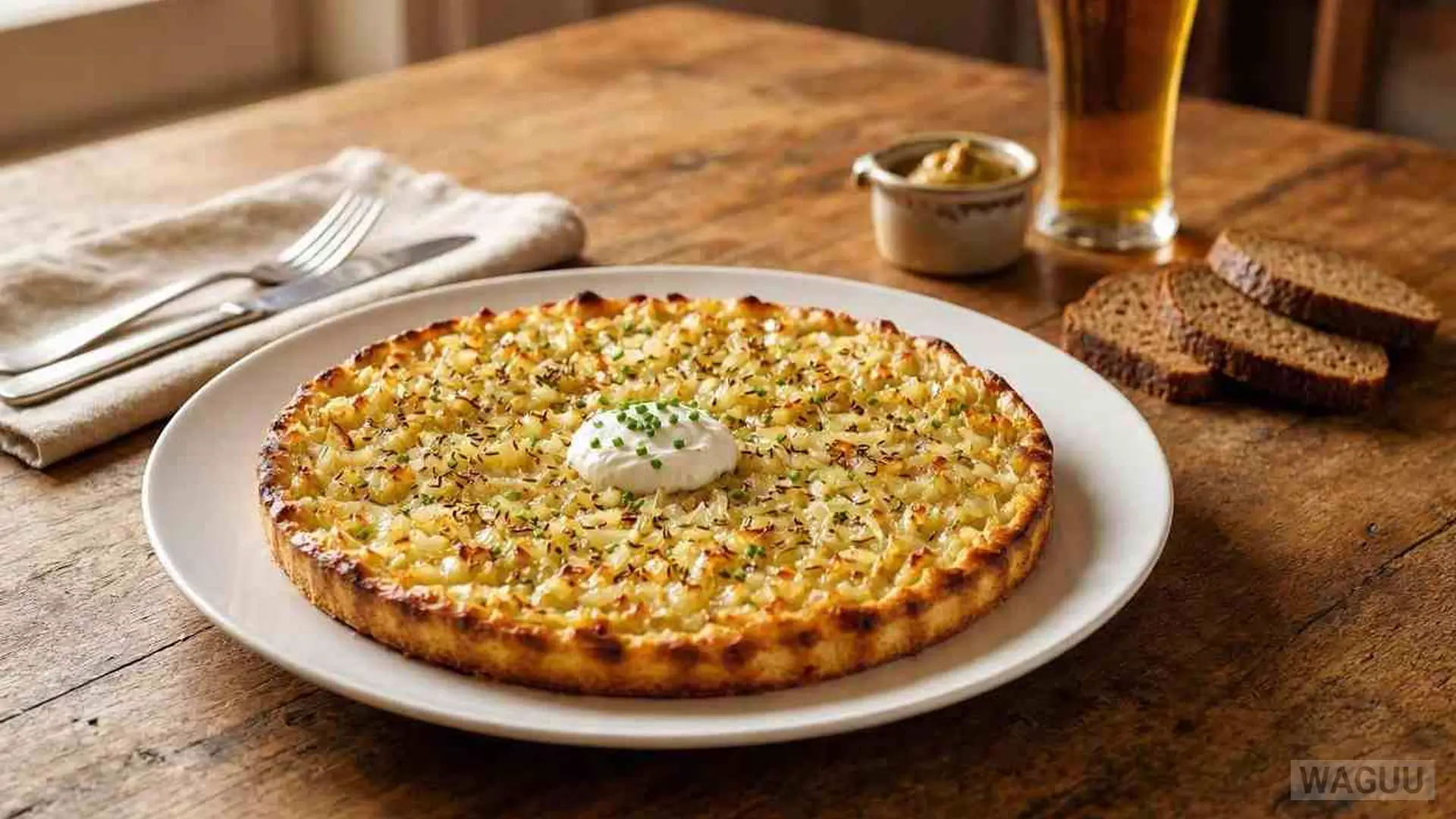
Summary: Zwiebelkuchen is a traditional German savory yeast cake loaded with slow-cooked sweet onions, smoky bacon, and a rich sour cream custard. Featuring a tender yeast dough base and a golden-baked topping, this classic autumn specialty pairs wonderfully with a glass of young wine and takes about 2 hours and 30 minutes to prepare for 6 servings.
Did you make this recipe? Share the result with the community.
Category: Bread and Pastry, German Cuisine
Success rate: 98% of users successfully made this recipe
Quick overview
- Dish: Zwiebelkuchen
- Category: Bread and Pastry, German Cuisine
- Cuisine: German
- Main ingredient: Yellow onions, 3 lb (softened and caramelized)
- Guide: 12 Most Popular German Foods: Favorite Recipes of German Cuisine
- Total time: 150 minutes (90 min prep + 60 min cooking)
- Difficulty: Medium
- Servings: 6 servings (Serving weight: 260 g)
- Key technique: Dough kneading, gentle onion sweating, and custard baking
- Preparation types: Baking, sautéing, mixing
- Dietary info & Allergens: Contains wheat, milk, eggs
- Suitable for: Autumn dinners, festive gatherings, wine pairings
- Nutritional values (per 1 serving): 425.4 kcal, Protein: 14.2 g, Fat: 22.5 g, Carbs: 43.1 g
- Storage: 3 days in the fridge, 2 months in the freezer
- Pairing: Sparkling water, German Riesling, young wine (Federweißer)
- In a nutshell: A savory German yeast tart piled high with sweet caramelized onions, smoky bacon, and a silky sour cream custard.
- Last updated: September 21, 2026
WAGUU says: “Zwiebelkuchen transforms humble onions into a luxurious masterpiece through patient, gentle sweating that unlocks their natural sugars.”
How to take it further: Add a pinch of caraway seeds to the dough or sprinkle fresh chopped chives over the hot baked cake just before serving.
Key facts
| Prep time: | 90 minutes |
| Cooking time: | 60 minutes |
| Temperature: | 375 °F |
| Number of servings: | 6 servings |
In a nutshell
Discover the authentic taste of German autumn bakeries with Zwiebelkuchen, featuring a golden yeast crust, mountains of meltingly tender onions, smoky bacon lardons, and a rich, creamy custard.
Ingredients
Base servings: 6 servings • Serving weight: 260 g
| Ingredient | Quantity | Quality |
|---|---|---|
| All-purpose flour | 2.5 cups | Unbleached, high protein |
| Active dry yeast | 2.25 tsp | Fresh, active |
| Whole milk | 0.75 cup | Lukewarm |
| Unsalted butter | 3 tbsp | Melted and cooled |
| Granulated sugar | 1 tsp | Fine white |
| Table salt | 1.5 tsp | Fine iodized |
| Yellow onions | 3 lb | Peeled and thinly sliced |
| Smoked bacon | 6 oz | Diced lardons |
| All-purpose flour for onion coating | 2 tbsp | Unbleached |
| Sour cream | 1 cup | Full fat |
| Heavy cream | 0.5 cup | 36% milk fat |
| Large eggs | 3 pcs | Fresh grade A |
| Caraway seeds | 1 tsp | Whole dried |
| Black pepper | 0.5 tsp | Freshly ground |
Why you’ll love this recipe
- Authentic tradition: Recreates the beloved German autumn baking heritage right in your home kitchen.
- Perfect texture balance: Combines a sturdy yeast crust with meltingly soft onions and a velvety custard filling.
- Flavor harmony: Balances the natural sweetness of caramelized onions with savory, smoky bacon and aromatic caraway.
Why it works: Slow-cooking the onions removes excess moisture and caramelizes natural sugars, ensuring a rich flavor without making the pastry soggy.
Recipe overview
Prep: 90 min | Cooking: 60 min | Difficulty: Medium | Servings: 6 | Type: Bread and Pastry | Origin: German
Detailed instructions
Overall progress: 0% completed
Phase 1: Preparing the Yeast Dough – 30 min
Appliances: Stove
1. In a small bowl, combine 0.75 cup lukewarm whole milk, 2.25 tsp active dry yeast, and 1 tsp granulated sugar. Stir gently and let sit for 10 minutes until frothy. In a large mixing bowl, combine 2.5 cups all-purpose flour and 1 tsp table salt. Pour in the yeast mixture and 3 tbsp melted and cooled unsalted butter. Knead vigorously for 8 minutes until a smooth, elastic dough forms that pulls away from the sides of the bowl. Cover the bowl with a clean kitchen towel and let rise in a warm, draft-free spot for 45 minutes.
CP: Visual check point (VKB): Dough increases to double its original volume and springs back lightly when poked with a finger.
Before moving to the next step:
Ensure the yeast has fully activated and created a rich foam before mixing with the flour to guarantee proper dough rise.
Phase 2: Sautéing Onions and Bacon – 35 min
Appliances: Stove
2. While the dough rises, place a large deep skillet over medium heat. Add 6 oz diced smoked bacon lardons and sauté for 6 minutes until rendered and lightly crisp. Add 3 lb peeled and thinly sliced yellow onions to the skillet. Cook over medium-low heat, stirring frequently, for 20 minutes until the onions are soft, translucent, and reduced in volume. Remove from heat, stir in 2 tbsp all-purpose flour, 0.5 tsp table salt, 0.5 tsp freshly ground black pepper, and 1 tsp whole caraway seeds. Let the onion mixture cool to room temperature.
CP: VKB: Onions are thoroughly softened, translucent, and evenly coated with flour and rendered bacon fat without any burning.
Before moving to the next step:
Allow the cooked onions to cool down so they do not scramble the eggs when combined in the next phase.
Phase 3: Mixing the Custard – 10 min
Appliances: None
3. In a medium mixing bowl, whisk together 1 cup full-fat sour cream, 0.5 cup 36% heavy cream, and 3 fresh grade A large eggs until completely smooth. Fold this creamy mixture directly into the cooled onion and bacon pan until all ingredients are evenly incorporated.
CP: VKB: Custard mixture is uniform in color, thick, and coats the onions completely without any visible lumps of sour cream.
Before moving to the next step:
Check that the egg and dairy mixture is seasoned well and thoroughly combined before pouring onto the dough base.
Phase 4: Assembling the Cake – 15 min
Appliances: Oven
4. Preheat your oven to 375 °F. Punch down the risen yeast dough and turn it out onto a lightly floured work surface. Roll the dough out into a 12-inch circle and press it firmly into a greased 10-inch springform pan, creating a 1-inch raised edge all around. Pour the onion and bacon custard filling evenly over the dough base, spreading it out smoothly with a spatula.
CP: VKB: Dough covers the bottom and sides of the pan evenly, and the onion filling is distributed across the surface without overflowing the crust edges.
Before moving to the next step:
Verify that the oven has reached 375 °F before placing the cake inside to ensure proper baking and crust rise.
Phase 5: Baking – 60 min
Appliances: Oven
5. Place the springform pan on the middle rack of the preheated 375 °F oven. Bake for 60 minutes until the crust is deeply golden brown and the onion custard topping is set and slightly browned on top.
CP: VKB: Top of the cake is golden brown, the center is completely set without wobbling, and the edges are crisp.
Before moving to the next step:
Check the center with a toothpick or skewer to ensure the custard is fully baked before removing from the oven.
Phase 6: Resting and Serving – 10 min
Appliances: None
6. Remove the baked Zwiebelkuchen from the oven and let it rest in the pan for 10 minutes. Carefully release the springform ring, slice the cake into wedge portions, and serve warm.
CP: VKB: Slices hold their shape cleanly when cut and retain a moist, cohesive interior structure.
Required equipment
| Utensil | Ideal size | Alternative | Risk |
|---|---|---|---|
| Mixing bowl | 3-quart capacity | Large ceramic bowl | Dough sticking if not greased |
| Skillet | 12-inch diameter | Large sauté pan | Overcrowding when adding onions |
| Springform pan | 10-inch diameter | Tart pan with removable bottom | Leakage if not greased properly |
Shopping list
Nutrition profile
Values per 1 serving (excluding side dishes). Calculated from average ingredient nutrition values.
| Nutrient | Per 100 g | Per 1 serving | Per 6 servings |
|---|---|---|---|
| Energy | 163.6 kcal | 425.4 kcal | 2,552.4 kcal |
| Fat | 8.7 g | 22.5 g | 135.0 g |
| of which saturates | 4.2 g | 10.9 g | 65.4 g |
| Carbohydrates | 16.6 g | 43.1 g | 258.6 g |
| of which sugars | 6.1 g | 15.8 g | 94.8 g |
| Protein | 5.5 g | 14.2 g | 85.2 g |
| Salt | 0.4 g | 1.0 g | 6.0 g |
Reference intake of an average adult (8400 kJ / 2000 kcal).
WAGUU Pro level
- Pro standard: Verified recipe with precise ratios and visual checkpoints.
- Tip 1: Slice onions uniformly to ensure they sweat and caramelize at the exact same rate in the pan.
- Tip 2: Toss the cooked onions with flour to absorb excess moisture and bind the custard during baking.
- Tip 3: Let the yeast dough undergo a full secondary rise in the pan if you prefer a thicker, fluffier crust.
- Tip 4: Serve Zwiebelkuchen lukewarm rather than piping hot so the custard sets fully and flavors concentrate.
Scientific background
Slow-cooking onions breaks down complex carbohydrates into simple sugars through thermal hydrolysis and Maillard reactions, creating intense natural sweetness. Combining sour cream and eggs creates a heat-set protein gel matrix that traps moisture from the onions while maintaining a creamy texture.
Fine Dining – Professional techniques
- Plate composition: Serve neat triangular wedges on warm matte ceramic plates with a sprig of fresh flat-leaf parsley.
- Texture contrasts: Contrast the crispy outer yeast crust with the velvety, melting onion custard interior.
- Temperature contrast: Pair warm slices of Zwiebelkuchen with chilled young white wine.
- Aromatic garnishes: Garnish with toasted caraway seeds and freshly cracked black pepper.
Sensory radar
- Appearance: Golden-brown crust with a rich, glossy amber onion topping
- Aroma: Sweet caramelized onions, smoky bacon, and warm yeast dough
- Taste: Savory, buttery, and subtly sweet with a hint of caraway
- Texture: Tender yeast crust supporting a creamy, soft onion custard
Pairing
- BEER: Crisp German Pilsner
- WINE: Young German Riesling or Federweißer
- NON-ALCOHOLIC: Sparkling apple juice with mineral water
Various preparation methods
- Sheet Pan Style: Bake the Zwiebelkuchen in a rectangular baking sheet for party-sized squares.
- Vegetarian Version: Omit the smoked bacon and add roasted mushrooms for an earthy vegetarian alternative.
Allergens and dietary information
Contains: Wheat, milk, eggs • Gluten: Contains gluten • Not suitable for: Vegan, dairy-free, or gluten-free diets
Suitable for
Autumn dinners, festive gatherings, wine pairings
Substitution guide
- Sour cream: Substitute with full-fat Greek yogurt or crème fraîche.
- Smoked bacon: Substitute with pancetta or smoked tofu for a different flavor profile.
FAQ
Can I make the yeast dough ahead of time?
Yes, you can let the dough rise in the refrigerator overnight for a slower, more flavorful fermentation.
What wine goes best with Zwiebelkuchen?
Traditional German Federweißer (sweet semi-fermented young wine) or a crisp dry Riesling are classic pairings.
Why do I need to add flour to the onions?
The flour absorbs moisture released by the onions during baking, preventing a soggy crust.
Can I freeze baked Zwiebelkuchen?
Yes, wrap individual slices tightly in plastic wrap and freeze for up to 2 months. Reheat in the oven.
WAGUU Petr advises: Cooking for 12 or more people?
12–16 people: Double the recipe ingredients and bake in two separate 10-inch springform pans simultaneously. • 20+ people: Prepare the dough and filling in large batches and bake on standard rimmed baking sheets as sheet-pan Zwiebelkuchen squares.
Sides and serving
- Green garden salad with vinaigrette – (not included in the recipe)
- Pickled gherkins – (not included in the recipe)
Serving: Serve warm in triangular wedges, accompanied by a glass of young white wine.
Storage and reheating
Fridge: 3 days • Freezer: 2 months • Reheating: Warm in a 325 °F oven for 10 minutes to restore crust crispness.
Author: WAGUU Petr & Team • Published: 21 Sep 2026 • Updated: 30 Oct 2026
More Recipes in This Article
Guide: 12 Most Popular German Foods: Favorite Recipes of German Cuisine
Other recipes you might enjoy
Why WAGUU?
Recipes on WAGUU undergo checks for ingredient accuracy, procedures, and nutritional values.
Process photo gallery
Community photos: Cook, take a picture, and share your results.
You can upload photos in the comments below or send them via email.
Did you record a video of your process for our recipe? Paste a link to YouTube, YouTube Shorts, TikTok, Instagram Reels, Facebook Reels, Pinterest, Vimeo, or X (Twitter) in the comments – we’d love to share it and help give you and your content more visibility.
Common mistakes
- Not sweating onions long enough – Results in excess moisture and a soggy pastry crust.
- Adding hot onions to eggs – Scrambles the eggs before the custard is mixed.
- Skipping the flour dusting – Fails to bind the moisture in the onion mixture.
- Cutting while piping hot – Causes the custard filling to collapse instead of holding its shape.