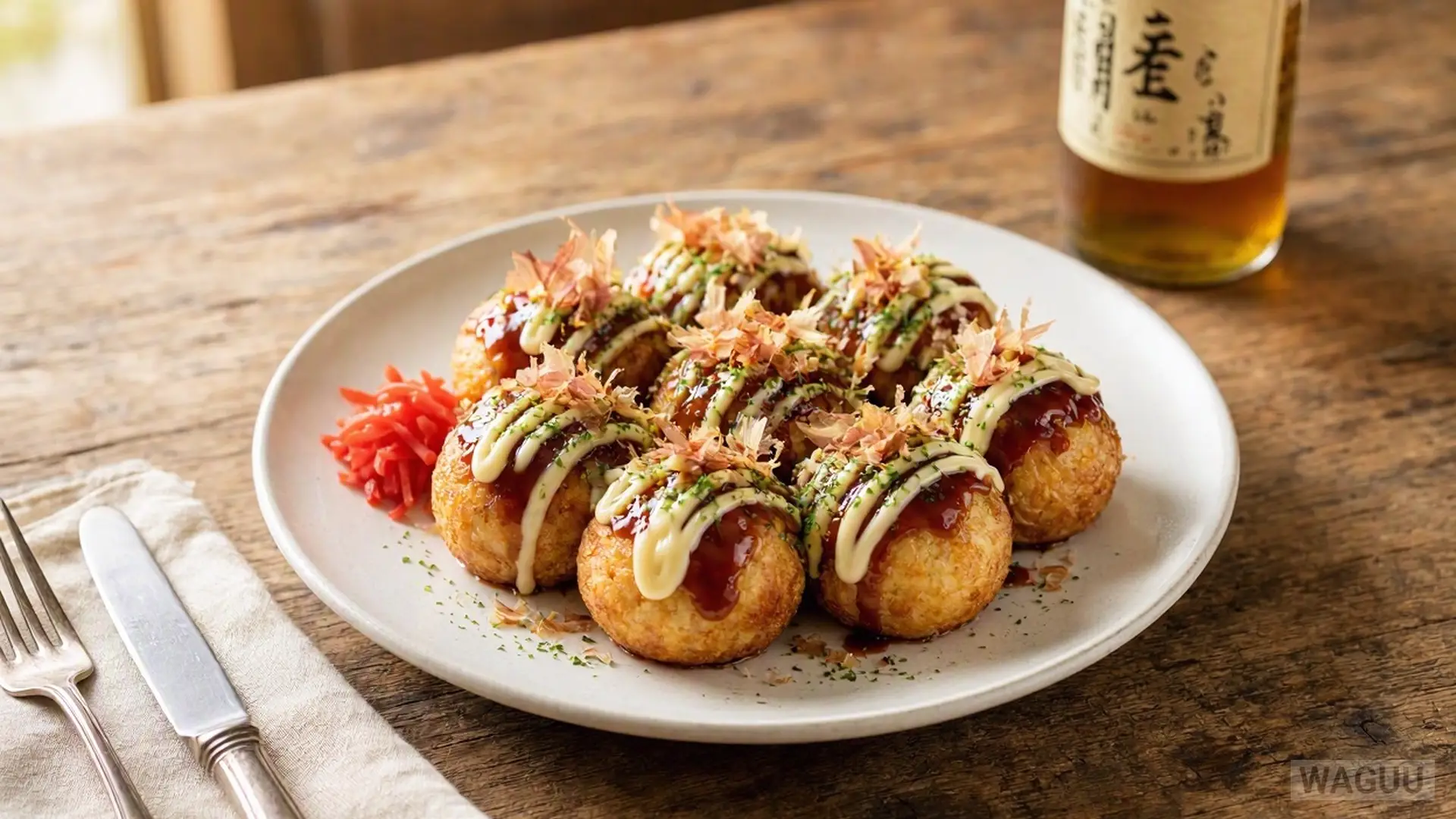
Summary: Takoyaki are iconic Japanese street food snacks consisting of golden, crispy spheres of savoury batter filled with tender pieces of octopus, pickled ginger, and green onions. These bite-sized treats are cooked in a specialised takoyaki pan, topped with a tangy sauce, creamy mayonnaise, and delicate bonito flakes that dance in the heat. Preparation takes approximately 45 minutes, yielding 6 portions of these delightful delicacies.
Did you cook this recipe? Share the result with the community.
Category: Starters, Japanese Cuisine
Success rate: 98% of users successfully made this recipe
Quick overview
- Dish: Takoyaki
- Category: Starters, Japanese Cuisine
- Cuisine: Japanese
- Main ingredient: Octopus, 300 g (fresh, cleaned)
- Guide: 12 most popular Japanese dishes: favourite Japanese cuisine recipes
- Total time: 45 minutes (15 min prep + 30 min cooking)
- Difficulty: Intermediate
- Portions: 6 (Portion weight: 220 g)
- Key technique: Griddle-frying in a spherical mould
- Preparation types: Batter-based pan frying
- Dietary info & Allergens: Contains gluten, fish, eggs, molluscs
- Suitable for: Casual dining, party snacks
- Nutritional values (per 1 portion): 320.5 kcal, Protein: 14.2 g, Fat: 12.8 g, Carbohydrates: 36.4 g
- Storage: 2 days in the fridge, 3 months in the freezer
- Pairing: Japanese lager, chilled sake, green tea
- In short: Crispy, savoury octopus balls served with umami-rich toppings.
- Last updated: 21 September 2026
WAGUU says: “Mastering the flip is the secret to the perfect spherical shape and crispy exterior of true Takoyaki.”
How to take it further: Add a pinch of tenkasu (tempura scraps) inside for extra crunch, or experiment with a sprinkle of aonori (seaweed flakes) for authentic oceanic aroma.
Key facts
| Prep time: | 15 min |
| Cooking time: | 30 min |
| Temperature: | 180 °C (pan surface) |
| Number of portions: | 6 |
In a nutshell
Takoyaki are the quintessential Japanese street snack. Combining a light, savoury batter with succulent octopus, these golden balls are finished with a rich, tangy sauce and aromatic bonito flakes. Whether hosting a party or craving an authentic taste of Osaka, this recipe provides a foolproof method to achieve the perfect balance of crispy crust and tender, molten interior.
Ingredients
Base portions: 6 portions • Portion weight: 220 g
| Ingredient | Amount | Quality |
|---|---|---|
| Octopus meat | 300 g | Fresh, cleaned |
| Plain flour | 400 g | Sifted |
| Dashi stock | 800 ml | Chilled |
| Eggs | 2 pcs | Large, free-range |
| Pickled ginger | 50 g | Finely chopped |
| Spring onions | 40 g | Finely sliced |
| Takoyaki sauce | 100 ml | Commercial grade |
| Japanese mayonnaise | 60 ml | Kewpie style |
| Bonito flakes | 20 g | Dried, high quality |
| Rapeseed oil | 30 ml | For greasing |
| Salt | 12 g | Fine sea salt |
Why you will love this recipe
- Authentic street flavour: Experience the true taste of Osaka with perfectly balanced ingredients.
- Interactive cooking: Turning the balls in the pan is a fun and engaging culinary experience.
- Textural harmony: A delightful contrast between the crispy outer shell and the creamy, octopus-filled centre.
Why it works: Our precise batter-to-dashi ratio ensures a light, flavourful crust that holds its shape while remaining tender inside.
Recipe overview
Prep: 15 min | Cooking: 30 min | Difficulty: Intermediate | Portions: 6 | Type: Starter | Origin: Japanese
Detailed instructions
Overall progress: 0% complete
Phase 1: Preparing the batter – 5 min
Appliances: Mixing bowl, whisk
1. In a large bowl, whisk the sifted plain flour with the chilled dashi stock and salt until a smooth, thin batter forms. Incorporate the beaten eggs, ensuring no lumps remain. Visual check point (VKB): The batter should have the consistency of single cream. Set aside to rest while preparing the fillings.
VKB: Batter consistency should be smooth and pourable.
Phase 2: Filling preparation – 5 min
Appliances: Knife, cutting board
2. Cut the cleaned octopus meat into 1.5 cm bite-sized cubes. Finely chop the pickled ginger and prepare the spring onions by slicing them into thin rounds. Keep these ingredients organised in small bowls for easy access during the cooking process.
VKB: Octopus cubes must be uniform for even cooking.
Phase 3: Heating and greasing – 5 min
Appliances: Takoyaki pan, hob
3. Place the takoyaki pan over medium-high heat. Generously brush each spherical mould with the rapeseed oil. Ensure the oil coats the sides of the moulds to prevent sticking. VKB: The pan is ready when a drop of batter sizzles immediately upon contact.
VKB: Pan surface must be hot enough to crisp the batter instantly.
Phase 4: Filling the moulds – 5 min
Appliances: Ladle
4. Pour the batter into each mould until nearly full. Drop a piece of octopus into the centre of each mould, followed by a pinch of chopped ginger and spring onions. The batter will overflow slightly—this is intentional and helps in shaping the spheres later.
VKB: Ensure every mould contains at least one piece of octopus.
Phase 5: Forming the spheres – 5 min
Appliances: Takoyaki picks or skewers
5. After 2-3 minutes, use the picks to slice through the connecting batter between the moulds. Gently flip each ball 90 degrees, pushing the overhanging batter into the mould. Continue turning until the balls are perfectly spherical and golden brown on all sides.
VKB: The crust should be firm enough to turn without breaking.
Phase 6: Serving – 5 min
Appliances: Serving plate
6. Transfer the hot takoyaki to a plate. Drizzle generously with takoyaki sauce and Japanese mayonnaise. Finish by sprinkling with the dried bonito flakes, which will move due to the steam. Serve immediately while hot.
VKB: Bonito flakes should curl and dance upon the hot surface.
Required equipment
| Utensil | Ideal size | Alternative | Risk |
|---|---|---|---|
| Takoyaki pan | 24-hole | Electric pan | Uneven heating |
| Takoyaki picks | Stainless steel | Wooden skewers | Scratching surface |
| Mixing bowl | 2 litre | Large jug | Spillage |
Shopping list
Nutritional profile
Values per 1 portion (excluding side dishes). Calculated from average nutritional values of ingredients.
| Nutrient | Per 100 g | Per 1 portion | Per 6 portions |
|---|---|---|---|
| Energy | 145.6 kcal | 320.5 kcal | 1923.0 kcal |
| Fat | 5.8 g | 12.8 g | 76.8 g |
| of which saturates | 1.2 g | 2.6 g | 15.6 g |
| Carbohydrates | 16.5 g | 36.4 g | 218.4 g |
| of which sugars | 2.1 g | 4.6 g | 27.6 g |
| Protein | 6.4 g | 14.2 g | 85.2 g |
| Salt | 0.5 g | 1.1 g | 6.6 g |
Reference intake of an average adult (8400 kJ / 2000 kcal).
WAGUU Pro Level
- Pro standard: Verified recipe with precise ratios and visual control points.
- Tip 1: Use a high-quality dashi stock for a deeper umami profile.
- Tip 2: Keep the batter chilled to ensure a sharper temperature contrast in the pan.
- Tip 3: Don’t rush the flipping process; wait for a firm crust to form.
- Tip 4: Use a light touch when turning to maintain the spherical shape.
Scientific background
The success of takoyaki relies on the Maillard reaction occurring on the surface of the batter, creating a crispy exterior while the internal proteins and starches remain in a gelatinous state. The use of dashi provides glutamates that enhance the overall umami experience, creating a synergistic effect with the octopus proteins.
Fine Dining – Professional techniques
- Plate composition: Arrange in an odd number for visual balance.
- Textural contrasts: Pair the soft interior with crispy tempura bits.
- Temperature contrast: Ensure the sauce is at room temperature to avoid cooling the hot balls.
- Aromatic garnishes: Use freshly sliced spring onions for a bright, pungent contrast.
Sensory radar
- Appearance: Golden-brown spheres with a glossy sauce finish.
- Aroma: Savoury dashi and oceanic octopus scent.
- Taste: Umami-rich, salty, and slightly tangy.
- Texture: Crispy exterior with a creamy, molten centre.
Pairing
- BEER: Dry, crisp Japanese lager.
- WINE: Chilled Junmai sake.
- NON-ALCOHOLIC: Hot roasted green tea (Hojicha).
Various preparation variants
- Cheese Takoyaki: Add small cubes of melting cheese inside for a gooey centre.
- Kimchi Takoyaki: Replace ginger with chopped kimchi for a spicy, fermented twist.
Allergens and dietary information
Contains: Gluten, fish, eggs, molluscs • Gluten: Contains wheat flour • Not suitable for: Vegetarians, vegans, nut allergy sufferers
Suitable for
Parties, casual dinners, authentic Japanese dining experiences.
Substitution catalog
- Octopus: Squid or small prawns.
FAQ
Can I use a regular frying pan?
No, a specialised takoyaki pan is essential for the spherical shape.
How do I know they are cooked?
They should be firm to the touch and golden brown.
Can I reheat them?
Yes, reheating in an air fryer or oven will restore the crispness.
Are bonito flakes essential?
They provide a vital umami aroma, though they can be omitted.
WAGUU Petr advises: Cooking for 12 or more people?
12–16 people: Use two pans simultaneously to ensure fresh service. • 20+ people: Prepare the batter in advance and keep it chilled; enlist help for the turning process.
Sides and Serving
- Edamame – lightly salted (not included in the recipe)
- Pickled radish – for palate cleansing (not included in the recipe)
Serving: Serve on a small plate or boat with plenty of sauce and mayonnaise.
Storage and reheating
Fridge: 2 days • Freezer: 3 months • Reheating: Oven at 180 °C for 10 minutes.
Author: WAGUU Petr & Team • Published: 21 Sep 2026 • Updated: 30 Oct 2026
More Recipes from This Article
Other recipes you might be interested in
Why WAGUU?
Recipes on WAGUU undergo checks for the accuracy of ingredients, procedures, and nutritional values.
Process photo gallery
Community photos: Cook, take a photo, and share the result.
You can upload photos in the comments below or send them via email.
Did you record a video guide for our recipe? Insert a link to YouTube, YouTube Shorts, TikTok, Instagram Reels, Facebook Reels, Pinterest, Vimeo, or X (Twitter) in the comment – we’d be happy to publish it and help promote you and your content.
Common mistakes
- Overfilling: Pouring too much batter leads to messy, misshapen balls.
- Insufficient oil: Not using enough oil causes sticking and ruins the crust.
- Premature flipping: Turning too early results in broken, soft spheres.
- Low heat: Cooking at low temperatures prevents the formation of a crispy shell.