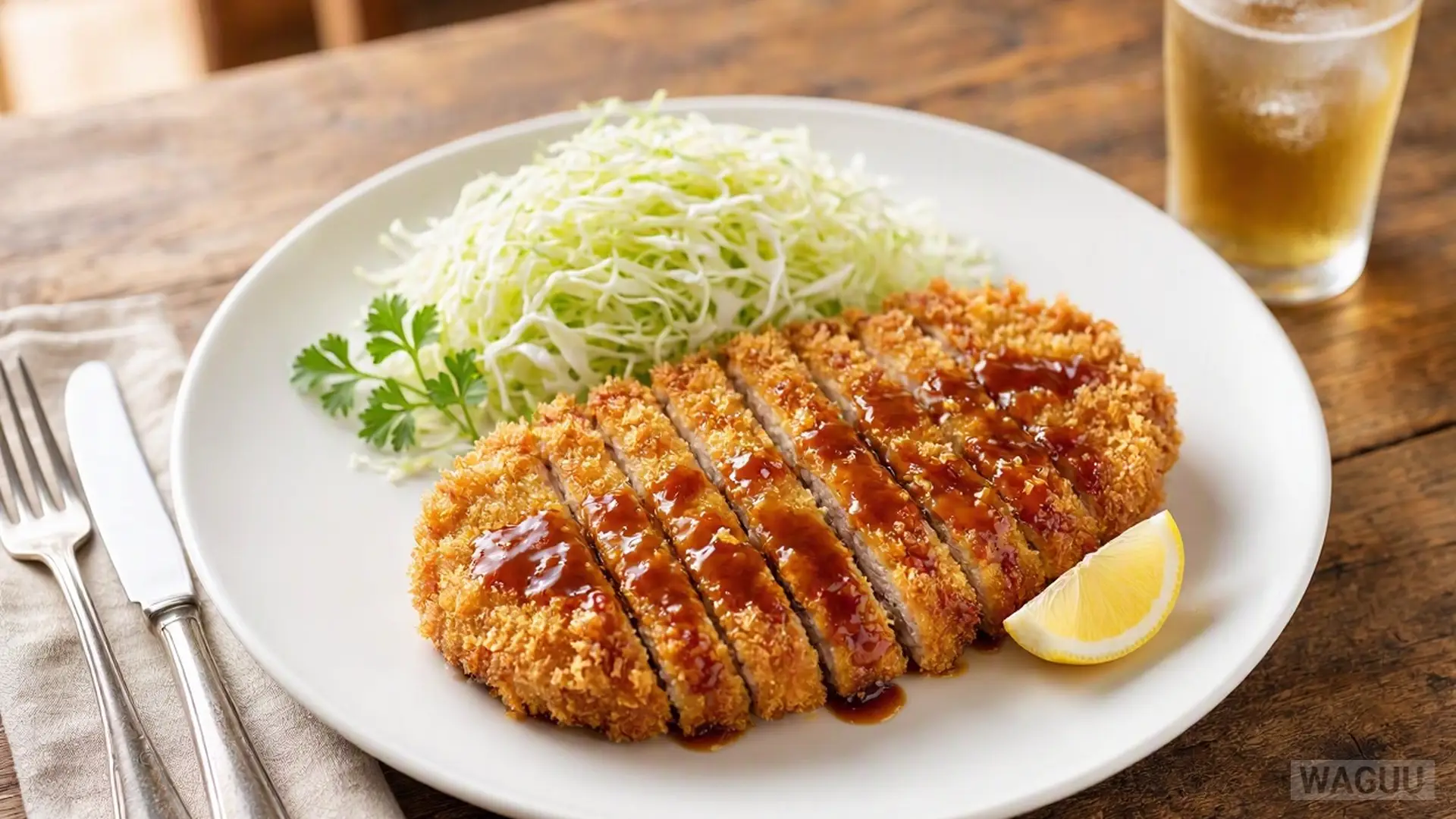
Summary: Tonkatsu is a quintessential Japanese comfort dish consisting of a thick, tender pork loin cutlet, coated in coarse panko breadcrumbs and deep-fried until golden and shatteringly crisp. This recipe focuses on achieving the perfect balance between a juicy interior and a light, crunchy exterior, served with a tangy, umami-rich tonkatsu sauce and a refreshing mound of finely shredded cabbage. Preparation time is approximately 45 minutes for 6 generous portions.
Did you cook this recipe? Share the result with the community.
Category: Main Dishes, Pork
Success rate: 98% of users successfully made this recipe
Quick overview
- Dish: Tonkatsu
- Category: Main Dishes, Pork
- Cuisine: Japanese
- Main ingredient: Pork loin, 900 g (high-quality, well-marbled)
- Guide: 12 most popular Japanese dishes: favourite Japanese cuisine recipes
- Total time: 45 minutes (15 min prep + 30 min cooking)
- Difficulty: Intermediate
- Portions: 6 (Portion weight: 280 g)
- Key technique: Deep-frying
- Preparation types: Breading, Frying
- Dietary info & Allergens: Contains: Gluten, Eggs, Soy
- Suitable for: Meat lovers
- Nutritional values (per 1 portion): 620.5 kcal, Protein: 38.2 g, Fat: 34.5 g, Carbohydrates: 38.8 g
- Storage: 2 days in the fridge, 2 months in the freezer
- Pairing: Japanese lager, crisp dry sake, green tea
- In short: Crispy, juicy, golden pork cutlets served with tangy sauce and fresh cabbage.
- Last updated: 21 September 2026
WAGUU says: “Tonkatsu is all about the quality of the breadcrumbs and the temperature control of the oil. Do not rush the frying process.”
How to take it further: Add a tablespoon of toasted sesame seeds to the sauce, or serve with a side of pickled ginger to cut through the richness.
Key facts
| Prep time: | 15 minutes |
| Cooking time: | 30 minutes |
| Temperature: | 170–180 °C |
| Number of portions: | 6 |
In a nutshell
Tonkatsu represents the pinnacle of Japanese home-style fried food. By meticulously breading a thick cut of pork loin and frying it to a perfect golden brown, you create a dish that is both texturally exciting and deeply satisfying. It is the ultimate comfort food, best shared with friends and family.
Ingredients
Base portions: 6 portions • Portion weight: 280 g
| Ingredient | Amount | Quality |
|---|---|---|
| Pork loin | 900 g | Trimmed |
| Panko breadcrumbs | 300 g | Coarse |
| Plain flour | 100 g | Sifted |
| Eggs | 2 pcs | Large |
| Rapeseed oil | 500 ml | For frying |
| Salt | 9 g | Fine |
| White pepper | 2 g | Freshly ground |
Why you will love this recipe
- Texture contrast: The combination of the shatteringly crisp panko crust and the tender, juicy pork loin is unparalleled.
- Simplicity: Despite its professional appearance, Tonkatsu is remarkably straightforward to prepare at home with basic ingredients.
- Versatility: It pairs beautifully with rice, shredded cabbage, or even as a filling for a sandwich.
Success guaranteed: By following the temperature guidelines and ensuring the pork is evenly sliced, you will achieve consistent, restaurant-quality results every time.
Recipe overview
Prep: 15 min | Cooking: 30 min | Difficulty: Intermediate | Portions: 6 | Type: Main Dish | Origin: Japanese
Detailed instructions
Overall progress: 0% complete
Phase 1: Preparation of the pork – 5 min
Appliances: None
1. Slice the pork loin into 6 even cutlets, about 2 cm thick. Use a meat mallet to tenderise the meat slightly and ensure uniform thickness. Visual check point (VKB): The cutlets should be of equal thickness to ensure even cooking.
VKB: Even thickness of cutlets.
Before moving to the next step:
Ensure the cutlets are seasoned well with salt and white pepper.
Phase 2: Breading – 5 min
Appliances: None
2. Set up three shallow bowls: one with flour, one with beaten eggs, and one with panko breadcrumbs. Dredge each cutlet in flour, dip into the egg, and press firmly into the panko until fully coated. VKB: The breadcrumbs must adhere completely to the surface.
VKB: Full coverage of breadcrumbs.
Before moving to the next step:
Shake off any excess panko so the oil stays clean.
Phase 3: Deep-frying – 20 min
Appliances: Hob, Deep-frying pan
3. Heat the oil to 170–180 °C. Fry the cutlets for 4–5 minutes on each side until the crust is golden brown and the internal temperature reaches 65 °C. VKB: The crust should be crisp and uniform in colour.
VKB: Golden-brown crust.
Before moving to the next step:
Rest the meat on a wire rack for 3 minutes before slicing.
Phase 4: Serving – 0 min
Appliances: None
4. Slice the cutlets into strips and serve immediately with shredded cabbage and tonkatsu sauce (not part of the recipe).
VKB: Crisp slices.
Required equipment
| Utensil | Ideal size | Alternative | Risk |
|---|---|---|---|
| Deep-frying pan | 28 cm | Heavy pot | Oil splatter |
| Meat mallet | Standard | Heavy pan base | Tearing meat |
| Wire rack | Large | Paper towels | Soggy crust |
Shopping list
Nutritional profile
Values per 1 portion (excluding side dishes). Calculated from average nutritional values of ingredients.
| Nutrient | Per 100 g | Per 1 portion | Per 6 portions |
|---|---|---|---|
| Energy | 221.6 kcal | 620.5 kcal | 3723.0 kcal |
| Fat | 12.3 g | 34.5 g | 207.0 g |
| of which saturates | 2.1 g | 5.9 g | 35.4 g |
| Carbohydrates | 13.8 g | 38.8 g | 232.8 g |
| of which sugars | 0.5 g | 1.4 g | 8.4 g |
| Protein | 13.6 g | 38.2 g | 229.2 g |
| Salt | 0.35 g | 1.0 g | 6.0 g |
Reference intake of an average adult (8400 kJ / 2000 kcal).
WAGUU Pro Level
- Pro standard: Verified recipe with precise ratios and visual control points.
- Tip 1: Use high-quality panko for the best crunch; regular breadcrumbs will not yield the same result.
- Tip 2: Ensure the oil temperature is stable; use a thermometer if possible.
- Tip 3: Do not overcrowd the frying pan, as this causes the oil temperature to drop.
- Tip 4: Resting the meat after frying is crucial to retain juices.
Scientific background
The crispness of Tonkatsu is a result of the Maillard reaction occurring between the proteins and carbohydrates in the breadcrumbs during deep-frying. The panko crumbs, with their light, airy structure, provide a larger surface area for heat distribution, creating a crunch that is significantly lighter than that produced by standard breadcrumbs. The pork loin, when cooked to the correct internal temperature, undergoes collagen hydrolysis, resulting in tender, succulent meat.
Fine Dining – Professional techniques
- Plate composition: Fan the sliced cutlet to showcase the golden crust and tender interior.
- Textural contrasts: Pair the hot, crunchy pork with cold, crisp, finely shredded cabbage.
- Temperature contrast: Ensure the pork is served immediately, while the cabbage remains chilled.
- Aromatic garnishes: Finish with a light dusting of toasted sesame seeds or fresh coriander leaves.
Sensory radar
- Appearance: Golden-brown, uniform crust.
- Aroma: Savoury, toasted bread notes with a hint of pork.
- Taste: Umami-rich, balanced by tangy sauce.
- Texture: Shatteringly crisp exterior, tender and juicy interior.
Pairing
- BEER: A crisp, cold Japanese rice lager.
- WINE: A dry, high-acid Riesling or a light Pinot Noir.
- NON-ALCOHOLIC: Chilled sencha green tea.
Various preparation variants
- Katsudon: Simmer the fried Tonkatsu in a dashi-based sauce with egg and onions, served over rice.
- Tonkatsu Sandwich: Place the fried cutlet between two slices of soft white bread with tonkatsu sauce and finely shredded cabbage.
Allergens and dietary information
Contains: Gluten, Eggs, Soy • Gluten: Breadcrumbs and flour contain gluten. • Not suitable for: Vegetarians, Vegans.
Suitable for
This dish is suitable for meat lovers and those who enjoy traditional Japanese cuisine. It is a hearty main course.
Substitution catalog
- Pork loin: Chicken breast or pork fillet can be substituted.
- Panko breadcrumbs: While not ideal, regular breadcrumbs can be used if panko is unavailable.
FAQ
Can I use a different cut of pork?
Yes, pork fillet is a great, tender alternative, though it will cook faster.
How do I stop the crust from falling off?
Ensure the pork is dry before dredging in flour, and press the panko firmly into the egg wash.
Can I bake Tonkatsu instead of frying?
Baking will not produce the same crispy, golden result, but you can brush with oil and bake at 200 °C.
How long does it keep?
It keeps for up to 2 days in the fridge; reheat in an oven to restore crispness.
WAGUU Petr advises: Cooking for 12 or more people?
12–16 people: Prepare the breaded cutlets in advance and store them in the fridge; fry in batches just before serving. • 20+ people: Use multiple frying pans simultaneously and ensure you have enough oil on hand to maintain temperature.
Sides and Serving
- Steamed white rice – A classic, neutral base (not included in the recipe).
- Finely shredded cabbage – Essential for freshness and texture (not included in the recipe).
Serving: Serve hot with a generous drizzle of tonkatsu sauce.
Storage and reheating
Fridge: 2 days • Freezer: 2 months • Reheating: Preheat oven to 180 °C and bake for 10 minutes until crisp.
Author: WAGUU Petr & Team • Published: 21 Sep 2026 • Updated: 30 Oct 2026
More Recipes from This Article
Other recipes you might be interested in
Why WAGUU?
Recipes on WAGUU undergo checks for the accuracy of ingredients, procedures, and nutritional values.
Process photo gallery
Community photos: Cook, take a photo, and share the result.
You can upload photos in the comments below or send them via email.
Did you record a video guide for our recipe? Insert a link to YouTube, YouTube Shorts, TikTok, Instagram Reels, Facebook Reels, Pinterest, Vimeo, or X (Twitter) in the comment – we’d be happy to publish it and help promote you and your content.
Common mistakes
- Incorrect temperature: If the oil is too cold, the breading will absorb excess grease.
- Too thick cutlets: Thick cutlets won’t cook through before the breading burns.
- Skipping the rest: Cutting immediately lets the juices escape, making the meat dry.
- Crowding the pan: This lowers the oil temperature and prevents crisping.