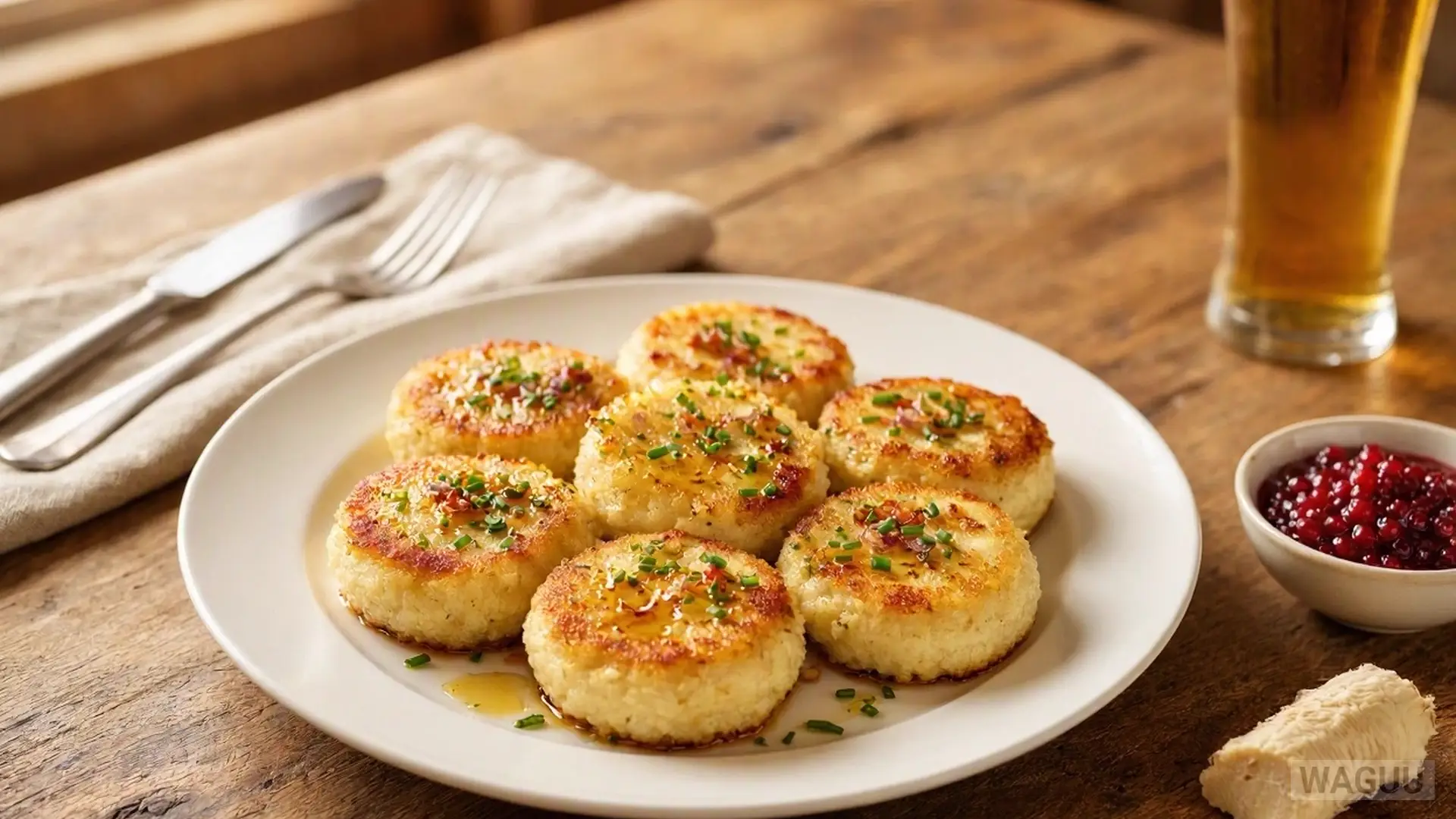
Summary: Kaspressknödel are traditional Tyrolean cheese dumplings made from stale bread, a blend of strong mountain cheeses, fresh herbs, and eggs. They are hand-shaped into flat patties, pan-fried until the crust is golden and crunchy, and served either in a rich beef broth or alongside a crisp green salad. This preparation takes 60 minutes and yields 6 hearty portions.
Did you cook this recipe? Share the result with the community.
Category: Main Dishes, Austrian Cuisine
Success rate: 98% of users successfully made this recipe
Quick overview
- Dish: Kaspressknödel
- Category: Main Dishes, Austrian Cuisine
- Cuisine: Austrian
- Main ingredient: Stale bread, 300 g
- Guide: 12 Most Popular Austrian Dishes: Favourite Recipes of Austrian Cuisine
- Total time: 60 minutes (20 min prep + 40 min cooking)
- Difficulty: Medium
- Portions: 6 (Portion weight: 220 g)
- Key technique: Pan-frying
- Preparation types: Mixing, shaping, frying
- Dietary info & Allergens: Gluten, Milk, Eggs
- Suitable for: Vegetarians
- Nutritional values (per 1 portion): 410.5 kcal, Protein: 18.2 g, Fat: 16.5 g, Carbohydrates: 48.3 g
- Storage: 2 days in the fridge, 3 months in the freezer
- Pairing: Lager beer, Grüner Veltliner, Sparkling mineral water
- In short: Crispy, cheese-packed dumplings that define alpine comfort food.
- Last updated: 21 September 2026
WAGUU says: “Kaspressknödel are the ultimate alpine comfort. The secret lies in using a mix of aged mountain cheeses to ensure a deep, savoury profile that balances the texture of the toasted bread.”
How to take it further: Add a pinch of toasted caraway seeds to the dough or serve with a side of warm sauerkraut.
Key facts
| Prep time: | 20 min |
| Cooking time: | 40 min |
| Temperature: | 170 °C |
| Number of portions: | 6 |
In a nutshell
Experience the authentic taste of the Tyrol region with these golden, pan-fried cheese dumplings. They offer a delightful contrast between a crispy exterior and a soft, molten cheese centre, perfect for a warming meal.
Ingredients
Base portions: 6 portions • Portion weight: 220 g
| Ingredient | Amount | Quality |
|---|---|---|
| Stale bread (cubed) | 300 g | White or sourdough |
| Strong mountain cheese | 250 g | Mature, grated |
| Milk (whole) | 250 ml | Warm |
| Eggs | 3 pc | Free-range |
| Fresh parsley | 30 g | Finely chopped |
| Butter | 60 g | Unsalted |
| Salt | 12 g | Sea salt |
Why you will love this recipe
- Alpine tradition: An authentic taste of the Austrian mountains in your own kitchen.
- Texture contrast: A perfectly crispy crust hides a soft, gooey cheese interior.
- Versatility: Serve as a main meal with salad or as a hearty addition to clear broth.
Why it works: The combination of stale bread and warm milk creates a perfect base that absorbs the flavour of the mature cheese, while the pan-frying step ensures a Maillard reaction that adds deep complexity.
Recipe overview
Prep: 20 min | Cooking: 40 min | Difficulty: Medium | Portions: 6 | Type: Main Dish | Origin: Austrian
Detailed instructions
Overall progress: 0% complete
Phase 1: Preparing the base – 10 min
Appliances: Hob
1. Place the cubed bread in a large bowl. Heat the milk until lukewarm and pour it over the bread. Let it soak for 10 minutes. Visual check point (VKB): The bread should be soft but not disintegrated.
VKB: Bread is evenly moistened.
Phase 2: Mixing the dough – 5 min
Appliances: None
2. Add the grated mountain cheese, eggs, chopped parsley, and salt to the soaked bread. Mix thoroughly until a cohesive, slightly sticky dough forms. VKB: The dough should hold its shape when pressed.
VKB: Uniform distribution of cheese and herbs.
Phase 3: Shaping – 5 min
Appliances: None
3. Divide the dough into 12 equal portions. With moistened hands, shape each portion into a flat, round patty, about 2 cm thick. VKB: Patties are even in size to ensure uniform cooking.
VKB: Patties are compact and smooth.
Phase 4: Pan-frying – 20 min
Appliances: Hob
4. Melt the butter in a large frying pan over medium heat (170 °C). Add the patties and fry for 5–7 minutes on each side until golden brown and crispy. VKB: The cheese inside should be melted.
VKB: Deep golden crust on both sides.
Required equipment
| Utensil | Ideal size | Alternative | Risk |
|---|---|---|---|
| Large mixing bowl | 3 litres | Large pot | Difficult mixing |
| Frying pan | 28 cm diameter | Cast iron skillet | Uneven browning |
| Fish slice | Wide | Spatula | Breaking the patty |
Shopping list
Nutritional profile
Values per 1 portion (excluding side dishes). Calculated from average nutritional values of ingredients.
| Nutrient | Per 100 g | Per 1 portion | Per 6 portions |
|---|---|---|---|
| Energy | 186.6 kcal | 410.5 kcal | 2463.0 kcal |
| Fat | 7.5 g | 16.5 g | 99.0 g |
| of which saturates | 4.5 g | 9.9 g | 59.4 g |
| Carbohydrates | 21.9 g | 48.3 g | 289.8 g |
| of which sugars | 2.5 g | 5.5 g | 33.0 g |
| Protein | 8.3 g | 18.2 g | 109.2 g |
| Salt | 0.9 g | 2.0 g | 12.0 g |
Reference intake of an average adult (8400 kJ / 2000 kcal).
WAGUU Pro Level
- Pro standard: Verified recipe with precise ratios and visual control points.
- Tip 1: Use at least two types of cheese for a more complex flavour profile.
- Tip 2: Ensure the bread is truly dry; if it is too fresh, toast it lightly in the oven first.
- Tip 3: Let the dough rest for 15 minutes before shaping to allow the bread to absorb all moisture.
- Tip 4: Use clarified butter for frying to achieve a higher smoke point and better crispiness.
Scientific background
The Kaspressknödel relies on the principle of osmosis and hydration. Stale bread acts as a sponge, rehydrating in the milk and egg mixture. The Maillard reaction during pan-frying creates the characteristic golden crust, while the proteins in the mountain cheese undergo controlled melting, providing the unique gooey texture.
Fine Dining – Professional techniques
- Plate composition: Serve the dumpling slightly off-centre to allow space for the side salad.
- Textural contrasts: Pair with a vibrant, crunchy salad to offset the richness of the dumpling.
- Temperature contrast: Ensure the dumpling is hot while the serving plate is pre-warmed.
- Aromatic garnishes: Finish with a light dusting of fresh chives for a bright aromatic note.
Sensory radar
- Appearance: Golden-brown crust with visible green parsley flecks.
- Aroma: Intense toasted bread and melted alpine cheese.
- Taste: Savoury, nutty, and rich, balanced by the freshness of the herbs.
- Texture: Crunchy exterior with a soft, dense, and elastic interior.
Pairing
- BEER: A crisp, refreshing Helles lager.
- WINE: A dry, acidic Grüner Veltliner.
- NON-ALCOHOLIC: Sparkling mineral water with a slice of lemon.
Various preparation variants
- Bacon-infused: Add 100 g of finely diced, fried bacon to the dough for an extra layer of saltiness.
- Herbal variation: Replace parsley with a mix of wild garlic and chives for a fresh, seasonal profile.
Allergens and dietary information
Contains: Gluten, Milk, Eggs • Gluten: Bread contains wheat flour • Not suitable for: Vegans, Lactose-intolerant individuals
Suitable for
Vegetarians and anyone seeking a hearty, traditional Austrian main dish.
Substitution catalog
- Mountain cheese: Use a blend of Gruyère and Emmental if mountain cheese is unavailable.
- White bread: Use day-old sourdough for a more complex, tangy flavour.
FAQ
Can I make the dough in advance?
Yes, you can shape the patties and refrigerate them for up to 3 hours before frying.
Why did my dumplings fall apart?
This usually happens if the dough is too wet. Ensure you squeeze out excess milk from the bread if necessary.
Can I bake them instead of frying?
Frying is essential for the characteristic texture, but you can bake them at 200 °C for 15 minutes with a brush of butter.
What if I don’t have mountain cheese?
Use any firm, mature cheese that melts well, such as Comté or mature Cheddar.
WAGUU Petr advises: Cooking for 12 or more people?
12–16 people: Prepare the dough in two separate batches to ensure even mixing and consistency. 20+ people: Use a large industrial mixer for the dough and bake the patties on trays in a convection oven at 200 °C, brushing with butter to ensure browning.
Sides and Serving
- Green salad – Fresh leaves with a vinaigrette dressing (not included in the recipe)
- Beef broth – A clear, hot broth for a traditional soup serving (not included in the recipe)
Serving: Serve immediately while the crust is hot and crispy.
Storage and reheating
Fridge: 2 days • Freezer: 3 months • Reheating: Reheat in a pan with a little butter or in the oven at 180 °C until crisp.
Author: WAGUU Petr & Team • Published: 21 Sep 2026 • Updated: 30 Oct 2026
Other Recipe Variations
Other recipes you might be interested in
Why WAGUU?
Recipes on WAGUU undergo checks for the accuracy of ingredients, procedures, and nutritional values.
Process photo gallery
Community photos: Cook, take a photo, and share the result.
You can upload photos in the comments below or send them via email.
Did you record a video guide for our recipe? Insert a link to YouTube, YouTube Shorts, TikTok, Instagram Reels, Facebook Reels, Pinterest, Vimeo, or X (Twitter) in the comment – we’d be happy to publish it and help promote you and your content.
Common mistakes
- Using fresh bread – The dumpling will become mushy; always use stale, dry bread.
- Overworking the dough – This leads to a dense, tough texture; mix only until combined.
- Frying at low temperature – The dumplings will soak up too much fat instead of becoming crispy.
- Not using enough seasoning – The bread and milk base needs proper salt and herb seasoning to shine.