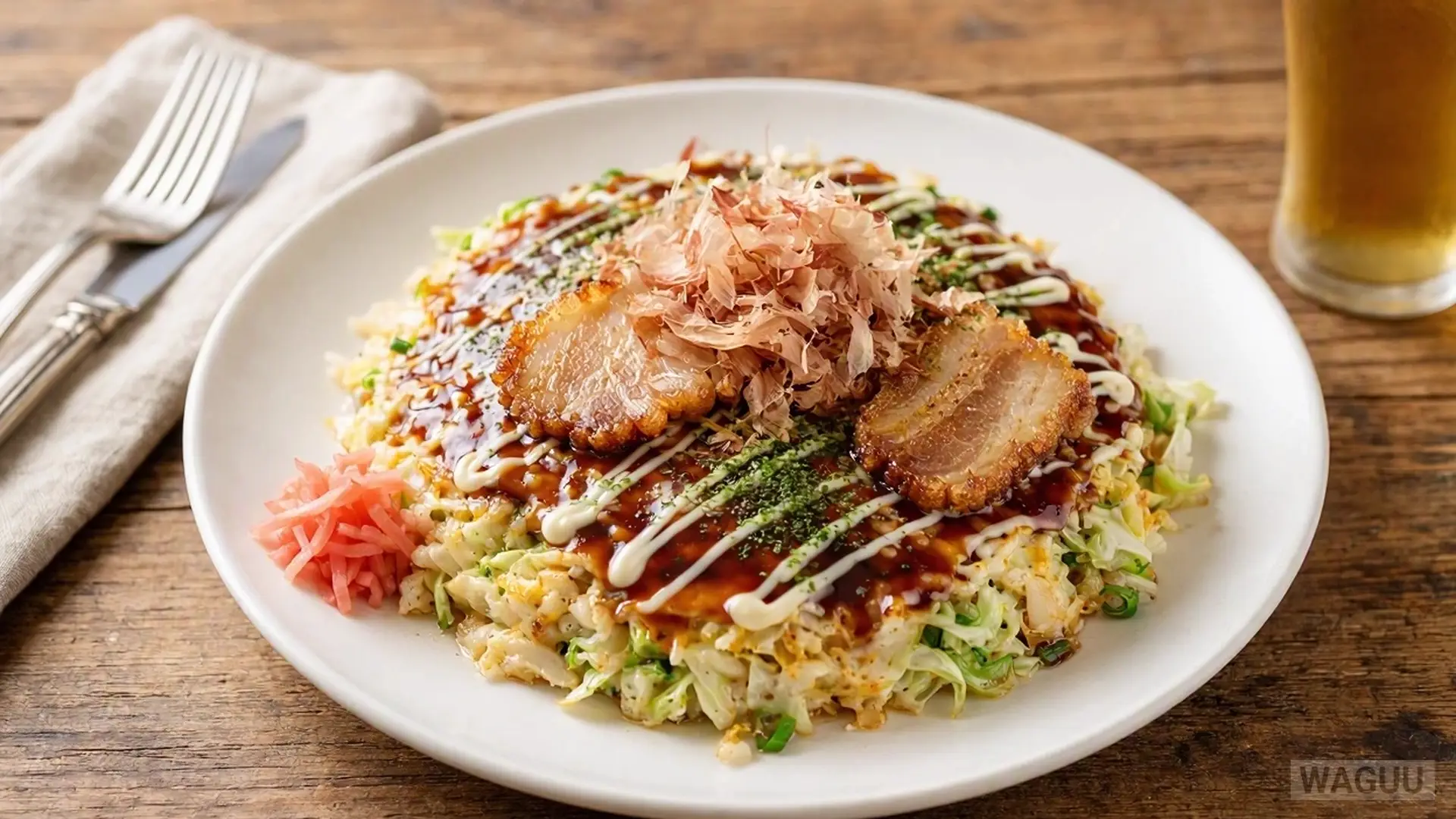
Summary: Okonomiyaki is a quintessential Japanese savoury pancake, often described as “Japanese pizza.” It features a light, cabbage-based batter cooked on a griddle, layered with thinly sliced pork belly, and finished with a signature sweet-savoury sauce, creamy mayonnaise, and dancing bonito flakes. This recipe serves 6, takes 45 minutes to prepare, and is perfect for a fun, interactive family dinner.
Did you cook this recipe? Share the result with the community.
Category: Main Dishes, Japanese Cuisine
Success rate: 98% of users successfully made this recipe
Quick overview
- Dish: Okonomiyaki
- Category: Main Dishes, Japanese Cuisine
- Cuisine: Japanese
- Main ingredient: White cabbage, 600 g (finely shredded)
- Guide: 12 most popular Japanese dishes: favourite Japanese cuisine recipes
- Total time: 45 minutes (15 min prep + 30 min cooking)
- Difficulty: Intermediate
- Portions: 6 (Portion weight: 350 g)
- Key technique: Pan-frying on a flat surface
- Preparation types: Griddle cooking
- Dietary info & Allergens: Contains eggs, wheat (gluten), soy, fish (bonito)
- Suitable for: Casual dinner, party food
- Nutritional values (per 1 portion): 420.5 kcal, Protein: 18.2 g, Fat: 22.4 g, Carbohydrates: 36.8 g
- Storage: 2 days in the fridge, 1 month in the freezer
- Pairing: Japanese lager, dry Riesling, green tea
- In short: A savoury, customizable pancake packed with cabbage and pork.
- Last updated: 21 September 2026
WAGUU says: “Okonomiyaki is all about the texture—crispy edges, a soft, cabbage-rich centre, and the savoury punch of the sauce.”
Key facts
| Prep time: | 15 minutes |
| Cooking time: | 30 minutes |
| Temperature: | 180 °C (griddle) |
| Number of portions: | 6 |
In a nutshell
Experience the authentic flavour of Japanese street food at home. This recipe guides you through creating the perfect batter, layering fresh ingredients, and achieving that golden, crispy finish that makes Okonomiyaki truly special.
Ingredients
Base portions: 6 portions • Portion weight: 350 g
| Ingredient | Amount | Quality |
|---|---|---|
| White cabbage | 600 g | Fresh, finely shredded |
| Pork belly | 300 g | Thinly sliced |
| Plain flour | 300 g | Sifted |
| Dashi stock | 450 ml | Cold |
| Eggs | 6 pc | Free-range |
| Okonomiyaki sauce | 150 ml | Store-bought or homemade |
| Japanese mayonnaise | 100 ml | Kewpie style |
| Bonito flakes | 20 g | High quality |
| Salt | 10 g | Fine sea salt |
Why you will love this recipe
- Interactive dining: It is a communal meal that brings people together at the table.
- Texture perfection: Combines a soft, moist interior with crispy, savoury pork belly.
- Versatile flavours: The combination of sweet sauce and tangy mayo is addictive.
Success guaranteed: Follow the temperature guidelines to ensure the cabbage softens while the pork cooks through without burning the pancake.
Recipe overview
Prep: 15 min | Cooking: 30 min | Difficulty: Intermediate | Portions: 6 | Type: Main dish | Origin: Japan
Detailed instructions
Overall progress: 0% complete
Phase 1: Batter preparation – 5 min
Appliances: Mixing bowl, whisk
1. In a large mixing bowl, whisk together the plain flour, dashi stock, and salt until smooth. Let the batter rest for 10 minutes to hydrate the flour.
VKB: The batter should have the consistency of heavy cream; no lumps should remain.
Before moving to the next step:
Ensure the dashi is completely cold to prevent pre-cooking the flour.
Phase 2: Combining ingredients – 5 min
Appliances: Large spoon
2. Add the finely shredded cabbage and eggs to the rested batter. Mix gently with a spoon until the cabbage is evenly coated. Do not overmix.
VKB: The cabbage volume should look significant compared to the amount of batter.
Before moving to the next step:
The mixture should be thick; if it is too runny, add a tablespoon of flour.
Phase 3: Initial cooking – 10 min
Appliances: Griddle or large non-stick pan
3. Heat the griddle to 180 °C. Pour portions of the mixture onto the surface, shaping them into 2 cm thick circles. Place strips of pork belly on top of the pancakes.
VKB: The pork belly should start to render fat immediately upon contact with the heat.
Before moving to the next step:
Cook undisturbed for 5 minutes until the bottom is golden brown.
Phase 4: Flipping and steaming – 5 min
Appliances: Spatula
4. Flip the pancakes carefully. Cover with a lid or a large bowl to steam the cabbage through for another 5 minutes.
VKB: The cabbage should become translucent and tender.
Before moving to the next step:
The pork belly must be fully cooked and crispy on the underside.
Phase 5: Finishing – 5 min
Appliances: Serving plates
5. Flip once more so the pork side faces up. Brush generously with Okonomiyaki sauce and drizzle with Japanese mayonnaise. Sprinkle with bonito flakes just before serving.
VKB: The bonito flakes should “dance” due to the heat rising from the pancake.
Required equipment
| Utensil | Ideal size | Alternative | Risk |
|---|---|---|---|
| Griddle | 30 cm | Large non-stick pan | Burning if temp too high |
| Spatula | Wide | Fish slice | Breaking the pancake |
| Mixing bowl | 3 litre | Large pot | None |
Shopping list
Nutritional profile
Values per 1 portion. Calculated from average nutritional values of ingredients.
| Nutrient | Per 100 g | Per 1 portion | Per 6 portions |
|---|---|---|---|
| Energy | 120.1 kcal | 420.5 kcal | 2523.0 kcal |
| Fat | 6.4 g | 22.4 g | 134.4 g |
| of which saturates | 2.1 g | 7.3 g | 43.8 g |
| Carbohydrates | 10.5 g | 36.8 g | 220.8 g |
| of which sugars | 2.8 g | 9.8 g | 58.8 g |
| Protein | 5.2 g | 18.2 g | 109.2 g |
| Salt | 0.3 g | 1.1 g | 6.6 g |
Reference intake of an average adult (8400 kJ / 2000 kcal).
WAGUU Pro Level
- Pro standard: Verified recipe with precise ratios and visual control points.
- Tip 1: Use a high-quality Dashi for a deeper umami foundation.
- Tip 2: Shred the cabbage into uniform, thin strips for consistent cooking.
- Tip 3: Do not press the pancake down with the spatula, or it will become dense.
- Tip 4: Serve immediately for the best textural contrast between the sauce and the crispy pork.
Scientific background
The Maillard reaction, occurring between amino acids and reducing sugars in the pork belly and batter, is responsible for the complex roasted flavours. The dashi provides glutamates, creating a powerful umami synergy that enhances the sweetness of the cabbage.
Fine Dining – Professional techniques
- Plate composition: Use a squeeze bottle to create artistic cross-hatch patterns with the sauce and mayo.
- Textural contrasts: The combination of crispy pork, tender cabbage, and soft batter is key.
- Temperature contrast: Serve the pancake hot with cold, thinly sliced spring onion garnish (not part of the recipe).
- Aromatic garnishes: Use high-quality Aonori seaweed (not part of the recipe) for a distinct oceanic aroma.
Sensory radar
- Appearance: Golden brown, topped with intricate sauce lines and fluttering flakes.
- Aroma: Rich umami from dashi and bonito, combined with the scent of caramelised pork.
- Taste: A balance of sweet, savoury, and slightly tangy notes from the sauces.
- Texture: A delightful interplay of crunchy cabbage, tender meat, and light, fluffy batter.
Pairing
- BEER: A crisp, dry Japanese rice lager.
- WINE: A dry, high-acid Riesling that cuts through the richness of the mayo and pork.
- NON-ALCOHOLIC: Chilled Sencha green tea.
Various preparation variants
- Seafood version: Substitute pork belly with shrimp and squid rings for a lighter, oceanic flavour.
- Vegetarian version: Omit pork and use sautéed mushrooms and extra cheese for a hearty, meat-free alternative.
Allergens and dietary information
Contains: Eggs, Wheat, Soy, Fish • Gluten: Contains gluten from flour • Not suitable for: Coeliacs, those with soy or fish allergies
Suitable for
Casual gatherings, family dinners, and fans of authentic Japanese comfort food.
Substitution catalog
- Dashi stock: Vegetable stock or water with a dash of soy sauce.
- Pork belly: Streaky bacon or thinly sliced chicken breast.
FAQ
Can I make the batter in advance?
It is best prepared just before cooking to ensure the cabbage stays crisp and the batter remains light.
What if I don’t have a griddle?
A large, heavy-bottomed non-stick frying pan works perfectly.
Why did my bonito flakes stop moving?
The pancake has cooled down; they dance due to the rising heat vapour.
Is the mayonnaise different from standard mayo?
Yes, Japanese mayo uses egg yolks and rice vinegar, giving it a richer, tangier flavour.
WAGUU Petr advises: Cooking for 12 or more people?
12–16 people: Prepare the batter in two batches to keep the cabbage fresh. 20+ people: Use multiple electric griddles to cook simultaneously.
Sides and Serving
- Miso soup – Light and savoury (not included in the recipe)
- Pickled ginger – Cleanses the palate (not included in the recipe)
Serving: Serve directly from the griddle or on warm plates.
Storage and reheating
Fridge: 2 days • Freezer: 1 month • Reheating: Reheat in a pan over medium heat to restore crispness.
Author: WAGUU Petr & Team • Published: 21 Sep 2026 • Updated: 30 Oct 2026
More Recipes from This Article
Other recipes you might be interested in
Why WAGUU?
Recipes on WAGUU undergo checks for the accuracy of ingredients, procedures, and nutritional values.
Process photo gallery
Community photos: Cook, take a photo, and share the result.
You can upload photos in the comments below or send them via email.
Did you record a video guide for our recipe? Insert a link to YouTube, YouTube Shorts, TikTok, Instagram Reels, Facebook Reels, Pinterest, Vimeo, or X (Twitter) in the comment – we’d be happy to publish it and help promote you and your content.
Common mistakes
- Overmixing the batter: Results in a tough, rubbery pancake rather than a light, fluffy one.
- Using too much heat: Causes the exterior to burn before the cabbage and pork are cooked through.
- Not resting the batter: Leads to a lack of structure in the pancake.
- Crowding the pan: Prevents proper browning and creates a steamed, soggy texture.