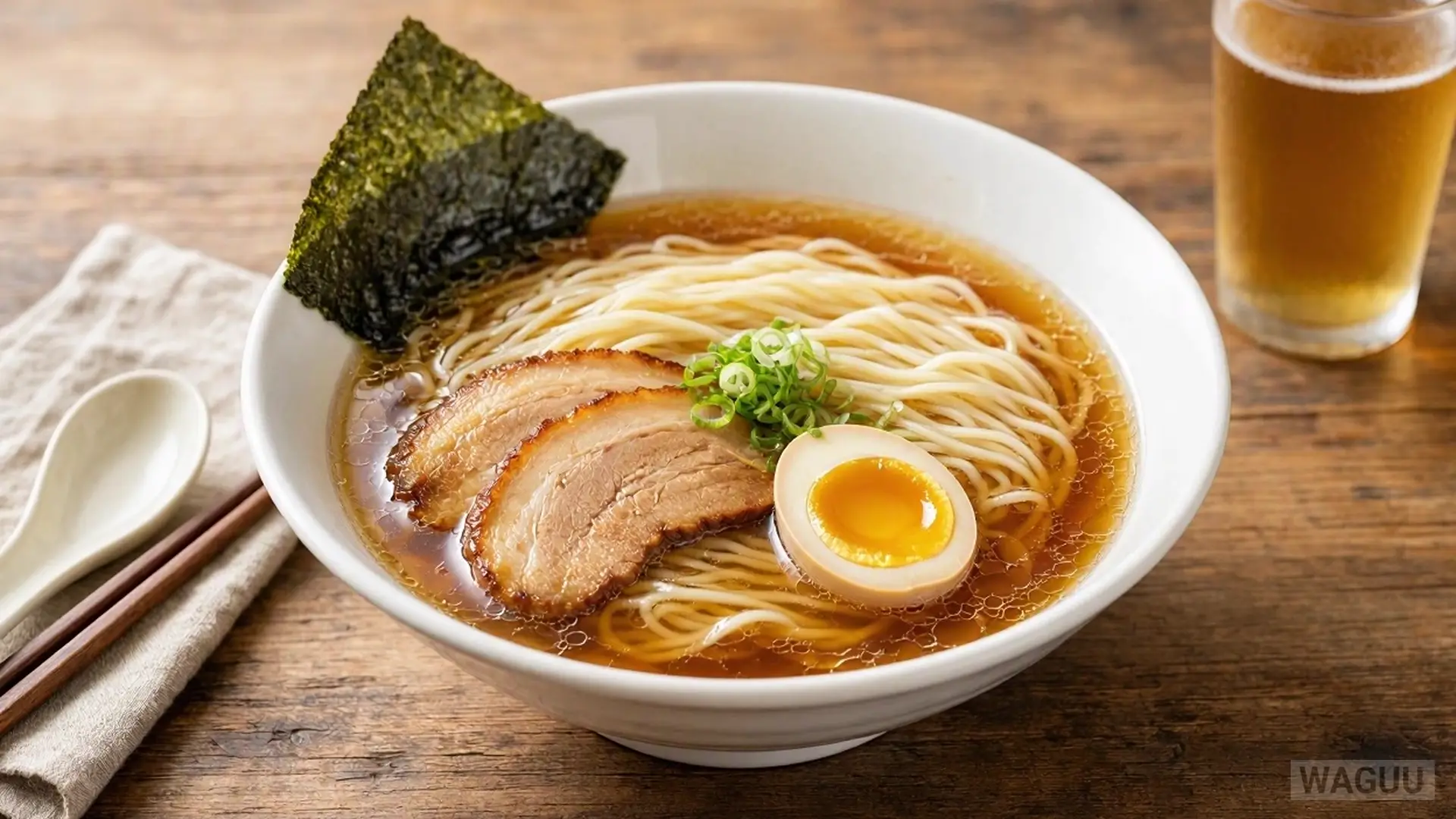
Summary: A classic Japanese noodle soup featuring a rich, aromatic chicken and pork broth, chewy alkaline wheat noodles, tender chashu pork belly, a perfectly soft-boiled marinated egg, crisp spring onions, and nori sheets. This comprehensive recipe covers the traditional multi-stage preparation, requiring 4 hours of active time and 8 hours of total preparation.
Did you cook this recipe? Share the result with the community.
Category: Main Dishes, Soups
Success rate: 98% of users successfully made this recipe
Quick overview
- Dish: Ramen
- Category: Main Dishes, Soups
- Cuisine: Japanese
- Main ingredient: Pork belly, 1.2 kg (high quality, fatty)
- Guide: 12 most popular Japanese dishes: favourite Japanese cuisine recipes
- Total time: 480 minutes (120 min prep + 360 min cooking)
- Difficulty: Advanced
- Portions: 6 (Portion weight: 850 g)
- Key technique: Slow simmering (broth), Marinating (egg)
- Preparation types: Boiling, Braising, Simmering
- Dietary info & Allergens: Gluten, Eggs, Soya
- Suitable for: Main course, Lunch, Dinner
- Nutritional values (per 1 portion): 720 kcal, Protein: 32 g, Fat: 28 g, Carbohydrates: 85 g
- Storage: 3 days in the fridge, 2 months in the freezer
- Pairing: Lager, Dry Riesling, Green tea
- In short: A masterclass in umami, balancing deep savoury broth with fresh textures.
- Last updated: 21 September 2026
WAGUU says: “The soul of a great ramen lies in the patience applied to the broth. Do not rush the extraction of collagen; it is the key to the velvety mouthfeel that defines this iconic dish.”
Key facts
| Prep time: | 120 min |
| Cooking time: | 360 min |
| Temperature: | 95 °C |
| Number of portions: | 6 |
In a nutshell
This recipe guides you through creating an authentic ramen from scratch. You will prepare a rich, long-simmered broth, succulent chashu pork belly, and the essential marinated soft-boiled egg. It is a rewarding project for any home cook looking to master the art of Japanese noodle soups.
Ingredients
Base portions: 6 portions • Portion weight: 850 g
| Ingredient | Amount | Quality |
|---|---|---|
| Pork belly | 1.2 kg | High quality, fresh |
| Chicken bones | 1 kg | Cleaned |
| Wheat noodles | 900 g | Alkaline, fresh |
| Eggs | 6 pcs | Free range |
| Spring onions | 6 pcs | Fresh, crisp |
| Sea salt | 45 g | Fine |
Why you will love this recipe
- Depth of flavour: The slow-simmered broth creates an umami-rich foundation that cannot be replicated with instant alternatives.
- Texture contrast: You get the perfect bite of al dente noodles against the melt-in-the-mouth pork belly.
- Customisation: Once you master the base, you can adjust the toppings to suit your personal preferences.
Success guaranteed: By following the strict temperature controls for the broth and marination times, you will achieve professional results every time.
Recipe overview
Prep: 120 min | Cooking: 360 min | Difficulty: Advanced | Portions: 6 | Type: Soup | Origin: Japan
Detailed instructions
Overall progress: 0% complete
Phase 1: Broth Preparation – 360 min
Appliances: Hob, Large Stock Pot
1. Place chicken bones in a large pot with 5 litres of water. Bring to a gentle simmer at 95 °C. Visual check point (VKB): The broth should remain clear, not boiling vigorously, to prevent emulsification of impurities.
VKB: The broth should remain clear, not boiling vigorously.
Phase 2: Chashu Pork – 120 min
Appliances: Hob, Braising Pan
2. Sear the rolled pork belly in a pan until golden brown on all sides. Braise in a mixture of soy sauce, ginger, and sugar at 90 °C for 2 hours until tender.
VKB: The pork should be easily pierced with a fork.
Phase 3: Marinated Eggs – 60 min
Appliances: Hob
3. Boil eggs for exactly 6.5 minutes. Immediately submerge in ice water to stop cooking. Peel and marinate in a mixture of soy sauce and mirin for 60 minutes.
VKB: The yolk should be jammy and custard-like.
Phase 4: Noodle Preparation – 10 min
Appliances: Hob
4. Boil the wheat noodles in salted water according to package instructions, typically 2–3 minutes. Drain well and divide into serving bowls.
VKB: Noodles should have a slight chew (al dente).
Phase 5: Assembly – 5 min
Appliances: None
5. Pour the hot broth over the noodles. Top with slices of chashu pork, a halved marinated egg, and finely sliced spring onions.
VKB: The broth must be steaming hot.
Phase 6: Final Touch – 5 min
Appliances: None
6. Garnish with nori sheets and serve immediately to maintain the texture of the noodles.
VKB: Visual presentation matches traditional ramen aesthetics.
Required equipment
| Utensil | Ideal size | Alternative | Risk |
|---|---|---|---|
| Stock pot | 10 litres | Large Dutch oven | Boiling over |
| Braising pan | 30 cm | Deep skillet | Burning sugars |
| Fine mesh sieve | 20 cm | Cheesecloth | Cloudy broth |
Shopping list
Nutritional profile
Values per 1 portion (excluding side dishes). Calculated from average nutritional values of ingredients.
| Nutrient | Per 100 g | Per 1 portion | Per 6 portions |
|---|---|---|---|
| Energy | 84.7 kcal | 720 kcal | 4320 kcal |
| Fat | 3.3 g | 28 g | 168 g |
| of which saturates | 1.1 g | 9.3 g | 55.8 g |
| Carbohydrates | 10.0 g | 85 g | 510 g |
| of which sugars | 0.5 g | 4.2 g | 25.2 g |
| Protein | 3.8 g | 32 g | 192 g |
| Salt | 0.9 g | 7.6 g | 45.6 g |
Reference intake of an average adult (8400 kJ / 2000 kcal).
WAGUU Pro Level
- Pro standard: Verified recipe with precise ratios and visual control points.
- Tip 1: Use a double-filter technique for the broth to ensure absolute clarity.
- Tip 2: Chill the pork belly before slicing to get perfect, uniform rounds.
- Tip 3: Marinate the eggs for at least 2 hours for a deeper flavour profile.
- Tip 4: Keep the noodles slightly undercooked before adding hot broth; they continue to cook in the bowl.
Scientific background
The richness of ramen broth is derived from the hydrolysis of collagen into gelatin during long, low-temperature simmering. This process creates the characteristic mouthfeel. The alkaline nature of the noodles (caused by kansui) contributes to their unique elasticity and yellow hue.
Fine Dining – Professional techniques
- Plate composition: Arrange toppings in a clock-like pattern to ensure visual balance.
- Textural contrasts: Pair soft pork with crisp spring onions and nori.
- Temperature contrast: Ensure the bowl is pre-warmed so the broth stays at an optimal serving temperature.
- Aromatic garnishes: Use toasted sesame oil as a final aromatic finishing touch.
Sensory radar
- Appearance: Deep, glossy broth with vibrant green onion and creamy egg yolk.
- Aroma: Rich, savoury, and slightly earthy with ginger notes.
- Taste: Savoury umami with a balanced saltiness.
- Texture: Velvety broth, elastic noodles, and succulent pork.
Pairing
- BEER: A crisp, light Japanese-style rice lager.
- WINE: A dry Riesling with high acidity to cut through the fat.
- NON-ALCOHOLIC: Hot green tea or a light sparkling ginger infusion.
Various preparation variants
- Miso Ramen: Incorporate 2 tbsp of red miso paste into the broth base for a deeper, earthier flavour.
- Spicy Ramen: Add a teaspoon of chili oil or shichimi to the bowl before serving for a spicy kick.
Allergens and dietary information
Contains: Gluten, Eggs, Soya • Gluten: Contains wheat flour • Not suitable for: Vegetarians, Vegans, Gluten-intolerant individuals.
Suitable for
Main course for family gatherings, special Japanese-themed dinners, or as a weekend culinary project.
Substitution catalog
- Pork belly: Pork shoulder (less fat, more lean meat).
- Wheat noodles: Soba noodles (note: texture will be different).
FAQ
Can I use store-bought stock?
While possible, it will significantly lack the gelatinous texture and depth of homemade broth.
How do I keep the noodles from getting soggy?
Serve immediately after adding the broth and do not overcook them initially.
Can I freeze the broth?
Yes, broth freezes exceptionally well for up to 2 months.
Is the egg necessary?
It is a signature component but can be omitted if preferred.
WAGUU Petr advises: Cooking for 12 or more people?
12–16 people: Prepare the broth in two separate large pots to maintain better temperature control. 20+ people: Consider preparing the chashu pork in advance and slicing just before service to ensure efficiency.
Sides and Serving
- Edamame – lightly salted steamed soybeans (not included in the recipe)
- Gyoza – pan-fried dumplings (not included in the recipe)
Serving: Serve in deep, pre-heated ceramic bowls for the best experience.
Storage and reheating
Fridge: 3 days • Freezer: 2 months • Reheating: Gently simmer the broth on the hob; reheat noodles separately.
Author: WAGUU Petr & Team • Published: 21 Sep 2026 • Updated: 30 Oct 2026
More Recipes from This Article
Other recipes you might be interested in
Why WAGUU?
Recipes on WAGUU undergo checks for the accuracy of ingredients, procedures, and nutritional values.
Process photo gallery
Community photos: Cook, take a photo, and share the result.
You can upload photos in the comments below or send them via email.
Did you record a video guide for our recipe? Insert a link to YouTube, YouTube Shorts, TikTok, Instagram Reels, Facebook Reels, Pinterest, Vimeo, or X (Twitter) in the comment – we’d be happy to publish it and help promote you and your content.
Common mistakes
- Boiling the broth too hard – This emulsifies the fat and bones, leading to a cloudy broth.
- Under-seasoning the broth – Ramen broth needs a strong base to stand up to the neutral noodles.
- Overcooking the eggs – The egg yolk should remain creamy for the best texture.
- Adding cold toppings – Always ensure toppings are at room temperature or warm to keep the soup hot.