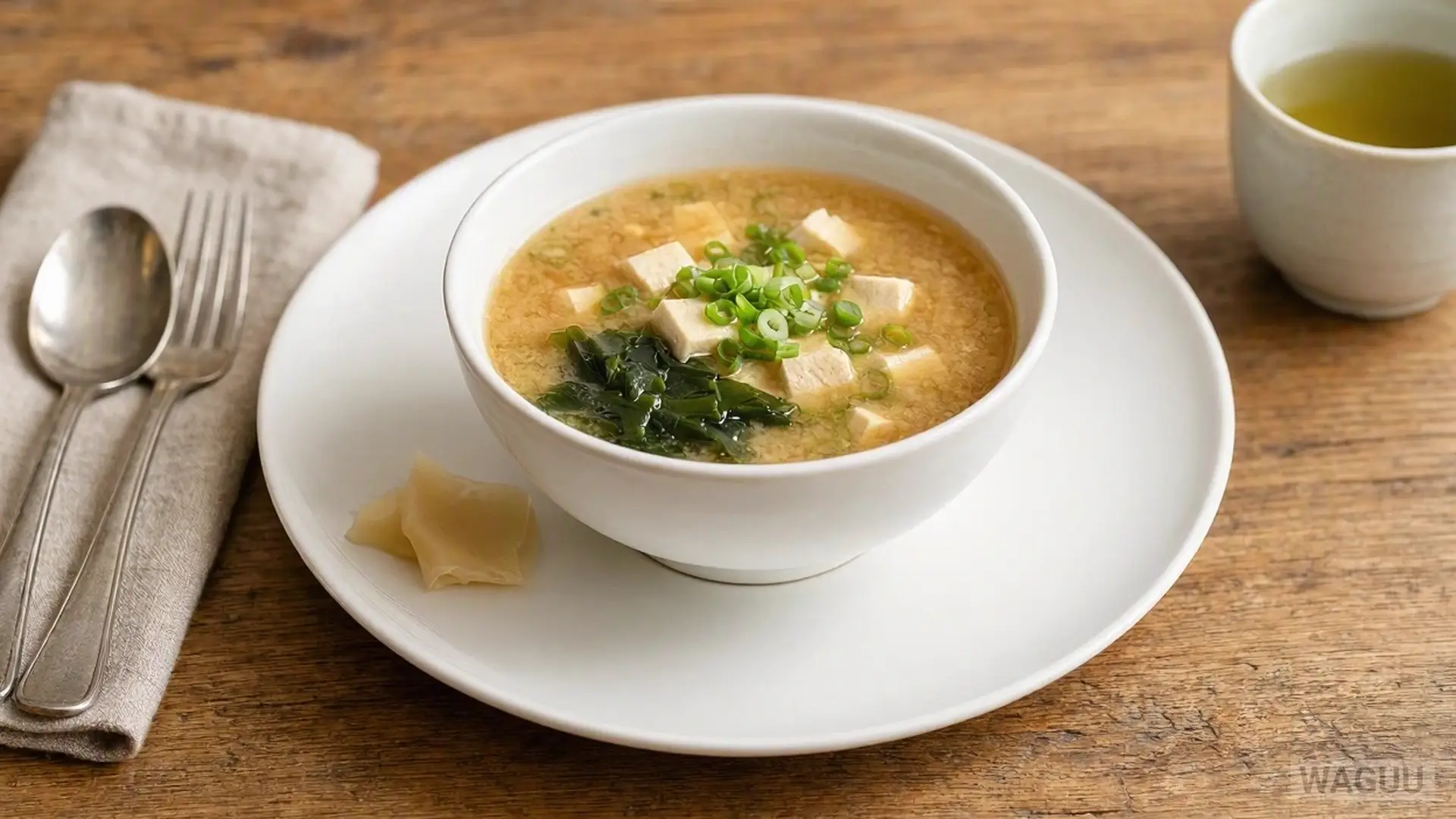
Summary: Miso Shiru is the quintessential Japanese comfort food, a delicate yet deeply flavourful soup based on a rich dashi stock and fermented miso paste. This recipe focuses on the traditional combination of silken tofu, wakame seaweed, and fresh spring onions. It is a light, nutritious dish prepared using a gentle simmering technique that preserves the probiotic benefits of the miso. Preparation takes approximately 20 minutes and serves 6 people as a starter or side dish.
Did you cook this recipe? Share the result with the community.
Category: Soups, Japanese Cuisine
Success rate: not rated yet% of users successfully made this recipe
Quick overview
- Dish: Miso Shiru
- Category: Soups, Japanese Cuisine
- Cuisine: Japanese
- Main ingredient: Miso paste, 4 tablespoons (high-quality fermented soybean paste)
- Guide: 12 most popular Japanese dishes: favourite Japanese cuisine recipes
- Total time: 20 minutes (10 min prep + 10 min cooking)
- Difficulty: Easy
- Portions: 6 (Portion weight: 250 g)
- Key technique: Infusing dashi and tempering miso
- Preparation types: Simmering, Rehydrating
- Dietary info & Allergens: Soya, Fish (if using traditional dashi)
- Suitable for: Daily breakfast, light dinner, digestive aid
- Nutritional values (per 1 portion): 85 kcal, Protein: 6 g, Fat: 3 g, Carbohydrates: 9 g
- Storage: 2 days in the fridge, 0 months in the freezer
- Pairing: Green tea, Japanese lager, Sake
- In short: A soothing, umami-rich broth with soft tofu and seaweed.
- Last updated: June 15, 2024
WAGUU says: “The secret to a perfect Miso Shiru lies in the dashi. Never let the soup boil once the miso is added, as high heat destroys the delicate aroma and beneficial enzymes.”
Key facts
| Prep time: | 10 minutes |
| Cooking time: | 10 minutes |
| Temperature: | 85°C (Simmering) |
| Number of portions: | 6 |
In a nutshell
Experience the authentic taste of Japan with this Miso Shiru recipe. It is a masterclass in simplicity, where the depth of fermented miso meets the oceanic notes of dashi and wakame. Perfectly balanced and incredibly healthy, it warms the soul and prepares the palate for any meal.
Ingredients
Base portions: 6 portions • Portion weight: 250 g
| Ingredient | Amount | Quality |
|---|---|---|
| Dashi stock (Awase dashi) | 1.5 litres | Homemade or high-quality instant |
| Miso paste (White or Awase) | 4 tablespoons | Fermented, non-pasteurised if possible |
| Silken tofu | 300 g | Firm silken variety, cut into 1cm cubes |
| Dried wakame seaweed | 2 tablespoons | Cut pieces, high expansion rate |
| Spring onions | 2 pieces | Fresh, finely sliced into rings |
| Salt | 2 g | Sea salt (adjust based on miso saltiness) |
Why you will love this recipe
- Authentic Umami: The combination of kombu and katsuobushi in the dashi creates a deep, savoury foundation.
- Probiotic Power: By using the correct temperature control, you preserve the healthy bacteria in the miso paste.
- Versatile Base: This recipe serves as a perfect template for adding seasonal vegetables or mushrooms.
Success guaranteed: Follow the “miso strainer” technique to ensure a perfectly smooth broth without clumps.
Recipe overview
Prep: 10 min | Cooking: 10 min | Difficulty: Easy | Portions: 6 | Type: Soup | Origin: Japan
Detailed instructions
Overall progress: 0% complete
Phase 1: Preparation of Solid Ingredients – 5 min
Appliances: None
1. Carefully remove the silken tofu from its packaging and drain any excess water. Place it on a clean cutting board and cut into uniform 1 cm cubes. Place the dried wakame seaweed in a small bowl of cold water for 2-3 minutes until fully expanded, then drain. Finely slice the spring onions into thin rounds, separating the white and green parts if desired.
VKB: Visual Control Point: Tofu cubes should be intact and wakame should look like soft, dark green leaves.
Phase 2: Heating the Dashi – 5 min
Appliances: Stove
2. Pour the 1.5 litres of dashi stock into a medium saucepan. Bring the stock to a gentle boil over medium heat. Once it reaches a boil, reduce the heat to low to maintain a steady simmer. Do not let it boil vigorously for a long time, as this can turn the dashi cloudy and bitter.
VKB: Visual Control Point: Small bubbles should be rising from the bottom of the pot, not a rolling boil.
Before moving to the next step:
Ensure the heat is lowered before adding the miso to prevent the destruction of nutrients.
Phase 3: Adding Tofu and Wakame – 2 min
Appliances: Stove
3. Gently slide the tofu cubes into the simmering dashi. Add the rehydrated and drained wakame seaweed. Simmer for about 1-2 minutes until the tofu is heated through. Be very gentle to avoid breaking the delicate silken tofu cubes.
VKB: Visual Control Point: The tofu cubes should start to float slightly as they warm up.
Phase 4: Incorporating Miso Paste – 3 min
Appliances: Stove
4. Place the 4 tablespoons of miso paste into a small fine-mesh strainer (miso-koshi). Partially submerge the strainer into the hot dashi. Use a spoon or chopsticks to stir and dissolve the miso through the mesh directly into the soup. This ensures no lumps remain. Remove the strainer once all miso is incorporated.
VKB: Visual Control Point: The broth should become opaque and uniform in colour.
Phase 5: Final Seasoning – 2 min
Appliances: None
5. Taste the soup. Depending on the brand and type of miso used, you might need a tiny pinch of salt or a drop of soy sauce, though usually, miso is salty enough. Turn off the heat immediately. Do not let the soup boil after the miso has been added.
VKB: Visual Control Point: The soup should have a rich, complex aroma.
Phase 6: Serving – 3 min
Appliances: None
6. Ladle the hot soup into traditional Japanese lacquerware or ceramic bowls. Ensure each bowl gets an equal amount of tofu and wakame. Garnish generously with the sliced spring onions just before serving to maintain their crunch and bright colour.
VKB: Visual Control Point: The green spring onions should contrast beautifully with the cloudy broth.
Required equipment
| Utensil | Ideal size | Alternative | Risk |
|---|---|---|---|
| Saucepan | 2-3 litres | Small stock pot | Boiling over if too small |
| Fine-mesh strainer | 10 cm diameter | Whisking in a separate bowl | Clumps of miso in the soup |
| Sharp knife | Gyuto or Chef’s knife | Utility knife | Crushing the delicate tofu |
Shopping list
Nutritional profile
Values per 1 portion (excluding side dishes). Calculated from average nutritional values of ingredients.
| Nutrient | Per 100 g | Per 1 portion | Per 6 portions |
|---|---|---|---|
| Energy | 34 kcal | 85 kcal | 510 kcal |
| Fat | 1.2 g | 3 g | 18 g |
| of which saturates | 0.2 g | 0.5 g | 3 g |
| Carbohydrates | 3.6 g | 9 g | 54 g |
| of which sugars | 1.2 g | 3 g | 18 g |
| Protein | 2.4 g | 6 g | 36 g |
| Salt | 0.4 g | 1.1 g | 6.6 g |
Reference intake of an average adult (8400 kJ / 2000 kcal).
WAGUU Pro Level
- Pro standard: Always use Awase Miso (a blend of red and white) for the most balanced flavour profile.
- Tip 1: To elevate the aroma, add a few drops of toasted sesame oil or a pinch of shichimi togarashi just before serving.
- Tip 2: When cutting tofu, place the block in the palm of your hand and slice carefully with a knife to avoid using a cutting board, which can crush the silken texture.
- Tip 3: If using instant dashi, look for brands that specify “no MSG” for a cleaner, more natural taste.
- Tip 4: Seasonal variations: In spring, add bamboo shoots; in autumn, add nameko mushrooms for a thicker texture.
Scientific background
Miso is a living food. It is produced by fermenting soybeans with salt and koji (the fungus Aspergillus oryzae). This fermentation process breaks down complex proteins into amino acids, primarily glutamic acid, which provides the intense umami flavour. The reason we avoid boiling miso is twofold: first, the volatile aromatic compounds that give miso its characteristic scent are highly heat-sensitive and evaporate quickly at 100°C. Second, miso contains beneficial enzymes and probiotics that are denatured and killed at high temperatures. By maintaining the soup at a simmer (approx. 85°C) and incorporating the miso at the very end, we preserve both the sensory and nutritional integrity of the dish.
Fine Dining – Professional techniques
- Plate composition: Use a high-quality black lacquer bowl to make the colours of the tofu and spring onions pop.
- Textural contrasts: Ensure the wakame is not overcooked; it should provide a slight oceanic “snap” against the creamy tofu.
- Temperature contrast: Serve the soup in a pre-warmed bowl to ensure it stays at the perfect sipping temperature of 65-70°C.
- Aromatic garnishes: Use a microplane to zest a tiny amount of Yuzu peel over the surface for a citrusy high note.
Sensory radar
- Appearance: Cloudy, golden-brown broth with floating white cubes and dark green ribbons.
- Aroma: Earthy, fermented, with a distinct scent of the sea and fresh alliums.
- Taste: Deeply savoury (umami), slightly salty, with a subtle sweetness from the fermented rice in the miso.
- Texture: Silky smooth liquid, meltingly soft tofu, and tender-crisp seaweed.
Pairing
- BEER: A crisp Japanese rice lager (like Asahi or Sapporo) cuts through the richness of the miso.
- WINE: A dry, mineral-forward Riesling or a light Junmai Sake served chilled.
- NON-ALCOHOLIC: Hot Sencha or Genmaicha (roasted rice green tea) complements the toasted notes of the miso.
Various preparation variants
- Vegetarian/Vegan Variant: Use a kombu-only dashi (Shiitake dashi) instead of Awase dashi to avoid fish products.
- Hearty Variant (Tonjiru): Add thinly sliced pork belly, daikon radish, and carrots for a more substantial meal.
Allergens and dietary information
Contains: Soya, Fish (in dashi) • Gluten: Naturally gluten-free (ensure miso is made from rice or soya, not barley) • Not suitable for: Those with soya allergies.
Suitable for
Weight loss diets, low-calorie snacking, traditional Japanese breakfast, and as a digestive aid before a large meal.
Substitution catalog
- Dashi: Vegetable bouillon (though the flavour will change significantly).
- Silken Tofu: Firm tofu (cut smaller) or even poached egg.
- Wakame: Spinach leaves or baby bok choy.
FAQ
Can I reheat miso soup?
Yes, but reheat it very gently on low heat and stop just before it boils to preserve the flavour and nutrients.
Why does my miso soup separate?
It is natural for the miso particles to settle at the bottom. Simply stir the soup with your chopsticks or a spoon before drinking.
Which miso is best for beginners?
Shiro Miso (white miso) is milder and sweeter, making it the perfect choice for those new to the flavour.
Is miso soup high in sodium?
Miso is salty, but because you only use a small amount per bowl, the overall sodium per portion is manageable for most people.
WAGUU Petr advises: Cooking for 12 or more people?
12–16 people: Prepare the dashi in a large stock pot and keep the tofu and wakame in a separate container. Add them to the hot stock just before the guests arrive to keep them fresh. • 20+ people: It is better to use a large miso dispenser or pre-mix the miso with a small amount of dashi in a jug to quickly incorporate it into the large pot without clumping.
Sides and Serving
- Steamed white rice – A staple accompaniment for a complete Japanese breakfast.
- Tsukemono (Pickled vegetables) – Provides a sour contrast to the salty soup.
Serving: Serve immediately while steaming hot. In Japan, it is customary to sip the broth directly from the bowl and use chopsticks for the solid ingredients.
Storage and reheating
Fridge: 2 days • Freezer: 0 months (tofu and miso do not freeze well in soup) • Reheating: Low heat on the stove, do not boil.
Author: WAGUU Petr & Team • Published: 30 Oct 2026
More Recipes from This Article
Guide: 12 most popular Japanese dishes: favourite Japanese cuisine recipes
1. Sushi
Sushi is perhaps the most iconic Japanese dish globally, representing the pinnacle of culinary precision and ingredient quality. At its core, sushi is not about raw fish, but about the “shari” – the vinegared rice. This rice must be seasoned with a precise blend of rice vinegar, sugar, and salt, and kept at body temperature to ensure the perfect texture. There are various types, from Nigiri (hand-pressed mounds of rice topped with fish) to Maki (rolled sushi wrapped in nori seaweed). The history of sushi dates back centuries to a method of preserving fish in fermented rice, which evolved during the Edo period into the fast-food style we recognize today. High-quality sushi relies on the “Shun” – the concept of eating ingredients at their absolute peak of seasonality. When eating Nigiri, it is traditionally correct to flip the piece and dip only the fish into the soy sauce, never the rice, to prevent it from falling apart. Wasabi is often placed between the fish and rice by the chef to highlight the natural flavours. Sushi Recipe
2. Ramen
Ramen has evolved from a simple wheat noodle dish imported from China into a complex Japanese cultural phenomenon. Each region in Japan boasts its own unique style, defined primarily by the broth. The four main categories are Shio (salt), Shoyu (soy sauce), Miso (fermented soybean paste), and Tonkotsu (pork bone). The preparation of a Ramen broth can take anywhere from several hours to several days, especially for Tonkotsu, where pork bones are boiled until the marrow dissolves into a creamy, white emulsion. The noodles are made with “kansui” (alkaline water), which gives them their characteristic yellow hue and springy texture. Toppings are equally important, ranging from “Chashu” (braised pork belly) to “Ajitsuke Tamago” (marinated soft-boiled eggs) and “Menma” (fermented bamboo shoots). Slurping the noodles is not only acceptable but encouraged, as it helps cool the noodles and aerates the broth, enhancing the flavour perception. Ramen is more than just soup; it is a bowl of soul-warming comfort that varies from street stalls to Michelin-starred restaurants. Ramen Recipe
3. Tempura
Tempura is a testament to the Japanese art of deep-frying, where the goal is a light, airy, and non-greasy coating. Introduced by Portuguese missionaries in the 16th century, the Japanese refined the technique into what it is today. The secret lies in the batter – a cold mixture of flour and water (sometimes with egg) that is barely mixed to prevent gluten development. This results in a shatteringly crisp texture when fried in high-quality vegetable oil, often with a hint of sesame oil for aroma. Common ingredients include prawns, white fish, and seasonal vegetables like sweet potato, lotus root, and shiso leaves. Tempura is typically served with a dipping sauce called “Tentsuyu,” made from dashi, soy sauce, and mirin, accompanied by grated daikon radish and ginger. The precision of the frying temperature (usually around 170-180°C) is crucial to ensure the ingredient inside is steamed to perfection while the outside remains golden and crisp. It is a dish that celebrates the natural sweetness and texture of the ingredients. Tempura Recipe
4. Tonkatsu
Tonkatsu is a beloved “Yoshoku” (Western-style Japanese) dish consisting of a breaded and deep-fried pork cutlet. It is usually made from either “Hire” (tenderloin) or “Rosu” (loin), with the latter being more popular due to its fat content which adds flavour and juiciness. The pork is dredged in flour, dipped in beaten egg, and coated in “Panko” – coarse, flaky Japanese breadcrumbs that create a uniquely crunchy exterior. Tonkatsu is traditionally served with a pile of finely shredded raw cabbage, which provides a refreshing contrast to the fried meat. The dish is accompanied by a thick, sweet, and tangy Tonkatsu sauce, similar to Worcestershire sauce but much richer. Many people also enjoy it with a dab of “Karashi” (Japanese mustard). Tonkatsu is not only served as a standalone main course but also appears in sandwiches (Katsu Sando) and on top of curry (Katsu Kare). Its popularity stems from its satisfying crunch and the perfect balance of savoury meat and tangy sauce. Tonkatsu Recipe
5. Yakitori
Yakitori translates literally to “grilled bird,” and it is the ultimate Japanese street and pub food. These small skewers of chicken are grilled over “Binchotan” (Japanese white charcoal), which burns at an extremely high temperature without producing smoke, allowing the natural flavour of the chicken to shine. Every part of the chicken is used, from the breast and thigh to more adventurous parts like the heart, liver, and skin. There are two primary seasoning styles: “Shio” (salt) and “Tare” (a sweet soy-based glaze). Yakitori is traditionally enjoyed at “Izakayas” (Japanese pubs) alongside cold beer or sake. The skill of a Yakitori master lies in the skewering technique and the “uchimizu” process of spraying water to control the charcoal’s heat. It is a social food, meant to be shared and eaten hot off the grill. The smoky aroma and tender, charred meat make it an irresistible favourite for locals and tourists alike. Yakitori Recipe
6. Kare Raisu
Japanese Curry, or Kare Raisu, is significantly different from Indian or Thai curries. It was introduced to Japan by the British in the 19th century and has since become one of the country’s most popular home-cooked meals. The sauce is thicker, sweeter, and milder than other curries, often thickened with a flour-based roux. Typical ingredients include onions, carrots, and potatoes, with meat such as beef, pork, or chicken. The secret to a good Japanese curry is the long simmering process, which allows the flavours to meld into a rich, dark gravy. It is almost always served with short-grain white rice and “Fukujinzuke” (red pickled vegetables) on the side. Many Japanese people believe that curry tastes even better the next day, as the spices continue to develop. It is considered a “national dish” of Japan and is a staple in school lunches and military mess halls. Its comforting nature and ease of preparation make it a household favourite across the nation. Kare Raisu Recipe
7. Okonomiyaki
Often described as a Japanese savoury pancake or “Japanese pizza,” Okonomiyaki is a versatile dish whose name literally means “grilled as you like it.” The base is a batter made of flour, eggs, shredded cabbage, and “nagaimo” (grated mountain yam), which gives the pancake a light and fluffy interior. There are two main regional styles: the Osaka style, where all ingredients are mixed together before grilling, and the Hiroshima style, where ingredients are layered and served on top of fried noodles. Popular additions include pork belly, shrimp, squid, and cheese. Once grilled, it is topped with a generous amount of Okonomiyaki sauce, Japanese mayonnaise, dried seaweed (aonori), and dancing bonito flakes (katsuobushi). The combination of the hot, savoury pancake with the sweet and creamy toppings creates a flavour explosion. It is a fun, interactive dish often cooked on a “teppan” (flat iron griddle) right at the table. Okonomiyaki Recipe
8. Takoyaki
Takoyaki are the famous “octopus balls” that originated in Osaka and have become a staple of Japanese festivals. These ball-shaped snacks are made of a wheat flour-based batter and cooked in a special moulded pan. Each ball contains a small piece of octopus (tako), tempura scraps (tenkasu), pickled ginger, and green onion. The cooking process is a spectacle in itself, as the cook uses small picks to rapidly turn the balls until they are perfectly spherical and golden brown. Takoyaki are served piping hot, brushed with Takoyaki sauce and mayonnaise, and sprinkled with bonito flakes and seaweed powder. The contrast between the crispy outer shell and the gooey, creamy interior is what makes them so addictive. They are the ultimate street food, designed to be eaten on the go with toothpicks. Be careful when taking the first bite, as the inside remains extremely hot for a long time! Takoyaki Recipe
9. Katsudon
Katsudon is a popular “Donburi” (rice bowl) dish that combines the crunch of Tonkatsu with the comfort of a warm egg topping. A fried pork cutlet is simmered in a sweet and savoury broth made of dashi, soy sauce, and mirin, along with sliced onions. Just before serving, a lightly beaten egg is poured over the cutlet and simmered until barely set. This mixture is then placed over a large bowl of hot steamed rice. The steam from the rice and the moisture from the broth slightly soften the breading of the Tonkatsu, creating a unique texture that is both crispy and tender. The name “Katsu” also sounds like the Japanese verb for “to win,” making Katsudon a traditional meal for students to eat before exams or for athletes before a big game. It is a hearty, filling, and incredibly satisfying meal that represents the best of Japanese home-style cooking. Katsudon Recipe
10. Gyūdon
Gyūdon, or “beef bowl,” is the quintessential Japanese fast food, offering a quick, nutritious, and delicious meal. It consists of thinly sliced beef and onions simmered in a mildly sweet broth flavoured with dashi, soy sauce, and mirin. The beef is served over a bowl of hot steamed rice, often topped with “Beni Shōga” (red pickled ginger) and sometimes a raw or soft-boiled egg. The key to a great Gyūdon is the quality of the beef and the balance of the simmering liquid, which should permeate the rice without making it soggy. Major chains like Yoshinoya and Sukiya have made this dish famous worldwide, but it remains a staple of the Japanese salaryman’s diet. It is a dish that values efficiency and flavour, providing a massive umami hit in every bite. Whether eaten as a quick lunch or a late-night snack, Gyūdon is a reliable and beloved part of modern Japanese life. Gyūdon Recipe
11. Miso Shiru
Miso Shiru, or Miso Soup, is the soul of the Japanese table. It is served with almost every meal, from breakfast to dinner, and is prized for its health benefits and comforting warmth. The soup is built on dashi stock, which provides the essential umami base. Miso paste, made from fermented soybeans, is then dissolved into the stock. There are hundreds of varieties of miso, ranging from the sweet and light Shiro (white) miso to the salty and robust Aka (red) miso. Common ingredients added to the soup include tofu, wakame seaweed, and spring onions, but seasonal vegetables, mushrooms, and even seafood can be used. The most important rule of Miso Shiru is never to boil the soup once the miso has been added, as this destroys the delicate probiotic cultures and alters the aroma. It is a dish that embodies the Japanese principle of “Ichiju Sansai” (one soup, three sides), providing balance and hydration to the palate. Miso Shiru Recipe
12. Shabu-Shabu
Shabu-Shabu is a popular Japanese hotpot dish (Nabemono) where diners cook thin slices of meat and vegetables in a simmering pot of dashi at the table. The name is an onomatopoeia for the “swish-swish” sound the meat makes as it is moved through the broth with chopsticks. Traditionally, high-quality beef is used, sliced so thin that it cooks in seconds. Once cooked, the meat is dipped into either “Ponzu” (a citrusy soy sauce) or a rich sesame sauce (Goma-dare). After the meat and vegetables are finished, the remaining broth, now enriched with the juices of the ingredients, is often used to cook udon noodles or rice to finish the meal. Shabu-Shabu is a social and interactive dining experience, emphasizing the freshness of the ingredients. It is considered a healthier alternative to other hotpots as the fat from the meat melts away into the broth. It is a perfect meal for cold winter nights and a celebration of high-grade Japanese ingredients. Shabu-Shabu Recipe
Other recipes you might be interested in
Why WAGUU?
Recipes on WAGUU undergo checks for the accuracy of ingredients, procedures, and nutritional values. We focus on culinary science and traditional techniques to ensure your home cooking reaches professional standards.
Process photo gallery
Community photos: Cook, take a photo, and share the result.
You can upload photos in the comments below or send them via email.
Did you record a video guide for our recipe? Insert a link to YouTube, YouTube Shorts, TikTok, Instagram Reels, Facebook Reels, Pinterest, Vimeo, or X (Twitter) in the comment – we’d be happy to publish it and help promote you and your content.
Common mistakes
- Boiling the miso – This is the most common error. High heat kills the probiotics and destroys the delicate aroma of the fermented beans.
- Using too much wakame – Dried wakame expands significantly (up to 10 times its size). Adding too much will turn your soup into a seaweed salad.
- Using cold dashi – Miso should be dissolved into warm/hot dashi (around 80°C) to ensure it integrates smoothly without clumping.
- Over-stirring the tofu – Silken tofu is extremely fragile. Stirring the soup vigorously after adding it will result in small white crumbs instead of beautiful cubes.