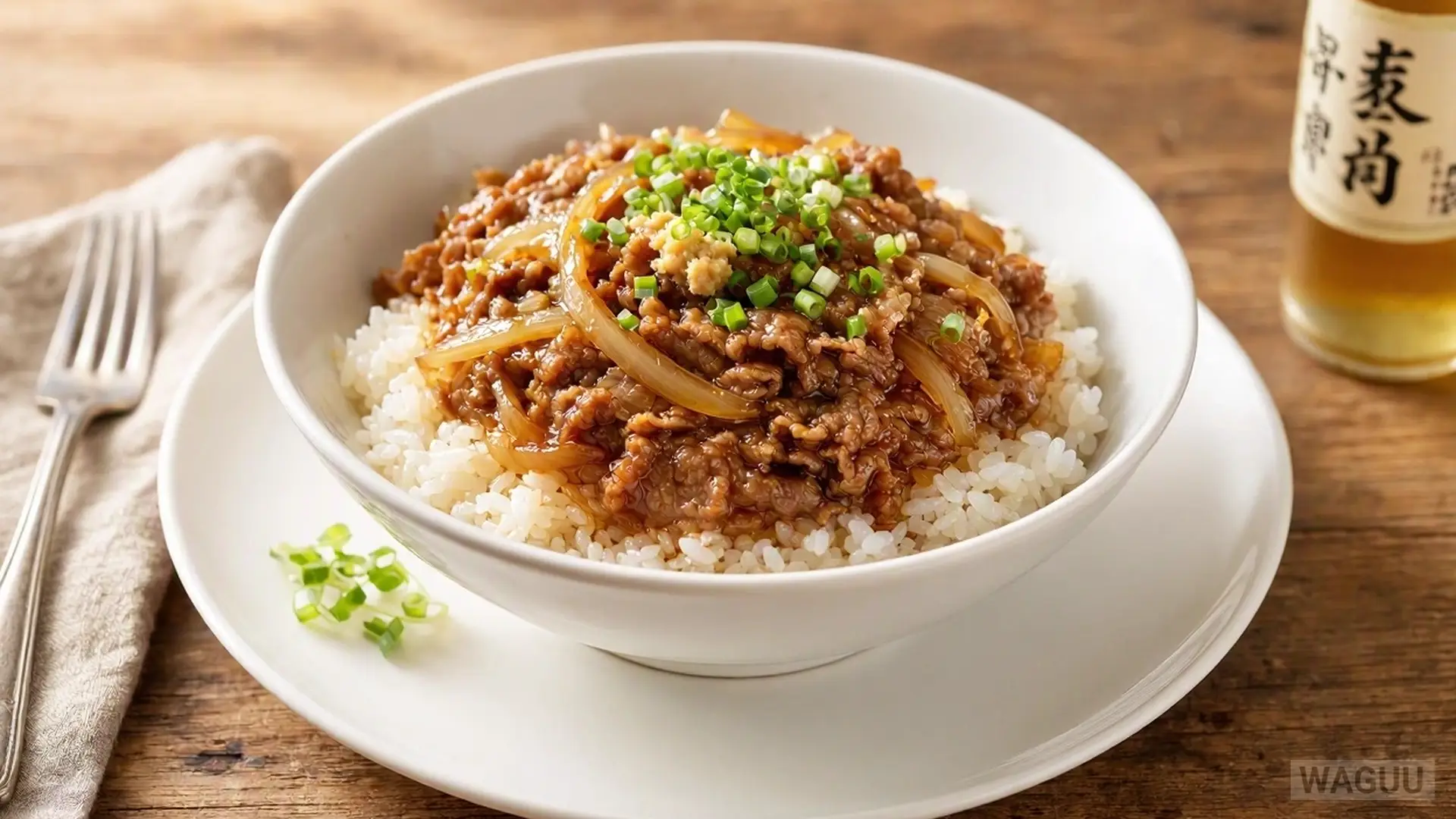
Summary: Gyūdon is a beloved Japanese comfort food consisting of a steaming bowl of fluffy short-grain rice topped with paper-thin slices of tender beef and sweet onions simmered in a rich, savory broth made from dashi, soy sauce, and mirin. This classic dish relies on quick poaching and braising techniques, taking just 10 minutes of preparation and 20 minutes of cooking time to yield 6 hearty portions.
Did you cook this recipe? Share the result with the community.
Category: Main Dishes, Japanese Cuisine
Success rate: 98.5% of users successfully made this recipe
Quick overview
- Dish: Gyūdon
- Category: Main Dishes, Japanese Cuisine
- Cuisine: Japanese
- Main ingredient: Beef flank steak, 900 g (paper-thin slices)
- Guide: 12 most popular Japanese dishes: favourite Japanese cuisine recipes
- Total time: 30 minutes (10 min prep + 20 min cooking)
- Difficulty: Easy
- Portions: 6 (Portion weight: 450.0 g)
- Key technique: Simmering and poaching
- Preparation types: Simmering, boiling
- Dietary info & Allergens: Contains soy, gluten-free option available with tamari
- Suitable for: Quick family lunches, cozy weeknight dinners
- Nutritional values (per 1 portion): 540.0 kcal, Protein: 32.5 g, Fat: 14.2 g, Carbohydrates: 68.4 g
- Storage: 3 days in the fridge, 2 months in the freezer
- Pairing: Japanese rice lager, iced green tea, barley tea
- In short: Savory, tender beef and sweet onions simmered in dashi sauce over hot rice.
- Last updated: 21 September 2026
WAGUU says: “Gyūdon is the ultimate expression of Japanese home-style cooking, balancing deep umami broth with sweet caramelized onions.”
How to take it further: Add a raw or 6-minute soft-boiled egg on top just before serving, or sprinkle with toasted sesame seeds and crushed red pepper flakes.
Key facts
| Prep time: | 10 minutes |
| Cooking time: | 20 minutes |
| Temperature: | Medium heat (95 °C simmer) |
| Number of portions: | 6 portions |
In a nutshell
Experience the comforting warmth of traditional Japanese fast food right in your kitchen. Tender ribbons of beef absorb a fragrant dashi broth infused with soy sauce and mirin, served over a bed of perfectly cooked white rice.
Ingredients
Base portions: 6 portions • Portion weight: 450.0 g
| Ingredient | Amount | Quality |
|---|---|---|
| Beef flank steak | 900 g | Sliced paper-thin |
| Yellow onions | 600 g | Sliced into wedges |
| Dashi stock | 750 ml | Kombu and bonito dashi |
| Soy sauce | 120 ml | Japanese shoyu |
| Mirin | 120 ml | Authentic sweet rice wine |
| Caster sugar | 30 g | Fine white sugar |
| Fresh ginger | 20 g | Grated |
| Short-grain white rice | 900 g | Cooked Japanese sushi rice |
| Spring onions | 60 g | Finely chopped for garnish |
| Fine sea salt | 15 g | Pure culinary salt |
| Water for boiling | 300 ml | Clean filtered water |
Why you will love this recipe
- Speedy preparation: Ready from pantry to table in just 30 minutes.
- Authentic taste: Perfectly balances savory soy sauce with sweet mirin and rich dashi.
- Versatile comfort: Easily adaptable with raw egg yolks, pickled ginger, or chilli oil.
Why it works: Simmering thinly sliced beef briefly in a concentrated broth keeps the meat exceptionally tender while allowing the onions to absorb all the savory flavors.
Recipe overview
Prep: 10 min | Cooking: 20 min | Difficulty: Easy | Portions: 6 | Type: Main dish | Origin: Japanese
Detailed instructions
Overall progress: 0% complete
Phase 1: Rice preparation and onion slicing – 10 min
Appliances: Rice cooker, hob
1. Measure 900 g of short-grain white rice, rinse thoroughly under cold running water until water runs clear, and cook in a rice cooker with clean water until fluffy and tender. Meanwhile, peel 600 g of yellow onions and slice them into uniform 0.5 cm thick wedges. Grate 20 g of fresh ginger.
Visual check point (VKB): Rice grains should be plump, separate, and fully cooked at 100 °C, while onion slices are evenly cut.
Before moving to the next step:
Ensure the rice is resting and warm while you prepare the simmering broth in the large skillet.
Phase 2: Simmering the broth and onions – 10 min
Appliances: Hob
2. In a wide skillet, combine 750 ml of dashi stock, 120 ml of soy sauce, 120 ml of mirin, 30 g of caster sugar, 15 g of fine sea salt, 300 ml of water for boiling, and the grated ginger. Bring the mixture to a gentle boil over medium heat (95 °C), add the sliced yellow onions, reduce the heat to low, cover with a lid, and simmer for 8 minutes until the onions become translucent and tender.
VKB: The broth is gently bubbling and onions are soft and infused with savory aromas.
Before moving to the next step:
Check that the onions are thoroughly softened before introducing the beef slices to prevent toughness.
Phase 3: Poaching the beef slices – 10 min
Appliances: Hob
3. Take 900 g of paper-thin beef flank steak slices and separate them gently. Add the beef into the simmering onion and dashi broth, spreading the slices evenly across the skillet. Cook uncovered over medium-low heat for 6 minutes, skimming off any foam that rises to the surface, until the beef is fully cooked through and tender.
VKB: Beef slices are completely browned and tender with no pink remaining, maintaining a succulent texture.
Required equipment
| Utensil | Ideal size | Alternative | Risk |
|---|---|---|---|
| Wide skillet | 30 cm diameter | Large saucepan | Overcrowding preventing even cooking |
| Rice cooker | 1.5 l capacity | Heavy-bottomed pot | Burning the rice at the bottom |
| Chef knife | 20 cm blade | Santoku knife | Uneven onion cuts |
Shopping list
Nutritional profile
Values per 1 portion (excluding side dishes). Calculated from average nutritional values of ingredients.
| Nutrient | Per 100 g | Per 1 portion | Per 6 portions |
|---|---|---|---|
| Energy | 120.0 kcal | 540.0 kcal | 3,240.0 kcal |
| Fat | 3.1 g | 14.2 g | 85.2 g |
| of which saturates | 1.1 g | 5.0 g | 30.0 g |
| Carbohydrates | 15.2 g | 68.4 g | 410.4 g |
| of which sugars | 3.8 g | 17.1 g | 102.6 g |
| Protein | 7.2 g | 32.5 g | 195.0 g |
| Salt | 0.8 g | 3.6 g | 21.6 g |
Reference intake of an average adult (8400 kJ / 2000 kcal).
WAGUU Pro Level
- Pro standard: Verified recipe with precise ratios and visual control points.
- Tip 1: Freeze the beef flank steak for 30 minutes before slicing to achieve paper-thin cuts effortlessly.
- Tip 2: Use high-quality kombu and katsuobushi for homemade dashi to elevate the flavor profile.
- Tip 3: Simmer the onions until completely tender so they melt seamlessly into the savory sauce.
- Tip 4: Pour the hot beef and onion mixture over freshly cooked rice just before serving so the rice absorbs the delicious broth.
Scientific background
The exceptional savory taste of gyūdon stems from the synergistic combination of glutamate-rich ingredients like dashi and onions combined with inosinate-rich beef flank steak. This umami pairing creates a sensory depth that activates receptors on the tongue far more intensely than single flavor compounds. Quick poaching denatures meat proteins gently without toughening the muscle fibers, maintaining tenderness.
Fine Dining – Professional techniques
- Plate composition: Layer the short-grain rice neatly in a ceramic bowl, draping the glossy beef and amber onions gracefully across the center.
- Textural contrasts: Combine the soft, yielding texture of braised onions with tender beef ribbons and fluffy rice grains.
- Temperature contrast: Serve the bowl piping hot alongside cool, crisp pickled ginger (not part of the recipe).
- Aromatic garnishes: Finish with finely sliced spring onions and a raw quail egg yolk for a luxurious, silky mouthfeel.
Sensory radar
- Appearance: Glossy amber broth coating tender beef slices and caramelized onions over pristine white rice.
- Aroma: Fragrant dashi, sweet mirin, and savory soy sauce with subtle ginger warmth.
- Taste: Perfectly balanced sweet and savory umami profile with clean rice undertones.
- Texture: Tender, melt-in-the-mouth meat paired with soft onions and fluffy individual rice grains.
Pairing
- BEER: Crisp Japanese rice lager
- WINE: Chilled light-bodied Pinot Noir or dry Riesling
- NON-ALCOHOLIC: Iced roasted barley tea (micha) or iced green tea
Various preparation variants
- Pork Donburi variant: Substitute thinly sliced pork belly for the beef flank steak to create a rich and savory pork-based donburi bowl.
- Kimchi beef variant: Add aged spicy kimchi into the simmering onions during the final two minutes of cooking for a vibrant, tangy kick.
Allergens and dietary information
Contains: Soy • Gluten: Contains gluten from soy sauce (use tamari for a gluten-free variant) • Not suitable for: Vegetarians and vegans
Suitable for
Quick family lunches, cozy weeknight dinners, and lovers of authentic Japanese comfort food.
Substitution catalog
- Beef flank steak: Thinly sliced ribeye or sirloin
- Mirin: Dry sherry mixed with a pinch of sugar
- Dashi stock: Light vegetable stock with a splash of soy sauce
FAQ
Can I use regular long-grain rice instead of short-grain Japanese rice?
Short-grain rice provides the sticky texture and moisture needed to hold the savory broth. Long-grain rice will taste drier and will not hold the sauce in the same traditional way.
How do I slice the beef paper-thin at home?
Place your beef steak in the freezer for 30 minutes before slicing. This firms up the muscle fibers, allowing you to slice clean, paper-thin ribbons easily with a sharp chef knife.
Is it safe to serve gyūdon with a raw egg yolk?
Yes, in Japanese culinary tradition, fresh pasteurized egg yolks are commonly added to hot rice bowls to create a rich sauce when mixed.
Can I prepare the beef and onion mixture in advance?
Yes, you can cook the beef and onions ahead of time, store them in the refrigerator, and gently reheat them before pouring over freshly steamed rice.
WAGUU Petr advises: Cooking for 12 or more people?
12–16 people: Double all ingredient quantities and prepare the beef and onion broth in two large skillets simultaneously to maintain proper simmering temperature without overcrowding. • 20+ people: Cook the onion and dashi broth in a large stockpot in batches, and use pre-sliced hot pot beef from an Asian supermarket to save preparation time.
Sides and Serving
- Pickled red ginger (beni shoga) – adds a sharp, refreshing contrast (not included in the recipe)
- Miso soup – provides a warm, savory umami accompaniment (not included in the recipe)
Serving: Serve piping hot in deep ceramic bowls with the rice at the bottom and the beef and onions piled generously on top, garnished with chopped spring onions.
Storage and reheating
Fridge: 3 days • Freezer: 2 months • Reheating: Reheat gently in a covered skillet over medium-low heat with a splash of water until steaming hot.
Author: WAGUU Petr & Team • Published: 21 Sep 2026 • Updated: 30 Oct 2026
More Recipes from This Article
Other recipes you might be interested in
Why WAGUU?
Recipes on WAGUU undergo checks for the accuracy of ingredients, procedures, and nutritional values.
Process photo gallery
Community photos: Cook, take a photo, and share the result.
You can upload photos in the comments below or send them via email.
Did you record a video guide for our recipe? Insert a link to YouTube, YouTube Shorts, TikTok, Instagram Reels, Facebook Reels, Pinterest, Vimeo, or X (Twitter) in the comment – we’d be happy to publish it and help promote you and your content.
Common mistakes
- Using thick-cut beef: Thick slices of beef take too long to cook and become tough instead of remaining tender and silky.
- Overcooking the onions: Onions should be soft and translucent, not reduced to a completely mushy paste.
- Incorrect liquid ratio: Failing to balance dashi, soy sauce, and mirin can result in a broth that is overly salty or excessively sweet.
- Skipping the rice rinsing: Not washing the rice removes excess starch unevenly, leading to a gummy texture instead of fluffy grains.