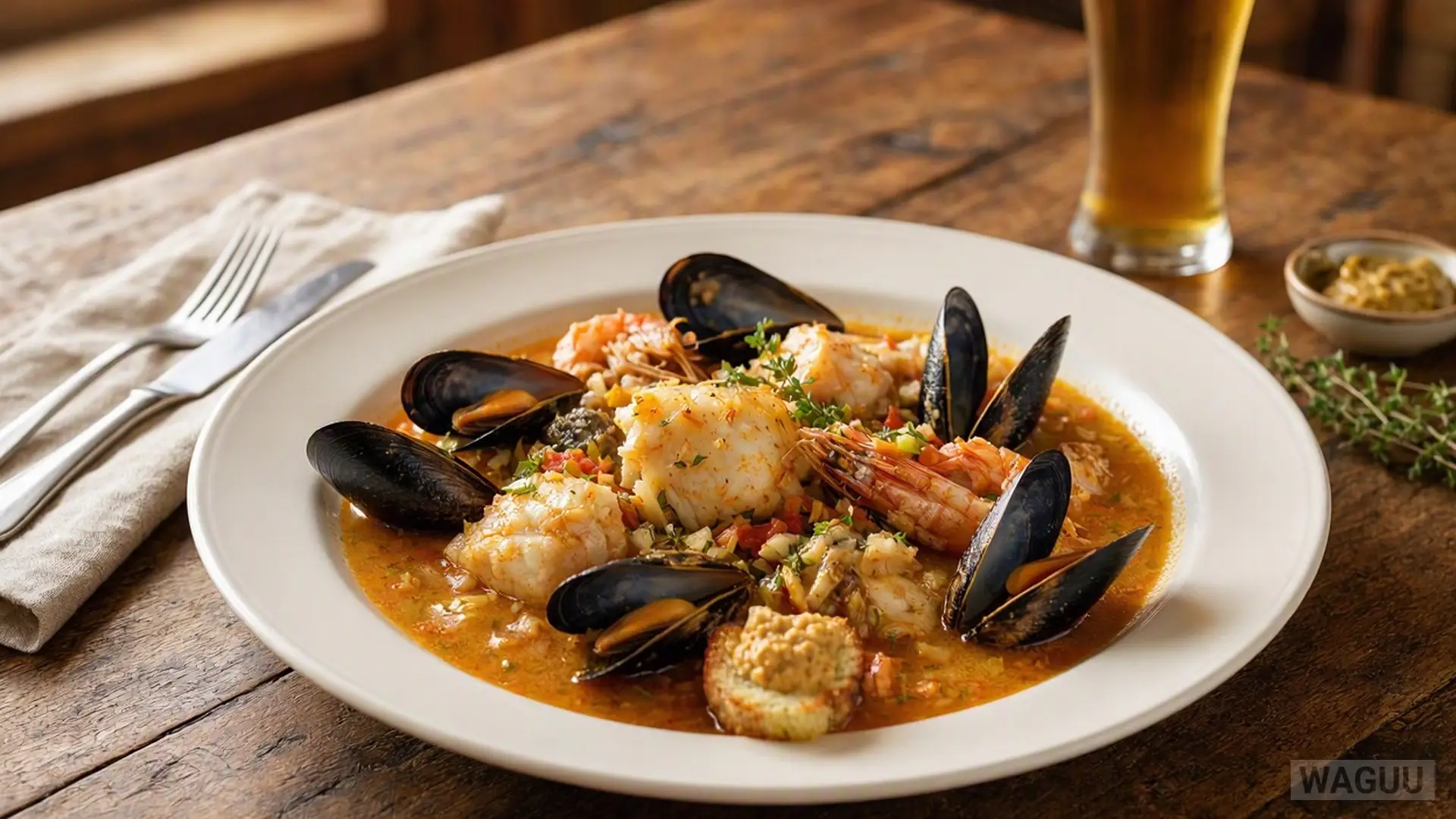
Summary: Authentic Provençal fish soup combining a robust, saffron-infused seafood broth, multiple varieties of fresh firm white fish and shellfish, gently simmered and traditionally served alongside toasted crusty bread and a sharp, garlic-heavy rouille. This classic Mediterranean masterpiece requires meticulous preparation of both the aromatic base and the delicate proteins over 150 minutes, perfectly yielding six generous portions.
Did you cook this recipe? Share the result with the community.
Category: Fish and Seafood, French Cuisine
Success rate: 97% of users successfully made this recipe
Quick overview
- Dish: Bouillabaisse
- Category: Fish and Seafood, French Cuisine
- Cuisine: French
- Main ingredient: Mixed marine fish fillets and shellfish, 1.8 kg (fresh Mediterranean catch quality)
- Guide: 12 most popular French dishes: favourite recipes of French cuisine
- Total time: 150 minutes (60 min prep + 90 min cooking)
- Difficulty: Advanced
- Portions: 6 portions (Portion weight: 550.0 g)
- Key technique: Emulsification and simmering
- Preparation types: Boiling, simmering, sweating, emulsifying
- Dietary info & Allergens: Contains fish, crustaceans, molluscs, eggs, sulphites, gluten
- Suitable for: Special occasions, weekend gatherings, gourmet seafood dinners
- Nutritional values (per 1 portion): 420.5 kcal, Protein: 42.8 g, Fat: 16.5 g, Carbohydrates: 24.2 g
- Storage: 2 days in the fridge, 3 months in spatial freezer (without delicate fish pieces)
- Pairing: Pale Ale, dry Provençal Rosé, sparkling mineral water
- In short: The ultimate French coastal soup, pairing rich saffron broth with delicate seafood and garlicky rouille.
- Last updated: 21 September 2026
WAGUU says: “True Bouillabaisse is not just soup; it is an homage to the Mediterranean sea where broth depth dictates everything.”
How to take it further: Infuse the stock with an extra star anise; finish the soup plating with freshly microplaned orange zest.
Key facts
| Prep time: | 60 minutes |
| Cooking time: | 90 minutes |
| Temperature: | Medium-low simmer 95 °C |
| Number of portions: | 6 portions |
In a nutshell
This prestigious Marseilles specialty delivers profound coastal flavours through a layered preparation. By sweating aromatic roots, fennel, garlic, and ripe tomatoes, then building a fragrant stock infused with saffron threads, orange peel, and pastis, you create a velvet canvas. Tender fish fillets and fresh mussels are gently poached at the final stage, guaranteeing absolute succulence in every bowl.
Ingredients
Base portions: 6 portions • Portion weight: 550.0 g
| Ingredient | Amount | Quality |
|---|---|---|
| White fish bones and heads (gurnard, monkfish, seabass) | 1200 g | Freshly cleaned, gills removed |
| Mixed firm fish fillets (red mullet, monkfish, cod) | 900 g | Skin on, scaled, cut into large portions |
| Fresh mussels | 500 g | Scrubbed, debearded |
| Olive oil | 90 ml | Extra virgin Provençal |
| Yellow onions | 250 g | Finely diced |
| Leeks | 200 g | White part only, sliced |
| Fennel bulbs | 250 g | Core removed, thinly sliced |
| Garlic cloves | 30 g | Fresh cloves, minced |
| Ripe tomatoes | 400 g | Blanched, peeled, chopped |
| Dry white wine | 300 ml | Crisp French Sauvignon Blanc |
| Pastis liqueur | 45 ml | Authentic anise spirit |
| Water for broth | 1800 ml | Filtered cold water |
| Saffron threads | 1 g | High-grade Spanish saffron |
| Orange zest | 10 g | Peeled strip without white pith |
| Thyme sprigs | 5 g | Fresh garden thyme |
| Bay leaves | 2 g | Dried bay leaves |
| Fine sea salt | 20 g | Pure sea salt |
| Black peppercorns | 4 g | Whole black peppercorns |
| Egg yolks | 40 g | Fresh free-range egg yolks (2 pieces) |
| Cayenne pepper | 2 g | Ground cayenne pepper |
| Baguette bread | 300 g | Traditional French artisanal loaf |
Why you will love this recipe
- Intense coastal profile: Combines fish bones, aromatics, and saffron into a rich, velvety broth.
- Authentic French tradition: Recreates the legendary Mediterranean bouillabaisse right in your kitchen.
- Perfect textural contrast: Pairs flaky tender fish and mussels with crunchy garlic-rubbed toast.
Why it works: Slow-simmering the fish trimmings extracts maximum collagen, while pastis and saffron elevate the liquid into an aromatic masterpiece.
Recipe overview
Prep: 60 min | Cooking: 90 min | Difficulty: Advanced | Portions: 6 portions | Type: Soup | Origin: French
Detailed instructions
Overall progress: 0% complete
Phase 1: Preparing aromatics and fish stock base – 35 min
Appliances: Hob
1. Heat 45 ml of olive oil in a large heavy-bottomed stockpot over medium heat at 170 °C. Add 250 g of diced yellow onions, 200 g of sliced leeks, and 250 g of sliced fennel bulbs. Sweat the vegetables for 12 minutes until translucent and soft, stirring frequently to prevent browning. Add 15 g of minced garlic, cooking for 1 minute until fragrant. Pour in 300 ml of dry white wine and 45 ml of pastis liqueur, scraping the bottom of the pot to deglaze, and simmer for 5 minutes until alcohol evaporates. Add 1,200 g of white fish bones and heads, 400 g of chopped ripe tomatoes, 1,800 ml of cold water, 1 g of saffron threads, 10 g of orange zest, 5 g of thyme sprigs, 2 g of bay leaves, 10 g of sea salt, and 4 g of black peppercorns. Bring to a gentle boil, then reduce heat to low and simmer uncovered for 35 minutes, skimming any foam from the surface.
Visual check point (VKB): Broth has acquired a rich golden-orange hue and aromatic herbal aroma, simmering at a gentle 95 °C.
Before moving to the next step:
Ensure the fish bones have released their gelatinous juices into the liquid before straining.
Phase 2: Straining and refining the broth – 20 min
Appliances: Hob
2. Strain the hot fish broth through a fine-mesh sieve into a clean pot, pressing firmly on the solid ingredients with a ladle to extract all flavorful juices. Discard the spent bones and aromatics. Place the strained golden broth back onto the hob over medium heat at 160 °C and reduce it slightly for 15 minutes until concentrated. Taste the broth and adjust seasoning with the remaining 10 g of sea salt if needed. Maintain a gentle simmer at 90 °C while preparing the rouille and fish fillets.
VKB: Liquid is perfectly clear of bones, vibrant yellow-orange, and deeply aromatic.
Before moving to the next step:
Check that no small bone fragments remain in the strained soup base.
Phase 3: Crafting the authentic rouille – 15 min
Appliances: Food processor
3. In a food processor bowl, combine 40 g of fresh egg yolks (2 pieces), 15 g of minced garlic, 2 g of cayenne pepper, and a pinch of salt. Pulse for 30 seconds until smooth. With the motor running on low speed, slowly drizzle in the remaining 45 ml of olive oil in a thin, steady stream to create a thick, glossy emulsion resembling mayonnaise. Transfer the rouille into a small serving bowl, cover, and refrigerate until serving time.
VKB: Rouille is thick, emulsified, glossy, and holds its shape on a spoon.
Before moving to the next step:
Ensure oil was added gradually to prevent the emulsion from splitting.
Phase 4: Poaching the fish and seafood – 15 min
Appliances: Hob
4. Bring the simmering fish broth back to a gentle 90 °C. Gently lay in 900 g of mixed firm fish fillets (red mullet, monkfish, cod) cut into large portions, and add 500 g of scrubbed fresh mussels. Cover the pot with a lid and poach gently for 8 to 10 minutes without aggressive boiling, ensuring the fish cooks through while retaining its structural integrity and the mussels open fully.
VKB: Fish flesh is opaque and flakes easily under gentle pressure; all mussel shells are fully opened.
Before moving to the next step:
Discard any mussels that failed to open during the poaching process.
Phase 5: Toasting the artisanal bread – 5 min
Appliances: Oven
5. Slice 300 g of baguette bread into diagonal rounds of 1.5 cm thickness. Arrange the slices on a baking sheet and toast them in a preheated oven at 200 °C for 5 minutes until golden brown and crispy on both edges.
VKB: Bread slices are golden brown, uniformly crisp, and ready to hold the rouille.
Phase 6: Plating and final service – 5 min
Appliances: None
6. Distribute the poached fish pieces and mussels evenly into six warm soup bowls. Ladle the hot saffron fish broth generously over the seafood. Spread the prepared rouille thickly onto the toasted baguette slices and serve them alongside the bowls for dipping.
VKB: Soup bowls showcase vibrant seafood and golden broth, accompanied by crisp garlic-spread toast.
Required equipment
| Utensil | Ideal size | Alternative | Risk |
|---|---|---|---|
| Heavy stockpot | 5-litre capacity | Cast iron Dutch oven | Scorching if heat is too high |
| Fine-mesh sieve | 20 cm diameter | Colander lined with cheesecloth | Bones passing through coarse mesh |
| Food processor | 1-litre bowl | Immersion blender beaker | Splitting the rouille emulsion |
Shopping list
Nutritional profile
Values per 1 portion (excluding side dishes). Calculated from average nutritional values of ingredients.
| Nutrient | Per 100 g | Per 1 portion | Per 6 portions |
|---|---|---|---|
| Energy | 76.5 kcal | 420.5 kcal | 2523.0 kcal |
| Fat | 3.0 g | 16.5 g | 99.0 g |
| of which saturates | 0.5 g | 2.8 g | 16.8 g |
| Carbohydrates | 4.4 g | 24.2 g | 145.2 g |
| of which sugars | 1.1 g | 6.1 g | 36.6 g |
| Protein | 7.8 g | 42.8 g | 256.8 g |
| Salt | 0.6 g | 3.3 g | 19.8 g |
Reference intake of an average adult (8400 kJ / 2000 kcal).
WAGUU Pro Level
- Pro standard: Verified recipe with precise ratios and visual control points.
- Tip 1: Use a mix of rockfish and white fish bones for maximum gelatin extraction and natural thickening.
- Tip 2: Steep the saffron threads in a splash of warm white wine before adding them to release maximum colour and aroma compounds.
- Tip 3: Ensure the fish fillets are cut into uniformly thick pieces so they poach evenly without disintegrating.
- Tip 4: Whisk the rouille continuously while adding olive oil in a thread-like stream to achieve a stable, glossy emulsion.
Scientific background
Simmering fish bones and heads releases water-soluble collagen, which hydrolyses into gelatine, naturally bodying the broth without needing starch thickeners. Saffron contains crocin and safranal, potent aromatic compounds that dissolve readily in hydroalcoholic solutions like wine and pastis, diffusing distinctive golden colour and herbal fragrance throughout the emulsion.
Fine Dining – Professional techniques
- Plate composition: Arrange the colourful fish chunks and open mussels neatly in the centre of a wide soup bowl before ladling the golden broth over top.
- Textural contrasts: Pair the velvety tender fish flesh and smooth broth with the satisfying crunch of toasted garlic baguette.
- Temperature contrast: Serve the piping hot soup alongside cool, chilled rouille spread on warm toasted bread.
- Aromatic garnishes: Garnish with freshly microplaned orange zest and chopped fennel fronds just before serving.
Sensory radar
- Appearance: Brilliant golden-orange translucent broth with vibrant pieces of white fish and dark mussel shells.
- Aroma: Pungent aniseed from pastis, warm saffron, garlic, and fresh Mediterranean sea breeze.
- Taste: Deep umami seafood flavour balanced by subtle fennel sweetness and a sharp garlic kick from the rouille.
- Texture: Silky, collagen-rich broth contrasting with flaky fish flesh and crisp bread.
Pairing
- BEER: Crisp Belgian Blonde Ale or dry artisanal Saison
- WINE: Chilled dry Provençal Rosé or mineral-driven Bandol Blanc
- NON-ALCOHOLIC: Sparkling mineral water with fresh lemon wheel and iced fennel herbal infusion
Various preparation variants
- Marseille classic variant: Incorporates traditional rockfish such as scorpionfish and sea robin along with sliced potatoes simmered directly in the broth.
- Seafood deluxe variant: Adds large langoustines and raw prawns alongside the fish fillets during the final poaching stage for extra luxury.
Allergens and dietary information
Contains: Fish, crustaceans, molluscs, eggs, sulphites, gluten • Gluten: Contains gluten from baguette bread • Not suitable for: Fish, seafood, egg, or gluten intolerances
Suitable for
Special occasions, weekend gourmet dinners, seafood enthusiasts, and celebratory family gatherings.
Substitution catalog
- White fish bones: Salmon or sea bream frames (note: oilier flavor profile)
- Pastis liqueur: Pernod or dry white vermouth with a pinch of fennel seeds
FAQ
Can I make the fish stock ahead of time?
Yes, the strained broth can be prepared up to 24 hours in advance and stored in the refrigerator before poaching the fresh fish.
What if I cannot find pastis?
You can substitute Pernod, Ouzo, or Sambuca in equal measure for the distinct aniseed undertone.
Why must the fish be added at the very end?
Delicate fish fillets cook in under 10 minutes; adding them too early will cause them to break apart and become dry.
How do I fix a splitting rouille?
If the oil separates, whisk a fresh egg yolk in a clean bowl and slowly beat the separated mixture into it tablespoon by tablespoon.
WAGUU Petr advises: Cooking for 12 or more people?
12–16 people: Double all ingredients and prepare the stock in a large 10-litre stockpot. Poach the fish in two separate batches to avoid overcrowding and breaking the delicate fillets. • 20+ people: Divide the stock preparation across two separate pots. Prepare the rouille in two batches using separate food processor bowls to maintain a stable emulsion.
Sides and Serving
- Boiled new potatoes – (not included in the recipe) Lightly buttered baby potatoes tossed with fresh parsley.
- Fennel and orange salad – (not included in the recipe) Crisp raw fennel ribbons dressed with olive oil and citrus segments.
Serving: Serve piping hot in shallow soup bowls with toasted baguette slices slathered in rouille on the side.
Storage and reheating
Fridge: 2 days • Freezer: 3 months (broth only, without poached fish) • Reheating: Reheat the strained broth gently on the hob over medium heat until hot, then add fresh fish pieces to poach for 8 minutes.
Author: WAGUU Petr & Team • Published: 21 Sep 2026 • Updated: 30 Oct 2026
More Recipes from This Article
Guide: 12 most popular French dishes: favourite recipes of French cuisine
Boeuf à la Bourguignonne
Other recipes you might be interested in
Why WAGUU?
Recipes on WAGUU undergo checks for the accuracy of ingredients, procedures, and nutritional values.
Process photo gallery
Community photos: Cook, take a photo, and share the result.
You can upload photos in the comments below or send them via email.
Did you record a video guide for our recipe? Insert a link to YouTube, YouTube Shorts, TikTok, Instagram Reels, Facebook Reels, Pinterest, Vimeo, or X (Twitter) in the comment – we’d be happy to publish it and help promote you and your content.
Common mistakes
- Boiling the fish too aggressively – High heat causes delicate fish fillets to break apart and turn mushy. Always maintain a gentle 90 °C poach.
- Skipping the fish bones – Using only fillets without bones and heads deprives the broth of essential gelatin and deep umami depth.
- Adding pastis too late – The anise liqueur must be simmered with the aromatics so the alcohol cooks off properly, leaving only subtle flavor.
- Rushing the rouille emulsion – Pouring olive oil into the egg yolks too quickly prevents proper emulsification, resulting in a separated sauce.