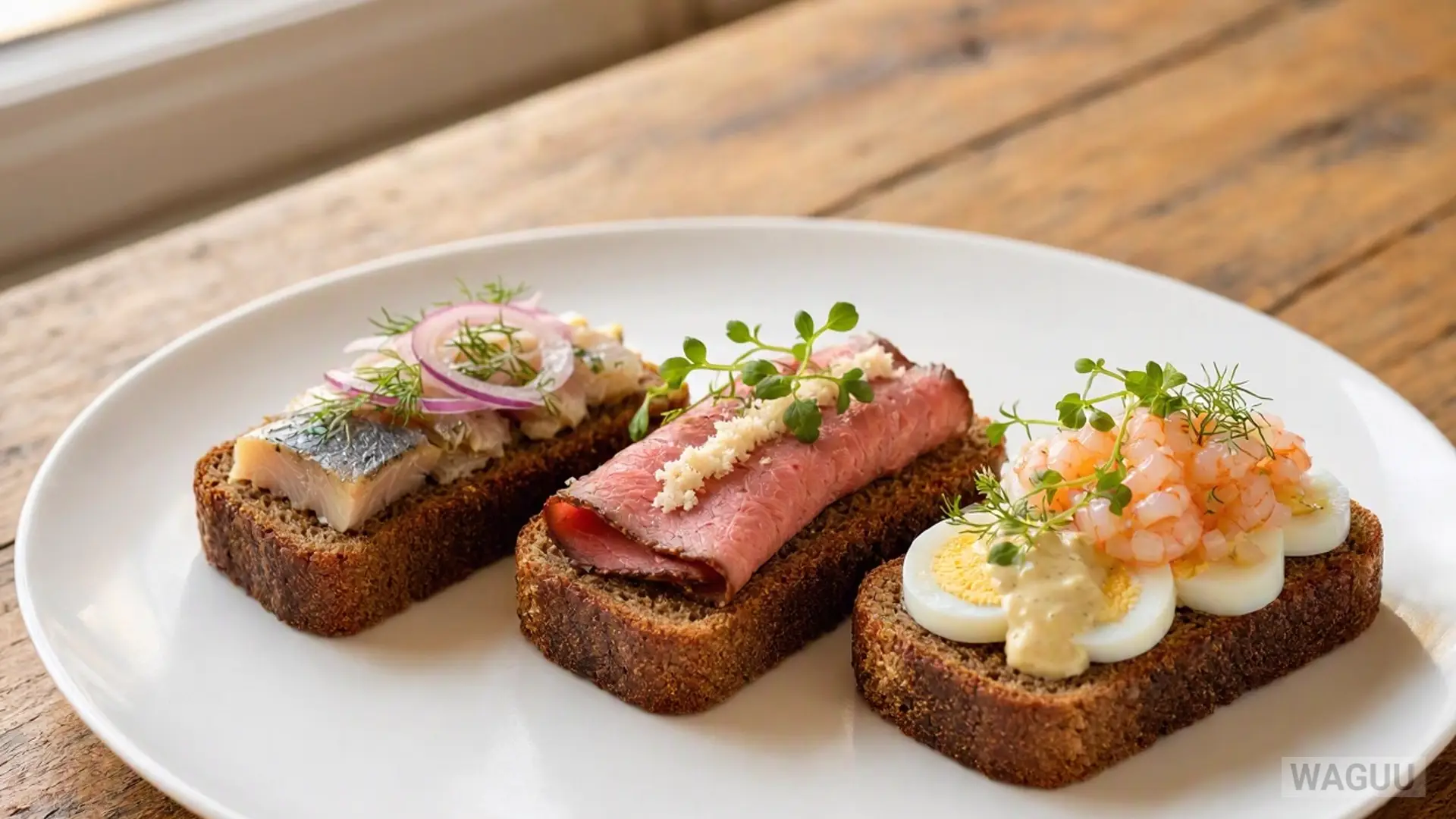
Summary: Smørrebrød – Traditional Danish open-faced rye bread sandwiches with various toppings, such as pickled herring, roast beef, egg, prawns or remoulade. Prepared using traditional assembly and curing techniques, preparation time 45 minutes, 6 portions.
Did you cook this recipe? Share the result with the community.
Category: Scandinavian Cuisine, Starters
Success rate: not rated yet% of users successfully made this recipe
Quick overview
- Dish: Smørrebrød
- Category: Scandinavian Cuisine, Starters
- Cuisine: Danish
- Main ingredient: Danish rye bread, 600 g (dense whole grain quality)
- Guide: 12 most popular Scandinavian dishes: favourite recipes of Scandinavian cuisine
- Total time: 45 minutes (30 min prep + 15 min cooking)
- Difficulty: Easy
- Portions: 6 portions (Portion weight: 220 g)
- Key technique: Precision layering and spread application
- Preparation types: Assembly, slicing, garnishing
- Dietary info & Allergens: Contains gluten, fish, crustaceans, eggs, mustard, dairy
- Suitable for: Lunch, festive gatherings, party appetizers
- Nutritional values (per 1 portion): 385 kcal, Protein: 18.5 g, Fat: 16.2 g, Carbohydrates: 41.0 g
- Storage: 1 days in the fridge, 0 months in the freezer
- Pairing: Aquavit, Danish lager, herbal iced tea
- In short: The quintessential Danish open-faced sandwich combining dense rye bread with exquisite gourmet toppings.
- Last updated: 2025-03-30
WAGUU says: “Smørrebrød is not just food; it is a canvas of Danish culinary heritage where every ingredient must balance texture, fat, and acidity.”
Key facts
| Prep time: | 30 minutes |
| Cooking time: | 15 minutes |
| Temperature: | Room temperature and chilled toppings (20 °C / 4 °C) |
| Number of portions: | 6 portions |
In a nutshell
Master the art of crafting authentic Danish Smørrebrød featuring buttered dark rye bread piled high with pickled herring, tender roast beef, boiled eggs, succulent prawns, and homemade remoulade.
Ingredients
Base portions: 6 portions • Portion weight: 220 g
| Ingredient | Amount | Quality |
|---|---|---|
| Danish rye bread (Rugbrød) | 6 slices | Dense, whole-grain, sourdough |
| Unsalted butter | 50 g | Softened at room temperature |
| Pickled herring fillets | 150 g | High quality, pickled in spiced brine |
| Roast beef (thinly sliced) | 150 g | Medium-rare, chilled |
| Prawns | 120 g | Small fjord prawns, cooked and peeled |
| Eggs | 3 pcs | Free-range, hard-boiled |
| Danish remoulade | 80 g | Traditional yellow remoulade with pickles |
| Mayonnaise | 60 g | Full fat, quality emulsion |
| Red onion | 50 g | Freshly sliced into rings |
| Fresh dill | 15 g | Freshly chopped |
| Capers | 20 g | Drained and rinsed |
| Grated horseradish | 20 g | Freshly grated |
| Lemon | 1 pcs | Organic, cut into wedges |
| Sea salt | 3 g | Fine crystal salt |
| Black pepper | 2 g | Freshly ground |
Why you will love this recipe
- Authentic Flavors: Delivers the genuine taste of traditional Danish coastal dining right to your home kitchen.
- Nutritional Balance: Combines wholesome rye bread fiber with high-quality protein from fish, meat, and eggs.
- Visual Elegance: Creates stunning, colorful open-faced presentations that impress guests at any gathering.
Success guaranteed: Following our precise layering and spreading techniques ensures structural integrity and optimal flavor harmony on every slice.
Recipe overview
Prep: 30 min | Cooking: 15 min | Difficulty: Easy | Portions: 6 | Type: Starter / Lunch | Origin: Denmark
Detailed instructions
Overall progress: 0% complete
Phase 1: Preparing the Base and Eggs – 15 min
Appliances: Stove
1. Place 3 eggs into a small saucepan of boiling water and cook for exactly 9 minutes to achieve firm yet tender hard-boiled eggs at 100 °C. Plunge into ice water immediately.
VKB: Visual control: egg whites should be completely opaque and yolks bright yellow without a gray ring.
Before moving to the next step:
Ensure eggs are fully cooled before peeling to prevent tearing the whites.
Phase 2: Buttering the Bread – 5 min
Appliances: None
2. Lay out 6 slices of dense Danish rye bread on a clean work surface at 20 °C. Evenly spread 50 g of softened unsalted butter across each slice to create a moisture barrier protecting the bread.
VKB: The butter layer should be uniform and completely cover the surface from edge to edge.
Before moving to the next step:
Check that butter is soft enough so it does not tear the dense rye bread.
Phase 3: Assembly of Herring Smørrebrød – 8 min
Appliances: None
3. Take 2 buttered rye bread slices and arrange 150 g of pickled herring fillets across them. Top with thin red onion rings, capers, and freshly chopped dill.
VKB: Herrings should overlap slightly, creating an inviting, textured pattern.
Before moving to the next step:
Ensure herring fillets are well-drained to avoid soggy bread.
Phase 4: Assembly of Roast Beef Smørrebrød – 8 min
Appliances: None
4. Take another 2 buttered slices and drape 150 g of thinly sliced roast beef artfully in gentle folds. Add dollops of remoulade, freshly grated horseradish, and pickled cucumbers.
VKB: The roast beef should have a ruffled, three-dimensional appearance.
Before moving to the next step:
Keep roast beef chilled until the moment of assembly to maintain texture.
Phase 5: Assembly of Prawn and Egg Smørrebrød – 9 min
Appliances: None
5. On the final 2 buttered slices, lay sliced boiled eggs, heap 120 g of prawns on top, add a swirl of mayonnaise, and garnish with lemon wedges and fresh dill.
VKB: Prawns should form a generous mound over the egg slices.
Before moving to the next step:
Ensure prawns are completely dry before placing on mayonnaise to prevent slipping.
Phase 6: Final Seasoning and Presentation – 5 min
Appliances: None
6. Season all assembled sandwiches with 3 g of fine sea salt and 2 g of freshly ground black pepper. Arrange on a serving platter and serve immediately at 20 °C.
VKB: Check that all garnishes are secure and visually balanced across the assortment.
Required equipment
| Utensil | Ideal size | Alternative | Risk |
|---|---|---|---|
| Saucepan | 1.5 litre capacity | Small pot | Water boiling over if heat is too high |
| Chef’s knife | 20 cm blade | Utility knife | Uneven slicing of bread and toppings |
| Offset spatula | 10 cm blade | Butter knife | Tearing the soft rye bread during buttering |
Shopping list
Nutritional profile
Values per 1 portion (excluding side dishes). Calculated from average nutritional values of ingredients.
| Nutrient | Per 100 g | Per 1 portion | Per 6 portions |
|---|---|---|---|
| Energy | 175.0 kcal | 385.0 kcal | 2310.0 kcal |
| Fat | 7.4 g | 16.2 g | 97.2 g |
| of which saturates | 3.1 g | 6.8 g | 40.8 g |
| Carbohydrates | 18.6 g | 41.0 g | 246.0 g |
| of which sugars | 2.2 g | 4.8 g | 28.8 g |
| Protein | 8.4 g | 18.5 g | 111.0 g |
| Salt | 0.95 g | 2.1 g | 12.6 g |
Reference intake of an average adult (8400 kJ / 2000 kcal).
WAGUU Pro Level
- Pro standard: Verified recipe with precise ratios and visual control points.
- Tip 1: Always apply a generous layer of butter (known as “fedt”) to create a waterproof barrier that prevents the heavy rye bread from becoming soggy.
- Tip 2: Slice the rugbrød thinly and uniformly to ensure each bite balances the robust grain flavor with delicate toppings.
- Tip 3: Use freshly peeled small fjord prawns when available for an authentic Scandinavian taste and superior texture.
- Tip 4: Assemble the sandwiches just moments before serving to preserve the crispness of garnishes and freshness of herbs.
Scientific background
The tradition of Smørrebrød relies on the chemistry of dense sourdough rye bread, which contains high levels of dietary fiber and lactic acid. The butter layer acts as an essential hydrophobic barrier preventing moisture transfer from protein-rich toppings into the crumb, while pickled components introduce acetic acid that stimulates the palate and enhances protein digestibility.
Fine Dining – Professional techniques
- Plate composition: Arrange each Smørrebrød on minimalist slate or white porcelain to highlight its vibrant, architectural layering.
- Textural contrasts: Combine dense chewy rye bread, creamy spreads, flaky fish, and crisp pickled vegetables.
- Temperature contrast: Serve chilled pickled herring and roast beef atop room-temperature buttered bread.
- Aromatic garnishes: Finish with micro-herbs, freshly shaved horseradish, and delicate citrus twists for elevated olfactory appeal.
Sensory radar
- Appearance: Colorful, architectural masterpieces showcasing layered seafood, meats, and bright garnishes
- Aroma: Rich sourdough, pickled spices, fresh dill, and sharp horseradish
- Taste: Harmonious balance of savory umami, briny acidity, creamy richness, and earthy grain notes
- Texture: Dense and chewy bread contrasting with tender fish, silky roast beef, and crisp toppings
Pairing
- BEER: Chilled Danish pilsner or traditional dark lager
- WINE: Crisp, dry white wine such as Riesling or Grüner Veltliner
- NON-ALCOHOLIC: Traditional elderflower cordial or sparkling mineral water with cucumber
Various preparation variants
- Vegetarian Smørrebrød: Substitute fish and meat with marinated beetroot, creamy goat cheese, walnuts, and watercress.
- Smoked Salmon Variant: Replace herring with cold-smoked salmon, dill-mustard sauce, and pickled cucumber ribbons.
Allergens and dietary information
Contains: Gluten, fish, crustaceans, eggs, mustard, dairy • Gluten: Contains rye and wheat gluten in traditional bread • Not suitable for: Celiac disease (unless certified gluten-free rye bread is used), lactose intolerance (due to butter)
Suitable for
Lunch, festive gatherings, party appetizers, traditional Scandinavian dinners
Substitution catalog
- Danish rye bread: Pumpernickel or dark sourdough bread
- Unsalted butter: Plant-based margarine or cream cheese
- Prawns: Smoked trout or cooked crayfish tails
FAQ
Can I make Smørrebrød in advance?
It is best to assemble them just before serving to prevent the bread from absorbing moisture and becoming soggy.
What is the purpose of buttering the bread?
The butter layer creates a waterproof seal that protects the dense rye bread from moisture originating from wet toppings.
Is rye bread mandatory for authentic Smørrebrød?
Yes, dense Danish rye bread (rugbrød) is the traditional foundation that provides the necessary structural and flavor profile.
How should Smørrebrød be eaten?
Traditionally, they are eaten with a knife and fork due to their generous and tall toppings.
WAGUU Petr advises: Cooking for 12 or more people?
12–16 people: Prep all components in bowls ahead of time and set up a Smørrebrød assembly station for guests • 20+ people: Pre-slice the rye bread and butter them in batches, keeping toppings chilled until final assembly.
Sides and Serving
- Pickled cucumber ribbons – Adds refreshing crunch and tang (not included in the recipe)
- Radish salad – Provides peppery flavor notes (not included in the recipe)
Serving: Serve on a large wooden board or slate platter accompanied by chilled aquavit and cold beer.
Storage and reheating
Fridge: 1 days • Freezer: 0 months • Reheating: Do not reheat; serve chilled or at room temperature.
Published by WAGUU Culinary Team on 2025-03-30.
More Recipes from This Article
Other recipes you might be interested in
Why WAGUU?
Recipes on WAGUU undergo checks for the accuracy of ingredients, procedures, and nutritional values.
Process photo gallery
Community photos: Cook, take a photo, and share the result.
You can upload photos in the comments below or send them via email.
Did you record a video guide for our recipe? Insert a link to YouTube, YouTube Shorts, TikTok, Instagram Reels, Facebook Reels, Pinterest, Vimeo, or X (Twitter) in the comment – we’d be happy to publish it and help promote you and your content.
Common mistakes
- Skipping the butter layer – Leads to moisture from toppings soaking into the rye bread and making it soggy.
- Overcooking the eggs – Results in a dry yolk with an unappealing gray sulfur ring around the edge.
- Using overly thick bread slices – Overpowers the delicate balance of flavors from the seafood and meats.
- Assembling too far in advance – Causes garnishes to lose their crisp texture and freshness.