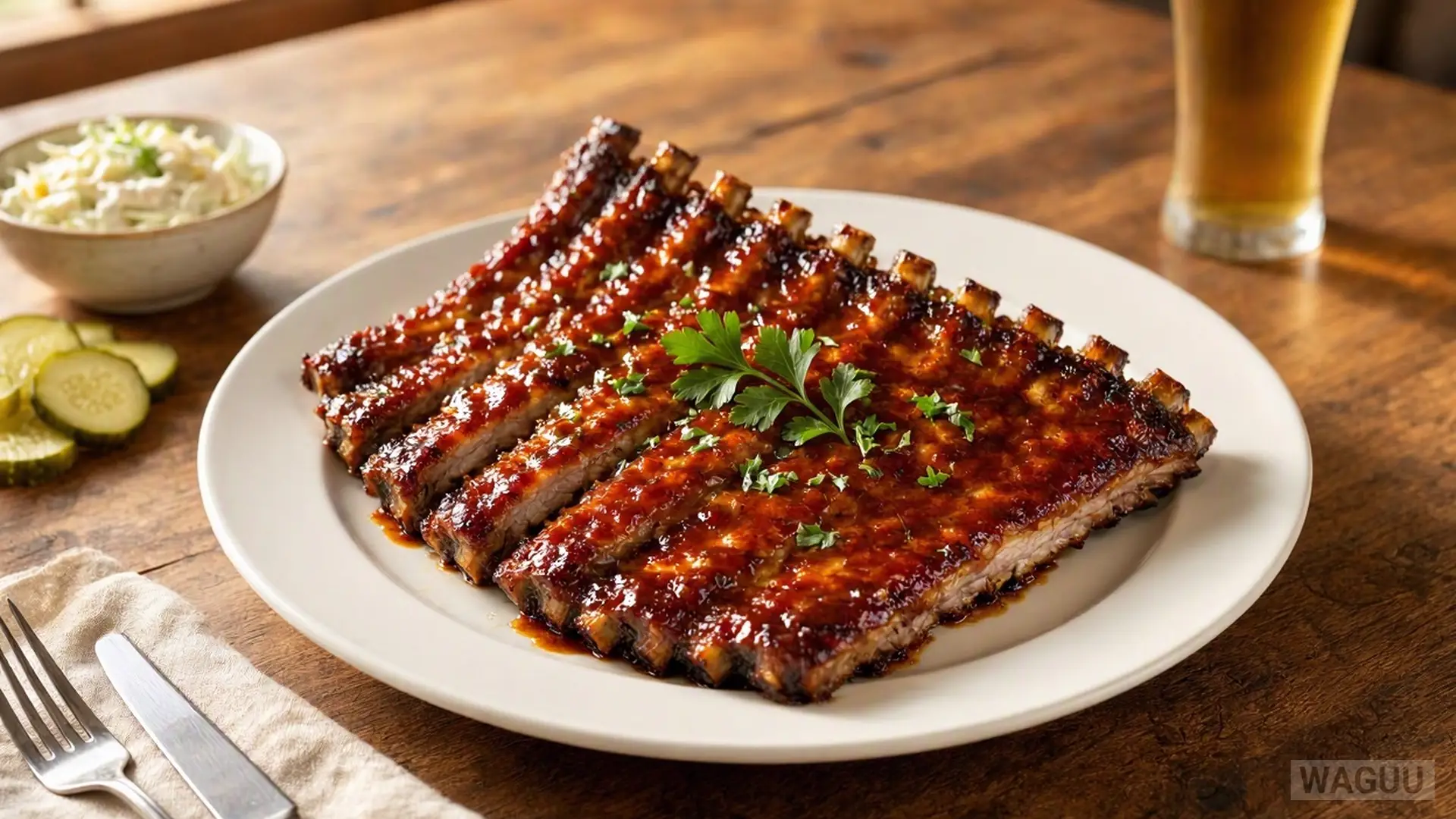
Summary: Tender, melt-in-your-mouth pork spare ribs rubbed with a savory-sweet spice blend, slow-cooked in the oven, and finished with a rich, caramelized barbecue glaze over 4 hours.
Did you make this recipe? Share the result with the community.
Category: Pork, U.S. Cuisine
Success rate: 96% of users successfully made this recipe
Quick overview
- Dish: Barbecue Ribs
- Category: Pork, U.S. Cuisine
- Cuisine: American
- Main ingredient: pork spare ribs, 4 lb (trimmed and membrane removed)
- Guide: 12 Most Popular American Foods: Favorite Recipes of American Cuisine
- Total time: 255 minutes (15 min prep + 240 min cooking)
- Difficulty: Medium
- Servings: 6 servings (Serving weight: 320 g)
- Key technique: Slow-roasting and glazing
- Preparation types: Rubbing, baking, broiling
- Dietary info & Allergens: Gluten-free, dairy-free
- Suitable for: Weekend family dinners, backyard gatherings
- Nutritional values (per 1 serving): 620 kcal, Protein: 42.5 g, Fat: 38.2 g, Carbs: 24.1 g
- Storage: 3 days in the fridge, 3 months in the freezer
- Pairing: Amber Ale, Zinfandel, Sweet Iced Tea
- In a nutshell: Juicy, tender pork ribs encased in a sweet and smoky bark, glazed to sticky perfection.
- Last updated: September 21, 2026
WAGUU says: “Removing the membrane from the back of the ribs is the single most important step to allow spices to penetrate and ensure tender meat.”
How to take it further: Add a pinch of chipotle powder to the rub for extra heat, or brush with apple cider vinegar midway through baking.
Key facts
| Prep time: | 15 min |
| Cooking time: | 240 min |
| Temperature: | 275 °F |
| Number of servings: | 6 |
In a nutshell
Experience authentic smokehouse flavor right from your home oven. These pork spare ribs are coated in a vibrant spice rub, wrapped tightly in foil to lock in juices, and slow-baked until the meat pulls effortlessly from the bone before receiving a glossy caramelized barbecue sauce finish.
Ingredients
Base servings: 6 servings • Serving weight: 320 g
| Ingredient | Quantity | Quality |
|---|---|---|
| pork spare ribs | 4 lb | well-marbled, membrane removed |
| yellow mustard | 2 tbsp | smooth yellow |
| dark brown sugar | 3 tbsp | packed |
| smoked paprika | 2 tbsp | high quality |
| garlic powder | 1 tbsp | pure powder |
| onion powder | 1 tbsp | pure powder |
| kosher salt | 1.5 tsp | coarse grain |
| black pepper | 1 tsp | freshly ground |
| apple cider vinegar | 0.25 cup | 5% acidity |
| barbecue sauce | 1 cup | sweet and smoky |
Why you’ll love this recipe
- Oven-Friendly: Achieves authentic smokehouse flavor and tenderness without requiring an outdoor smoker.
- Fall-Off-The-Bone Texture: Low and slow baking breaks down collagen completely for ultimate tenderness.
- Balanced Flavor Profile: The combination of savory rub and sweet barbecue glaze creates a classic taste.
Why it works: Wrapping the ribs in heavy-duty foil traps moisture and steam during the middle phase of cooking, effectively braising the meat in its own juices before the final high-heat glaze sets the exterior.
Recipe overview
Prep: 15 min | Cooking: 240 min | Difficulty: Medium | Servings: 6 | Type: Main Dish | Origin: American
Detailed instructions
Overall progress: 0% completed
Phase 1: Rib Preparation and Rub Application – 10 min
Appliances: None
1. Place 4 lb pork spare ribs bone-side up on a large cutting board. Use a butter knife to pry up the corner of the thin membrane on the back of the ribs, grab it with a paper towel, and peel it off completely. Brush both sides of the ribs evenly with 2 tbsp yellow mustard to act as a binder. In a small bowl, mix 3 tbsp dark brown sugar, 2 tbsp smoked paprika, 1 tbsp garlic powder, 1 tbsp onion powder, 1.5 tsp kosher salt, and 1 tsp black pepper. Generously apply the spice rub to all sides of the ribs, patting it firmly into the meat.
CP: Visual check point (VKB): The entire rack is uniformly coated with spices and no bare meat remains.
Before moving to the next step:
Ensure the oven is preheated precisely to 275 °F before placing the wrapped ribs inside.
Phase 2: Slow Baking in Foil – 180 min
Appliances: Oven
2. Preheat your oven to 275 °F. Place the seasoned ribs meat-side up on a double layer of heavy-duty aluminum foil large enough to wrap them completely. Pour 0.25 cup apple cider vinegar over the ribs. Seal the foil tightly around the ribs to create a completely sealed packet so no steam escapes during baking. Transfer the foil packet to a rimmed baking sheet and bake in the oven for 3 hours (180 minutes) until the meat starts to pull back from the bone ends.
CP: VKB: Meat retracts about ¼ inch from the bone tips, revealing tender bone ends.
Before moving to the next step:
Open the foil carefully to avoid steam burns before draining excess liquid.
Phase 3: Unwrapping and Initial Baking – 45 min
Appliances: Oven
3. Carefully open the foil packet, taking caution with the hot steam. Drain away any excess liquid pooling at the bottom, leaving the ribs sitting flat in the open foil. Return the uncovered ribs to the 275 °F oven for 45 minutes to let the surface dry slightly and set the spice bark.
CP: VKB: The surface rub appears dry, set, and slightly tacky to the touch.
Before moving to the next step:
Prepare the barbecue sauce brush and ensure the oven temperature is ready for glazing.
Phase 4: Glazing and Caramelization – 15 min
Appliances: Oven
4. Brush a generous layer of 1 cup barbecue sauce evenly over the top and sides of the ribs using a pastry brush. Increase the oven temperature to 400 °F (or switch on the broiler to high) and bake for 15 minutes until the barbecue sauce bubbles, thickens, and caramelizes into a sticky glaze.
CP: VKB: The glaze is glossy, deeply caramelized, and lightly charred at the edges.
Before moving to the next step:
Allow the ribs to rest undisturbed so juices redistribute throughout the meat.
Phase 5: Resting and Slicing – 10 min
Appliances: None
5. Remove the baked ribs from the oven and loosely tent them with a sheet of clean aluminum foil. Let the ribs rest at room temperature for 10 minutes. Transfer the rack to a clean cutting board, flip them bone-side up, and slice cleanly between the individual bones with a sharp chef’s knife. Serve immediately.
CP: VKB: Slices separate cleanly without shredding, revealing juicy pinkish meat layers.
Required equipment
| Utensil | Ideal size | Alternative | Risk |
|---|---|---|---|
| rimmed baking sheet | 12×17 inches | large roasting pan | dripping juices onto oven floor |
| heavy-duty aluminum foil | 18 inches wide | standard foil (double layered) | steam leakage |
| pastry brush | 2 inches wide | silicone basting brush | uneven sauce distribution |
Shopping list
Nutrition profile
Values per 1 serving (excluding side dishes). Calculated from average ingredient nutrition values.
| Nutrient | Per 3.5 oz (100 g) | Per 1 serving | Per 6 servings |
|---|---|---|---|
| Energy | 193.7 kcal | 620.0 kcal | 3,720.0 kcal |
| Fat | 11.9 g | 38.2 g | 229.2 g |
| of which saturates | 4.4 g | 14.1 g | 84.6 g |
| Carbohydrates | 7.5 g | 24.1 g | 144.6 g |
| of which sugars | 5.8 g | 18.6 g | 111.6 g |
| Protein | 13.3 g | 42.5 g | 255.0 g |
| Salt | 0.9 g | 2.9 g | 17.4 g |
Reference intake of an average adult (8400 kJ / 2000 kcal).
WAGUU Pro level
- Pro standard: Verified recipe with precise ratios and visual checkpoints.
- Tip 1: Apply the spice rub at least 2 hours before cooking (or refrigerate overnight) for deeper flavor penetration.
- Tip 2: Use foil with a shiny side facing inward to reflect heat evenly around the ribs.
- Tip 3: Let the ribs rest covered before slicing so the interior juices do not run out.
- Tip 4: Watch the broiler closely during the final 5 minutes to prevent the sugary barbecue glaze from burning.
Scientific background
Pork spare ribs contain high amounts of connective tissue rich in collagen. Cooking them at a moderate temperature of 275 °F inside a sealed foil pouch creates a humid environment where collagen slowly hydrolyzes into gelatin over several hours. This gelatinization is what transforms tough connective tissue into succulent, melt-in-your-mouth meat. The final high-heat phase triggers the Maillard reaction between amino acids and reducing sugars in the barbecue glaze, producing complex savory aromas and a rich caramel crust.
Fine Dining – Professional techniques
- Plate composition: Serve neat, equal-length bone segments arranged in a staggered fan on a dark matte ceramic platter.
- Texture contrasts: Combine the sticky, crisp exterior glaze with meltingly soft interior muscle fibers.
- Temperature contrast: Serve piping hot directly from the cutting board alongside a chilled, crisp side salad.
- Aromatic garnishes: Scatter finely minced fresh flat-leaf parsley and freshly cracked black peppercorns over the ribs just before serving.
Sensory radar
- Appearance: Deep mahogany color with a glossy, caramelized coating and clean bone ends.
- Aroma: Rich smoky paprika scent combined with sweet molasses and savory roasted pork.
- Taste: A harmonious balance of smoky, sweet, tangy, and savory notes with a hint of warmth.
- Texture: Exceptionally tender meat that pulls away cleanly from the bone with a sticky surface glaze.
Pairing
- BEER: American Amber Ale or Brown Ale with caramel malt sweetness.
- WINE: California Zinfandel or Syrah with ripe fruit notes.
- NON-ALCOHOLIC: Traditional southern sweet iced tea with a lemon wedge.
Various preparation methods
- Smoker Method: Cook the rubbed ribs in a hardwood smoker at 250 °F for 5 hours, spritzing with apple cider vinegar hourly, then wrap and glaze.
- Pressure Cooker Method: Cut the ribs to fit a pressure cooker, add 1 cup of beef broth, cook on high pressure for 45 minutes, then finish under the oven broiler with barbecue sauce.
Allergens and dietary information
Contains: None • Gluten: Naturally gluten-free (verify commercial BBQ sauce label) • Not suitable for: Vegetarians, vegans
Suitable for
Weekend family dinners, summer backyard barbecues, game day gatherings, and festive celebrations.
Substitution guide
- pork spare ribs: Baby back ribs (reduce baking time by 45 minutes)
- dark brown sugar: Light brown sugar or turbinado sugar
- yellow mustard: Apple cider vinegar or olive oil as a binder
FAQ
Do I really need to remove the membrane?
Yes, removing the membrane is crucial because it acts as a barrier preventing spices and smoke from penetrating the meat, and it remains tough and chewy after cooking.
Can I prepare the ribs a day in advance?
You can apply the dry rub up to 24 hours in advance and keep the wrapped ribs in the refrigerator. Bake them directly from the fridge when ready.
Why use mustard if I do not like mustard flavor?
The mustard flavor cooks away completely during the long baking process, leaving behind only moisture and a great crust without any vinegary mustard taste.
How do I know when the ribs are fully done?
The meat should pull back from the bone ends by about a quarter-inch, and a toothpick should insert into the thickest part of the meat with zero resistance.
WAGUU Petr advises: Cooking for 12 or more people?
12–16 people: Prepare three full racks of ribs (approx. 12 lb total). Bake them on two separate rimmed baking sheets in the oven, rotating the baking sheets between upper and lower racks halfway through the baking time.
20+ people: Procure five to six racks of ribs. Divide them across multiple baking sheets and bake in batches if necessary, or utilize a commercial convection oven. Keep glazed ribs warm in a low-temperature warming drawer set to 170 °F until ready to serve.
Sides and serving
- Classic Coleslaw – creamy cabbage and carrot salad with tangy mayonnaise dressing (not included in the recipe)
- Southern Cornbread – sweet golden cornbread baked in a cast-iron skillet (not included in the recipe)
Serving: Serve hot on large platters with extra barbecue sauce on the side for dipping, accompanied by plenty of paper napkins.
Storage and reheating
Fridge: 3 days • Freezer: 3 months • Reheating: Wrap leftover ribs tightly in aluminum foil with a splash of water and reheat in a preheated oven at 325 °F for 20 minutes until heated through.
Author: WAGUU Petr & Team • Published: 21 Sep 2026 • Updated: 30 Oct 2026
More Recipes in This Article
Other recipes you might enjoy
Why WAGUU?
Recipes on WAGUU undergo checks for ingredient accuracy, procedures, and nutritional values.
Process photo gallery
Community photos: Cook, take a picture, and share your results.
You can upload photos in the comments below or send them via email.
Did you record a video of your process for our recipe? Paste a link to YouTube, YouTube Shorts, TikTok, Instagram Reels, Facebook Reels, Pinterest, Vimeo, or X (Twitter) in the comments – we’d love to share it and help give you and your content more visibility.
Common mistakes
- Leaving the membrane on – prevents spices from penetrating and leaves the back tough and rubbery.
- Skipping the foil wrap – results in dry meat because moisture escapes without a covered braising phase.
- Applying barbecue sauce too early – causes the sugars in the sauce to burn during the long baking phase.
- Slicing immediately after baking – leads to loss of juices; resting is essential for moist meat.