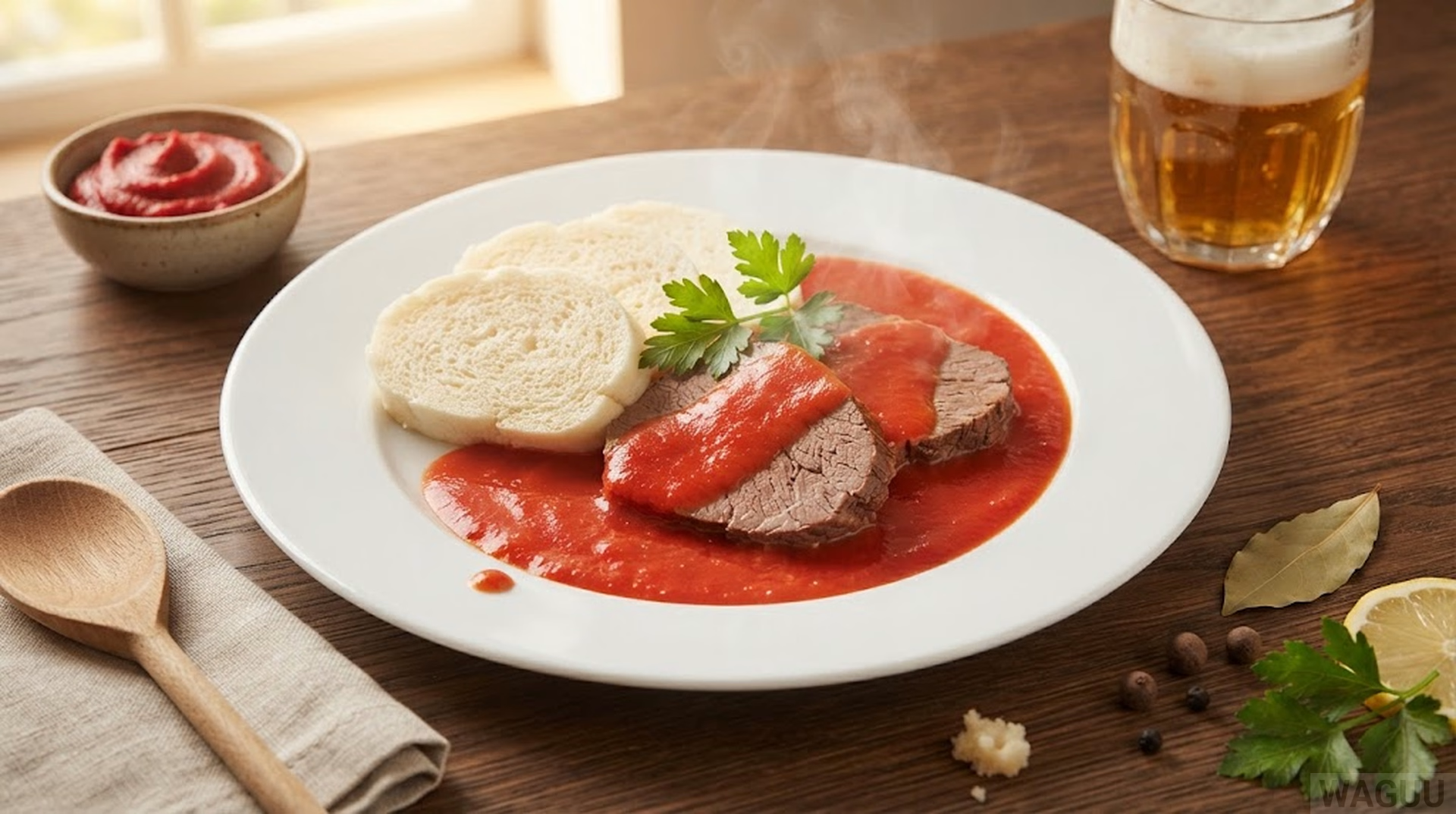
Summary: Beef chuck simmered at low heat in a sweet-and-sour tomato sauce with root vegetables, served with bread dumplings. Ready in 2.5 hours, serves 6.
Cooked this recipe? Share your result with the community.
Category: Beef, Czech Cuisine
Success rate: not rated yet % of users mastered this recipe
Quick overview
- Dish: Tomato Sauce with Beef
- Category: Beef, Czech Cuisine
- Cuisine: Czech
- Main ingredient: Beef chuck, 900 g (well-marbled, cut into 4 cm cubes)
- Guide: 20 Most Famous Czech Dishes
- Total time: 150 minutes (30 min preparation + 120 min cooking)
- Difficulty: Easy
- Servings: 6 (Portion weight: 380 g)
- Key technique: Simmering
- Preparation types: Braising, simmering
- Dietary info & allergens: Contains gluten, dairy, eggs
- Suitable for: Sunday lunch, family dinners, everyday cooking
- Nutritional values (per serving): 560 kcal, Protein: 38 g, Fat: 22 g, Carbohydrates: 52 g
- Storage: 3 days in the fridge, 3 months in the freezer
- Pairing: Pilsner, light red wine, apple juice
- In short: Beef cubes simmered in a tomato sauce with a sweet-and-sour balance and root vegetables, served with bread dumplings.
- Last updated: 18 September 2026
WAGUU says: “Tomato sauce is the dish that divides Czech families. Some like it sweet, some like it sour. The truth is in the middle – sweet from sugar, sour from vinegar and lemon, balanced until both are present but neither dominates.”
Key facts
| Preparation time: | 30 minutes |
| Cooking time: | 120 minutes |
| Temperature: | Gentle simmer (95 °C on the hob) |
| Servings: | 6 |
At a glance
Tender beef cubes in a deep red tomato sauce, balanced between sweet and sour, with root vegetables cooked into the sauce. Served with bread dumplings that soak up every drop.
Ingredients
Base servings: 6 • Portion weight: 380 g
| Ingredient | Amount | Quality |
|---|---|---|
| Beef chuck | 900 g | well-marbled, cut into 4 cm cubes |
| Beef stock | 1000 ml | good quality |
| Onions | 2 pieces | brown, medium, chopped |
| Carrots | 150 g | medium, sliced |
| Parsnip | 80 g | sliced |
| Celeriac | 80 g | sliced |
| Butter | 60 g | unsalted |
| Plain flour | 50 g | fine |
| Tomato purée | 3 tbsp | double concentrate |
| Tinned chopped tomatoes | 800 g | good quality |
| Caster sugar | 3 tbsp | fine |
| Red wine vinegar | 2 tbsp | good quality |
| Lemon juice | 1 tbsp | fresh |
| Bay leaves | 2 pieces | dried |
| Allspice berries | 6 pieces | whole |
| Black peppercorns | 8 pieces | whole |
| Ground cinnamon | 1 pinch | ground |
| Fine sea salt | 2 tsp | fine |
| Plain flour (for dumplings) | 500 g | strong white bread flour |
| Milk (for dumplings) | 250 ml | whole |
| Eggs (for dumplings) | 2 pieces | large, room temperature |
| Stale bread rolls | 3 pieces | day-old, cubed |
| Dried yeast | 7 g | fast-action |
| Caster sugar (for dumplings) | 1 tsp | fine |
| Fine sea salt (for dumplings) | 1 tsp | fine |
Why you will love this recipe
- One pot, one sauce: The beef, vegetables and sauce come together in a single casserole dish. No separate steps.
- The sweet-and-sour balance is yours: The recipe gives a starting point, but the final adjustment is on you – more sugar or more vinegar to taste.
- Better on day two: The sauce thickens and the tomatoes deepen overnight. It is often better reheated than fresh.
Why it works: The beef is simmered at low heat until the collagen breaks down into gelatine, which gives the sauce body without cream. The root vegetables cook into the sauce and add natural sweetness. The vinegar and lemon juice are added at the end – the acid preserves the bright red colour of the tomato and balances the sugar. Too much sugar and the sauce becomes jammy; too much acid and it turns sharp. The balance is the whole point.
Recipe overview
Preparation: 30 min | Cooking: 120 min | Difficulty: Easy | Servings: 6 | Type: Main course | Origin: Czech
Detailed method
Total progress: 0 % done
Phase 1: Preparation – 30 min
Equipment: Chopping board, sharp knife, kitchen paper
1. Pat the beef cubes dry with kitchen paper. Do not wash them. Season lightly with salt. Peel the onions and chop them. Peel the carrots, parsnip and celeriac and cut them into 1 cm slices. The vegetables will cook into the sauce, so there is no need to keep them perfect.
VKB: The beef is dry to the touch. The vegetables are cut into roughly equal slices so they cook in the same time.
Before you continue:
Do not wash the beef. Washing spreads bacteria and prevents the meat from browning properly. Pat it dry instead.
Phase 2: Browning the beef – 15 min
Equipment: Large heavy-bottomed casserole dish (28–30 cm), tongs
2. Heat half the butter in the casserole dish over medium-high heat. Add the beef cubes in a single layer and brown them on all sides, about 3 minutes per side. Work in two batches so the pan is never crowded. Remove the meat and set it aside.
VKB: The beef cubes are deep brown on all sides. The bottom of the pan has a brown crust (fond), but nothing is burnt.
Before you continue:
Do not overcrowd the pan. If the cubes touch each other, they steam instead of browning. Brown in two batches.
Phase 3: Vegetable base – 10 min
Equipment: Same casserole dish, wooden spoon
3. Add the remaining butter to the pan and cook the onions for 5 minutes until soft. Add the carrots, parsnip and celeriac and cook for another 5 minutes, stirring occasionally. Scrape the brown crust off the bottom of the pan with a wooden spoon and let it dissolve into the vegetables.
VKB: The onions are soft and translucent. The vegetables are slightly softened but still hold their shape. The bottom of the pan is clean.
Before you continue:
Do not let the vegetables brown. They should soften, not caramelise. If they start to catch, lower the heat and add a splash of stock.
Phase 4: Tomato base and simmering – 90 min
Equipment: Casserole dish with lid, wooden spoon
4. Return the beef to the pan. Add the tomato purée, tinned tomatoes, beef stock, bay leaves, allspice, peppercorns and a pinch of cinnamon. Stir well. Bring to a gentle simmer, cover with a lid and cook on the lowest heat for 90 minutes. Stir every 20 minutes. The beef should be fork-tender and the sauce slightly reduced.
VKB: The beef is fork-tender. The vegetables have softened and mostly dissolved into the sauce. The sauce is thick and deep red.
Before you continue:
Never let the sauce boil. A rolling boil makes the meat tough and the sauce splatters. Keep it at a lazy simmer with the lid on.
Phase 5: Straining and balancing – 20 min
Equipment: Fine sieve, large bowl, medium saucepan, whisk
5. Remove the beef cubes and set them aside. Strain the sauce through a fine sieve into a large bowl, pressing the vegetables with the back of a ladle to extract all the flavour. Discard the solids. Melt the remaining butter in a medium saucepan, add the flour and whisk for 1 minute to make a roux. Pour the strained sauce into the roux in a steady stream, whisking constantly. Simmer for 5 minutes. Now add the sugar, red wine vinegar and lemon juice. Taste and adjust – the sauce should be both sweet and sour, with neither dominating.
VKB: The sauce is smooth, glossy and deep red. It tastes balanced – sweet, sour, salty all at once. The sauce is thick enough to coat the back of a spoon.
Before you continue:
Add the sugar and vinegar slowly and taste after each addition. It is easier to add more than to fix an over-sweet or over-sour sauce.
Phase 6: Dumplings and serving – 60 min
Equipment: Large mixing bowl, clean tea towel, large pot, string, serving plates
6. Warm the milk to lukewarm. In a large bowl, mix the flour, yeast, sugar and salt. Add the warm milk and eggs and mix into a soft dough. Knead for 5 minutes until smooth. Fold in the cubed bread rolls. Cover with a tea towel and leave to rise for 45 minutes. Shape into two logs about 20 cm long. Tie each log tightly in a clean tea towel. Bring a large pot of water to a gentle simmer and cook the dumplings for 20 minutes, turning once. Meanwhile, return the beef to the sauce and warm through for 5 minutes. Serve the beef and sauce with the sliced dumplings.
VKB: The dumplings are firm and spring back when pressed gently. The beef is tender and holds its shape. The sauce coats each cube evenly.
Required equipment
| Equipment | Ideal size | Alternative | Risk |
|---|---|---|---|
| Heavy casserole dish | 28–30 cm, with lid | Dutch oven | Thin pans catch the sauce |
| Fine sieve | 20 cm | Muslin cloth | Coarse sieve lets solids through |
| Whisk | Balloon whisk | Fork | Fork leaves lumps |
| Clean tea towel | 40 × 40 cm, cotton | Muslin cloth | Synthetic cloth will melt |
Shopping list
Nutritional profile
Values per serving (with dumplings). Calculated from average nutritional values of ingredients.
| Nutrient | Per 100 g | Per serving | Per 6 servings |
|---|---|---|---|
| Energy | 147 kcal | 560 kcal | 3360 kcal |
| Fat | 5.8 g | 22 g | 132 g |
| of which saturated | 2.4 g | 9 g | 54 g |
| Carbohydrates | 13.7 g | 52 g | 312 g |
| of which sugars | 4.2 g | 16 g | 96 g |
| Protein | 10 g | 38 g | 228 g |
| Salt | 0.4 g | 1.6 g | 9.6 g |
Reference intake of an average adult (8400 kJ / 2000 kcal).
WAGUU Pro level
- Pro standard: Tested recipe with exact ratios and visual control points.
- Tip 1: Use good tinned tomatoes – the sauce tastes of what you put in. Cheap tinned tomatoes make a thin, watery sauce.
- Tip 2: Add a small piece of cinnamon stick to the simmering sauce instead of ground cinnamon. It gives a subtler, deeper note and is easy to remove.
- Tip 3: If the sauce is too thin after straining, reduce it gently for 10 minutes before adding the roux. Do not add more flour.
- Tip 4: The sauce is best made a day ahead. It thickens overnight, the flavours marry, and the next day all you do is reheat and steam dumplings.
Scientific background
Tomatoes contain glutamic acid, which is responsible for the savoury, umami taste of the sauce. This is why a tomato sauce made with beef stock tastes so rich – the glutamates in the tomato and the nucleotides in the beef stock combine to intensify the umami by many times. The acidity of the tomatoes is balanced by the sugar; without sugar, the sauce would taste raw and sharp. Adding acid at the end (vinegar and lemon juice) preserves the bright red colour of the tomato pigments, which would otherwise turn brownish during long cooking. The cinnamon is present in such small amounts that it does not taste like cinnamon – it rounds out the sweetness and makes the sauce taste deeper.
Fine Dining – Professional techniques
- Plate composition: Spoon the sauce into a shallow bowl, place three beef cubes in the centre, and lean two dumpling rounds against the beef.
- Texture contrasts: The smooth, glossy sauce contrasts with the tender beef and the airy dumplings.
- Temperature contrast: Serve the beef and sauce hot, the dumplings hot. A spoonful of cold sour cream on top adds a temperature contrast.
- Aromatic additions: A small sprig of fresh parsley or a few strips of lemon zest over the top before serving.
Sensory radar
- Appearance: Deep red glossy sauce, tender beef cubes, white dumplings
- Aroma: Tomato, allspice, bay, a hint of cinnamon
- Taste: Sweet, sour, savoury – all three at once, balanced
- Texture: Smooth sauce, tender beef, fluffy dumplings
Pairing
- BEER: Pilsner Urquell or a light lager
- WINE: Light red – Pinot Noir or Saint-Laurent
- SOFT DRINK: Sparkling water with lemon or apple juice
Other preparation variations
- Meatball version: Replace beef cubes with 800 g of beef mince formed into meatballs. Braise for 60 minutes instead of 120.
- Lighter version: Replace beef with turkey thigh. Braise for 60 minutes. The sauce is lighter and slightly less rich.
Allergens and dietary information
Contains: Gluten, dairy, eggs (in dumplings) • Gluten: Yes • Not suitable for: Coeliac disease, lactose intolerance (without substitutions)
Suitable for
Sunday lunch, family dinners, everyday cooking, meal prep
Substitution catalogue
- Beef chuck: Beef shin or brisket (longer cooking, deeper flavour)
- Tinned tomatoes: Fresh tomatoes, peeled and chopped (in season)
- Red wine vinegar: Apple cider vinegar or white wine vinegar
- Beef stock: Chicken stock or vegetable stock (lighter result)
FAQ
My sauce is too sour. How do I fix it?
Add a teaspoon of sugar and simmer for 2 minutes. Taste again. If it is still too sour, add another teaspoon. The sauce should be balanced – sweet and sour at the same time.
My sauce is too sweet. How do I fix it?
Add a splash of red wine vinegar or lemon juice. Simmer for 2 minutes and taste again. If it is still too sweet, add a pinch of salt – salt reduces the perception of sweetness.
Can I leave the vegetables in the sauce?
Yes. Some families prefer the sauce with visible pieces of carrot and celeriac. In that case, do not strain it – just thicken it with the roux and serve. The sauce will be less smooth but more rustic.
Can I use fresh tomatoes?
Yes, in summer when tomatoes are ripe. Peel them (blanch for 30 seconds in boiling water, then slip the skins off), chop them and use them in place of tinned. You may need slightly more sugar because fresh tomatoes are less sweet than tinned.
WAGUU Petr advises: Cooking for 6 or more?
6–8 people: Increase the beef to 1.2 kg and the tinned tomatoes to 1 kg. Keep the sugar and vinegar the same at first, then adjust after tasting. 10+ people: Double the recipe. Make the sauce in two pots to avoid overcrowding, then combine at the end.
Storage and reheating
Fridge: 3 days • Freezer: 3 months (without dumplings) • Reheating: Gently on the hob, adding a splash of stock or water if the sauce has thickened too much. Reheat the dumplings by steaming for 5 minutes.
Author: WAGUU Petr & Team • Published: 18 Sep 2026
More recipes from this article
Guide: 20 Most Famous Czech Dishes
Roast Pork with Dumplings and Sauerkraut
Garlic Roast Pork with Spinach and Dumplings
More recipes you might like
Why WAGUU?
Recipes on WAGUU are checked for accuracy of ingredients, methods and nutritional values.
Photo gallery from the process
Photos from the community: Cook, take a photo and share your result.
You can upload photos in the comments below or send them by email.
Have you filmed a video of our recipe? Post a link to YouTube, YouTube Shorts, TikTok, Instagram Reels, Facebook Reels, Pinterest, Vimeo or X (Twitter) in the comments – we will gladly publish it and help promote you and your content.
Most common mistakes
- Not enough sugar or vinegar – the sauce should be balanced between sweet and sour. Taste and adjust before serving.
- Skipping the straining – the sauce is smoother when the vegetables are strained out. If you leave them in, the texture is rustic but less refined.
- Boiling the beef – a rolling boil makes the meat tough. Keep it at a lazy simmer for the full 90 minutes.
- Using cheap tinned tomatoes – the sauce tastes of what you put in. Choose a good brand with no added sugar or herbs.