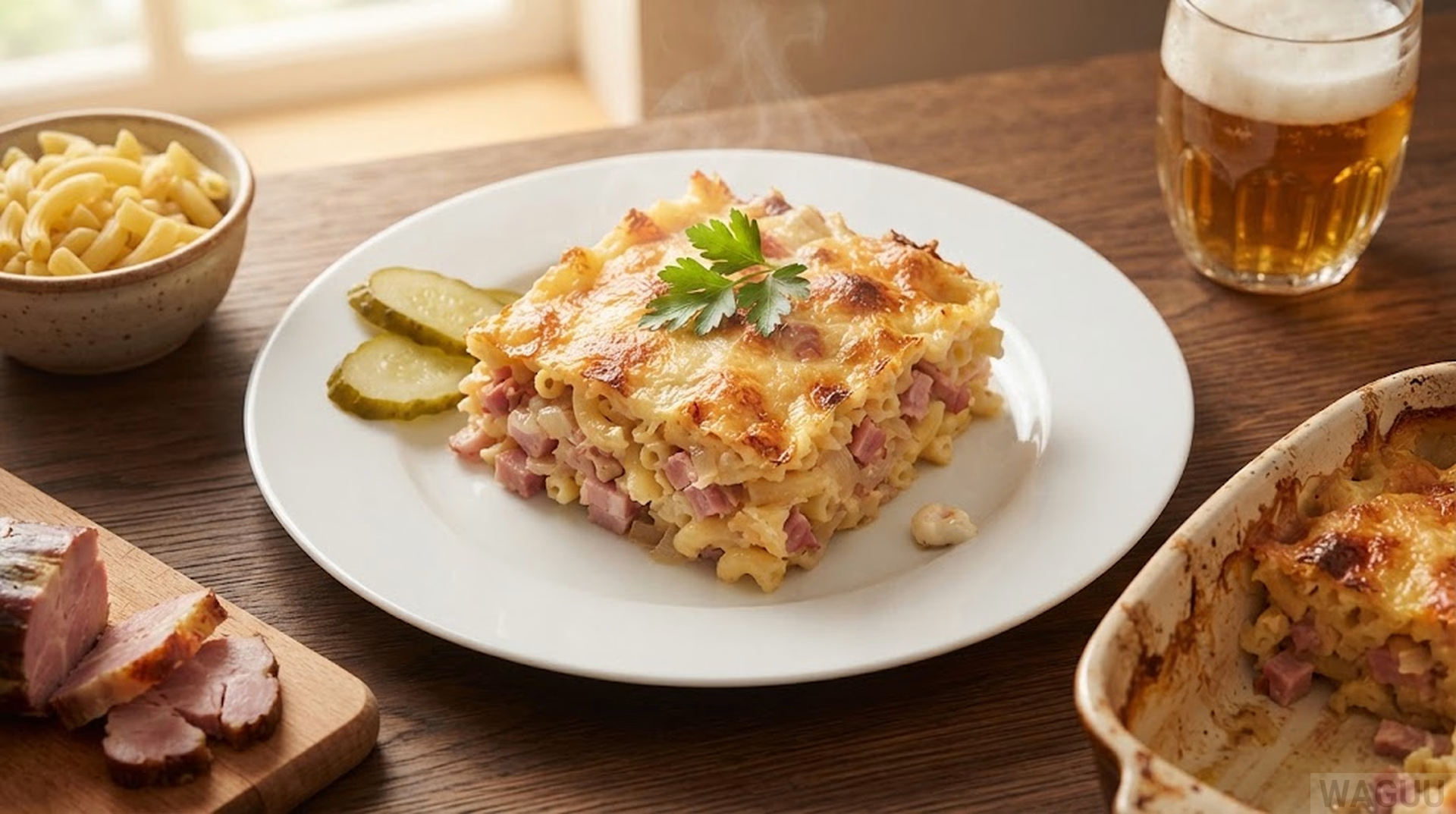
Summary: Cooked pasta layered with smoked ham, hard-boiled eggs and a light custard of eggs and cream, then baked at 180 °C until the top turns golden. Ready in 55 minutes, serves 6.
Cooked this recipe? Share your result with the community.
Category: Pasta, Czech Cuisine
Success rate: not rated yet % of users mastered this recipe
Quick overview
- Dish: Ham and Pasta Bake (Šunkofleky)
- Category: Pasta, Czech Cuisine
- Cuisine: Czech
- Main ingredient: Short pasta, 500 g, and smoked ham, 400 g
- Guide: 20 Most Famous Czech Dishes
- Total time: 55 minutes (20 min preparation + 35 min baking)
- Difficulty: Easy
- Servings: 6 (Portion weight: 380 g)
- Key technique: Baking
- Preparation types: Boiling, baking
- Dietary info & allergens: Contains gluten, dairy, eggs
- Suitable for: Everyday cooking, family dinners, using up leftover ham
- Nutritional values (per serving): 610 kcal, Protein: 32 g, Fat: 26 g, Carbohydrates: 58 g
- Storage: 3 days in the fridge • Freezer: 2 months
- Pairing: Pilsner, dry white wine, sparkling water
- In short: A layered pasta bake with smoked ham and hard-boiled eggs, bound together by a light egg-and-cream custard and baked until the top turns golden.
- Last updated: 18 September 2026
WAGUU says: “Šunkofleky is the dish every Czech family made on a Monday, using up the Sunday roast ham and the eggs left over from the weekend. It is not elegant food. It is honest, filling and gone in twenty minutes.”
Key facts
| Preparation time: | 20 minutes |
| Cooking time: | 35 minutes |
| Temperature: | 180 °C (oven) |
| Servings: | 6 |
At a glance
Layers of cooked pasta, smoked ham and hard-boiled eggs, bound together by a light custard of whisked eggs and cream. Baked in a buttered dish until the top turns golden and the edges pull away from the dish. Served hot with a simple cucumber salad.
Ingredients
Base servings: 6 • Portion weight: 380 g
| Ingredient | Amount | Quality |
|---|---|---|
| Short pasta | 500 g | penne, rigatoni or fusilli |
| Smoked ham | 400 g | cooked, cut into 1 cm cubes |
| Eggs | 6 pieces | large, hard-boiled and shelled |
| Eggs (for the custard) | 3 pieces | large, beaten |
| Double cream | 300 ml | 33–36% fat |
| Whole milk | 200 ml | whole |
| Onion | 1 piece | brown, medium, finely chopped |
| Butter | 60 g | unsalted, plus extra for the dish |
| Plain flour | 30 g | fine |
| Ground nutmeg | 0.25 tsp | freshly grated |
| Dried marjoram | 1 tsp | rubbed between fingers |
| Fine sea salt | 2 tsp | fine |
| Black pepper | 0.5 tsp | freshly ground |
| Eidam cheese | 100 g | grated, for the top |
| Fresh parsley | 10 g | fresh, chopped, for serving |
Why you will love this recipe
- Uses up what you have: Leftover ham from Sunday lunch, eggs from the fridge, half a packet of pasta. Šunkofleky is the dish that makes all three into a meal.
- Assemble ahead, bake later: You can layer everything in the dish in the morning, keep it in the fridge and bake it in the evening. The oven does the rest.
- Better the next day: The custard sets overnight and the flavours deepen. Reheat in a covered dish and it tastes even better than fresh.
Why it works: The pasta is cooked just short of al dente and drained well – if it is too soft, the bake turns into a mush. The custard of eggs, cream and milk sets in the oven and binds the layers together without needing a heavy sauce. The ham and hard-boiled eggs add salt and richness. The nutmeg cuts through the richness of the custard and lifts the whole dish. The top layer of grated cheese browns lightly and forms a crust, but the middle stays soft and creamy.
Recipe overview
Preparation: 20 min | Cooking: 35 min | Difficulty: Easy | Servings: 6 | Type: Main course | Origin: Czech
Detailed method
Total progress: 0 % done
Phase 1: Preparation – 15 min
Equipment: Large pot, chopping board, sharp knife, baking dish (28 × 20 cm), colander
1. Bring a large pot of well-salted water to the boil. Cook the pasta for 1 minute less than the package instructions say – it should be slightly undercooked so it does not turn to mush in the oven. Drain well and set aside. Meanwhile, cut the smoked ham into 1 cm cubes. Peel the hard-boiled eggs and slice them into rounds. Peel and finely chop the onion. Butter the baking dish generously, especially the corners.
VKB: The pasta is slightly firm when you bite it. The ham is cut into even cubes. The egg rounds are intact. The baking dish is buttered on all sides.
Before you continue:
Drain the pasta very well. Any water left on the pasta will thin the custard in the oven and the bake will turn out soggy instead of set.
Phase 2: Onion base – 5 min
Equipment: Medium pan, wooden spoon
2. Melt 40 g of butter in a medium pan over medium heat. Add the chopped onion and cook for 5 minutes until soft and golden. Sprinkle the flour over the onion and cook for 1 minute, stirring constantly. The flour should coat the onion and smell faintly nutty but not brown. Take the pan off the heat and let it cool slightly.
VKB: The onion is soft and golden. The flour coats every piece. The mixture smells nutty, not raw.
Before you continue:
Do not let the flour brown. A brown roux darkens the custard and gives the bake a roasted flavour that does not belong here.
Phase 3: Custard – 5 min
Equipment: Mixing bowl, whisk
3. In a mixing bowl, whisk the three raw eggs with the cream and milk. Season with salt, pepper, ground nutmeg and the dried marjoram. Whisk until the mixture is completely smooth and pale yellow. The custard should be thin enough to pour but thick enough to coat the back of a spoon lightly.
VKB: The custard is completely smooth with no lumps of egg white. It smells of nutmeg and marjoram. It coats the back of a spoon lightly.
Before you continue:
Whisk the eggs and cream thoroughly. If you leave streaks of egg white, the custard will not set evenly and the top will have rubbery patches.
Phase 4: Layering – 5 min
Equipment: Baking dish, large bowl, spoon
4. In a large bowl, mix the drained pasta with the cooked onion mixture, the cubed ham and half of the custard. Stir well so everything is evenly coated. Spread half of this mixture across the bottom of the buttered baking dish. Arrange the egg rounds in a single layer on top. Cover with the remaining pasta mixture and press down lightly with the back of a spoon. Pour the rest of the custard over the top so it seeps between the pasta pieces.
VKB: The layers are even. The egg rounds form a full layer in the middle. The custard has poured between the pasta and not just pooled on top.
Before you continue:
Do not skip pressing the pasta lightly with the back of a spoon. The pressing helps the custard settle between the pasta pieces and prevents dry pockets in the bake.
Phase 5: Baking – 35 min
Equipment: Oven, aluminium foil (optional)
5. Scatter the grated cheese evenly over the top of the bake. Bake at 180 °C for 30–35 minutes. After 20 minutes, check that the top is not browning too quickly – if it is, cover the dish loosely with foil and continue baking. The bake is ready when the custard is set – a knife inserted in the centre should come out clean – and the top is golden brown and slightly crisp.
VKB: A knife inserted in the centre comes out clean and hot. The top is deep golden brown. The edges of the bake have pulled slightly away from the sides of the dish. The kitchen smells of baked custard, ham and nutmeg.
Before you continue:
Do not overbake. The custard sets firm in the oven but continues to cook in the hot dish after you take it out. If the knife comes out almost clean, take the dish out – the residual heat will finish the job.
Phase 6: Resting and serving – 10 min
Equipment: Sharp knife, spatula, warm plates
6. Let the bake rest for 10 minutes before cutting. This gives the custard time to firm up and makes the portions easier to lift out in one piece. Cut into six rectangles with a sharp knife and lift each one out with a spatula. Serve with a simple cucumber salad dressed with vinegar and a pinch of sugar, or with pickled gherkins. Scatter the fresh chopped parsley over the top.
VKB: Each portion holds its shape when lifted. The custard does not run. The top is golden brown and slightly crisp. The ham and egg layers are visible in the cut side.
Required equipment
| Equipment | Ideal size | Alternative | Risk |
|---|---|---|---|
| Baking dish | 28 × 20 cm, deep | Any ovenproof dish of similar volume | Too shallow = custard overflows |
| Large pot | 5 litres | Wide saucepan | Too small = pasta sticks |
| Mixing bowl | 2 litres | Large measuring jug | Small bowl splashes |
| Whisk | Balloon whisk | Fork | Fork leaves lumps of egg white |
Shopping list
Nutritional profile
Values per serving. Calculated from average nutritional values of ingredients.
| Nutrient | Per 100 g | Per serving | Per 6 servings |
|---|---|---|---|
| Energy | 161 kcal | 610 kcal | 3660 kcal |
| Fat | 6.8 g | 26 g | 156 g |
| of which saturated | 3.3 g | 13 g | 78 g |
| Carbohydrates | 15.3 g | 58 g | 348 g |
| of which sugars | 1.8 g | 7 g | 42 g |
| Protein | 8.4 g | 32 g | 192 g |
| Salt | 0.7 g | 2.5 g | 15 g |
Reference intake of an average adult (8400 kJ / 2000 kcal).
WAGUU Pro level
- Pro standard: Tested recipe with exact ratios and visual control points.
- Tip 1: Use leftover roast ham or ham hock if you have it. The flavour is deeper and less salty than sliced supermarket ham.
- Tip 2: Add 100 g of frozen peas to the pasta mixture. They bring colour and a touch of sweetness that lifts the richness.
- Tip 3: If you want a richer top, sprinkle 2 tablespoons of breadcrumbs over the cheese before baking. It gives the crust more crunch.
- Tip 4: The dish is even better the next day. Cut it into portions, refrigerate, and reheat in a covered dish at 160 °C for 15 minutes. Do not microwave – it dries out the pasta.
Scientific background
A baked pasta custard sets because of the egg proteins coagulating in the oven. Egg whites (mostly ovalbumin) begin to set at 63 °C and become firm around 80 °C. The cream and milk slow down this process – fat and water both dilute the egg proteins and raise the temperature at which they set, which is why the custard stays smooth instead of turning rubbery. The hard-boiled eggs in the middle layer are already cooked, so they only warm through. The nutmeg contains myristicin, an aromatic compound that masks the eggy smell of the custard and makes the dish taste less heavy. The top layer of cheese browns through the Maillard reaction and forms a thin crust that contrasts with the soft custard underneath.
Fine Dining – Professional techniques
- Plate composition: Place one rectangular portion slightly off-centre, add a small mound of cucumber salad on the side, and scatter fresh parsley over the top.
- Texture contrasts: The soft custard and tender pasta contrast with the firm ham and the slightly crisp top.
- Temperature contrast: Serve the bake hot, the cucumber salad cold from the fridge.
- Aromatic additions: A small pinch of freshly ground black pepper over each portion, and a few drops of vinegar on the cucumber salad.
Sensory radar
- Appearance: Golden brown top with visible cheese crust, layers of pasta, ham and egg when cut
- Aroma: Baked custard, smoked ham, nutmeg, marjoram
- Taste: Savoury from the ham, creamy from the custard, warm from the nutmeg, mild from the pasta
- Texture: Soft custard, tender pasta, firm ham and egg, slightly crisp top
Pairing
- BEER: Pilsner Urquell or a light lager
- WINE: Dry white – Riesling or Pinot Blanc
- SOFT DRINK: Sparkling water with lemon
Other preparation variations
- Šunkofleky with smoked sausage: Replace the ham with 400 g of sliced smoked sausage. The flavour is deeper and smokier, closer to a mountain hut version.
- Šunkofleky with mushrooms: Replace 200 g of the ham with 200 g of sautéed mushrooms. The result is lighter and works well as a meat-free version.
Allergens and dietary information
Contains: Gluten, dairy, eggs • Gluten: Yes (pasta, flour) • Not suitable for: Coeliac disease (without substitutions), lactose intolerance (without substitutions)
Suitable for
Everyday cooking, family dinners, using up leftover ham, Sunday evening supper
Substitution catalogue
- Short pasta: Any shape that holds sauce – penne, fusilli, rigatoni, farfalle
- Smoked ham: Cooked ham, smoked sausage or leftover roast pork
- Double cream: Single cream or lactose-free cream
- Eidam cheese: Gouda, Emmental or smoked cheese
FAQ
My bake is dry. What went wrong?
The pasta absorbed too much liquid, or the custard was not enough. Next time, cook the pasta 1 minute less and drain it very well before mixing. Also make sure the custard is poured between the pasta pieces, not just on top.
My custard did not set. What happened?
Two possible reasons: too much liquid or not enough time in the oven. If the custard is still liquid after 35 minutes, bake for another 10 minutes. If it is still liquid after 45 minutes, the pasta was too wet when it went in.
Can I use fresh pasta instead of dried?
Yes, but reduce the cooking time by half. Fresh pasta cooks in 2–3 minutes and absorbs the custard faster, so it can turn mushy in the oven.
Can I make šunkofleky ahead of time?
Yes. Assemble the bake completely in the dish, cover it with cling film and refrigerate for up to 24 hours. Bake it straight from the fridge, adding 10 minutes to the baking time. The custard will be cold when it goes in, so it needs longer to set.
WAGUU Petr advises: Cooking for 6 or more?
6–8 people: Use 700 g of pasta and 550 g of ham. Keep the custard quantities the same – if the dish is too full, the custard cannot seep down. Use two dishes if needed. 10+ people: Double the recipe and use two baking dishes. Bake them side by side and rotate the trays halfway through for even browning.
Storage and reheating
Fridge: 3 days • Freezer: 2 months (cut into portions before freezing) • Reheating: Reheat in a covered dish at 160 °C for 15 minutes. Do not microwave – it dries out the pasta and makes the custard rubbery.
Author: WAGUU Petr & Team • Published: 18 Sep 2026
More recipes from this article
Guide: 20 Most Famous Czech Dishes
Roast Pork with Dumplings and Sauerkraut
Garlic Roast Pork with Spinach and Dumplings
More recipes you might like
Why WAGUU?
Recipes on WAGUU are checked for accuracy of ingredients, methods and nutritional values.
Photo gallery from the process
Photos from the community: Cook, take a photo and share your result.
You can upload photos in the comments below or send them by email.
Have you filmed a video of our recipe? Post a link to YouTube, YouTube Shorts, TikTok, Instagram Reels, Facebook Reels, Pinterest, Vimeo or X (Twitter) in the comments – we will gladly publish it and help promote you and your content.
Most common mistakes
- Overcooking the pasta – it will turn to mush in the oven. Cook it 1 minute less than the package says.
- Not draining the pasta well – water thins the custard and the bake turns soggy. Drain it in a colander and shake it dry.
- Streaky custard – whisk the eggs and cream thoroughly, otherwise the top will have rubbery patches of egg white.
- Cutting too soon – the custard needs 10 minutes to set after it comes out of the oven. Cut it straight away and the portions will collapse.