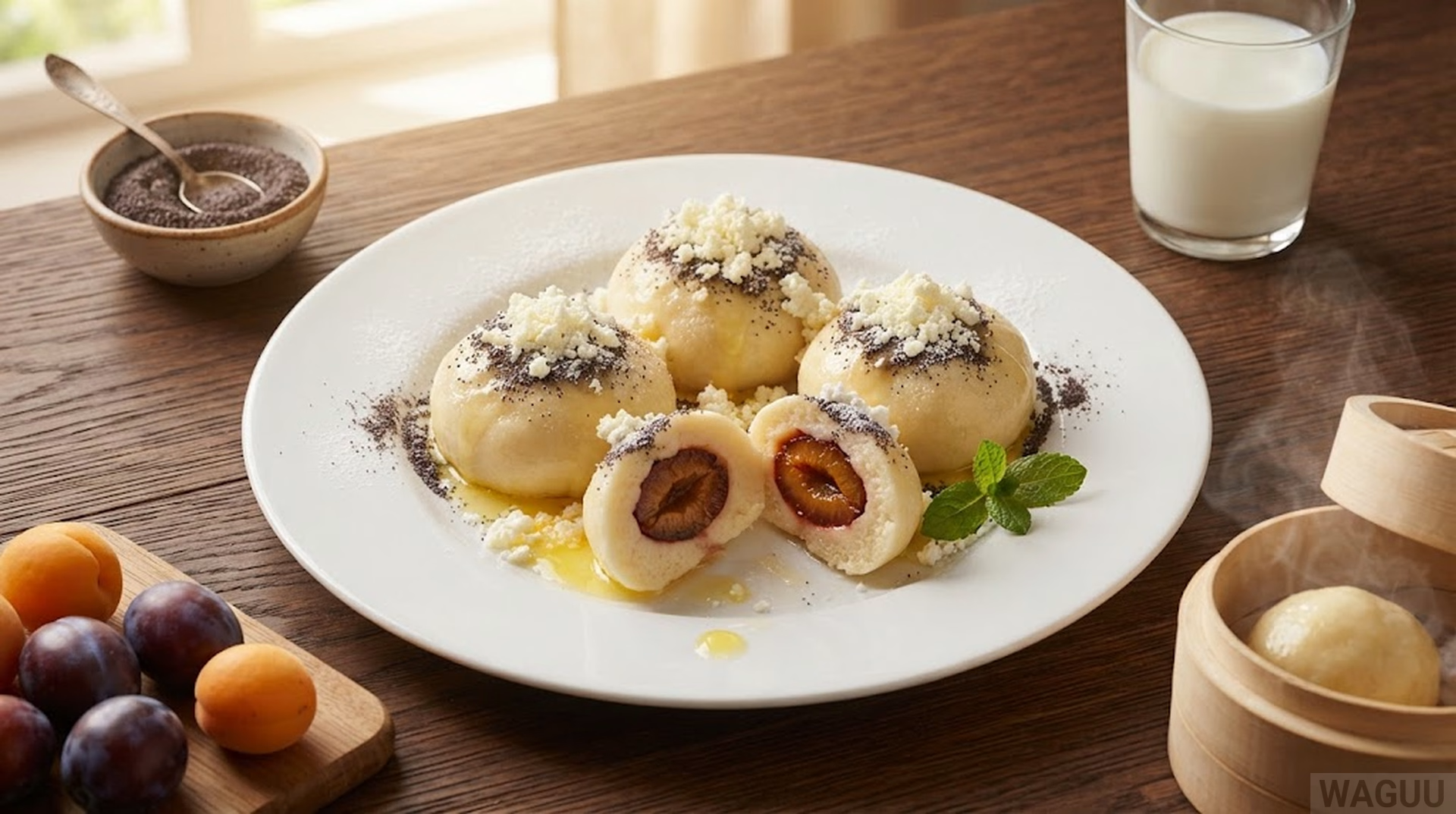
Summary: Soft yeast dumplings filled with fresh plums, apricots or strawberries, boiled in gently simmering water and served with melted butter, curd and sugar. Ready in 2 hours, serves 6.
Cooked this recipe? Share your result with the community.
Category: Desserts, Czech Cuisine
Success rate: not rated yet % of users mastered this recipe
Quick overview
- Dish: Fruit Dumplings (Ovocné knedlíky)
- Category: Desserts, Czech Cuisine
- Cuisine: Czech
- Main ingredient: Fresh plums, 18 pieces, and yeast dough
- Guide: 20 Most Famous Czech Dishes
- Total time: 120 minutes (30 min preparation + 90 min rising and cooking)
- Difficulty: Intermediate
- Servings: 6 (3 dumplings per person)
- Key technique: Yeast dough, boiling
- Preparation types: Boiling
- Dietary info & allergens: Contains gluten, dairy, eggs
- Suitable for: Summer desserts, family gatherings, afternoon snacks, festive meals
- Nutritional values (per serving): 480 kcal, Protein: 14 g, Fat: 16 g, Carbohydrates: 68 g
- Storage: 1 day in the fridge • Freezer: not recommended
- Pairing: Cold milk, dry white wine, sparkling water
- In short: Soft, fluffy yeast dumplings around a whole plum, served with butter, curd and sugar.
- Last updated: 18 September 2026
WAGUU says: “Fruit dumplings are the dessert that Czechs eat only in summer. When plums are ripe, they appear on the table. The rest of the year they wait. That waiting is part of the tradition.”
Key facts
| Preparation time: | 30 minutes |
| Cooking time: | 60 minutes (including 45 min rising) |
| Temperature: | Gentle simmer (95 °C on the hob) |
| Servings: | 6 |
At a glance
Soft, light yeast dumplings wrapped around a whole ripe plum (or apricot, or strawberry), boiled in gently simmering water and served with melted butter, sweet curd and a dusting of sugar. A summer dessert that is as much about the fruit as it is about the dough.
Ingredients
Base servings: 6 • 3 dumplings per person
| Ingredient | Amount | Quality |
|---|---|---|
| Strong white bread flour | 500 g | for the dough |
| Whole milk | 250 ml | lukewarm |
| Dried yeast | 7 g | fast-action |
| Caster sugar | 60 g | fine, for the dough |
| Eggs | 2 pieces | large, room temperature |
| Egg yolk | 1 piece | for the dough, extra |
| Butter | 80 g | unsalted, softened |
| Fine sea salt | 1 tsp | fine |
| Fresh plums | 18 pieces | ripe, small, stoned |
| Caster sugar (for filling) | 3 tbsp | for dusting the fruit |
| Ground cinnamon | 1 tsp | for the fruit |
| Butter (for serving) | 80 g | melted, for pouring |
| Curd cheese | 250 g | full-fat, or Greek yogurt |
| Icing sugar | 3 tbsp | for dusting |
| Ground cinnamon (for serving) | 0.5 tsp | for dusting |
Why you will love this recipe
- Made for summer fruit: Use plums, apricots, strawberries, blueberries or cherries. Whatever is ripe and sweet works. The dough is the frame, the fruit is the picture.
- Fruit inside, not on the side: The fruit cooks inside the dumpling and releases its juice into the dough. Every bite has fruit and dough together, not one after the other.
- Simple to shape: Once you have wrapped one dumpling, you have learned the whole technique. The dough is forgiving and the process is quick.
Why it works: The yeast dough is soft and lightly sweet – it is designed to be a wrapper, not a cake. When the dumpling hits the simmering water, the starch on the surface of the dough gelatinises and seals it. Inside, the fruit heats up and its juices start to simmer. The steam cannot escape through the sealed dough, so the dumpling puffs up and the fruit cooks in its own juice. The dumplings are cooked directly in water, not steamed – the water keeps them from drying out and the dough absorbs just enough moisture to stay soft. Once removed and drained, they are served immediately so the crust does not form.
Recipe overview
Preparation: 30 min | Cooking: 60 min | Difficulty: Intermediate | Servings: 6 | Type: Dessert | Origin: Czech
Detailed method
Total progress: 0 % done
Phase 1: Preparing the dough – 20 min
Equipment: Large mixing bowl, small bowl, whisk, wooden spoon
1. Warm the milk to lukewarm – about 37 °C, the temperature of your fingertip. If it is too hot, it will kill the yeast. In a small bowl, mix the yeast with 1 teaspoon of the sugar and 2 tablespoons of the warm milk. Leave it for 10 minutes until it becomes foamy – this proves the yeast is active. In a large bowl, mix the flour, the rest of the sugar and the salt. Add the foamy yeast mixture, the whole eggs, the egg yolk and the softened butter. Mix with a wooden spoon until the dough comes together, then knead on a lightly floured surface for 8–10 minutes. The dough should be soft, smooth and slightly tacky, not dry.
VKB: The dough is soft, smooth and just slightly sticky. When you press a finger into it, the indentation slowly springs back. It does not tear when stretched.
Before you continue:
Always prove the yeast first. If the yeast does not foam after 10 minutes, it is dead and the dough will not rise. Throw it away and start again with fresh yeast. Do not skip this step.
Phase 2: Rising – 45 min
Equipment: Large bowl, clean tea towel
2. Shape the dough into a ball and put it back in the large bowl. Cover the bowl with a clean tea towel and leave it in a warm place, away from draughts, for 45 minutes. The dough should double in size. A warm place means around 25–28 °C – a kitchen counter away from an open window, or inside a turned-off oven with just the light on.
VKB: The dough has visibly doubled in size. When you gently press it with a finger, the indentation stays. The dough smells faintly of yeast and feels airy.
Before you continue:
Do not leave the dough in a cold place or in a draught. If the kitchen is cold, put the bowl in the sink filled with warm water (about 30 °C). The dough needs warmth to rise.
Phase 3: Preparing the fruit – 10 min
Equipment: Small knife, small bowl
3. While the dough rises, prepare the fruit. Wash the plums and dry them with a clean tea towel. Cut each plum along one side and remove the stone – leave the plum whole, do not cut it in half. In a small bowl, mix the 3 tablespoons of sugar with the cinnamon. Roll each stoned plum in the sugar-cinnamon mixture so it is coated on all sides. This gives the fruit sweetness and helps the dough stick to it.
VKB: The plums are stoned but still whole. Each one is coated with sugar and cinnamon. The plums are dry, not wet with juice.
Before you continue:
Use small, firm plums, not large soft ones. Large soft fruit releases too much juice during cooking and the dumpling will burst open.
Phase 4: Shaping the dumplings – 20 min
Equipment: Floured work surface, rolling pin, small spoon, plate
4. Turn the risen dough out onto a lightly floured surface and knead it briefly for 30 seconds to knock out the air. Divide it into 18 equal pieces – weigh them if you want them identical, or divide by eye. Take one piece and flatten it with your fingers into a disc about 8 cm across and 5 mm thick. The centre should be slightly thicker than the edges. Place a plum in the middle. Bring the edges up around the fruit and pinch them together firmly at the top. Roll the dumpling briefly between your palms to make it round. Place it, seam side down, on a floured plate. Repeat with the remaining dough and fruit.
VKB: Each dumpling is round, smooth and completely sealed. There are no cracks or thin patches where the fruit might break through. The seam is neatly pinched and placed face down.
Before you continue:
Seal the dumplings carefully. If there is a crack in the dough, the fruit juice will leak out during boiling and the dumpling will fall apart in the water. Pinch the seam well and roll gently to close it.
Phase 5: Boiling – 15 min
Equipment: Large wide pot, slotted spoon, plate
5. Bring a large wide pot of water to a gentle simmer – it should tremble, not boil. Add a pinch of salt. Lower the dumplings into the water carefully with a slotted spoon, seam side down. Do not crowd the pot – cook in two or three batches. The dumplings will sink at first, then rise to the surface as they cook. Once they rise, simmer them for 8 minutes on one side, then turn them gently with a slotted spoon and cook for another 4 minutes on the other side. Total cooking time: 12 minutes from when they rise.
VKB: The dumplings have puffed up and float on the surface. When you lift one with a slotted spoon, it feels firm and holds its shape. The dough is cooked through – no raw dough taste when you bite into the edge.
Before you continue:
Never boil the dumplings rapidly. Hard boiling will tear the dough and the fruit juice will spill into the water. A gentle simmer is what keeps them intact.
Phase 6: Serving – 5 min
Equipment: Slotted spoon, serving plate, small pan for butter
6. Lift the dumplings out of the water with a slotted spoon and drain them briefly on a clean tea towel or kitchen paper. Melt the 80 g of butter in a small pan until it foams. Arrange three dumplings on each plate, pour the melted butter over them and spoon the curd cheese on top. Dust generously with icing sugar and a pinch of cinnamon. Serve immediately – fruit dumplings wait for no one, and once they cool, they lose their softness.
VKB: The dumplings are soft and pillowy. When you cut into one, the plum inside is soft and juicy. The butter, curd and sugar have soaked into the top layer of the dough. The cinnamon and icing sugar are visible on the surface.
Required equipment
| Equipment | Ideal size | Alternative | Risk |
|---|---|---|---|
| Large wide pot | 5 litres, wide bottom | Dutch oven | Narrow pot = dumplings stick |
| Slotted spoon | Wide, shallow | Spider skimmer | Fork pierces the dough |
| Clean tea towel | 40 × 40 cm, cotton | Kitchen paper | Synthetic cloth does not absorb |
| Rolling pin | Standard wooden | Fingers to flatten | Fingers can leave thin spots |
Shopping list
Nutritional profile
Values per serving (3 dumplings with butter, curd and sugar). Calculated from average nutritional values of ingredients.
| Nutrient | Per 100 g | Per serving | Per 6 servings |
|---|---|---|---|
| Energy | 185 kcal | 480 kcal | 2880 kcal |
| Fat | 6.2 g | 16 g | 96 g |
| of which saturated | 3.6 g | 9 g | 54 g |
| Carbohydrates | 26.2 g | 68 g | 408 g |
| of which sugars | 11.5 g | 30 g | 180 g |
| Protein | 5.4 g | 14 g | 84 g |
| Salt | 0.3 g | 1.3 g | 7.8 g |
Reference intake of an average adult (8400 kJ / 2000 kcal).
WAGUU Pro level
- Pro standard: Tested recipe with exact ratios and visual control points.
- Tip 1: Add 2 tablespoons of potato starch to the flour. The starch makes the dough lighter and gives the dumplings a smoother surface that does not crack during boiling.
- Tip 2: Instead of plums, use apricots, strawberries or cherries – but choose small, firm fruit. Large soft fruit releases too much juice and the dumplings burst.
- Tip 3: If the dough feels too sticky to handle, lightly oil your hands instead of adding more flour. Adding too much flour makes the dough tough.
- Tip 4: After boiling, pan-fry the dumplings briefly in butter for a minute on each side. The outside becomes slightly crisp while the inside stays soft – a restaurant version of the classic.
Scientific background
The dumpling dough is a yeast dough, which means it rises through fermentation. The yeast (Saccharomyces cerevisiae) feeds on the sugar in the dough and produces carbon dioxide and ethanol. The carbon dioxide gets trapped in the gluten network – a web of proteins that forms when the flour is kneaded – and the dough expands. When the dumpling is placed in simmering water, the starch on its surface gelatinises at around 60 °C and seals the dough. The heat continues to travel inward, cooking the dough from the outside in. Inside, the fruit releases its juice as it heats. The juice cannot escape through the sealed dough, so it simmers inside and cooks the fruit in its own liquid. The sugar coating on the fruit dissolves into the juice and becomes a light syrup. The cinnamon in the coating contains cinnamaldehyde, an aromatic compound that survives cooking and pairs well with the tartness of the plums.
Fine Dining – Professional techniques
- Plate composition: Place three dumplings in a row on a shallow plate, spoon melted butter over each, and place a quenelle of curd cheese on the side. Dust with icing sugar and cinnamon.
- Texture contrasts: The soft dumplings contrast with the creamy curd and the slight graininess of the icing sugar.
- Temperature contrast: Serve the dumplings hot, the curd cold from the fridge. The contrast is part of the experience.
- Aromatic additions: A few strips of lemon zest over the curd, or a small drizzle of honey instead of icing sugar.
Sensory radar
- Appearance: White, round dumplings with a slightly glossy surface, dusted with icing sugar and cinnamon
- Aroma: Fresh yeast, sweet fruit, cinnamon, melted butter
- Taste: Soft, mild dough, sweet-tart fruit, rich butter, tangy curd
- Texture: Pillowy dough, soft fruit, creamy curd
Pairing
- BEER: Wheat beer or a light fruit lambic
- WINE: Sweet white – Moscato or Riesling Auslese
- SOFT DRINK: Cold milk or a strong black tea
Other preparation variations
- Curd dumplings: Replace the yeast dough with a curd-based dough (500 g curd, 2 eggs, 200 g flour). The dumplings are denser but tangier.
- Potato dumplings with fruit: Use a potato dough (700 g cooked potatoes, 2 eggs, 200 g flour). The dumplings are heavier and better suited to savoury fruits like plums.
Allergens and dietary information
Contains: Gluten, dairy, eggs • Gluten: Yes (flour) • Not suitable for: Coeliac disease (without substitutions), lactose intolerance (without substitutions)
Suitable for
Summer desserts, family gatherings, afternoon snacks, festive meals, Sunday lunch
Substitution catalogue
- Fresh plums: Apricots, strawberries, cherries, blueberries or peaches
- Curd cheese: Greek yogurt, quark, or mascarpone
- Whole milk: Oat milk or almond milk (for a dairy-free version, also replace butter with plant-based butter)
- Plain flour: Gluten-free flour blend (add 1 extra egg yolk for binding)
FAQ
My dumplings burst open during boiling. What went wrong?
The dough was too thin in places or the seam was not sealed properly. Next time, leave the centre of the disc slightly thicker than the edges and pinch the seam firmly. Also make sure the water is at a gentle simmer, not a rolling boil.
My dumplings are dense and heavy. What went wrong?
Either the dough did not rise long enough or too much flour was added during shaping. Let the dough rise until it doubles in size – 45 minutes is the minimum. If the dough is sticky, oil your hands instead of adding flour.
Can I use frozen fruit?
Yes, but do not thaw it. Use the frozen fruit directly from the freezer. Thawed fruit is too soft and releases too much juice. The dumplings will need 2 extra minutes in the water.
Can I make fruit dumplings ahead of time?
You can shape them up to 2 hours ahead and keep them in the fridge, covered with a tea towel, on a floured plate. Boil them just before serving. Once boiled, they should be eaten the same day – they do not reheat well.
WAGUU Petr advises: Cooking for 6 or more?
6–8 people: Use 700 g of flour and 24 small plums. Boil the dumplings in two batches so they do not crowd the pot. 10+ people: Double the recipe and shape the dumplings ahead. Boil them just before serving and keep the finished ones warm in a low oven at 80 °C, covered with a tea towel – but no longer than 15 minutes.
Storage and reheating
Fridge: 1 day (best eaten fresh) • Freezer: Not recommended (the dough loses its texture) • Reheating: Briefly steam the dumplings for 3 minutes or pan-fry them in butter for 2 minutes per side. Do not microwave – they become rubbery.
Author: WAGUU Petr & Team • Published: 18 Sep 2026
More recipes from this article
Guide: 20 Most Famous Czech Dishes
Roast Pork with Dumplings and Sauerkraut
Garlic Roast Pork with Spinach and Dumplings
More recipes you might like
Why WAGUU?
Recipes on WAGUU are checked for accuracy of ingredients, methods and nutritional values.
Photo gallery from the process
Photos from the community: Cook, take a photo and share your result.
You can upload photos in the comments below or send them by email.
Have you filmed a video of our recipe? Post a link to YouTube, YouTube Shorts, TikTok, Instagram Reels, Facebook Reels, Pinterest, Vimeo or X (Twitter) in the comments – we will gladly publish it and help promote you and your content.
Most common mistakes
- Cracks in the dough – the fruit juice leaks out and the dumplings fall apart. Leave the centre of the disc thicker than the edges and pinch the seam firmly.
- Not proving the yeast – if the yeast does not foam, the dough will not rise. Always prove it in warm milk with a little sugar first.
- Boiling too hard – a rolling boil tears the dough. Keep the water at a gentle simmer.
- Using large soft plums – they release too much juice. Use small, firm plums that hold their shape during cooking.