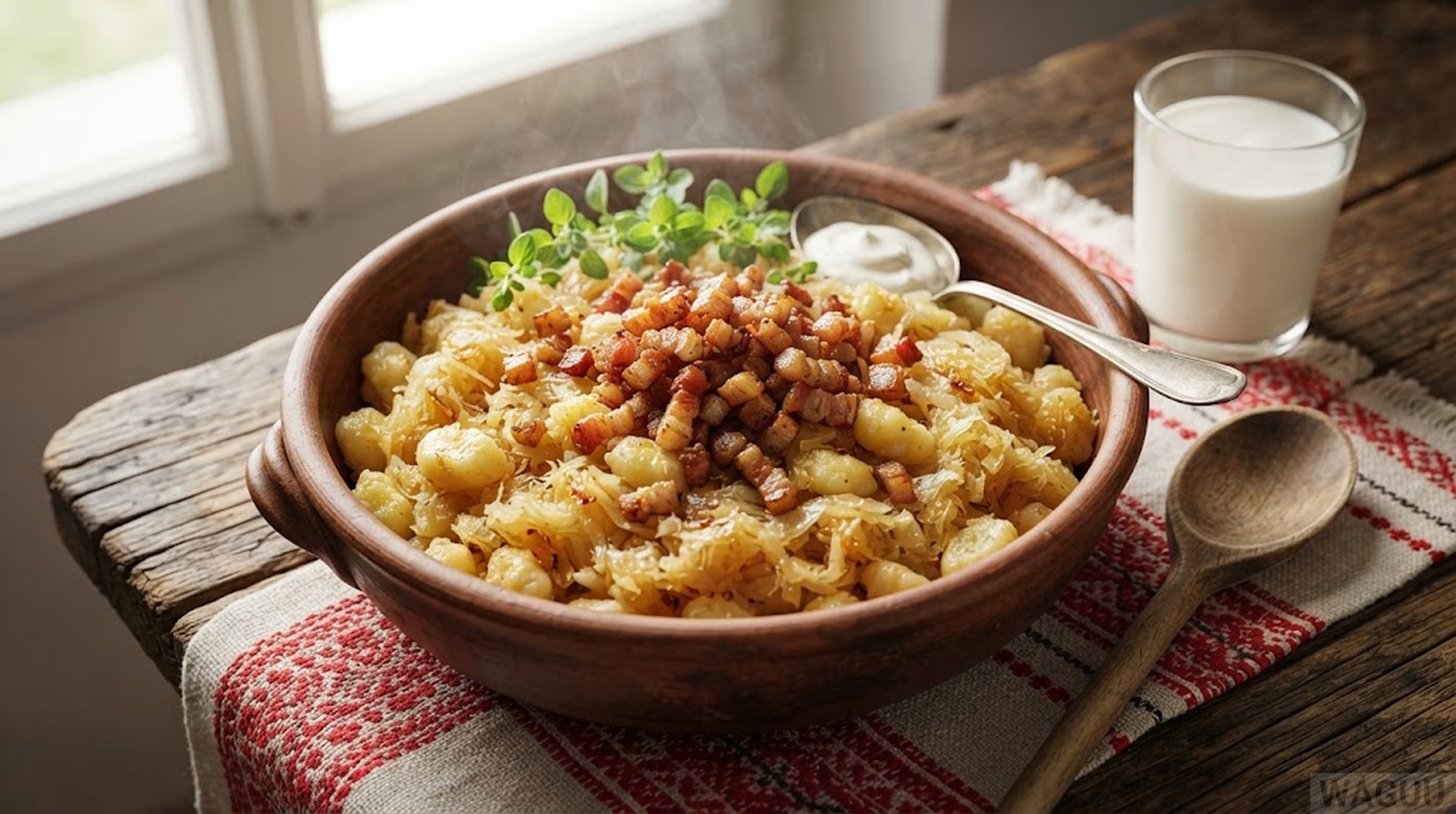
Summary: Strapačky – potato-flour dumplings folded through braised sauerkraut and crisp bacon. A Slovak cousin of bryndzové halušky, sharper and more savory. Ready in about 55 minutes, serves 6.
Cooked the recipe? Share the result with the community.
Category: American Pasta, American Slovak Cuisine
Success rate: not rated yet % of users managed this recipe
Quick overview
- Dish: Slovak Dumplings with Sauerkraut and Bacon (Strapačky)
- Category: American Pasta, American Slovak Cuisine
- Cuisine: Slovak
- Main ingredient: Sauerkraut, 14 oz, drained and chopped
- Guide: 12 Most Famous Slovak Dishes: Traditional Recipes from Slovak Cuisine
- Total time: 55 minutes (30 min prep + 25 min cooking)
- Difficulty: Medium
- Servings: 6 (Portion weight: 14 oz)
- Key technique: Boiling potato-flour dumplings, braising sauerkraut, folding everything together in a pan
- Preparation types: Boiling, braising, pan-frying
- Dietary info & allergens: Contains gluten, eggs. Not suitable for gluten-free, vegan or lactose-free (if using sour cream) diets.
- Suitable for: Autumn and winter lunches, family meals, casual dinners
- Nutrition per serving: 680 kcal, Protein: 22 g, Fat: 28 g, Carbohydrates: 82 g
- Storage: 3 days in the fridge, 2 months in the freezer
- Pairing: Žinčica (sheep whey), light lager, dry Riesling
- In short: The other Slovak dumpling dish – this time with sauerkraut instead of bryndza.
- Last updated: September 22, 2026
WAGUU says: “Strapačky is what Slovaks cook when they want something sharp and savory – no bryndza, just cabbage and bacon doing the work.”
Key facts
| Prep time: | 30 minutes |
| Cook time: | 25 minutes |
| Temperature: | Boiling water (212 °F), medium pan heat |
| Servings: | 6 |
At a glance
Strapačky are Slovak potato-flour dumplings cooked with sauerkraut and bacon. The result is sharper and less rich than bryndzové halušky, but just as filling. A dish for cold evenings and hungry people.
Ingredients
Base servings: 6 servings • Portion weight: 14 oz
| Ingredient | Amount | Quality |
|---|---|---|
| Russet potatoes | 1½ lb | Peeled, boiled, cooled, riced |
| All-purpose flour | 2⅓ cups | Plus extra for dusting |
| Egg | 1 pc | Large |
| Fine sea salt | 1 tsp | Plus more for the water |
| Raw sauerkraut | 14 oz | Drained, chopped |
| Brown onion | 1 pc | Medium, chopped |
| Thick-cut bacon | 7 oz | Cut into ½-inch strips |
| Sweet Hungarian paprika | 1 tsp | Fresh, sweet |
| Pork lard or unsalted butter | 2 tbsp | For the pan |
| Full-fat sour cream (18–20 %) | ⅓ cup + 1 tbsp | For serving |
Why you will love this recipe
- Sharp and savory: Sauerkraut does the same job as bryndza – it cuts through the richness of the bacon and gives the dish its character.
- One pan finish: Boil the dumplings, then fold everything together in a single pan. Fewer dishes, more flavor.
- Better the next day: Like most cabbage dishes, strapačky taste deeper after a night in the fridge.
Why it works: Sauerkraut is braised first to soften its sharpness and concentrate its sweetness. The dumplings are boiled separately, then folded into the pan with the cabbage and bacon. The last-minute addition of paprika into the hot fat releases its color and aroma without burning it. The dumplings soak up the cabbage juices and bacon fat, so every bite is savory.
Recipe overview
Prep: 30 min | Cooking: 25 min | Difficulty: Medium | Servings: 6 | Type: Main course | Origin: Slovak
Detailed method
Total progress: 0 % done
Phase 1: Preparing the potatoes – 10 min
Equipment: Peeler, saucepan, potato ricer
1. Peel the potatoes, cut into 1-inch chunks and boil in salted water for 15–18 minutes until tender. Drain and steam dry for 2 minutes. Pass through a potato ricer. Spread on a tray and leave to cool to room temperature.
VKB: The mash is smooth, dry and lukewarm. No lumps, no visible steam.
Phase 2: Making the dough – 8 min
Equipment: Large bowl, work surface
2. Put the cooled potatoes in a bowl. Add the egg and 1 tsp salt. Sift in the flour. Mix with a wooden spoon, then briefly knead by hand for 60 seconds – just until the dough comes together. Do not overwork. Cover with a clean tea towel.
VKB: The dough is soft and slightly tacky. It holds together without crumbling.
Before you continue:
Do not knead longer than 60 seconds. The dough should just hold together – not become elastic.
Phase 3: Cooking the dumplings – 8 min
Equipment: Large pot, halušky board or shallow plate, slotted spoon
3. Bring a large pot of salted water to a rolling boil. Drop small pieces of dough into the water using a halušky board or by spreading the dough on a plate and flicking with a knife. Boil in two batches. The dumplings are done when they float – about 2–3 minutes. Remove with a slotted spoon and drain.
VKB: The dumplings float and look plump. They are tender but not mushy.
Phase 4: Braising the sauerkraut – 10 min
Equipment: Large deep frying pan or sauté pan
4. Heat the lard or butter in a large pan over medium heat. Add the bacon and fry for 4 minutes until golden. Add the onion and cook for 3 minutes until soft. Add the sauerkraut and cook for 5 minutes, stirring occasionally. Take the pan off the heat and stir in the paprika.
VKB: The sauerkraut is soft and glossy, the bacon is golden, and the paprika has colored the fat deep red.
Before you continue:
Taste the sauerkraut before you add salt. Some brands are very salty, and you may not need any extra.
Phase 5: Folding everything together – 3 min
Equipment: Large pan, wooden spoon
5. Add the drained dumplings to the pan with the sauerkraut and bacon. Return to low heat. Fold gently with a wooden spoon for 2–3 minutes so the dumplings absorb the cabbage juices and the bacon fat. Taste and season with a little salt and pepper.
VKB: Every dumpling is coated in a little cabbage and bacon fat. No dry patches, no pool of liquid at the bottom of the pan.
Phase 6: Serving – 2 min
Equipment: Warm bowls
6. Divide between six warm bowls. Add a spoon of sour cream on top, and if you like, a little more fried bacon on the side. Serve immediately.
VKB: The dumplings are steaming hot, the sour cream is melting into them, and the plate smells of sauerkraut and bacon.
Required equipment
| Item | Ideal size | Alternative | Risk |
|---|---|---|---|
| Potato ricer | Standard, 9-inch | Fine sieve or masher | A masher leaves lumps that make the dough uneven |
| Large deep pan | 12-inch sauté pan | Wide Dutch oven | A shallow pan makes folding messy and the dumplings fall out |
| Halušky board | Traditional wooden board | Shallow plate and knife | Without a board, the dumplings are less uniform |
Shopping list
Nutritional profile
Values per 1 serving (without any side dish). Calculated from average nutritional values of the ingredients.
| Nutrient | Per 100 g | Per 1 serving | Per 6 servings |
|---|---|---|---|
| Energy | 170 kcal | 680 kcal | 4080 kcal |
| Fat | 7.0 g | 28 g | 168 g |
| of which saturates | 3.0 g | 12 g | 72 g |
| Carbohydrates | 20.5 g | 82 g | 492 g |
| of which sugars | 2.5 g | 10 g | 60 g |
| Protein | 5.5 g | 22 g | 132 g |
| Salt | 1.0 g | 4.0 g | 24 g |
Reference intake of an average adult (8400 kJ / 2000 kcal).
WAGUU Pro level
- Pro standard: Verified recipe with exact proportions and visual checkpoints.
- Tip 1: Use the freshest sauerkraut you can find. The longer it has been sitting, the softer and less sharp it becomes.
- Tip 2: Do not drain the sauerkraut completely – a little brine keeps the dish juicy.
- Tip 3: If the sauerkraut is very salty, rinse it briefly in cold water and squeeze out the excess before cooking.
- Tip 4: Finish with a spoon of sour cream at the table, not in the pan. The contrast between hot dumplings and cool cream is part of the pleasure.
Scientific background
Sauerkraut and potato-flour dumplings are a natural pairing. The acidity of the sauerkraut cuts through the fat of the bacon, and the dumplings absorb both the acidic juices and the fat. When the dumplings are folded into the pan, the starch on their surface partly dissolves into the cabbage juices, thickening them slightly. This is why the finished dish feels cohesive rather than dry. The paprika is added off the heat because the pigments and aromatic compounds in paprika are sensitive to high temperatures – they burn quickly and turn bitter.
Fine Dining – Professional techniques
- Plate composition: Build a small mound of dumplings on a warm plate, spoon the sauerkraut and bacon around it, and add a quenelle of sour cream on top.
- Texture contrast: Top with a few crisp fried onions or a scatter of toasted breadcrumbs.
- Temperature contrast: Serve very hot, with cold sour cream and a cool glass of buttermilk on the side.
- Aromatic additions: A little fresh marjoram or caraway seeds add a Slovak note without overwhelming the sauerkraut.
Sensory radar
- Appearance: Pale dumplings mixed through golden-brown sauerkraut and bacon, with a swirl of sour cream.
- Aroma: Tangy sauerkraut, sweet paprika, and smoked bacon.
- Taste: Sharp, savory, and warming. Salty from the bacon, sour from the cabbage.
- Texture: Tender dumplings, soft cabbage with a slight bite, crisp bacon pieces.
Pairing
- BEER: A light lager or a dark amber lager. The malt softens the acidity.
- WINE: Dry Riesling or a light red such as Blaufränkisch.
- SOFT DRINK: Žinčica (sheep whey) or cold buttermilk.
Variations of preparation
- With smoked sausage: Replace the bacon with 5 oz of sliced smoked sausage, fried until golden.
- Vegetarian: Skip the bacon. Use 2 tbsp of lard or butter and add a pinch of smoked paprika for depth.
Allergens and dietary information
Contains: Gluten, eggs, milk (if using sour cream) • Gluten: Yes (all-purpose flour) • Not suitable for: Celiac disease, vegan diets
Suitable for
Autumn and winter lunches, family meals, casual dinners, batch cooking for the freezer.
Substitution catalogue
- Sauerkraut: Fresh is best. Canned works but needs extra cooking and more seasoning.
- Bacon: Smoked pancetta, diced ham, or smoked sausage.
- Pork lard: Unsalted butter, duck fat, or a neutral oil.
FAQ
Can I make strapačky ahead of time?
Yes. Cook the whole dish, cool, refrigerate, and reheat gently in a pan with a spoon of water. It tastes even better the next day.
Why is my dish too sour?
Either the sauerkraut is very sharp or you used too much brine. Rinse the sauerkraut briefly and add a spoon of sour cream at the end.
Can I freeze strapačky?
Yes, up to 2 months. Reheat in a pan with a little water or butter. Do not microwave.
What if I don’t have a halušky board?
Spread the dough on a shallow plate and flick small pieces into the boiling water with a knife. The shape will be less uniform but the taste is the same.
WAGUU Petr advises: Cooking for 6 or more?
6–8 people: Cook the dumplings in two batches. Keep the finished ones warm in a low oven (140 °F) and fold with the cabbage just before serving. • 10+ people: Double the recipe. Use two large pans for the sauerkraut and bacon. Boil the dumplings in three or four batches.
Sides and serving
Storage and reheating
Fridge: 3 days • Freezer: 2 months • Reheating: Gently in a pan with a spoon of water or butter. Do not microwave.
Author: WAGUU Petr & Team • Published: 22 Sep 2026
More recipes from this article
Guide: 12 Most Famous Slovak Dishes: Traditional Recipes from Slovak Cuisine
Bryndza Dumplings with Bacon and Crackling
Bryndza Pierogi with Bacon or Sour Cream
Slovak Sauerkraut Soup with Smoked Meat
Slovak Potato Pancakes with Garlic and Marjoram
Demikát: Traditional Slovak Bryndza Soup
Slovak Potato Rolls with Poppy Seeds
Slovak Roast Goose with Potato Flatbread and Cabbage
Bryndza Soup with Potatoes and Bacon
More recipes you might like
Why WAGUU?
WAGUU recipes are checked for accuracy of ingredients, methods and nutritional values.
Photo gallery from the process
Photos from the community: Cook it, photograph it, and share the result.
You can upload photos in the comments below or send them by email.
Have you filmed a video of your version of our recipe? Post a link to YouTube, YouTube Shorts, TikTok, Instagram Reels, Facebook Reels, Pinterest, Vimeo or X (Twitter) in the comments – we will happily feature it and help you and your content get seen.
Most common mistakes
- Over-salting – Both sauerkraut and bacon are salty. Taste before you add any salt.
- Burning the paprika – Stir it in off the heat, or it turns bitter.
- Kneading the dough too long – The dumplings become chewy instead of light.
- Draining the sauerkraut completely – A little brine keeps the dish juicy and balanced.