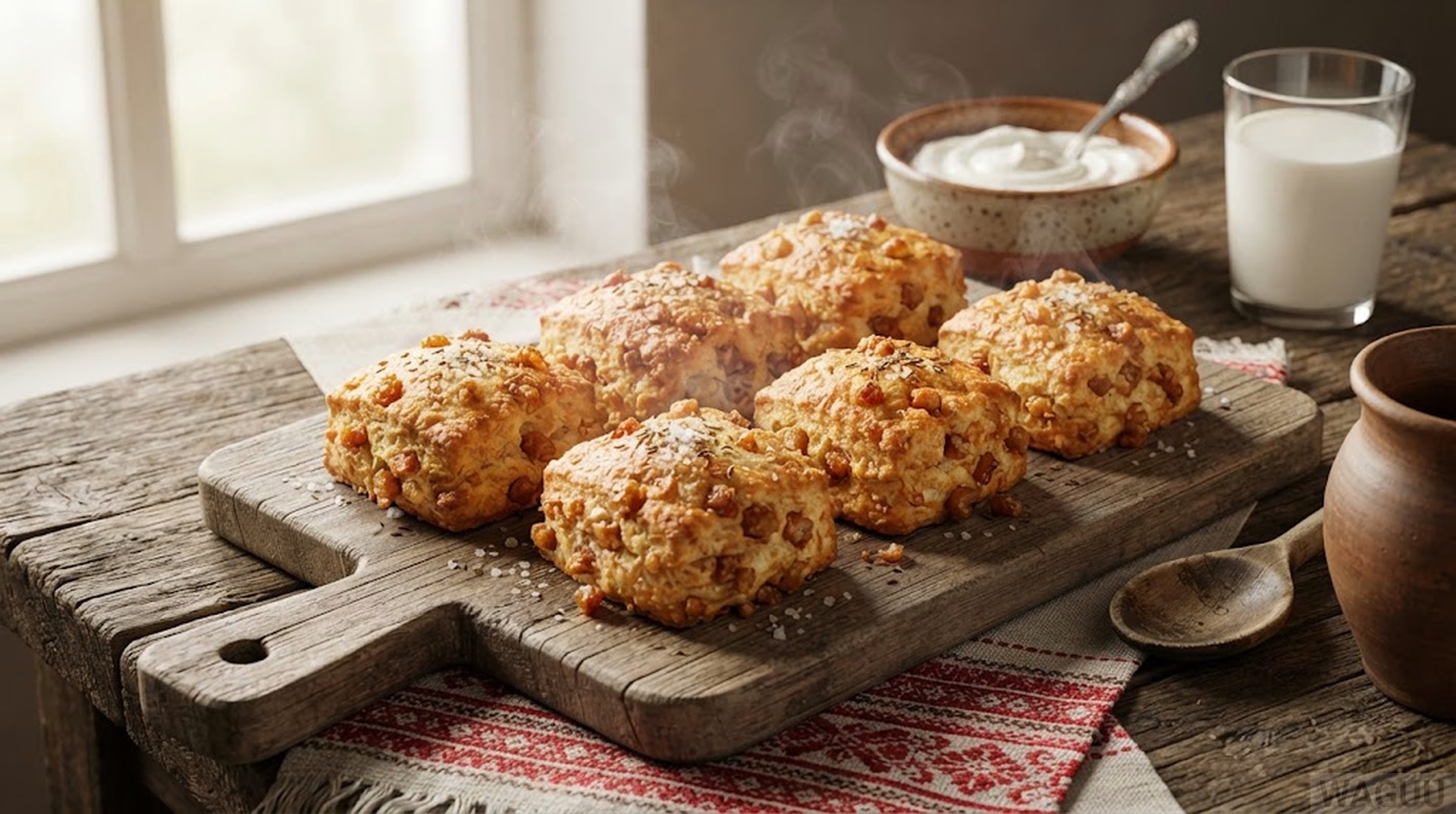
Summary: Slovak pork crackling biscuits – small, savory pastry squares enriched with lard and filled with chopped pork crackling. Golden, flaky and rich. Ready in about 2 hours 30 minutes, serves 6.
Cooked the recipe? Share the result with the community.
Category: American Bread and Pastry, American Slovak Cuisine
Success rate: not rated yet % of users managed this recipe
Quick overview
- Dish: Slovak Pork Crackling Biscuits (Oškvarkové pagáče)
- Category: American Bread and Pastry, American Slovak Cuisine
- Cuisine: Slovak
- Main ingredient: Pork crackling (oškvarky), 9 oz, finely chopped
- Guide: 12 Most Famous Slovak Dishes: Traditional Recipes from Slovak Cuisine
- Total time: 150 minutes (45 min prep + 105 min including proving and baking)
- Difficulty: Medium
- Servings: 6 (Portion weight: 6½ oz)
- Key technique: Enriched yeast dough, layering with crackling, brushing with egg wash
- Preparation types: Baking
- Dietary info & allergens: Contains gluten, milk, eggs. Not suitable for gluten-free, vegetarian or vegan diets.
- Suitable for: Sunday breakfast, casual snacks, picnic, beer accompaniment
- Nutrition per serving: 646 kcal, Protein: 16 g, Fat: 38 g, Carbohydrates: 56 g
- Storage: 4 days in the fridge, 2 months in the freezer
- Pairing: Light lager, dark lager, cold buttermilk
- In short: Small savory biscuits with pork crackling – a Slovak pub classic.
- Last updated: September 22, 2026
WAGUU says: “Pagáče are what Slovaks bake on a Sunday morning, when there is leftover crackling from Saturday’s pig slaughter.”
Key facts
| Prep time: | 45 minutes |
| Cook time: | 20 minutes + 90 minutes proving |
| Temperature: | 350 °F |
| Servings: | 6 |
At a glance
A soft yeast dough layered with finely chopped pork crackling and baked into small squares. Golden, rich and savory – the kind of biscuit you eat with a glass of cold beer or with a bowl of soup.
Ingredients
Base servings: 6 servings • Portion weight: 6½ oz
| Ingredient | Amount | Quality |
|---|---|---|
| Strong white bread flour | 4 cups | Plus extra for dusting |
| Whole milk, lukewarm | 1 cup + 1 tbsp | Warm to the touch, not hot |
| Fresh yeast | 0.7 oz | Or 2¼ tsp dried active yeast |
| Granulated sugar | 1 tsp | For activating the yeast |
| Egg | 1 pc | Large, free-range |
| Pork lard or unsalted butter | 2.8 oz | Softened, room temperature |
| Fine sea salt | 1 tsp | Plus more for sprinkling |
| Pork crackling (oškvarky), cooked | 9 oz | Finely chopped, crisp |
| Caraway seeds | 1 tsp | Lightly crushed |
| Black pepper, freshly ground | ½ tsp | Coarse grind |
| Egg yolk | 1 pc | For the egg wash |
| Coarse sea salt | 1 tsp | For sprinkling on top |
Why you will love this recipe
- Uses leftover crackling: After a roast pork dinner, crackling is a gift. This recipe turns it into something new.
- Soft and rich: The enriched yeast dough stays soft for days and the crackling gives it a deep, savory flavor.
- Perfect with beer: Pagáče are the Slovak bar snack – salty, fatty, and ready to soak up a cold lager.
Why it works: The dough is enriched with lard and egg, which makes it soft and rich rather than crusty. The crackling is folded through in layers, so each bite has a mix of soft dough and crisp, savory crackling. The egg wash gives the surface a deep golden color and a slight shine. Baking at 350 °F browns the surface without drying the interior.
Recipe overview
Prep: 45 min (+90 min proving) | Cooking: 20 min | Difficulty: Medium | Servings: 6 | Type: Bread and pastry | Origin: Slovak
Detailed method
Total progress: 0 % done
Phase 1: Activating the yeast – 10 min
Equipment: Small bowl, fork
1. Warm the milk to lukewarm (about 100 °F – it should feel slightly warm on your wrist, not hot). Crumble the fresh yeast into the milk, add 1 tsp of sugar, and stir with a fork. Leave for 10 minutes until the surface is covered with a creamy foam.
VKB: The surface of the milk is covered with a thick, creamy foam about ½ inch high. It smells of fresh bread.
Before you continue:
If the milk is too hot, the yeast dies. If it is too cold, the yeast does not activate. Aim for 100 °F.
Phase 2: Making the dough – 15 min
Equipment: Large bowl, wooden spoon, work surface
2. Put the flour and 1 tsp of salt in a large bowl. Add the yeast mixture, the egg, and the softened lard. Mix with a wooden spoon, then tip onto a lightly floured surface. Knead for 8–10 minutes until the dough is smooth, soft and slightly elastic. Put it back in the bowl, cover with a clean cloth and leave in a warm place for 60 minutes until doubled in size.
VKB: The dough is smooth and springs back when pressed. After 60 minutes, it has doubled in size and small bubbles are visible under the surface.
Phase 3: Shaping – 15 min
Equipment: Rolling pin, baking sheet lined with parchment paper
3. Knock back the dough and roll it into a rectangle about 12 × 16 inches and ⅓ inch thick. Sprinkle the chopped crackling, caraway seeds and pepper evenly over the surface. Fold the dough in thirds – like a letter – then roll it out again to the same size. This creates layers of crackling inside the dough. Cut into 2-inch squares and place on the lined baking sheet, spaced 1 inch apart.
VKB: The squares are even and the crackling is visible through the thin dough. The dough springs back when pressed lightly.
Phase 4: Second proving – 30 min
Equipment: Clean kitchen towel
4. Cover the baking sheet with a clean kitchen towel and leave in a warm place for 30 minutes. The squares will puff slightly.
VKB: The squares are visibly puffed and soft. A light finger press leaves a slow-filling indentation.
Phase 5: Baking – 20 min
Equipment: Oven, pastry brush
5. Preheat the oven to 350 °F (fan 325 °F). Brush the tops of the squares with the beaten egg yolk and sprinkle with coarse sea salt. Bake for 18–20 minutes until deep golden brown and crisp at the edges.
VKB: The tops are glossy and deep golden. The edges are crisp. The baking smells of bread, crackling and caraway.
Phase 6: Cooling – 10 min
Equipment: Wire rack
6. Take the pan out of the oven and leave the biscuits to cool on the pan for 5 minutes, then transfer them to a wire rack. Serve warm or at room temperature.
VKB: The biscuits are firm on the outside and soft in the middle. They come away easily from the parchment paper.
Required equipment
| Item | Ideal size | Alternative | Risk |
|---|---|---|---|
| Baking sheet | 16 × 12 inches, flat | Two smaller sheets | A warped sheet bakes unevenly |
| Rolling pin | 18-inch wooden | Wine bottle, clean and floured | A thin rolling pin makes uneven layers |
| Pastry brush | Silicone, 1-inch wide | Clean small paint brush (food-safe) | A thick brush makes a mess with the egg wash |
Shopping list
Nutritional profile
Values per 1 serving (6½ oz, about 5 pagáče). Calculated from average nutritional values of the ingredients.
| Nutrient | Per 100 g | Per 1 serving | Per 6 servings |
|---|---|---|---|
| Energy | 359 kcal | 646 kcal | 3876 kcal |
| Fat | 21.0 g | 38 g | 228 g |
| of which saturates | 8.5 g | 15 g | 90 g |
| Carbohydrates | 31.2 g | 56 g | 336 g |
| of which sugars | 1.5 g | 2.7 g | 16.2 g |
| Protein | 8.9 g | 16 g | 96 g |
| Salt | 0.9 g | 1.6 g | 9.6 g |
Reference intake of an average adult (8400 kJ / 2000 kcal).
WAGUU Pro level
- Pro standard: Verified recipe with exact proportions and visual checkpoints.
- Tip 1: Chop the crackling finely – the size of a grain of rice. Bigger pieces tear the dough as you roll it.
- Tip 2: For extra flavor, fry the chopped crackling briefly with a little onion and cool before folding into the dough.
- Tip 3: Rest the dough in a warm, humid place. A closed oven with a bowl of hot water inside is perfect.
- Tip 4: Pagáče freeze well. Freeze baked, cool them, and refresh in a hot oven for 5 minutes before serving.
Scientific background
The soft, rich texture of pagáče comes from two factors: the fat in the dough and the layered structure. Lard coats the flour particles and interrupts gluten formation, which keeps the dough tender rather than chewy. Folding the dough into thirds with the crackling in between creates thin layers of fat and dough, like a rough puff pastry. When the pagáče bake, the fat melts and creates steam pockets that lift the layers slightly, giving a rich, tender crumb. The egg wash on top causes Maillard reactions that produce the deep golden color and the slight shine.
Fine Dining – Professional techniques
- Plate composition: Serve three warm pagáče on a small slate or wooden board, with a small pot of rendered lard and pickled onion on the side.
- Texture contrast: Serve one crisp pagáč and one softer, thicker one for a contrast in texture.
- Temperature contrast: Serve the pagáče warm, and a cold glass of buttermilk or a light lager alongside.
- Aromatic additions: A few sprigs of fresh marjoram or thyme in the dough or on top for a herbal note.
Sensory radar
- Appearance: Small, golden-brown squares with a slightly uneven surface from the crackling inside.
- Aroma: Fresh bread, roast pork, caraway and warm lard.
- Taste: Savory and rich from the crackling, with a subtle sweetness from the bread dough and a hint of salt on top.
- Texture: Soft and tender inside, with crisp edges and small pockets of crackling.
Pairing
- BEER: A light or dark lager. Both work – the light cuts through the fat, the dark complements the smoke.
- WINE: A young Riesling or Sauvignon Blanc. A light red like Gamay also works.
- SOFT DRINK: Cold buttermilk or kefir.
Variations of preparation
- With smoked bacon: Replace half the crackling with finely chopped smoked bacon.
- Sweet pagáče: Skip the crackling and caraway. Add 2 tbsp of sugar and 1 tsp of ground cinnamon to the dough, and a handful of raisins.
Allergens and dietary information
Contains: Gluten (bread flour), milk (whole milk), eggs • Gluten: Yes • Not suitable for: Celiac disease, vegetarian, vegan, lactose-free diets
Suitable for
Sunday breakfast, casual snacks, picnic, beer accompaniment, Slovak pig-slaughter celebration (zabíjačka).
Substitution catalogue
- Pork crackling: Smoked bacon, chopped ham, or even finely chopped chorizo.
- Pork lard: Unsalted butter or duck fat.
- Fresh yeast: 2¼ tsp of dried active yeast (activate in the milk as above).
FAQ
Can I use dried yeast?
Yes. Use 2¼ tsp of dried active yeast. Activate it in the warm milk with the sugar just as you would fresh yeast.
Why is my dough not rising?
Either the yeast was old, the milk was too hot or too cold, or the room is too cold. Move the bowl to a warmer place and give it more time.
Can I make pagáče without crackling?
Yes. Use finely chopped smoked bacon or ham. The result will be softer but still savory.
Can I freeze pagáče?
Yes. Bake, cool completely, and freeze in a bag for up to 2 months. Refresh in a 350 °F oven for 5 minutes.
WAGUU Petr advises: Cooking for 6 or more?
6–8 people: Double the recipe and use two baking sheets. Bake in two batches. • 10+ people: Make the dough the night before and prove slowly in the fridge. Bring to room temperature for 1 hour before shaping. Bake fresh on the day.
Sides and serving
Storage and reheating
Fridge: 4 days in an airtight container • Freezer: 2 months (baked and cooled) • Reheating: Oven at 350 °F for 4–5 minutes.
Author: WAGUU Petr & Team • Published: 22 Sep 2026
More recipes from this article
Guide: 12 Most Famous Slovak Dishes: Traditional Recipes from Slovak Cuisine
Bryndza Dumplings with Bacon and Crackling
Bryndza Pierogi with Bacon or Sour Cream
Slovak Sauerkraut Soup with Smoked Meat
Slovak Dumplings with Sauerkraut and Bacon
Slovak Potato Pancakes with Garlic and Marjoram
Demikát: Traditional Slovak Bryndza Soup
Slovak Potato Rolls with Poppy Seeds
Slovak Roast Goose with Potato Flatbread and Cabbage
More recipes you might like
Why WAGUU?
WAGUU recipes are checked for accuracy of ingredients, methods and nutritional values.
Photo gallery from the process
Photos from the community: Cook it, photograph it, and share the result.
You can upload photos in the comments below or send them by email.
Have you filmed a video of your version of our recipe? Post a link to YouTube, YouTube Shorts, TikTok, Instagram Reels, Facebook Reels, Pinterest, Vimeo or X (Twitter) in the comments – we will happily feature it and help you and your content get seen.
Most common mistakes
- Milk too hot – Kills the yeast. If the milk is too hot to touch comfortably, it is too hot for yeast.
- Crackling chopped too coarsely – Large pieces tear the dough during rolling.
- Skipping the second prove – The pagáče will be dense instead of light and airy.
- Not brushing with egg wash – Without it, the surface stays pale and dull instead of golden and glossy.