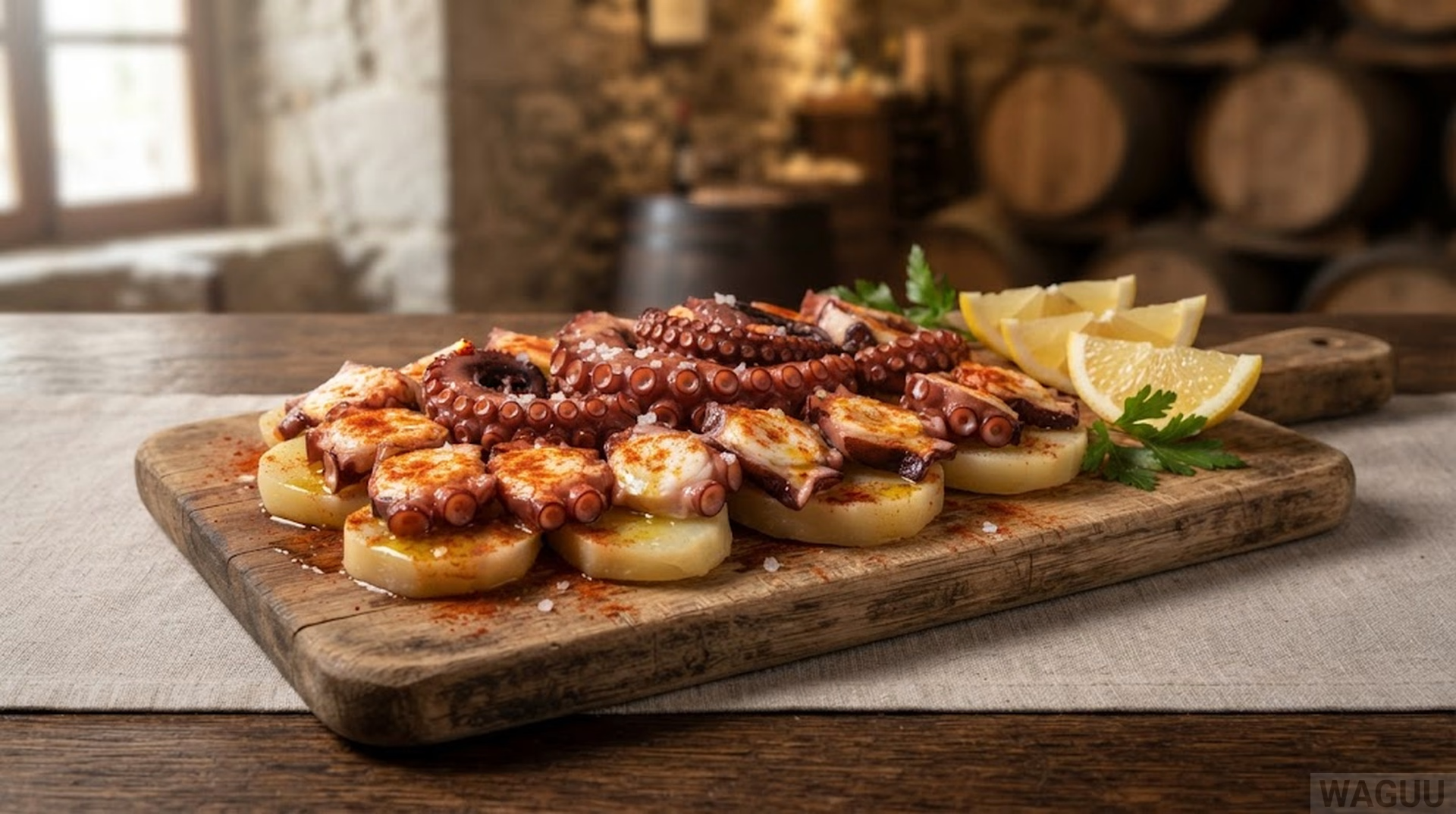
Summary: A traditional Galician dish of boiled octopus served with potatoes, olive oil, sea salt and smoked paprika. The octopus is cooked until tender and sliced over potato rounds. Ready in 1 hour 15 minutes, serves 6.
Cooked this recipe? Share your result with the community.
Category: Fish and Seafood, Spanish Cuisine
Success rate: not rated yet % of users mastered this recipe
Quick overview
- Dish: Galician Octopus
- Category: Fish and Seafood, Spanish Cuisine
- Cuisine: Spanish (Galicia)
- Main ingredient: Octopus, 3.3 lb
- Guide: 12 Most Famous Spanish Dishes
- Total time: 75 minutes (15 min prep + 60 min cooking)
- Difficulty: Medium
- Servings: 6 (portion weight: 9 oz)
- Key technique: Boiling, tenderizing
- Preparation types: Boiling
- Dietary info & allergens: Gluten-free, lactose-free. Contains mollusks.
- Suitable for: Main course, festive meal
- Nutritional values (per serving): 220 kcal, Protein: 28 g, Fat: 8 g, Carbs: 12 g
- Storage: 2 days in fridge, not suitable for freezing
- Pairing: Albariño wine, beer, sparkling water
- In short: Tender boiled octopus with potatoes and smoked paprika.
- Last updated: 25. 9. 2026
WAGUU says: “Pulpo a la Gallega is simplicity at its best – tender octopus, good olive oil and a dusting of paprika.”
Key facts
| Prep time: | 15 minutes |
| Cooking time: | 60 minutes |
| Temperature: | Boiling water |
| Servings: | 6 |
At a glance
Tender octopus slices over warm potato rounds, drizzled with olive oil and dusted with smoked paprika. A Galician classic.
Ingredients
Base servings: 6 • Portion weight: 9 oz
| Ingredient | Amount | Quality |
|---|---|---|
| Octopus | 3.3 lb | Fresh or frozen, cleaned |
| Potatoes | 1.3 lb | Waxy, peeled |
| Onion | 1 pc | Medium |
| Bay leaf | 2 pcs | Dried |
| Olive oil | 0.25 cup | Extra virgin |
| Smoked paprika | 2 tsp | Sweet or hot |
| Coarse sea salt | 1 tsp | For serving |
Why you will love this recipe
- Tender octopus: The gentle cooking method ensures a soft, non-rubbery texture.
- Simple flavors: Olive oil, paprika and salt let the octopus shine.
- Impressive: A plate of pulpo is always a centerpiece.
Why it works: The triple-dip method tenderizes the octopus by shocking the tentacles. Slow simmering breaks down the collagen, resulting in a tender texture.
Recipe overview
Prep: 15 min | Cook: 60 min | Difficulty: Medium | Servings: 6 | Type: Main | Origin: Spanish
Detailed method
Total progress: 0 % done
Phase 1: Tenderizing – 5 min
Equipment: Large pot
1. Bring a large pot of water to the boil with the onion and bay leaf. Holding the octopus by the head, dip the tentacles into the boiling water three times, then submerge completely.
VCP: The tentacles curl and the skin tightens.
Phase 2: Simmering – 45 min
Equipment: Same pot
2. Reduce the heat to a gentle simmer and cook for 40–50 minutes, until the octopus is tender. To test, insert a knife into the thickest part of a tentacle – it should slide in easily.
VCP: The octopus is tender but not falling apart.
Before you continue:
Do not boil vigorously – the octopus will become tough. Keep the water at a gentle simmer.
Phase 3: Potatoes – 20 min
Equipment: Saucepan
3. Boil the potatoes in salted water until tender. Drain and slice into 0.4 inch thick rounds.
VCP: The potatoes are soft and easily pierced with a knife.
Phase 4: Slicing – 5 min
Equipment: Knife, chopping board
4. Cut the octopus tentacles into 0.4 inch thick slices. Discard the head or use it for another dish.
VCP: The slices are uniform and show the characteristic white suckers.
Phase 5: Assembling – 3 min
Equipment: Plate
5. Arrange the potato rounds on a plate. Top with the octopus slices. Drizzle generously with olive oil and sprinkle with smoked paprika and coarse salt.
VCP: The plate is colorful, with red paprika and golden oil.
Phase 6: Serving – 2 min
Equipment: None
6. Serve immediately with crusty bread and a glass of Albariño wine.
VCP: The octopus is tender, the potatoes are warm and the oil is glistening.
Required equipment
| Utensil | Ideal size | Alternative | Risk |
|---|---|---|---|
| Large pot | 5 quart capacity | Stock pot | Octopus may not fit |
| Sharp knife | 8 inch blade | Kitchen scissors | Torn slices |
| Slotted spoon | 12 inch | Tongs | None |
Shopping list
Nutritional profile
Values per 1 serving (without side dish). Calculated from average nutritional values of ingredients.
| Nutrient | Per 100 g | Per 1 serving | Per 6 servings |
|---|---|---|---|
| Energy | 88 kcal | 220 kcal | 1320 kcal |
| Fat | 3.2 g | 8 g | 48 g |
| of which saturates | 0.6 g | 1.5 g | 9 g |
| Carbohydrates | 4.8 g | 12 g | 72 g |
| of which sugars | 1 g | 2.5 g | 15 g |
| Protein | 11.2 g | 28 g | 168 g |
| Salt | 0.6 g | 1.5 g | 9 g |
Reference intake of an average adult (8400 kJ / 2000 kcal).
WAGUU Pro level
- Pro standard: Verified recipe with precise ratios and visual control points.
- Tip 1: Freezing the octopus before cooking helps tenderize it. If using fresh, massage it with salt to relax the muscles.
- Tip 2: Cook the octopus in the water used to boil the potatoes for extra flavor.
- Tip 3: Use a good quality smoked paprika – it makes all the difference.
- Tip 4: Serve on a warm plate to keep the dish hot.
Scientific background
The collagen in octopus breaks down during slow simmering, converting to gelatin and resulting in a tender texture. The triple-dip method shocks the tentacles, helping to tenderize them further. The smoked paprika adds color and a unique smoky flavor.
Fine Dining – Professional techniques
- Plate composition: Arrange potato rounds in a circle, top with octopus slices, and drizzle with oil.
- Texture contrasts: The tender octopus contrasts with the soft potatoes.
- Temperature contrast: Serve warm, with a chilled Albariño.
- Aromatic additions: A sprinkle of smoked paprika and coarse salt.
Sensory radar
- Appearance: Pinkish-white octopus slices with bright red paprika.
- Aroma: Smoky paprika, olive oil, sea.
- Taste: Savory, slightly smoky, with a hint of sweetness from the potatoes.
- Texture: Tender, slightly chewy, with soft potatoes.
Pairing
- Wine: Albariño or a dry Riesling.
- Beer: A cold lager.
- Non-alcoholic: Sparkling water with lemon.
Different preparation variations
- Grilled octopus: After boiling, grill the tentacles for a charred flavor.
- Octopus salad: Toss with onion, pepper and vinaigrette.
Allergens and dietary information
Contains: Mollusks • Gluten: Gluten-free • Suitable for: Lactose-free, low-carb
Suitable for
Main course, festive meal, summer lunch.
Substitution catalogue
- Octopus: Squid (cook for less time).
- Smoked paprika: Sweet paprika + a pinch of cayenne.
FAQ
How do I know when the octopus is cooked?
Insert a knife into the thickest part of a tentacle – it should slide in easily. If it resists, cook for a few more minutes.
Can I use frozen octopus?
Yes, frozen octopus is often more tender because the freezing process helps break down the fibers. Thaw completely before cooking.
What do I do with the head?
The head can be used in soups, stews or rice dishes. It is edible but has a different texture.
Is pulpo a la gallega gluten-free?
Yes, it is naturally gluten-free. Serve with gluten-free bread if needed.
WAGUU Petr advises: Cooking for 6 or more?
6–8 people: Use a 4.4 lb octopus and increase the potatoes. 10+ people: Cook two smaller octopuses – they cook faster and more evenly.
Serving suggestion
Storage and reheating
Fridge: 2 days • Freezer: Not suitable • Reheating: Reheat gently in a pan with a little olive oil, or serve cold in a salad.
Author: WAGUU Petr & Team • Published: 27 Sep 2026
More Recipes from This Article
More recipes you might like
Why WAGUU?
Recipes on WAGUU are checked for accuracy of ingredients, procedures and nutritional values.
Photo gallery from the process
Community photos: Cook, take a photo and share your result.
You can upload photos in the comments below or send them by email.
Did you film a video tutorial for our recipe? Insert a link to YouTube, YouTube Shorts, TikTok, Instagram Reels, Facebook Reels, Pinterest, Vimeo or X (Twitter) in the comment – we will gladly publish it and help promote you and your content.
Most common mistakes
- Boiling vigorously: This makes the octopus tough. Keep the water at a gentle simmer.
- Not tenderizing: The triple-dip method is essential for tender tentacles.
- Overcooking: Check the octopus regularly – it can become mushy if cooked too long.
- Undercooking: If it’s chewy, it needs more time. Return to the pot and simmer longer.