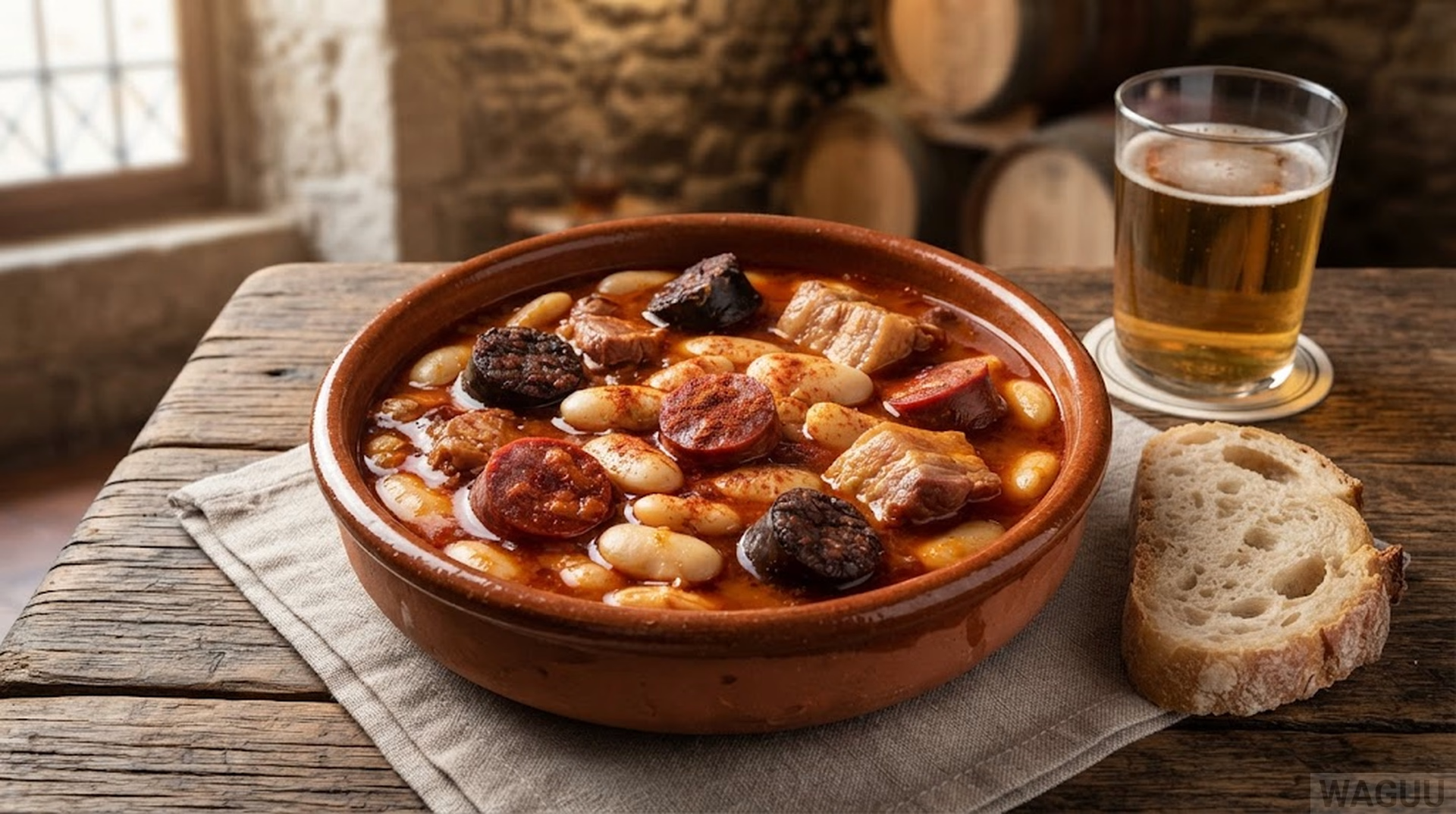
Summary: A rich, hearty stew from Asturias made with large white beans, chorizo, morcilla, pork belly and paprika. Slow-cooked until the beans are creamy and the broth is thick. Ready in 2 hours 30 minutes, serves 6.
Cooked this recipe? Share your result with the community.
Category: Soups, Spanish Cuisine
Success rate: not rated yet % of users mastered this recipe
Quick overview
- Dish: Asturian Bean Stew
- Category: Soups, Spanish Cuisine
- Cuisine: Spanish (Asturias)
- Main ingredient: Large white beans, 1.1 lb
- Guide: 12 Most Famous Spanish Dishes
- Total time: 150 minutes (30 min prep + 120 min cooking)
- Difficulty: Medium
- Servings: 6 (portion weight: 14 oz)
- Key technique: Slow simmering
- Preparation types: Stewing
- Dietary info & allergens: Gluten-free, lactose-free. Contains pork.
- Suitable for: Winter lunch, main course, family meal
- Nutritional values (per serving): 520 kcal, Protein: 28 g, Fat: 22 g, Carbs: 48 g
- Storage: 3 days in fridge, 2 months in freezer
- Pairing: Cider, red wine, crusty bread
- In short: Hearty bean stew with chorizo, morcilla and pork.
- Last updated: 25. 9. 2026
WAGUU says: “Fabada is a hug in a bowl – rich, warming and deeply satisfying.”
Key facts
| Prep time: | 30 minutes |
| Cooking time: | 120 minutes |
| Temperature: | Gentle simmer |
| Servings: | 6 |
At a glance
A hearty Asturian stew with creamy white beans, spicy chorizo and rich morcilla. Perfect for cold days.
Ingredients
Base servings: 6 • Portion weight: 14 oz
| Ingredient | Amount | Quality |
|---|---|---|
| Large white beans (fabes) | 1.1 lb | Dried, soaked overnight |
| Chorizo | 7 oz | Spanish, cured |
| Morcilla | 7 oz | Spanish blood sausage |
| Pork belly | 7 oz | Cubed |
| Onion | 1 pc | Medium |
| Garlic | 3 cloves | Fresh |
| Smoked paprika | 2 tsp | Sweet or hot |
| Olive oil | 0.25 cup | Extra virgin |
| Bay leaf | 2 pcs | Dried |
| Salt | 1 tsp | Fine sea salt |
Why you will love this recipe
- Hearty and warming: Perfect for cold winter days.
- Deep flavor: The chorizo, morcilla and paprika create a rich, smoky broth.
- Freezes well: Make a big batch and freeze for later.
Why it works: Soaking the beans overnight ensures they cook evenly. Gentle simmering allows the beans to absorb the flavors of the meats and spices without breaking apart.
Recipe overview
Prep: 30 min | Cook: 120 min | Difficulty: Medium | Servings: 6 | Type: Main | Origin: Spanish
Detailed method
Total progress: 0 % done
Phase 1: Sofrito – 10 min
Equipment: Large pot
1. Heat the olive oil in a large pot. Sauté the onion and garlic until soft. Add the paprika and cook for 1 minute.
VCP: The onions are translucent and the paprika is fragrant.
Phase 2: Adding beans and meat – 10 min
Equipment: Same pot
2. Add the soaked beans, chorizo, morcilla, pork belly and bay leaves. Cover with cold water by about 2 inches. Bring to a boil, then reduce the heat.
VCP: The water covers all ingredients.
Before you continue:
Never add salt at this stage – it toughens the beans. Salt only at the end.
Phase 3: Simmering – 90 min
Equipment: Same pot
3. Simmer gently for 1.5 to 2 hours, until the beans are tender and the broth is thick. Add a little hot water if needed.
VCP: The beans are soft and creamy, and the broth is rich and flavorful.
Phase 4: Seasoning – 5 min
Equipment: None
4. Remove the bay leaves. Taste and season with salt. Let rest for 10 minutes before serving.
VCP: The stew is well seasoned and aromatic.
Phase 5: Serving – 3 min
Equipment: Bowls
5. Ladle into warm bowls, making sure each serving gets some chorizo, morcilla and pork.
VCP: The bowls are steaming and full of color.
Phase 6: Accompaniments – 2 min
Equipment: None
6. Serve with crusty bread and a glass of dry cider.
VCP: The bread is perfect for soaking up the broth.
Required equipment
| Utensil | Ideal size | Alternative | Risk |
|---|---|---|---|
| Large pot | 5 quart capacity | Dutch oven | Beans may stick |
| Wooden spoon | 12 inch | Silicone spatula | None |
| Ladle | 4 oz | Measuring cup | None |
Shopping list
Nutritional profile
Values per 1 serving (without side dish). Calculated from average nutritional values of ingredients.
| Nutrient | Per 100 g | Per 1 serving | Per 6 servings |
|---|---|---|---|
| Energy | 130 kcal | 520 kcal | 3120 kcal |
| Fat | 5.5 g | 22 g | 132 g |
| of which saturates | 2 g | 8 g | 48 g |
| Carbohydrates | 12 g | 48 g | 288 g |
| of which sugars | 1 g | 4 g | 24 g |
| Protein | 7 g | 28 g | 168 g |
| Salt | 0.5 g | 2 g | 12 g |
Reference intake of an average adult (8400 kJ / 2000 kcal).
WAGUU Pro level
- Pro standard: Verified recipe with precise ratios and visual control points.
- Tip 1: Use fabes de la Granja, a traditional Asturian bean, if you can find them.
- Tip 2: Add a piece of panceta (cured pork belly) for extra depth.
- Tip 3: The stew tastes even better the next day – reheat gently.
- Tip 4: Serve with a drizzle of olive oil and a sprinkle of smoked paprika.
Scientific background
Soaking the beans rehydrates them and reduces cooking time. Gentle simmering allows the starch to gelatinize, creating a creamy texture. The collagen from the pork belly and chorizo breaks down into gelatin, thickening the broth. The paprika adds color and flavor through its carotenoid pigments and volatile oils.
Fine Dining – Professional techniques
- Plate composition: Serve in a deep bowl with the meats arranged on top and a drizzle of olive oil.
- Texture contrasts: The creamy beans contrast with the firm chorizo and morcilla.
- Temperature contrast: Serve hot, with a glass of chilled cider.
- Aromatic additions: A sprinkle of fresh parsley or a pinch of smoked paprika.
Sensory radar
- Appearance: Creamy white beans in a rich red broth with chunks of sausage.
- Aroma: Smoked paprika, garlic, cured meat.
- Taste: Savory, smoky, slightly spicy from the chorizo.
- Texture: Creamy beans, tender meat, thick broth.
Pairing
- Wine: A robust red Rioja or Ribera del Duero.
- Beer: A dark beer or stout.
- Non-alcoholic: Dry apple cider or sparkling water.
Different preparation variations
- With clams: Add a handful of clams in the last 10 minutes.
- Vegetarian: Omit the meat and use vegetable stock with smoked paprika.
Allergens and dietary information
Contains: None of the main allergens • Gluten: Gluten-free • Not suitable for: Vegetarians, vegans
Suitable for
Winter lunch, main course, family meal, festive menu.
Substitution catalogue
- Morcilla: Black pudding or omit.
- Chorizo: Any smoked paprika sausage.
FAQ
Can I use canned beans?
Yes, but reduce the cooking time to 30 minutes and add the beans after the meat has cooked for an hour.
Why are my beans still hard?
Old beans take longer to cook. Soak them overnight and simmer gently. If they are still hard after 2 hours, they may be too old.
Can I freeze fabada?
Yes, it freezes well for up to 2 months. Thaw overnight in the fridge and reheat gently.
Is fabada spicy?
It has a mild heat from the chorizo. Use sweet chorizo if you prefer it milder.
WAGUU Petr advises: Cooking for 6 or more?
6–8 people: Double the recipe – it tastes even better the next day. 10+ people: Cook in two pots to avoid overcrowding.
Serving suggestion
Storage and reheating
Fridge: 3 days • Freezer: 2 months • Reheating: Reheat gently on the stove, adding a splash of water if needed.
Author: WAGUU Petr & Team • Published: 27 Sep 2026
More Recipes from This Article
More recipes you might like
Why WAGUU?
Recipes on WAGUU are checked for accuracy of ingredients, procedures and nutritional values.
Photo gallery from the process
Community photos: Cook, take a photo and share your result.
You can upload photos in the comments below or send them by email.
Did you film a video tutorial for our recipe? Insert a link to YouTube, YouTube Shorts, TikTok, Instagram Reels, Facebook Reels, Pinterest, Vimeo or X (Twitter) in the comment – we will gladly publish it and help promote you and your content.
Most common mistakes
- Adding salt too early: Salt toughens the beans. Add it only at the end.
- Boiling vigorously: The beans will break apart. Keep the heat low.
- Not soaking the beans: Soaking is essential for even cooking.
- Using old beans: Old beans take much longer to cook and may never soften properly.