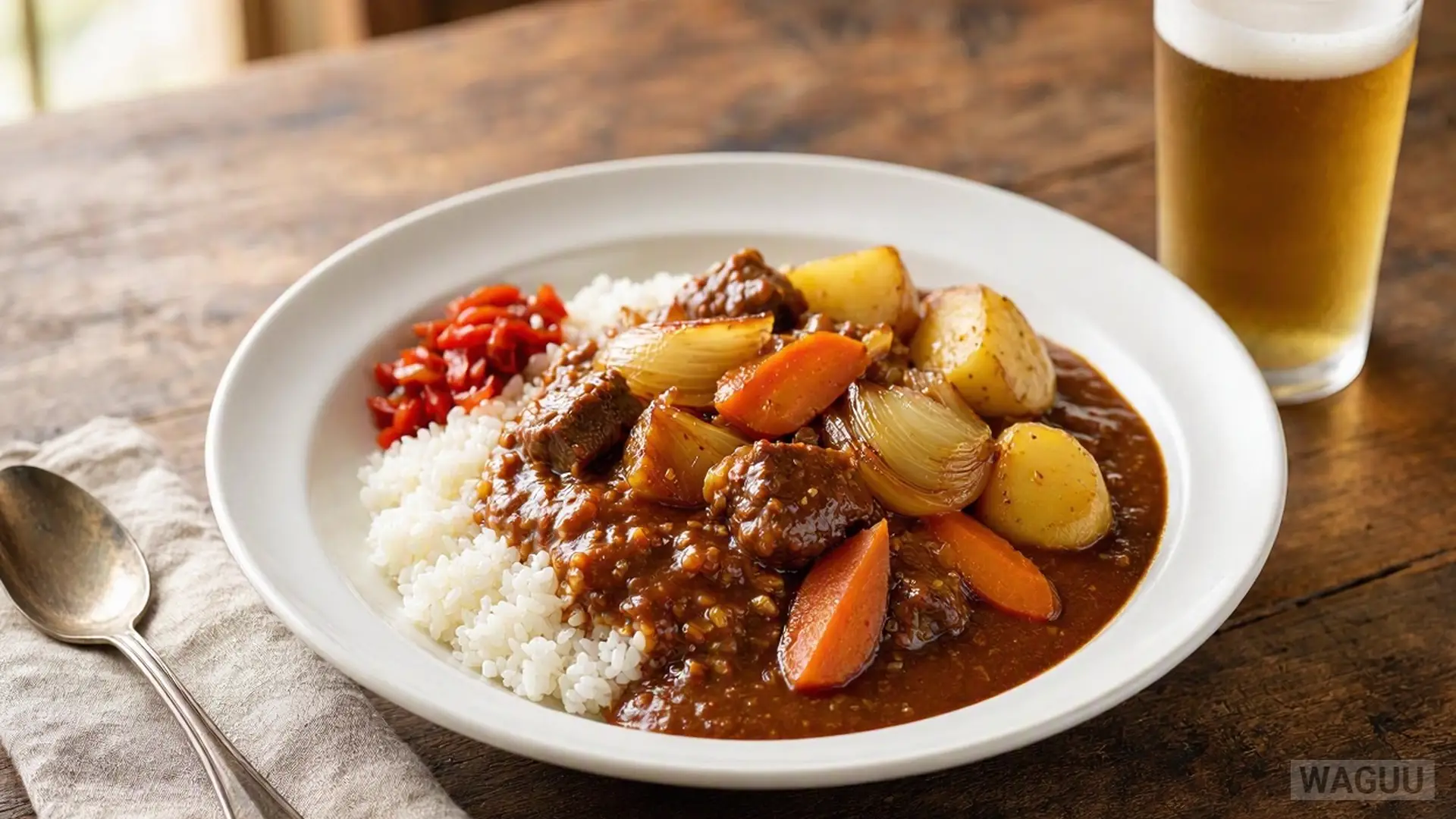
Summary: Kare Raisu is the ultimate Japanese comfort food—a rich, aromatic Japanese curry featuring tender cubes of beef, sweet caramelized onions, crisp carrots, and velvety potatoes simmered in a thick, savory gravy balanced with sweet apple and umami-rich sauces. Prepared via classic braising and thickened with curry roux, this dish takes 75 minutes from prep to table and yields 6 hearty servings served alongside warm white rice.
Did you make this recipe? Share the result with the community.
Category: Main Dishes, Japanese Cuisine
Success rate: 98% of users successfully made this recipe
Quick overview
- Dish: Kare Raisu – Japanese Curry with Meat and Vegetables
- Category: Main Dishes, Japanese Cuisine
- Cuisine: Japanese (Yoshoku style)
- Main ingredient: Boneless beef chuck roast, 1.5 lbs (well-marbled, cut into 1-inch cubes)
- Guide: 12 Most Popular Japanese Dishes: Favorite Recipes of Japanese Cuisine
- Total time: 75 minutes (25 min prep + 50 min cooking)
- Difficulty: Intermediate
- Servings: 6 servings (Serving weight: 13.4 oz / 380 g curry per portion without rice)
- Key technique: Browning, onion caramelization, braising, roux emulsification
- Preparation types: Stovetop braising, simmering
- Dietary info & Allergens: Contains Soy, Wheat, Gluten, Celery
- Suitable for: Family dinners, meal prep, winter comfort food meals
- Nutritional values (per 1 serving): 480 kcal, Protein: 32 g, Fat: 22 g, Carbs: 38 g
- Storage: 4 days in the fridge, 3 months in the freezer
- Pairing: Asahi Super Dry beer, Pinot Noir, Iced Green Tea (Sencha)
- In a nutshell: Rich Japanese curry braised with tender beef, sweet onions, carrots, and potatoes in a thick, mildly spiced gravy.
- Last updated: October 24, 2023
WAGUU says: “The secret to an unforgettable Japanese curry lies in deep, slow caramelization of the onions and adding a touch of grated fresh Fuji apple. This creates that characteristic sweet-and-savory depth that sets Kare Raisu apart from all other world curries.”
Key facts
| Prep time: | 25 minutes |
| Cooking time: | 50 minutes |
| Temperature: | Medium-high heat for searing (375 °F), gentle simmer (200 °F) |
| Number of servings: | 6 servings |
In a nutshell
Sink your spoon into a steaming bowl of Kare Raisu—a beloved Japanese classic featuring melt-in-your-mouth beef, velvety potatoes, and sweet carrots cloaked in a glossy, deeply aromatic curry sauce. Less spicy and significantly sweeter than Indian or Thai curries, this Japanese comfort food harmonizes rich umami with gentle warm spices, perfect for pouring over a bed of warm, fluffy short-grain white rice.
Ingredients
Base servings: 6 servings • Serving weight: 13.4 oz (380 g) per portion
| Ingredient | Quantity | Quality |
|---|---|---|
| Beef chuck roast (boneless) | 1.5 lbs | USDA Choice, trimmed and cubed into 1-inch pieces |
| Yellow onions | 3 large | Fresh, thinly sliced against the grain (approx. 1.5 lbs) |
| Carrots | 3 medium | Peeled, cut into bite-sized rangiri (wedge cuts) |
| Yukon Gold potatoes | 3 medium | Peeled, cut into 1.5-inch large chunks |
| Garlic | 4 cloves | Fresh, finely minced |
| Fresh ginger | 1 tbsp | Finely grated |
| Vegetable oil | 2 tbsp | High smoke point neutral cooking oil |
| Beef broth | 4 cups | Low-sodium unsalted stock (32 fl oz) |
| Water | 1 cup | Filtered water (8 fl oz) |
| Japanese curry roux blocks | 3.5 oz | Commercial roux (S&B Golden Curry or Vermont Curry) or homemade curry roux |
| Soy sauce | 1 tbsp | Japanese Shoyu (Kikkoman brand) |
| Tonkatsu sauce (or Worcestershire sauce) | 1 tbsp | Bull-Dog brand Tonkatsu sauce |
| Fuji apple | ½ piece | Fresh, peeled and finely grated on a microplane |
| Fine sea salt | 1 tsp | Divided use (½ tsp for beef seasoning, ½ tsp for final adjustment) |
| Black pepper | ½ tsp | Freshly ground |
| Cooked Japanese short-grain rice | 6 cups | Warm, cooked Koshihikari rice (for serving garnish, non-recipe side dish) |
| Fukujinzuke (Japanese red pickles) | ¼ cup | Traditional relish for serving side garnish |
Why you’ll love this recipe
- Deep Flavor Profile: The addition of caramelized onions combined with grated apple and savory Tonkatsu sauce creates an exceptional sweet-umami balance.
- Melt-in-Your-Mouth Beef: Braising beef chuck roast over medium-low heat transforms tough muscle fibers into tender, juicy morsels.
- Meal-Prep Perfection: Japanese curry actually tastes significantly better the next day as the spices integrate and mature in the refrigerator.
Success guaranteed: By turning off the heat before dissolving the curry roux blocks, you prevent lump formation and secure a silky, glossy emulsified sauce every single time.
Recipe overview
Prep: 25 min | Cooking: 50 min | Difficulty: Intermediate | Servings: 6 | Type: Main Dish | Origin: Japan
Detailed instructions
Overall progress: 0% completed
Phase 1: Prep & Beef Searing – 15 min
Appliances: Dutch oven or heavy stockpot (5.5 quart), stovetop burner
1. Pat 1.5 lbs of boneless beef chuck roast thoroughly dry with paper towels to ensure optimal crust formation. Cut beef into uniform 1-inch cubes. Season evenly with ½ tsp fine sea salt and ½ tsp freshly ground black pepper. Heat 1 tbsp vegetable oil in a large heavy-bottom Dutch oven over medium-high heat (approx. 375 °F) for 2 minutes until shimmering. Add beef cubes in a single layer (work in two batches if necessary to avoid crowding). Sear undisturbed for 3–4 minutes until a dark brown caramelized crust forms on the bottom. Flip and brown the remaining sides for another 3 minutes. Transfer seared beef cubes and accumulated juices to a clean plate and set aside.
CP: Beef cubes should be deeply browned on all sides with clear fond stuck to the bottom of the Dutch oven. Internal meat temperature isn’t critical at this browning stage, but surface browning must be rich and aromatic.
Before moving to the next step:
Do not overcrowd the pan during searing. Overcrowding drops the vessel temperature drastically, causing meat to steam in its juices rather than browning through the Maillard reaction.
Phase 2: Onion Caramelization & Aromatics – 15 min
Appliances: Stovetop burner, wooden spatula
2. Lower heat under the Dutch oven to medium. Add remaining 1 tbsp vegetable oil to the remaining beef fat in the pot. Add 3 large thinly sliced yellow onions. Cook for 12 minutes, stirring frequently with a flat wooden spatula while scraping up the browned beef bits (fond) from the pot bottom. The onions will soften, release moisture, shrink significantly, and gradually turn a golden amber color. Add 4 minced garlic cloves and 1 tbsp finely grated fresh ginger. Cook stirring constantly for an additional 2 minutes until highly fragrant and sweet.
CP: Onions should be deeply translucent, soft, reduced by two-thirds in volume, and caramelized to a rich golden brown without any black burnt edges.
Before moving to the next step:
Ensure garlic and ginger do not burn. Stir continuously during the final 2 minutes of aromatics cook time to preserve clean, bright flavor notes.
Phase 3: Simmering Meat and Vegetables – 25 min
Appliances: Stovetop burner
3. Return seared beef and reserved juices to the pot with the caramelized onions. Add 3 medium carrots cut into rangiri pieces, 4 cups beef broth, and 1 cup water. Bring to a rolling boil over high heat (212 °F). Using a fine mesh skimmer or spoon, skim off any foam or excess floating fat from the surface. Reduce heat to medium-low, partially cover pot with lid, and gentle simmer for 15 minutes. Add 3 medium Yukon Gold potatoes (cut into 1.5-inch chunks) and ½ grated Fuji apple. Stir gently, partially cover again, and simmer for another 10 minutes until beef and potatoes are fork-tender.
CP: Potatoes should yield easily to a paring knife without disintegrating, beef cubes should be supple and tender, and liquid should be reduced slightly.
Before moving to the next step:
Do not add potatoes at the beginning of braising. Cooking potatoes for the full 25 minutes will cause them to break apart completely and turn the curry stock cloudy and overly starchy.
Phase 4: Adding Curry Roux & Thickening – 10 min
Appliances: Stovetop burner, ladle, whisk
4. TURN OFF THE HEAT COMPLETELY. Break 3.5 oz Japanese curry roux blocks into individual pre-scored squares. Place roux blocks into a large ladle, dip ladle into hot broth, and stir with a small whisk or chopstick to dissolve roux completely before releasing into pot. Alternatively, add roux pieces directly into pot and stir continuously for 3 minutes until all roux is thoroughly dissolved with zero lumps. Turn heat back to low and simmer gently uncovered for 7 minutes, stirring frequently along pot bottom to prevent scorching as sauce thickens into a glossy, velvety gravy.
CP: The curry sauce should coat the back of a wooden spoon smoothly (nappe consistency) without any visible flour granules or undissolved curry paste fragments.
Before moving to the next step:
Always turn off heat prior to adding curry roux blocks. Dropping roux directly into actively boiling broth cooks starches prematurely, resulting in stubborn, gummy roux lumps.
Phase 5: Flavor Balancing & Seasoning – 5 min
Appliances: Stovetop burner
5. Stir 1 tbsp Japanese soy sauce and 1 tbsp Tonkatsu sauce (or Worcestershire sauce) into the thickened curry sauce. Taste sauce carefully. If extra saltiness is required depending on your broth brand, stir in remaining ½ tsp fine sea salt. Keep pot over low heat for 2 minutes to allow seasoning to harmonize with sauce. Remove pot from heat source.
CP: Curry flavor is balanced—harmonious combination of savory umami, mild aromatic spice warmth, and gentle fruit sweetness.
Before moving to the next step:
Taste test before adding extra salt. Commercial Japanese curry roux blocks already contain sodium; adding additional seasoning without tasting can over-salt the dish.
Phase 6: Resting, Plating & Serving – 5 min
Appliances: None
6. Let curry rest uncovered in Dutch oven for 5 minutes off heat so flavors consolidate and sauce achieves optimum serving viscosity. To serve, ladle warm, cooked Japanese short-grain white rice onto one side of wide, shallow serving bowls (approx. 1 cup cooked rice per portion). Ladle generous portion of curry meat, potatoes, carrots, and thick sauce on opposite side, slightly overlapping edge of rice mound. Place 1 tbsp Fukujinzuke red pickles on border between rice and curry. Serve immediately while piping hot.
CP: Beautiful half-and-half bowl presentation where glossy curry gravy stays distinct yet gently meets pristine white rice, garnished with crisp red pickles.
Required equipment
| Utensil | Ideal size | Alternative | Risk |
|---|---|---|---|
| Enameled Cast Iron Dutch Oven | 5.5 Quart capacity | Heavy-bottom stainless steel stockpot | Thin pot bottoms create hot spots that scorch thick curry roux quickly. |
| Chef’s Knife & Cutting Board | 8-inch Chef knife | Santoku knife | Dull blades crush onion fibers causing tearing and uneven browning. |
| Flat Wooden Spatula / Ladle | 12-inch spatulas | Heat-resistant silicone spatula | Metal utensils may scratch enameled pot linings while scraping fond. |
Shopping list
Nutrition profile
Values per 1 serving (380 g / 13.4 oz of curry dish, excluding white rice side dish). Calculated from average ingredient nutrition values.
| Nutrient | Per 100 g | Per 1 serving | Per 6 servings |
|---|---|---|---|
| Energy | 126.3 kcal | 480.0 kcal | 2880.0 kcal |
| Fat | 5.8 g | 22.0 g | 132.0 g |
| of which saturates | 2.1 g | 8.0 g | 48.0 g |
| Carbohydrates | 10.0 g | 38.0 g | 228.0 g |
| of which sugars | 2.9 g | 11.0 g | 66.0 g |
| Protein | 8.4 g | 32.0 g | 192.0 g |
| Salt | 1.0 g | 3.8 g | 22.8 g |
Reference intake of an average adult (8400 kJ / 2000 kcal).
WAGUU Pro level
- Pro standard: Verified recipe with precise ratios and visual checkpoints.
- Tip 1: Rangiri Cutting Method: Cut carrots using the traditional Japanese rangiri rotational technique. Rotate the carrot 90 degrees after every diagonal slice. This maximizes surface area for even cooking and optimal sauce adhesion.
- Tip 2: Onion Patience: Slice onions thinly against the grain to break plant cell walls. Take the full 12 to 15 minutes to brown them. High onion natural sugar content provides the baseline sweetness essential to Japanese curry.
- Tip 3: The Heat Off Rule: Never dissolve roux blocks into boiling liquid. Starches gelatinize rapidly around 180–190 °F; boiling temperatures seal roux blocks on the exterior, leaving hard raw centers. Turn off heat completely first.
- Tip 4: Next-Day Maturity: Like stew, Japanese curry’s flavor profile matures substantially after resting overnight in the refrigerator as volatile spice aromatics meld with beef proteins.
Scientific background
The luxurious texture of Japanese curry relies on starch gelatinization and fat emulsification. Commercial curry roux blocks consist of wheat flour browned in fat (butter or palm oil), combined with ground spices, salt, and flavor enhancers. When added to warm liquid (175–190 °F), starch granules absorb water and swell. Once heated again to a gentle simmer, gelatinization breaks starch amylose chains, building a viscous, stable suspension that coats ingredients smoothly. Furthermore, slowly caramelizing onions converts complex carbohydrates into sweet fructose and glucose while forming aromatic Maillard reaction compounds that counteract spice bitterness.
Fine Dining – Professional techniques
- Plate composition: Utilize a wide, low-brimmed ceramic bowl. Mold warm Japanese short-grain white rice using a crescent ring mold on one side of the plate. Spoon the curry neatly on the remaining half, keeping the top surface of meat and carrots glistening without drowning the white rice rim.
- Texture contrasts: Pair the silky, tender simmered meat and soft potatoes with crunchy red Fukujinzuke pickles or house-pickled radish (Rakkyo) to refresh the palate between bites.
- Temperature contrast: Serve curry scorching hot (around 170 °F) against warm, freshly steamed white rice (150 °F) and chilled, crisp pickled vegetables (45 °F).
- Aromatic garnishes: Garnish with a subtle drizzle of toasted sesame oil, micro-greens, or a tiny pinch of Shichimi Togarashi (Japanese seven spice) along the ridge of the curry sauce.
Sensory radar
- Appearance: Deep mahogany brown glossy sauce featuring visible chunks of tender reddish-brown beef, vibrant orange carrots, and creamy yellow potatoes side by side with pristine white rice.
- Aroma: Warm sweet curry spice notes (cardamom, cumin, clove, cinnamon) layered over savory roasted beef broth, rich caramelized onions, and subtle garlic-ginger undertones.
- Taste: A complex balance of savory umami, mild warming spice, natural onion-apple sweetness, and a pleasant tangy finish from soy and Tonkatsu sauce.
- Texture: Thick, velvety sauce consistency enveloping fork-tender beef chuck, soft creamy potatoes, and slightly firm carrots, contrasted against chewy, sticky rice grains.
Pairing
- BEER: Crisp Japanese Rice Lagers (Asahi Super Dry, Sapporo Premium). The sharp carbonation and clean, dry finish cut through the rich curry roux fat effortless.
- WINE: Medium-bodied, fruity red wines with low tannins like Pinot Noir or Gamay (Beaujolais). Alternatively, an off-dry Riesling complements the gentle spice and apple sweetness wonderfully.
- NON-ALCOHOLIC: Unsweetened Japanese Iced Green Tea (Sencha or Genmaicha) or a cold glass of Calpis milk drink to refresh the palate.
Various preparation methods
- Chicken or Pork Kare Raisu (Katsu Curry Variant): Replace beef chuck with pork shoulder cutlets or chicken thighs. Alternatively, serve plain curry sauce over crispy deep-fried pork cutlets (Tonkatsu) to make Katsu Curry.
- Seafood Curry (Kaisan Kare): Omit beef and braise carrots and onions in dashi broth. Add shrimp, squid rings, and sea scallops during the final 5 minutes of cooking so seafood stays tender.
Allergens and dietary information
Contains: Soy, Wheat, Gluten, Celery (in stock base) • Gluten: Contains gluten from wheat flour used in commercial curry roux blocks and soy sauce. Use certified gluten-free curry roux and tamari for a gluten-free adaptation. • Not suitable for: Celiac disease sufferers (unless gluten-free roux is substituted) or low-carb/keto diets due to potato and flour content.
Suitable for
Ideal for cozy family dinners, batch meal prep, feeding hungry crowds, and introducing children or spice-sensitive diners to Asian curry styles due to its mild heat level.
Substitution guide
- Beef chuck roast: Can be substituted with pork shoulder, boneless skinless chicken thighs, or extra mushrooms and kabocha squash for a vegetarian option.
- Japanese curry roux blocks: Substitute with homemade curry roux (3 tbsp butter, 3 tbsp flour, 1 tbsp S&B curry powder, ½ tsp garam masala cooked into a brown roux).
- Tonkatsu sauce: Substitute with Worcestershire sauce blended with a touch of ketchup and brown sugar.
- Yukon Gold potatoes: Russet potatoes work as an alternative, though Yukon Golds hold their shape better during simmering.
FAQ
Why is my Japanese curry sauce too thin and runny?
If your curry sauce turns out thin, you either used too much stock/water or did not allow the sauce to simmer uncovered after adding the curry roux. Let the curry simmer gently uncovered over low heat for 5–10 minutes while stirring continuously. If still too thin, dissolve an additional block of curry roux or stir in a cornstarch slurry (1 tbsp cornstarch dissolved in 2 tbsp cold water).
Can I make Japanese curry roux from scratch?
Yes, making homemade Japanese curry roux is easy. Melt 3 tbsp unsalted butter in a saucepan over medium heat, whisk in 3 tbsp all-purpose flour, and cook for 15–20 minutes stirring constantly until roux turns dark golden brown. Whisk in 1 tbsp Japanese curry powder (S&B brand), ½ tsp garam masala, and ½ tsp cayenne pepper. Cook 1 minute until fragrant, then let cool and use in place of commercial blocks.
Why did my potatoes break down into small pieces?
Potatoes break down if cut into pieces that are too small or added too early during the beef braising process. Cut Yukon Gold potatoes into large 1.5-inch chunks and add them during the final 10–12 minutes of simmering before adding the roux. Waxy potatoes like Yukon Gold hold their structural shape far better than starchy Russet potatoes.
Is Japanese curry supposed to be spicy?
Traditionally, Japanese curry is significantly milder and sweeter than Indian or Southeast Asian curries. Commercial curry roux blocks come labeled as Mild (Amakuchi), Medium Hot (Chukara), or Hot (Karaguchi). Even “Hot” Japanese curry is relatively mild compared to spicy Thai or Indian dishes, emphasizing warmth and savory comfort over burning chilies.
WAGUU Petr advises: Cooking for 12 or more people?
12–16 people: When scaling up to double batch (12 servings), double all ingredients linearly except the stock—reduce stock volume by 15% (use 7 cups broth instead of 8) as large batches retain steam moisture longer. Use an 8-to-10 quart Dutch oven. • 20+ people: For massive crowds (20+ portions), sear beef in 3 separate batches to ensure high heat browning. Caramelize onions in a wide separate skillet before adding to the main stockpot. Simmer curry roux carefully while stirring constantly with a long wooden paddle to ensure roux does not stick to the bottom.
Sides and serving
- Steamed Japanese Short-Grain Rice (Koshihikari) – Warm, glossy, sticky rice that absorbs thick curry sauce perfectly (not included in the recipe).
- Fukujinzuke or Rakkyo Pickles – Crisp Japanese sweet-and-savory pickled relish that cleanses the palate (not included in the recipe).
Serving: Serve in shallow, broad bowls. Place rice on one half and curry gravy on the other. Eat using a tablespoon rather than chopsticks for an authentic Japanese diner experience.
Storage and reheating
Fridge: Store cooled leftover curry in airtight containers for up to 4 days in the refrigerator. • Freezer: Freeze in freezer-safe containers for up to 3 months. Note: Potatoes can become slightly grainy upon thawing; remove potato pieces before freezing if texture sensitivity is a concern. • Reheating: Reheat gently in a saucepan over medium-low heat with 2–3 tbsp of added water or beef broth to restore original sauce consistency.
Author: WAGUU Culinary Team | Published date: October 24, 2023
More Recipes in This Article
Other recipes you might enjoy
Why WAGUU?
Recipes on WAGUU undergo rigorous testing for ingredient accuracy, step-by-step technological procedures, core temperatures, and exact nutritional calculations.
Process photo gallery
Community photos: Cook, take a picture, and share your results.
You can upload photos in the comments below or send them via email.
Did you record a video of your process for our recipe? Paste a link to YouTube, YouTube Shorts, TikTok, Instagram Reels, Facebook Reels, Pinterest, Vimeo, or X (Twitter) in the comments – we’d love to share it and help give you and your content more visibility.
Common mistakes
- Boiling liquid when adding roux – Adding commercial curry roux blocks directly to boiling stock causes starches to gelatinize unevenly, creating stubborn floury lumps. Always remove pot from heat source before stirring in roux blocks.
- Rushing onion caramelization – Skipping proper onion browning leaves the curry flat and excessively savory. High heat turns onions bitter; cook them slowly over medium heat for at least 12–15 minutes until amber.
- Adding potatoes too early – Adding potatoes alongside carrots at the start of braising turns potatoes mushy and degrades curry sauce texture. Add potatoes during the last 10 minutes of simmering.
- Overcrowding beef while searing – Crowding cold beef cubes lowers pan temperature, causing meat to release juices and steam instead of browning. Sear beef chuck in multiple batches for maximum flavor.