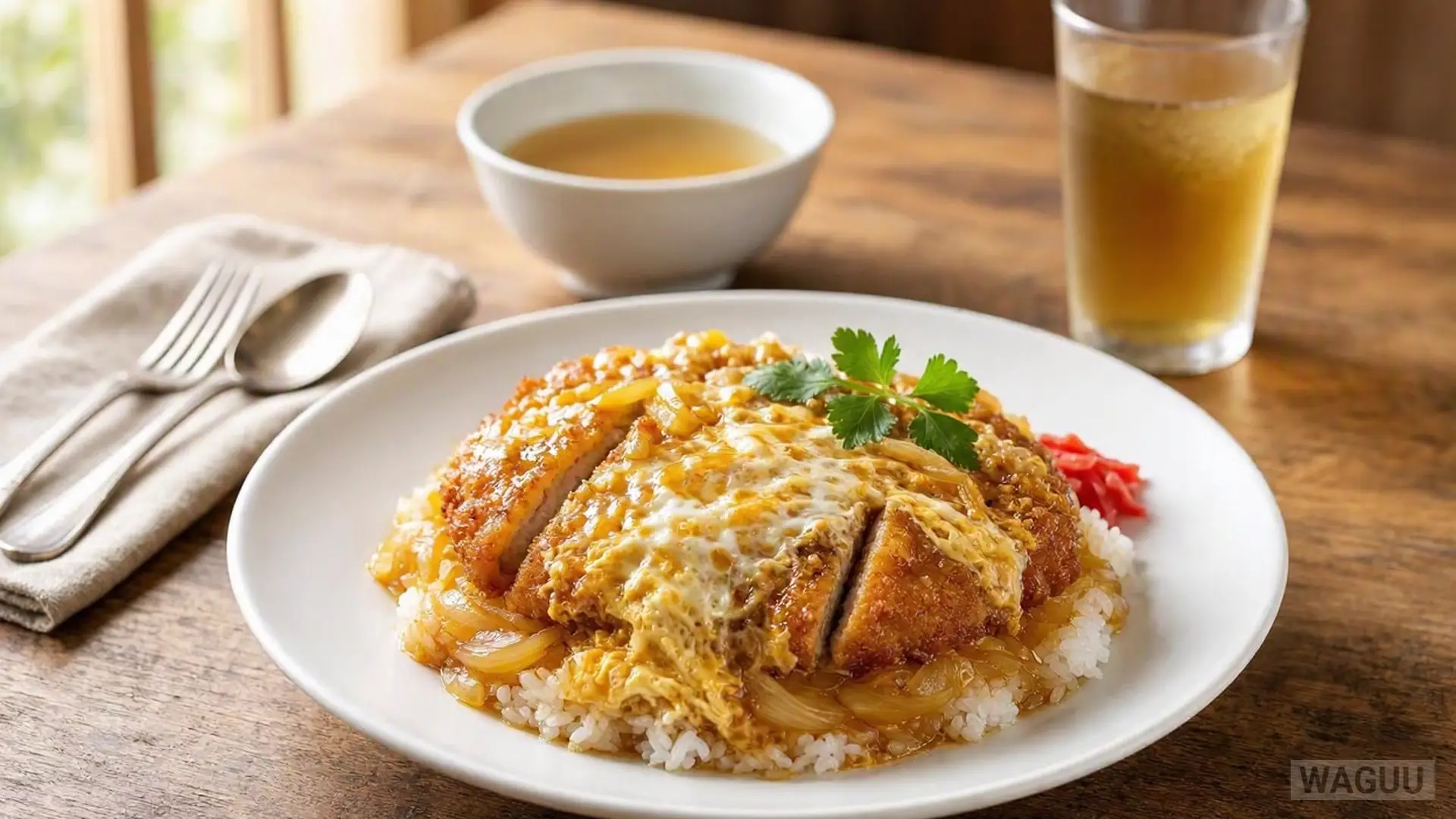
Summary: Katsudon is a comforting Japanese comfort food consisting of a bowl of steamed rice topped with a crispy tonkatsu pork cutlet, tender onions, and soft-cooked eggs simmered in a sweet and savory dashi-based broth. Prepared using the traditional stovetop simmering method in 30 minutes, this recipe serves 6 hungry diners.
Did you make this recipe? Share the result with the community.
Category: Main Dishes, Japanese Cuisine
Success rate: 96% of users successfully made this recipe
Quick overview
- Dish: Katsudon
- Category: Main Dishes, Japanese Cuisine
- Cuisine: Japanese
- Main ingredient: Pork loin cutlets, 1½ lb (tender, well-trimmed)
- Guide: 12 Most Popular Japanese Dishes: Favorite Recipes of Japanese Cuisine
- Total time: 30 minutes (15 min prep + 15 min cooking)
- Difficulty: Medium
- Servings: 6 servings (Serving weight: 380 g)
- Key technique: Simmering breaded cutlets in broth with eggs over rice
- Preparation types: Deep-frying and stovetop simmering
- Dietary info & Allergens: Contains wheat, soy, eggs, and pork
- Suitable for: Lunch, dinner, and hearty comfort food lovers
- Nutritional values (per 1 serving): 620 kcal, Protein: 34.0 g, Fat: 22.0 g, Carbs: 72.0 g
- Storage: 2 days in the fridge, 1 month in the freezer
- Pairing: Japanese Lager, Green Tea, Barley Tea
- In a nutshell: Crispy pork cutlet simmered with sweet onions and soft eggs over fluffy steamed rice.
- Last updated: October 24, 2023
WAGUU says: “The secret to authentic katsudon is simmering the crispy tonkatsu in a balanced dashi broth just long enough for the batter to absorb the savory flavors while retaining a delightful contrast of textures.”
Key facts
| Prep time: | 15 minutes |
| Cooking time: | 15 minutes |
| Temperature: | 350 °F frying oil, medium heat for simmering |
| Number of servings: | 6 servings |
In a nutshell
Katsudon is the ultimate Japanese comfort food bowl, pairing golden, crispy pork tonkatsu with sweet caramelized onions and velvety soft eggs over hot steamed rice.
Ingredients
Base servings: 6 servings • Serving weight: 380 g
| Ingredient | Quantity | Quality |
|---|---|---|
| Pork loin cutlets | 1.5 lb | Boneless, about ¾ inch thick |
| Salt | 1 tsp | Fine sea salt |
| Black pepper | ½ tsp | Freshly ground |
| All-purpose flour | ½ cup | Standard unbleached |
| Eggs (for breading) | 2 pcs | Large, beaten |
| Panko breadcrumbs | 2 cups | Japanese style |
| Vegetable oil | 3 cups | For deep frying |
| Dashi broth | 1½ cups | Standard bonito and kelp stock |
| Soy sauce | 4½ tbsp | Japanese brewed |
| Mirin | 4½ tbsp | Sweet cooking rice wine |
| Sugar | 1½ tbsp | Granulated white |
| Yellow onion | 1½ pcs | Medium, thinly sliced |
| Eggs (for simmering) | 6 pcs | Large, lightly beaten |
| Steamed short-grain rice | 6 cups | Japanese rice, cooked |
| Scallions | 3 tbsp | Thinly sliced for garnish |
Why you’ll love this recipe
- Ultimate Comfort Food: Combines crispy pork cutlet with savory broth and tender eggs over fluffy rice.
- Restaurant Quality at Home: Master the authentic Japanese frying and simmering technique easily.
- Balanced Flavor Profile: A perfect harmony of umami dashi, sweet mirin, and salty soy sauce.
Success guaranteed: Follow our precise oil temperature and simmering guidelines for perfectly crispy yet tender katsudon every time.
Recipe overview
Prep: 15 min | Cooking: 15 min | Difficulty: Medium | Servings: 6 | Type: Main Dish | Origin: Japanese
Detailed instructions
Overall progress: 0% completed
Phase 1: Preparing and Breadind Pork Cutlets – 8 min
Appliances: Cutting board, knife
1. Trim excess fat from 1.5 lb pork loin cutlets and make small shallow cuts along the connective tissue to prevent curling during frying. Season both sides evenly with 1 tsp salt and ½ tsp black pepper. Dredge each cutlet lightly in ½ cup all-purpose flour, shake off the excess, dip into 2 beaten eggs, and coat thoroughly with 2 cups panko breadcrumbs, pressing gently to adhere.
CP: Pork cutlets are fully coated with breadcrumbs without bare spots.
Before moving to the next step:
Ensure the oil temperature is stable before frying to prevent soggy breading.
Phase 2: Deep-Frying Tonkatsu – 7 min
Appliances: Deep skillet, thermometer, tongs
2. Heat 3 cups vegetable oil in a deep skillet to 350 °F. Carefully slide the breaded pork cutlets into the hot oil and fry for about 3 to 4 minutes per side until golden brown and crispy. Internal pork temperature must reach 145 °F. Remove and drain on a wire rack.
CP: Cutlets are deeply golden and crispy on the outside.
Before moving to the next step:
Let the fried tonkatsu rest for 2 minutes before slicing into strips.
Phase 3: Preparing Simmering Broth and Onions – 5 min
Appliances: Small saucepan, knife
3. In a shallow pan, combine 1½ cups dashi broth, 4½ tbsp soy sauce, 4½ tbsp mirin, and 1½ tbsp granulated white sugar. Add 1½ pcs thinly sliced yellow onions. Bring the mixture to a simmer over medium heat and cook for 3 to 4 minutes until the onions become tender and translucent.
CP: Onions are soft and aromatic in the simmering broth.
Before moving to the next step:
Slice the cooked tonkatsu into bite-sized strips before placing into the broth.
Phase 4: Simmering Pork in Broth – 3 min
Appliances: Shallow pan
4. Slice the rested tonkatsu cutlets into 3/4-inch wide strips and arrange them neatly over the simmering onions and broth in the pan. Ensure the pork is heated through and soaking up the savory liquids.
CP: Pork slices absorb the flavors of the dashi mixture.
Before moving to the next step:
Lightly beat 6 large eggs, keeping whites and yolks slightly streaked for best texture.
Phase 5: Adding Eggs and Covering – 3 min
Appliances: Pan lid
5. Drizzle 6 lightly beaten eggs evenly over and around the pork cutlets. Cover the pan with a lid and cook on low heat for 1 to 2 minutes until the egg whites are set while the yolks remain wonderfully soft and creamy.
CP: Eggs are softly set and glossy over the pork cutlets.
Before moving to the next step:
Prepare 6 bowls of hot steamed rice before sliding the egg-pork mixture on top.
Phase 6: Assembling and Serving Katsudon – 4 min
Appliances: Serving bowls, spatula
6. Divide 6 cups hot steamed rice among individual serving bowls. Gently slide one portion of the simmered pork, egg, and onion mixture directly on top of the rice. Garnish with 3 tbsp thinly sliced scallions and serve hot.
CP: Katsudon is neatly served over rice with visible layers and fresh garnish.
Required equipment
| Utensil | Ideal size | Alternative | Risk |
|---|---|---|---|
| Deep skillet | 10 inches diameter | Cast iron pan or Dutch oven | Oil splashing if too shallow |
| Shallow simmering pan | 8 inches diameter | Small frying pan with lid | Crowding cutlets |
| Kitchen thermometer | Digital probe | Wooden chopstick test | Incorrect frying temperature |
Shopping list
Nutrition profile
Values per 1 serving (excluding side dishes). Calculated from average ingredient nutrition values.
| Nutrient | Per 100 g | Per 1 serving | Per 6 servings |
|---|---|---|---|
| Energy | 163.0 kcal | 620.0 kcal | 3720.0 kcal |
| Fat | 5.8 g | 22.0 g | 132.0 g |
| of which saturates | 1.5 g | 5.8 g | 34.8 g |
| Carbohydrates | 18.9 g | 72.0 g | 432.0 g |
| of which sugars | 2.1 g | 8.0 g | 48.0 g |
| Protein | 8.9 g | 34.0 g | 204.0 g |
| Salt | 1.1 g | 4.2 g | 25.2 g |
Reference intake of an average adult (8400 kJ / 2000 kcal).
WAGUU Pro level
- Pro standard: Verified recipe with precise ratios and visual checkpoints.
- Tip 1: Use high-quality panko breadcrumbs for an extra light and crispy tonkatsu crust.
- Tip 2: Do not overcook the eggs; they should remain velvety and semi-liquid to bind the cutlet and rice.
- Tip 3: Keep the broth simmering gently so the dashi concentrates without evaporating too quickly.
- Tip 4: Serve immediately in warmed Donburi bowls to keep the dish hot throughout the meal.
Scientific background
Simmering fried pork in a dashi-soy-mirin broth triggers Maillard reaction compounds from the crispy crust to meld with amino acid-rich umami dashi, creating a deeply satisfying flavor profile while softening the exterior coating just enough to absorb the sauce.
Fine Dining – Professional techniques
- Plate composition: Serve in traditional ceramic donburi bowls with cleanly sliced pork overlapping the glossy egg layer.
- Texture contrasts: Maintain the crispy underside of the pork cutlet by pouring broth carefully around rather than completely drenching the top.
- Temperature contrast: Contrast hot steaming rice and simmering broth with freshly chopped cold scallion garnish.
- Aromatic garnishes: Top with freshly sliced scallions and optional toasted sesame seeds.
Sensory radar
- Appearance: Golden crispy pork ribbons partially bound in glossy yellow and white cooked eggs over white rice.
- Aroma: Rich savory dashi, soy sauce, caramelized onions, and fried pork cutlet.
- Taste: Sweet, savory, umami-rich, and comforting.
- Texture: Crispy yet tender pork cutlet, silky soft eggs, tender onions, and fluffy rice.
Pairing
- BEER: Japanese rice lager
- WINE: Crisp dry Riesling
- NON-ALCOHOLIC: Iced green tea (Sencha)
Various preparation methods
- Chicken Katsudon (Oyakodon style): Substitute pork cutlet with crispy breaded chicken breast.
- Vegetarian Katsudon: Use thick-cut firm tofu or portobello mushroom cutlets in place of pork.
Allergens and dietary information
Contains: Wheat, eggs, soy, pork • Gluten: Contains gluten from flour and breadcrumbs • Not suitable for: Vegetarians, vegans, and gluten-intolerant individuals
Suitable for
Lunch, dinner, Japanese cuisine enthusiasts, and hearty comfort food lovers.
Substitution guide
- Panko breadcrumbs: Regular breadcrumbs can be used, though panko provides superior crunch.
- Dashi broth: Chicken broth with a splash of soy sauce can substitute if dashi is unavailable.
FAQ
Can I make katsudon ahead of time?
It is best served immediately so the pork crust maintains its contrasting texture against the broth.
How do I prevent the pork from getting soggy?
Simmer the cutlet in the broth for only a short time and do not submerge completely before serving.
What cut of pork is best for tonkatsu?
Boneless pork loin or pork tenderloin cut to about ¾ inch thickness works best.
Can I use leftover tonkatsu?
Yes! Leftover refrigerated tonkatsu works wonderfully for a quick weeknight katsudon.
WAGUU Petr advises: Cooking for 12 or more people?
12–16 people: Fry the tonkatsu cutlets in separate batches and keep warm in a 200 °F oven, then assemble in individual pans in quick succession. • 20+ people: Prepare the dashi broth and sliced onions in large quantities and fry cutlets ahead, assembling bowls in assembly-line fashion right before serving.
Sides and serving
- Miso Soup – Traditional Japanese soybean paste soup with tofu and wakame (not included in the recipe)
- Pickled Daikon – Crisp and tangy Japanese pickles to cleanse the palate (not included in the recipe)
Serving: Serve hot in traditional Japanese Donburi bowls directly over freshly steamed short-grain rice.
Storage and reheating
Fridge: 2 days • Freezer: 1 month • Reheating: Reheat gently in a covered pan over low heat on the stovetop until warmed through.
Author: WAGUU Petr & Team • Published: 30 Oct 2026
More Recipes in This Article
Other recipes you might enjoy
Why WAGUU?
Recipes on WAGUU undergo checks for ingredient accuracy, procedures, and nutritional values.
Process photo gallery
Community photos: Cook, take a picture, and share your results.
You can upload photos in the comments below or send them via email.
Did you record a video of your process for our recipe? Paste a link to YouTube, YouTube Shorts, TikTok, Instagram Reels, Facebook Reels, Pinterest, Vimeo, or X (Twitter) in the comments – we’d love to share it and help give you and your content more visibility.
Common mistakes
- Oil temperature too low – Results in soggy, oil-saturated breading instead of crispy tonkatsu.
- Overcooking the eggs – Completely hard eggs ruin the velvety binding texture characteristic of katsudon.
- Too much broth – Excess liquid makes the rice soggy and overpowers the dish balance.
- Slicing pork too thick – Thick cutlets do not absorb the dashi broth properly.