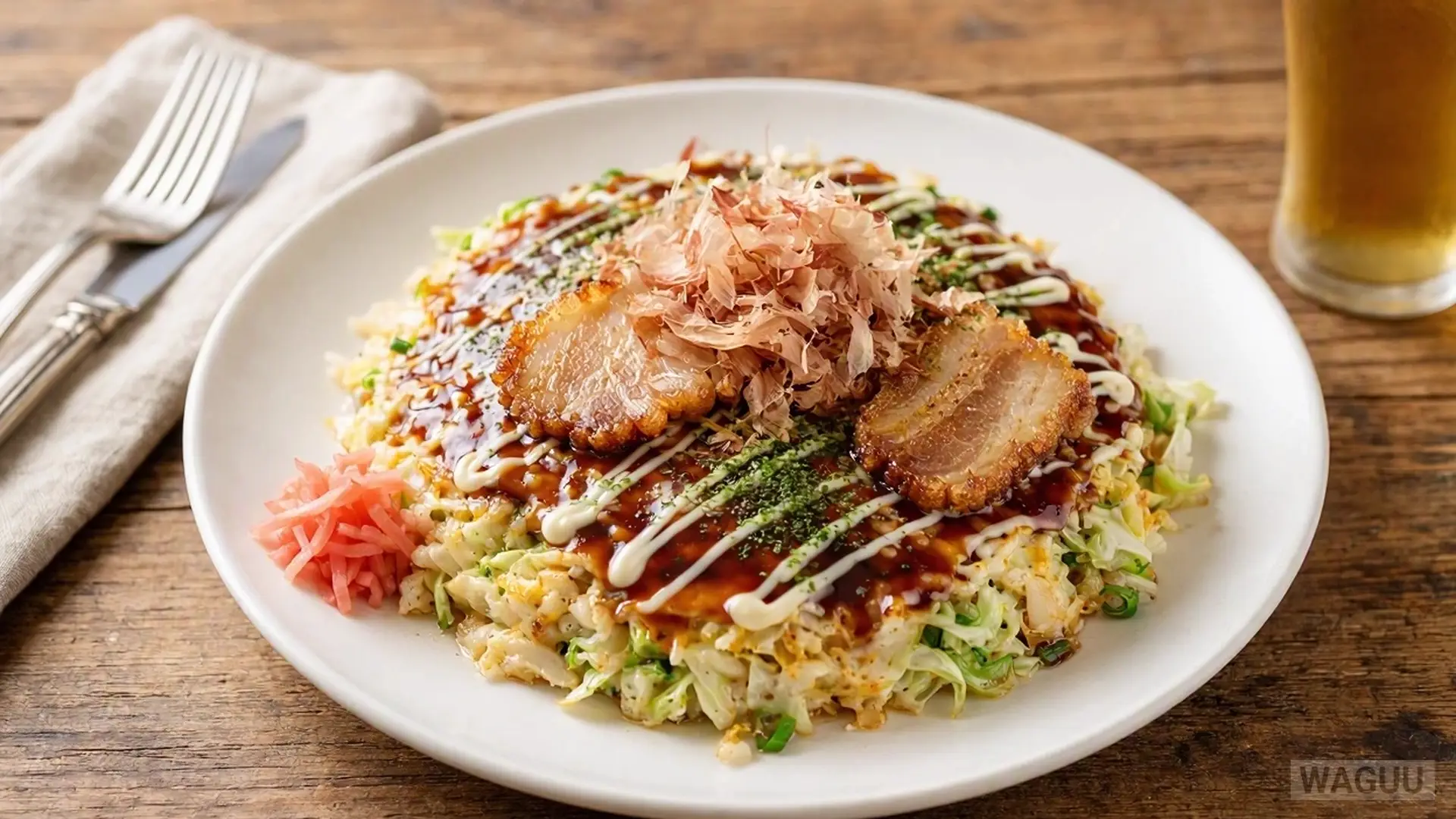
Summary: Authentic Japanese Okonomiyaki – main ingredients green cabbage, thin pork belly slices, and dashi batter; technique teppanyaki-style skillet searing; preparation time 20 minutes, cooking time 25 minutes; yields 6 generous savory pancakes.
Did you make this recipe? Share the result with the community.
Category: Pork Dishes, Japanese Cuisine
Success rate: 96% of users successfully made this recipe
Quick overview
- Dish: Japanese Okonomiyaki
- Category: Pork Dishes, Japanese Cuisine
- Cuisine: Japanese Cuisine
- Main ingredient: Finely shredded green cabbage (18 oz / 1.1 lb) and thinly sliced pork belly (12 oz)
- Guide: 12 Most Popular Japanese Dishes: Favorite Recipes of Japanese Cuisine
- Total time: 45 minutes (20 min prep + 25 min cooking)
- Difficulty: Medium
- Servings: 6 (Serving weight: 345 g)
- Key technique: Pan-frying on a flat griddle or skillet (Teppanyaki style)
- Preparation types: Batter whisking, fine vegetable shredding, layered pan-searing
- Dietary info & Allergens: Contains Wheat (Gluten), Eggs, Soy, Fish (Katsuobushi, Dashi)
- Suitable for: Casual weeknight dinners, Japanese street food theme nights, fun cooking parties
- Nutritional values (per 1 serving): 520 kcal, Protein: 22 g, Fat: 28 g, Carbs: 45 g
- Storage: 2 days in the fridge, 1 month in the freezer
- Pairing: Crisp Japanese draft lager (Asahi Super Dry), chilled Sake, or Iced Green Tea
- In a nutshell: Savory Japanese cabbage pancake layered with tender pork belly, pan-seared to crispy golden perfection, and smothered in rich okonomiyaki sauce, Kewpie mayo, aonori, and dancing bonito flakes.
- Last updated: May 15, 2024
WAGUU says: “Okonomiyaki literally translates to ‘grilled as you like it’ — the magic lies in folding air into the finely shredded cabbage batter and rendering crisp pork belly slices right on top of the pancake for unmatched savory umami.”
Key facts
| Prep time: | 20 minutes |
| Cooking time: | 25 minutes |
| Temperature: | Medium heat (350 °F / 175 °C griddle surface) |
| Number of servings: | 6 servings |
In a nutshell
Experience iconic Japanese soul food right in your home kitchen. Osaka-style Okonomiyaki combines sweet, crunchy shredded cabbage with a light savory dashi batter, topped with strips of rich pork belly that crisp as they sear. Finished with crisscrossed Japanese mayo, tangy dark okonomiyaki sauce, fragrant green seaweed powder, and smoky bonito flakes that dance in the steam!
Ingredients
Base servings: 6 servings • Serving weight: 345 g
| Ingredient | Quantity | Quality |
|---|---|---|
| All-purpose flour | 2 cups | Sifted standard unbleached flour |
| Dashi broth (chilled) | 1½ cups | Fresh dashi brewed from kombu & bonito or dashi powder |
| Nagaimo (Japanese yam) finely grated | 3 oz | Peeled and freshly grated (or sub 1 tsp baking powder) |
| Kosher salt | 1 tsp | Fine grain kosher salt |
| Large eggs | 4 pcs | Fresh farm eggs, room temperature |
| Green cabbage | 6 cups | Finely shredded/chopped (approx. 18 oz / 1.1 lb) |
| Green onions (scallions) | 1 cup | Thinly sliced green and white parts |
| Tenkasu (tempura scraps) | ½ cup | Crispy tempura flakes for texture |
| Beni shoga (pickled red ginger) | 3 tbsp | Finely chopped Japanese red pickled ginger |
| Pork belly slices | 12 oz | Paper-thin raw pork belly strips (approx. 18 slices) |
| Vegetable oil | 3 tbsp | High-smoke point neutral oil for pan frying |
| Okonomiyaki sauce | ¾ cup | Store-bought or homemade sweet savory brown sauce |
| Kewpie Japanese mayonnaise | ½ cup | Rich egg-yolk mayonnaise in squeeze bottle |
| Katsuobushi (bonito flakes) | 1 cup | Delicate shaved dried skipjack tuna flakes |
| Aonori (green seaweed powder) | 2 tbsp | Fine dried green laver seaweed powder |
Why you’ll love this recipe
- Authentic Osaka Flavor: Combines savory umami-rich dashi batter with crisp cabbage and crunchy bacon-like pork belly strips.
- Customizable & Interactive: Perfect for cooking directly at the table or together with family and friends.
- Unmatched Texture Contrast: Golden crispy exterior from pork fat, tender fluffy cabbage center, and creamy luscious sauce finish.
Success guaranteed: By adding grated nagaimo (or baking powder) and letting the batter rest for 10 minutes before gently folding in cabbage, your pancake will remain wonderfully light and fluffy inside without becoming dense or rubbery.
Recipe overview
Prep: 20 min | Cooking: 25 min | Difficulty: Medium | Servings: 6 | Type: Main Dish | Origin: Japan
Detailed instructions
Overall progress: 0% completed
Phase 1: Preparing Batter and Shredding Cabbage – 10 min
Appliances: Large mixing bowl, wire whisk, fine grater, chef’s knife
1. In a large mixing bowl, whisk together 2 cups of sifted all-purpose flour and 1 tsp of fine kosher salt. In a separate cup, combine 1½ cups of chilled dashi broth with 3 oz of finely grated nagaimo (Japanese mountain yam). Slowly pour the liquid into the flour while whisking gently until smooth. Cover and let the batter rest in the refrigerator for 10 minutes. Meanwhile, chop 6 cups of fresh green cabbage into fine ⅛-inch pieces ( do not shred too long, short bits prevent soggy pockets). Thinly slice 1 cup of scallions and chop 3 tbsp of pickled red ginger (beni shoga).
CP: Batter should be smooth with a fluid consistency similar to heavy cream, slightly viscous from the nagaimo.
Before moving to the next step:
Make sure the dashi broth is chilled before mixing into flour; warm broth activates gluten prematurely and results in chewy pancakes instead of light, tender pancakes.
Phase 2: Combining Batter Ingredients – 5 min
Appliances: Rubber spatula, portion bowls
2. Retrieve the rested batter from the fridge. For optimal lightness, assemble each pancake batch individually or mix together right before cooking. Add 4 large eggs, 6 cups of chopped cabbage, 1 cup of green onions, ½ cup of tempura scraps (tenkasu), and 3 tbsp of chopped red pickled ginger into the batter bowl. Using a spatula, fold gently from the bottom up until cabbage leaves are evenly coated in a thin layer of batter. Do not overmix or press down on the cabbage to preserve air pockets.
CP: The mixture should look mostly like cabbage coated in batter rather than liquid soup with floating cabbage.
Before moving to the next step:
Do not mix cabbage into the batter hours ahead of time; salt in the dashi will draw water out of cabbage, watering down batter and ruining pancake texture.
Phase 3: Shaping and Searing First Side – 8 min
Appliances: Electric griddle or large non-stick skillet, metal spatulas
3. Heat 1½ tbsp of vegetable oil in a large skillet or electric griddle set to medium heat (350 °F / 175 °C). Scoop one portion of cabbage mixture onto the pan, forming a round disc roughly 6 inches in diameter and 1 inch thick. Do not press down with spatula! Lay 3 thin slices of raw pork belly side-by-side across the top of the pancake, covering the surface. Cover pan with lid and cook over medium heat for 5 minutes until bottom is golden brown and firm.
CP: The bottom is deep golden brown and pancake holds structure when gently nudged.
Phase 4: Flipping and Searing Pork Side – 7 min
Appliances: Two wide spatulas, pan lid
4. Slip two spatulas under the pancake and smoothly flip it over in one quick confident motion so pork belly strips are now facing down against hot pan surface. Cover skillet again with lid and cook on medium-low heat for another 5 to 6 minutes. Pork fat will render and fry pork belly slices until crispy and deeply browned, steaming cabbage pancake interior to tender perfection.
CP: Internal pork temperature reaches 145 °F (63 °C) minimum, rendered fat sizzling actively beneath pancake.
Before moving to the next step:
Never squash or flatten okonomiyaki with your spatula after flipping! Pressing forces out trapped moisture and air, making pancake heavy, dense, and oily.
Phase 5: Final Flip and Sauce Glazing – 3 min
Appliances: Pastry brush, squeeze bottles
5. Uncover pan and perform final flip so crisp pork belly side faces upward. Cook uncovered for 1 to 2 minutes to crisp bottom edge. Transfer hot okonomiyaki to a plate. Generously brush top surface with 2 tbsp of Okonomiyaki sauce per pancake. Drizzle Kewpie Japanese mayonnaise in thin zigzag lines across top (tip: use a squeeze bottle with fine tip for authentic look).
CP: Sauce forms glossy dark brown coat, white mayonnaise lines create striking high-contrast lattice pattern.
Phase 6: Garnish and Immediate Serving – 2 min
Appliances: Serving platter, wooden spatula
6. Dust surface evenly with 1 tsp of aonori (dried green seaweed powder) and scatter a generous handful of katsuobushi (bonito flakes) on top. Heat rising from fresh pancake causes thin bonito flakes to sway and “dance”. Serve immediately piping hot directly off skillet or griddle with extra green onions and pickled ginger on side.
CP: Bonito flakes gently move in steam convection currents; pancake is piping hot throughout.
Required equipment
| Utensil | Ideal size | Alternative | Risk |
|---|---|---|---|
| Large Non-Stick Skillet / Electric Griddle | 12-inch pan or 10×18 inch griddle | Heavy cast iron skillet | Pancake sticks and tears if surface temperature fluctuates or lacks non-stick oil coating. |
| Wide Metal / Silicone Spatulas | Two 4-inch wide offset spatulas | Flexible pancake spatulas | Using a single small spatula leads to pancake breaking in half during flipping motion. |
| Finely Toothed Japanese Grater (Oroshigane) | Standard 6-inch grater plate | Microplane or fine box grater side | Coarsely chopped mountain yam creates dense lumps instead of velvety mucilaginous foam. |
Shopping list
Nutrition profile
Values per 1 serving (345 g). Calculated from average ingredient nutrition values.
| Nutrient | Per 100 g | Per 1 serving | Per 6 servings |
|---|---|---|---|
| Energy | 150.7 kcal | 520.0 kcal | 3120.0 kcal |
| Fat | 8.1 g | 28.0 g | 168.0 g |
| of which saturates | 2.6 g | 9.0 g | 54.0 g |
| Carbohydrates | 13.0 g | 45.0 g | 270.0 g |
| of which sugars | 3.5 g | 12.0 g | 72.0 g |
| Protein | 6.4 g | 22.0 g | 132.0 g |
| Salt | 1.0 g | 3.5 g | 21.0 g |
Reference intake of an average adult (8400 kJ / 2000 kcal).
WAGUU Pro level
- Pro standard: Verified recipe with precise ratios and visual checkpoints.
- Tip 1: The Secret Mucilage Effect: Authentic okonomiyaki relies on grated nagaimo (Japanese mountain yam). Its unique starch complex traps steam bubbles inside the pancake during searing, producing an airy, souffle-like interior texture that cannot be duplicated by flour alone.
- Tip 2: Cabbage Cutting Geometry: Cut cabbage leaves into fine, square-like shreds roughly ⅛ inch wide. Long thin strands whip together and compress into dense dough balls, whereas small squares leave miniature gaps for heat and air flow.
- Tip 3: Steaming Under Lid: Always cook covered with a lid for the initial 10 minutes total (5 min side 1, 5 min side 2). Lid cooking traps moisture to steam cabbage sweet and tender without scorching the outer crust.
- Tip 4: Squeeze Bottle Presentation: For restaurant-quality Kewpie mayonnaise lines, transfer mayonnaise into a bottle equipped with a fine triple-tip nozzle. Drizzle rapidly perpendicular to okonomiyaki sauce strokes, then drag a toothpick lightly through lines to create beautiful chevron patterns.
Scientific background
Okonomiyaki represents a masterclass in thermal balance and starch gelatinization. Standard pancake batters rely on gluten networks for structure, which can easily turn chewy or heavy when dense vegetables are mixed in. By incorporating dashi liquid combined with the mucilaginous glycoprotein complex of nagaimo (yam), the batter coats shredded cabbage lightly without developing gluten elasticity. During searing at 350 °F (175 °C), water within cabbage vaporizes into steam trapped within the egg-dashi matrix. Meanwhile, fat from raw pork belly laid directly against hot steel renders down (lipolysis), frying the base in its own flavorful fat and creating Maillard reaction compounds that deliver crisp savory notes alongside sweet cooked cabbage.
Fine Dining – Professional techniques
- Plate composition: Serve on custom dark ceramic teppan plates preheated to 140 °F (60 °C). Center pancake perfectly, coat with sauce glossy up to ¼ inch from the outer rim, creating a clean circular frame.
- Texture contrasts: Juxtapose crisp pork belly skin and crunchy tempura scraps (tenkasu) against soft, velvety cabbage batter and melting emulsified mayonnaise droplets.
- Temperature contrast: Serve sizzling hot from the griddle immediately so heat continues activating volatile aroma compounds in cold-drizzled sauce and room-temperature bonito flakes.
- Aromatic garnishes: Dust bright emerald aonori green seaweed powder along one diagonal half and cascade whisper-thin katsuobushi flakes along opposite side for dramatic artistic contrast.
Sensory radar
- Appearance: Thick golden-brown pancake topped with glistening dark barbecue-style glaze, creamy ivory mayonnaise grid, vibrant green seaweed dust, and dancing smoky wood-shaving flakes.
- Aroma: Smoky bonito tuna, caramelized pork fat, sweet cooked cabbage, rich soy sauce glaze, and ocean-fresh seaweed aroma.
- Taste: Complex explosive balance of savory umami, mild sweetness from cabbage and okonomiyaki sauce, tangy acidity from pickled red ginger, and rich egg yolk creaminess.
- Texture: Crispy exterior with crunchy pork edges giving way to a pillow-soft, airy, moist cabbage core.
Pairing
- BEER: Crisp Japanese rice lager such as Asahi Super Dry or Sapporo Premium. The high carbonation and sharp dry finish cleanse rich pork belly fat and sweet glaze from the palate.
- WINE: Off-dry German Riesling or sparkling Prosecco. Bright fruitiness and vibrant acidity balance rich mayonnaise and salty-sweet okonomiyaki sauce.
- NON-ALCOHOLIC: Chilled unsweetened Sencha green tea, roasted Hojicha barley tea, or traditional Japanese Ramune marble soda for a fun nostalgic pairing.
Various preparation methods
- Hiroshima-Style Okonomiyaki: Instead of mixing all ingredients into batter beforehand, Hiroshima style layers components sequentially starting with thin crepe batter, followed by mountains of shredded cabbage, pork belly, fried yakisoba or udon noodles, and topped with a fried egg.
- Seafood & Cheese Mix (Modan-yaki): Fold peeled baby shrimp, chopped squid tentacles, and shredded low-moisture mozzarella cheese directly into cabbage batter prior to cooking for a decadent stretchy cheese melt.
Allergens and dietary information
Contains: Wheat (Gluten), Eggs, Soybeans, Fish (Katsuobushi bonito flakes and Dashi stock) • Gluten: Contains gluten from wheat flour and standard soy sauce. For gluten-free option, use a 1:1 gluten-free flour blend and tamari-based okonomiyaki sauce. • Not suitable for: Strictly vegetarian or vegan diets (unless pork, eggs, dashi, and bonito flakes are substituted with plant-based alternatives).
Suitable for
Perfect for casual family dinners, Japanese street food nights, interactive table-top griddle cooking parties, and sports game-day appetizers.
Substitution guide
- Nagaimo (Japanese Yam): Substitute with 1 tsp baking powder plus 2 tbsp plain full-fat Greek yogurt to simulate light aeration and moisture.
- Pork Belly Slices: Substitute with thin raw bacon strips, shaved ribeye beef, peeled raw shrimp, or sliced shiitake mushrooms for a vegetarian base.
- Okonomiyaki Sauce: Mix 4 tbsp ketchup, 2 tbsp Tonkatsu or Worcestershire sauce, 1 tbsp soy sauce, and 1 tbsp honey until smooth.
- Kewpie Mayonnaise: Mix ⅓ cup standard American mayonnaise with 1 egg yolk, ½ tsp rice vinegar, and a pinch of sugar.
FAQ
Why is my okonomiyaki soggy or falling apart in the middle?
Sogginess usually happens when cabbage is chopped too coarse, mixed too early into wet batter, or cooked at high heat without covering. Steam gets trapped inside without cooking the flour. Ensure pan heat is medium (350 °F / 175 °C), cook covered with a lid for at least 10 minutes overall, and chop cabbage into fine ⅛-inch pieces.
Can I make okonomiyaki batter ahead of time?
You can whisk flour, dashi broth, and grated nagaimo together and store in the fridge for up to 24 hours. However, do NOT add shredded cabbage, eggs, or salt into the batter until right before pouring onto hot pan, otherwise cabbage releases water and thins out batter.
What gives okonomiyaki its distinctive street food flavor?
The defining street food flavor comes from combining savory umami-rich dashi in batter, crispy rendered pork belly fat, tang from red pickled ginger (beni shoga), crunch from tempura scraps (tenkasu), and signature toppings (sweet Okonomiyaki sauce, Kewpie mayo, aonori, and smoky bonito flakes).
Should I press down on okonomiyaki with my spatula while cooking?
No! Never press down with spatula. Pressing squeezes out steam and air pockets, flattening fluffy cabbage layers into a dense, chewy rubbery disk.
WAGUU Petr advises: Cooking for 12 or more people?
12–16 people: Use two electric countertop teppan griddles set side by side to cook 4 pancakes simultaneously. Chop cabbage in large prep batches but mix batter and cabbage in portioned stainless steel bowls right before placing on griddles. • 20+ people: Prepare pancakes slightly smaller (4-inch mini rounds). Pre-cook on griddles for 8 minutes until pork crisps, then arrange on parchment-lined baking sheets. Reheat at 400 °F (200 °C) in oven for 5 minutes right before sauce glazing and serving to large crowds.
Sides and serving
- Edamame with Sea Salt – Steamed green soybeans sprinkled with coarse sea salt (not included in the recipe)
- Japanese Sunomono Cucumber Salad – Thinly sliced English cucumbers dressed in rice vinegar and sesame (not included in the recipe)
Serving: Slice finished pancake crosswise into grid squares or wedge triangles using mini metal spatula. Serve piping hot directly on table-top griddle or preheated stoneware plates.
Storage and reheating
Fridge: 2 days in airtight container (store without sauce/mayo toppings if possible) • Freezer: 1 month wrapped tightly in plastic film and aluminum foil • Reheating: Reheat cooked pancakes in a 350 °F (175 °C) toaster oven or skillet for 8 minutes until warm and crispy. Avoid microwave reheating as it turns cabbage soft and soggy.
Author: WAGUU Petr & Team • Published: 30 Oct 2026
More Recipes in This Article
Other recipes you might enjoy
Why WAGUU?
Recipes on WAGUU undergo checks for ingredient accuracy, procedures, and nutritional values.
Process photo gallery
Community photos: Cook, take a picture, and share your results.
You can upload photos in the comments below or send them via email.
Did you record a video of your process for our recipe? Paste a link to YouTube, YouTube Shorts, TikTok, Instagram Reels, Facebook Reels, Pinterest, Vimeo, or X (Twitter) in the comments – we’d love to share it and help give you and your content more visibility.
Common mistakes
- Pressing the pancake with spatula – Squashing the pancake forces out air and moisture trapped inside, leaving pancake dense, flat, and greasy.
- Mixing cabbage hours in advance – Salt in dashi draws moisture out of cabbage, watering down batter and creating soggy batter pockets during searing.
- Using warm dashi broth for batter – Mixing flour with warm or hot dashi activates gluten instantly, yielding a tough rubbery pancake rather than a tender interior.
- Skipping lid during frying – Cooking without pan lid prevents steam from cooking raw cabbage inside, leaving outer pork skin burnt while cabbage core remains raw.