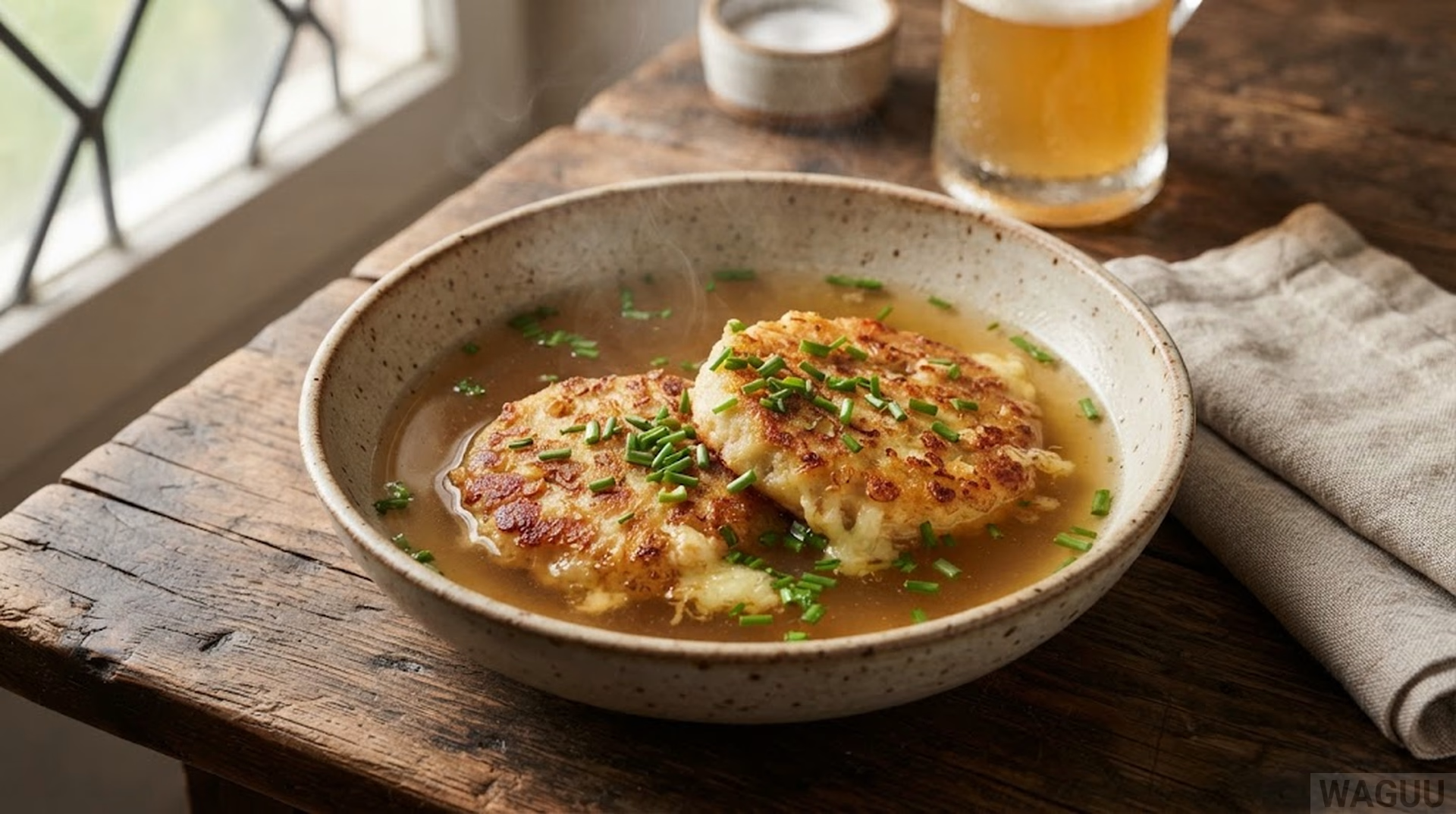
Summary: Tyrolean flat dumplings made with stale bread, Alpine cheese and herbs, pan-fried until crisp on both sides. Ready in 50 minutes, serves 6.
Cooked this recipe? Share your result with the community.
Categories: American Meatless Dishes, American Austrian Cuisine
Success rate: not rated yet % of users cooked this recipe without problems
Quick Overview
- Dish: Kaspressknödel
- Categories: American Meatless Dishes, American Austrian Cuisine
- Cuisine: Austrian
- Main ingredient: Stale bread, 14 oz + Alpine cheese, 10.6 oz
- Guide: 12 Most Famous Austrian Dishes
- Total time: 50 minutes (20 minutes preparation + 30 minutes cooking)
- Difficulty: Easy
- Servings: 6 (portion weight: 8 oz)
- Key technique: Pan-frying flat dumplings
- Preparation types: Pan-frying, simmering
- Dietary info & allergens: Contains gluten, eggs, milk
- Suitable for: Family dinner, meatless Monday, light lunch
- Nutritional values (per portion): 465 kcal, Protein: 22 g, Fat: 24 g, Carbohydrates: 38 g
- Storage: 2 days in the fridge, 1 month in the freezer
- Pairing: Light lager, Grüner Veltliner, apple cider
- In short: A flat cheese dumpling that is crisp on the outside and soft inside — the Tyrolean answer to a savory pancake.
- Last update: September 29, 2026
WAGUU says: “Kaspressknödel is not a dumpling in the usual sense. It is pressed flat, fried on both sides and served in broth or with a salad. The crisp surface is the whole point.”
Key Facts
| Prep time: | 20 minutes |
| Cooking time: | 30 minutes |
| Temperature: | Medium pan heat |
| Servings: | 6 |
At a Glance
Kaspressknödel is a Tyrolean classic made from stale bread, cheese and eggs. The mixture is shaped into flat patties and fried in butter until crisp on both sides. Served in broth or with a green salad, it is both comfort food and a proper meal.
Ingredients
Base servings: 6 servings • Portion weight: 8 oz
| Ingredient | Amount | Quality |
|---|---|---|
| Stale white bread | 14 oz | Day-old, crusts removed, cubed |
| Whole milk | 1.7 cups | Warm |
| Eggs | 4 pcs | Large, free-range |
| Mountain cheese | 10.6 oz | Grated, Alpine cheese |
| Yellow onions | 7 oz | Finely chopped |
| Butter | 2.8 oz | Unsalted |
| Fresh parsley | 0.7 oz | Finely chopped |
| Fresh chives | 0.5 oz | Finely chopped |
| Marjoram | 0.07 oz | Dried |
| Nutmeg | 0.04 oz | Freshly grated |
| Fine sea salt | 0.4 oz | For seasoning |
| Black pepper | 0.07 oz | Freshly ground |
| Beef broth | 5.1 cups | Clear, hot, for serving |
Why You Will Love This Recipe
- Uses up stale bread: The dish exists to turn yesterday’s bread into something better.
- Crisp outside, soft inside: Pan-frying gives it a golden crust while the inside stays creamy from the cheese.
- Two ways to serve: In broth as a soup, or with a salad as a main course.
Why it works: The warm milk softens the bread and binds the mixture. The eggs hold it together, and the cheese melts inside during frying, giving the dumpling its creamy center. Pressing the mixture flat gives it a large surface area for browning, which is what makes the crust so crisp.
Recipe Overview
Prep: 20 min | Cook: 30 min | Difficulty: Easy | Servings: 6 | Type: Main | Origin: Austrian
Detailed Method
Total progress: 0 % done
Phase 1: Soaking the Bread – 15 min
Equipment: Large bowl
1. Put the cubed bread into a large bowl. Pour the warm milk over it and let it soak for 15 minutes, stirring once or twice, until the bread is soft but not falling apart.
VKB: The bread has absorbed most of the milk and is soft to the touch. There is no pool of liquid at the bottom of the bowl.
Before you continue:
If there is still milk in the bowl after 15 minutes, squeeze the bread gently and pour off the excess. A wet mixture gives soggy dumplings.
Phase 2: Making the Mixture – 10 min
Equipment: Large bowl, wooden spoon, skillet
2. While the bread soaks, fry the chopped onions in 0.7 oz of the butter over medium heat until soft and pale golden. Let them cool slightly. Add the eggs, cheese, fried onions, parsley, chives, marjoram, nutmeg, salt and pepper to the soaked bread. Mix with your hands until everything is evenly combined.
VKB: The mixture holds together when you press a handful. It is moist but not wet. The cheese and bread are evenly distributed.
Before you continue:
Let the mixture rest for 10 minutes before shaping. The bread absorbs the egg and the mixture firms up, making it easier to form patties.
Phase 3: Shaping the Dumplings – 5 min
Equipment: Cutting board, hands
3. Shape the mixture into 12 equal patties, about 3 inches wide and ¾ inch thick. Press them firmly so they hold their shape.
VKB: All twelve patties are the same size and thickness. They hold their shape when you lift them and do not fall apart.
Before you continue:
Wet your hands with cold water before shaping each patty. This stops the mixture from sticking and gives you a smooth surface.
Phase 4: Frying the Dumplings – 20 min
Equipment: Large skillet, spatula
4. Heat half of the remaining butter in a large skillet over medium heat. Fry the patties in batches for 4–5 minutes on each side, until deep golden and crisp. Add more butter between batches as needed. Do not overcrowd the pan.
VKB: The patties are deep golden brown on both sides and crisp to the touch. The cheese inside is fully melted.
Before you continue:
Keep the heat at medium. If the pan is too hot, the outside burns before the cheese melts. If it is too cold, the patties absorb the butter and turn greasy.
Phase 5: Heating the Broth – 5 min
Equipment: Medium saucepan, fine sieve
5. Strain the beef broth into a medium saucepan and bring it to a bare tremble over medium-low heat. Season with salt to taste.
VKB: The broth is clear and hot but not bubbling. It smells of beef and herbs.
Before you continue:
Do not boil the broth. Boiling clouds the liquid and turns a clear soup into a muddy one.
Phase 6: Serving – 2 min
Equipment: Warm soup bowls or plates
6. Place two dumplings in each warm soup bowl and ladle the hot broth over them. Alternatively, serve the dumplings on warm plates with a green salad on the side. Scatter with fresh chives and serve immediately.
VKB: The dumplings float in the broth or sit neatly on the plate without falling apart. The crust is still crisp when they reach the table.
Required Equipment
| Item | Ideal size | Alternative | Risk |
|---|---|---|---|
| Large skillet | 12 inch, non-stick | Cast iron pan, well seasoned | Thin pans scorch the patties before the cheese melts |
| Large mixing bowl | 4 quart | Any deep bowl | A small bowl makes mixing awkward and uneven |
| Medium saucepan | 2 quart | Any deep pot | A large pot boils the broth too quickly |
Shopping List
Nutritional Profile
Values per portion (without side dish). Calculated from average nutritional values of ingredients.
| Nutrient | Per 100 g | Per 1 portion | Per 6 portions |
|---|---|---|---|
| Energy | 211 kcal | 465 kcal | 2790 kcal |
| Fat | 10.9 g | 24 g | 144 g |
| of which saturated | 6.4 g | 14 g | 84 g |
| Carbohydrates | 17.3 g | 38 g | 228 g |
| of which sugars | 3.2 g | 7 g | 42 g |
| Protein | 10.0 g | 22 g | 132 g |
| Salt | 1.1 g | 2.4 g | 14.4 g |
Reference intake of an average adult (8400 kJ / 2000 kcal).
WAGUU Pro Level
- Pro standard: Verified recipe with exact ratios and visual control points.
- Tip 1: Use day-old bread, not fresh. Fresh bread makes a sticky mixture that will not hold together.
- Tip 2: Press the patties firmly with your hands. Loose patties fall apart in the pan.
- Tip 3: Use a mix of mountain cheese and Emmental. Mountain cheese gives the flavor, Emmental gives the melt.
- Tip 4: Let the cooked dumplings rest for 2 minutes before serving so the cheese sets slightly and they hold together when cut.
Scientific Background
The bread in Kaspressknödel is a starch sponge. When soaked in milk, the starch granules absorb liquid and swell, becoming soft and pliable. The eggs provide protein that coagulates during frying, binding the mixture together. The cheese melts and releases fat, which coats the bread and gives it a creamy texture. Pressing the mixture flat is key — a flat patty has a large surface area for browning and cooks through without needing to be boiled first.
Fine Dining – Professional Techniques
- Plate composition: Serve two dumplings on a shallow plate with a drizzle of herb oil and a small green salad on the side.
- Texture contrasts: The crisp crust against the soft, cheesy interior.
- Temperature contrast: Serve very hot, with a cold green salad.
- Aromatic additions: A few fresh chives snipped over the dumplings.
Sensory Radar
- Appearance: Deep golden-brown patties, crisp at the edges.
- Aroma: Melted cheese, fried bread, fresh herbs.
- Taste: Savory, cheesy, with a hint of nutmeg and marjoram.
- Texture: Crisp outside, soft and creamy inside.
Pairing
- BEER: Light lager, wheat beer, or a Vienna lager.
- WINE: Grüner Veltliner, Riesling, or a light Pinot Blanc.
- SOFT DRINK: Apple cider, or a light apple spritzer.
Preparation Variations
- With bacon: Fry 5 oz of chopped bacon with the onions and stir it into the mixture.
- With spinach: Add 7 oz of cooked, chopped spinach to the mixture for a green version.
Allergens and Dietary Information
Contains: Gluten, eggs, milk • Gluten: Yes (from bread) • Not suitable for: Celiac disease, lactose intolerance, vegan
Suitable For
Family dinner, meatless Monday, light lunch, après-ski meal
Substitution Catalogue
- Mountain cheese: Gruyère, Comté, or any strong Alpine cheese
- Whole milk: Semi-skimmed milk, or oat milk (lighter)
- Butter: Clarified butter or vegetable oil
FAQ
Can I use fresh bread instead of stale?
No. Fresh bread makes a sticky mixture that will not hold together. Use day-old bread or dry it in a low oven for 15 minutes.
Why do my Kaspressknödel fall apart?
The mixture was too wet, or the patties were not pressed firmly enough. Squeeze excess milk out of the bread and press each patty firmly with your hands.
Can I bake them instead of frying?
Yes, at 400 °F for 15 minutes on each side. They will be drier but still good.
What can I serve with them?
In beef broth as a soup, or with a green salad and a glass of white wine as a main course.
WAGUU Petr advises: Cooking for 6 or more?
6–8 people: Make a double batch of patties and fry them in two pans at once. • 10+ people: Fry the patties ahead and reheat them in a 350 °F oven for 8 minutes. They will crisp up again.
Side Dishes and Serving
Storage and Reheating
Fridge: 2 days • Freezer: 1 month (freeze before frying) • Reheating: Reheat in a 350 °F oven for 8 minutes, or in a hot pan with a little butter for 3 minutes per side.
Author: WAGUU Petr & Team • Published: 30 Sep 2026
More Recipes from This Article
More Recipes You Might Like
Why WAGUU?
Recipes on WAGUU go through a check of ingredient accuracy, method and nutritional values.
Photo Gallery from the Process
Community photos: Cook it, photograph it, and share the result.
You can upload photos in the comments below or send them by email.
Filmed a video of our recipe? Post a link to YouTube, YouTube Shorts, TikTok, Instagram Reels, Facebook Reels, Pinterest, Vimeo or X (Twitter) in the comments — we will be glad to publish it and help you and your content get noticed.
Most Common Mistakes
- Using fresh bread – Fresh bread makes a sticky mixture that falls apart. Use day-old bread.
- Mixture too wet – Squeeze excess milk out of the soaked bread before mixing.
- Loose patties – Press each patty firmly so it holds together during frying.
- Pan too hot – The outside burns before the cheese melts. Keep the heat at medium.