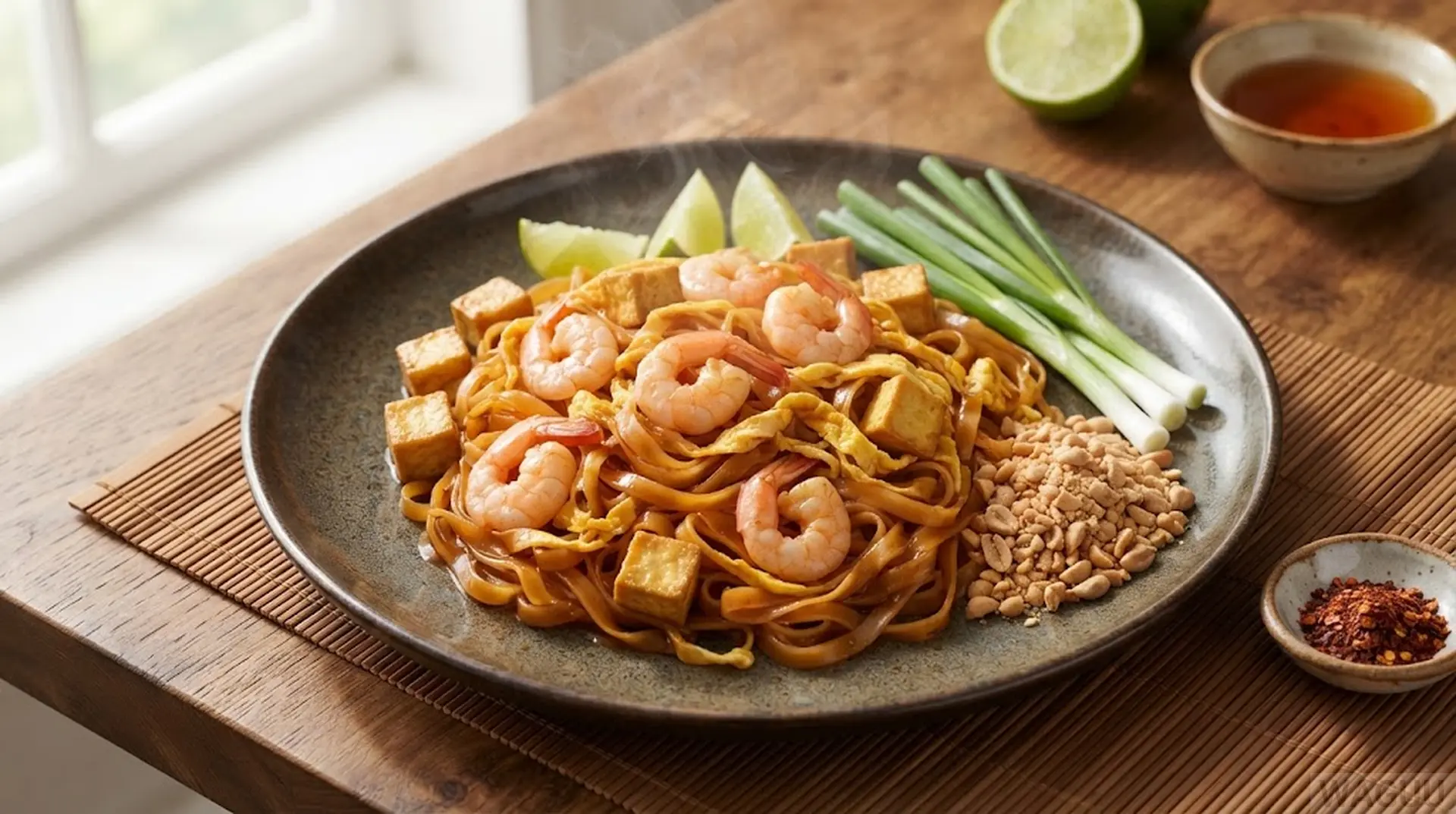
Summary: Pad Thai is a world-famous Thai stir-fried rice noodle dish featuring shrimp and chicken, scrambled eggs, firm tofu, mung bean sprouts, crushed peanuts, and an aromatic tamarind-fish sauce dressing. Prepared using a wok-searing technique, total preparation and cooking time is 35 minutes for 6 servings.
Did you make this recipe? Share the result with the community.
Category: Thai Cuisine, Main Dishes
Success rate: 98% of users successfully made this recipe
Quick overview
- Dish: Pad Thai
- Category: Thai Cuisine, Main Dishes
- Cuisine: Thai
- Main ingredient: rice noodles, 1 lb (high quality)
- Guide: 12 Most Popular Thai Dishes: Favorite Thai Cuisine Recipes
- Total time: 35 minutes (20 min prep + 15 min cooking)
- Difficulty: Intermediate
- Servings: 6 servings (Serving weight: 380 g)
- Key technique: Wok-searing and high-heat tossing
- Preparation types: Stir-frying
- Dietary info & Allergens: Contains shellfish, fish, peanuts, and soy
- Suitable for: Lunch, dinner, festive gatherings
- Nutritional values (per 1 serving): 540 kcal, Protein: 28 g, Fat: 16 g, Carbs: 68 g
- Storage: 2 days in the fridge, 0 months in the freezer
- Pairing: Singha Beer, Riesling, Thai iced tea
- In a nutshell: The ultimate balance of sweet, sour, and savory stir-fried noodles with shrimp and chicken.
- Last updated: 2025-02-25
WAGUU says: “Mastering Pad Thai is all about keeping your noodles al dente before they hit the wok and maintaining high, consistent heat.”
Key facts
| Prep time: | 20 minutes |
| Cooking time: | 15 minutes |
| Temperature: | 450 °F (high heat) |
| Number of servings: | 6 servings |
In a nutshell
Experience the vibrant street flavors of Bangkok right in your kitchen with this authentic Pad Thai recipe, combining tender rice noodles, succulent shrimp and chicken, crunchy peanuts, and an unforgettable tangy tamarind sauce.
Ingredients
Base servings: 6 servings • Serving weight: 380 g
| Ingredient | Quantity | Quality |
|---|---|---|
| Rice noodles | 1 lb | Medium width, dried |
| Tamarind paste | 6 tbsp | Seedless, pure concentrate |
| Fish sauce | 6 tbsp | High grade |
| Palm sugar | 6 tbsp | Finely grated |
| Vegetable oil | 4 tbsp | High smoke point |
| Garlic | 4 cloves | Minced fresh |
| Shrimp | ¾ lb | Peeled and deveined |
| Chicken breast | ¾ lb | Thinly sliced |
| Firm tofu | 1 cup | Diced into small cubes |
| Eggs | 3 large | Fresh whole eggs |
| Mung bean sprouts | 3 cups | Fresh and crisp |
| Roasted peanuts | ¾ cup | Coarsely crushed |
| Garlic chives | 1 cup | Cut into 1-inch lengths |
| Limes | 2 whole | Cut into wedges |
Why you’ll love this recipe
- Authentic Flavors: Recreates the quintessential balance of sweet, sour, and salty notes found in traditional Thai cooking.
- Protein-Rich: Combines tender shrimp, chicken, tofu, and eggs for a hearty and satisfying main dish.
- Quick Preparation: Cooks in minutes over high heat, making it perfect for both weeknight dinners and weekend entertaining.
Success guaranteed: Follow the precise soaking times for the rice noodles to prevent them from becoming mushy in the wok.
Recipe overview
Prep: 20 min | Cooking: 15 min | Difficulty: Intermediate | Servings: 6 | Type: Main Dish | Origin: Thailand
Detailed instructions
Overall progress: 0% completed
Phase 1: Preparing Noodles and Sauce – 10 min
Appliances: Mixing bowl
1. Soak 1 lb of dried rice noodles in warm water for 15 minutes until pliable but still firm to the bite. Drain thoroughly. In a small bowl, whisk together 6 tbsp tamarind paste, 6 tbsp fish sauce, and 6 tbsp grated palm sugar until the sugar completely dissolves.
CP: Noodles must remain firm (al dente) as they will finish cooking in the wok sauce.
Before moving to the next step:
Ensure the sauce is fully emulsified and noodles are drained completely to avoid steaming.
Phase 2: Searing Proteins – 8 min
Appliances: Wok, stove
2. Heat 2 tbsp of vegetable oil in a large wok over high heat at 450 °F. Add 4 minced garlic cloves and 1 cup of diced firm tofu cubes, tossing until lightly browned. Add ¾ lb of sliced chicken breast and ¾ lb of peeled shrimp, stir-frying until the shrimp turn pink and chicken is cooked through.
CP: Shrimp reaches 140 °F internal temperature and chicken reaches 165 °F.
Before moving to the next step:
Remove cooked proteins from the wok temporarily to prevent overcooking while tossing the noodles.
Phase 3: Stir-Frying Noodles – 5 min
Appliances: Wok, stove
3. Add remaining 2 tbsp of vegetable oil to the hot wok. Add the drained rice noodles and pour the prepared tamarind sauce directly over them. Toss continuously over high heat for 3 to 4 minutes until the noodles absorb the sauce and soften completely.
CP: Noodles should absorb the liquid evenly without sticking together.
Before moving to the next step:
Push the noodles to one side of the wok to clear space for scrambling the eggs.
Phase 4: Adding Eggs – 3 min
Appliances: Wok, stove
4. Crack 3 large eggs directly into the cleared side of the wok. Let them set for 20 seconds, then scramble gently with a spatula until soft curds form. Toss the scrambled eggs together with the noodles.
CP: Eggs should be fully cooked yet tender.
Before moving to the next step:
Return the cooked shrimp, chicken, and tofu back into the wok with the noodles.
Phase 5: Combining and Toss – 4 min
Appliances: Wok, stove
5. Add the cooked shrimp, chicken, and tofu back into the wok. Toss everything vigorously over high heat for 2 minutes so all ingredients are heated through and coated with the savory tamarind sauce.
CP: All components evenly incorporated and steaming hot.
Before moving to the next step:
Turn off the heat before adding fresh sprouts and herbs to preserve their crunch.
Phase 6: Garnishing and Serving – 2 min
Appliances: None
6. Fold in 2 cups of fresh mung bean sprouts and 1 cup of chopped garlic chives off the heat. Plate immediately and garnish generously with ¾ cup of coarsely crushed roasted peanuts and fresh lime wedges on the side.
CP: Serve immediately while hot with lime wedges.
Required equipment
| Utensil | Ideal size | Alternative | Risk |
|---|---|---|---|
| Carbon steel wok | 14 inches diameter | Large skillet | Overcrowding causes steaming instead of frying |
| Chef’s knife | 8 inches | Utility knife | Uneven vegetable cuts |
| Mixing bowls | 1-quart capacity | Any ceramic bowls | Spilling sauce ingredients |
Shopping list
Nutrition profile
Values per 1 serving (excluding side dishes). Calculated from average ingredient nutrition values.
| Nutrient | Per 100 g | Per 1 serving | Per 6 servings |
|---|---|---|---|
| Energy | 142.1 kcal | 540 kcal | 3240 kcal |
| Fat | 4.2 g | 16 g | 96 g |
| of which saturates | 0.8 g | 3 g | 18 g |
| Carbohydrates | 17.9 g | 68 g | 408 g |
| of which sugars | 5.3 g | 20 g | 120 g |
| Protein | 7.4 g | 28 g | 168 g |
| Salt | 0.9 g | 3.4 g | 20.4 g |
Reference intake of an average adult (8400 kJ / 2000 kcal).
WAGUU Pro level
- Pro standard: Verified recipe with precise ratios and visual checkpoints.
- Tip 1: Soak noodles in lukewarm water rather than boiling water to maintain structural integrity.
- Tip 2: Cook in small batches if doubling the recipe to ensure the wok retains maximum heat.
- Tip 3: Use authentic palm sugar and tamarind paste for the true depth of Thai flavor profiles.
- Tip 4: Keep all ingredients prepped and near the stove before turning on the burner.
Scientific background
High-heat wok cooking initiates the Maillard reaction between protein amino acids and reducing sugars in the palm sugar and tamarind glaze, creating complex savory aromas while flash-cooking keeps the shrimp and chicken tender and juicy.
Fine Dining – Professional techniques
- Plate composition: Mound noodles neatly in the center of a wide white bowl, topped with whole shrimp and crushed peanuts.
- Texture contrasts: Combine chewy rice noodles, tender proteins, crunchy bean sprouts, and crisp peanuts.
- Temperature contrast: Serve piping hot noodles alongside cool, crisp raw bean sprouts and fresh lime wedges.
- Aromatic garnishes: Finish with finely sliced garlic chives and toasted crushed peanuts for visual appeal.
Sensory radar
- Appearance: Glossy amber noodles speckled with vibrant green chives, pink shrimp, and golden peanuts.
- Aroma: Pungent fish sauce balanced by sweet tamarind and toasted garlic.
- Taste: Harmonious blend of sweet, sour, salty, and nutty umami flavors.
- Texture: Chewy noodles with contrasting crunch from sprouts and peanuts.
Pairing
- BEER: Singha or Chang Thai lager
- WINE: Off-dry German Riesling
- NON-ALCOHOLIC: Traditional Thai iced tea with condensed milk
Various preparation methods
- Vegetarian Pad Thai: Substitute fish sauce with soy sauce or mushroom vegetarian sauce and omit shrimp and chicken, doubling the firm tofu.
- Spicy Street Style: Add 1 tbsp of crushed Thai bird eye chilies or chili flakes along with the garlic for extra heat.
Allergens and dietary information
Contains: Crustacean shellfish, fish, peanuts, soybeans, eggs • Gluten: Naturally gluten-free when using pure rice noodles and certified gluten-free fish sauce • Not suitable for: Nut allergies, seafood allergies, strict vegans
Suitable for
Lunch, casual dinners, weekend cooking projects, and Asian-themed dinner parties.
Substitution guide
- Palm sugar: Substitute with light brown sugar in equal measure.
- Tamarind paste: Substitute with fresh lime juice mixed with a touch of rice vinegar.
FAQ
Why are my noodles mushy?
Noodles were soaked in boiling water or soaked for too long. Always use lukewarm or room temperature water for soaking.
Can I make Pad Thai ahead of time?
Pad Thai is best enjoyed immediately after cooking. Reheating noodles in a wok can alter their texture.
Where can I buy tamarind paste?
Tamarind paste is widely available in Asian grocery stores and the international aisle of most supermarkets.
Can I omit the shrimp?
Yes, you can increase the amount of chicken or tofu to suit your dietary preferences.
WAGUU Petr advises: Cooking for 12 or more people?
12–16 people: Cook in two separate batches using two woks to prevent overcrowding and loss of heat. • 20+ people: Prepare all sauce and ingredient components in advance, setting up a dual wok station for rapid cooking.
Sides and serving
- Extra lime wedges – for adjusting sourness at the table (not included in the recipe)
- Chili flakes – for adding extra heat according to personal preference (not included in the recipe)
Serving: Serve hot on individual white ceramic plates with fresh lime and extra crushed peanuts.
Storage and reheating
Fridge: 2 days • Freezer: 0 months • Reheating: Reheat gently in a hot skillet with a splash of water over medium heat.
Author: WAGUU Petr & Team • Published: 24 Aug 2026 • Updated: 31 Oct 2026
More Recipes in This Article
Other recipes you might enjoy
Why WAGUU?
Recipes on WAGUU undergo checks for ingredient accuracy, procedures, and nutritional values.
Process photo gallery
Community photos: Cook, take a picture, and share your results.
You can upload photos in the comments below or send them via email.
Did you record a video of your process for our recipe? Paste a link to YouTube, YouTube Shorts, TikTok, Instagram Reels, Facebook Reels, Pinterest, Vimeo, or X (Twitter) in the comments – we’d love to share it and help give you and your content more visibility.
Common mistakes
- Oversoaking noodles – Soaking rice noodles in boiling water results in mushy noodles that disintegrate in the wok.
- Overcrowding the wok – Cooking too much at once causes the ingredients to steam rather than sear properly.
- Incorrect sauce balance – Failing to balance sweet, sour, and salty notes properly will flatten the authentic flavor profile.
- Adding sprouts too early – Adding bean sprouts during high-heat cooking makes them soggy instead of crisp.