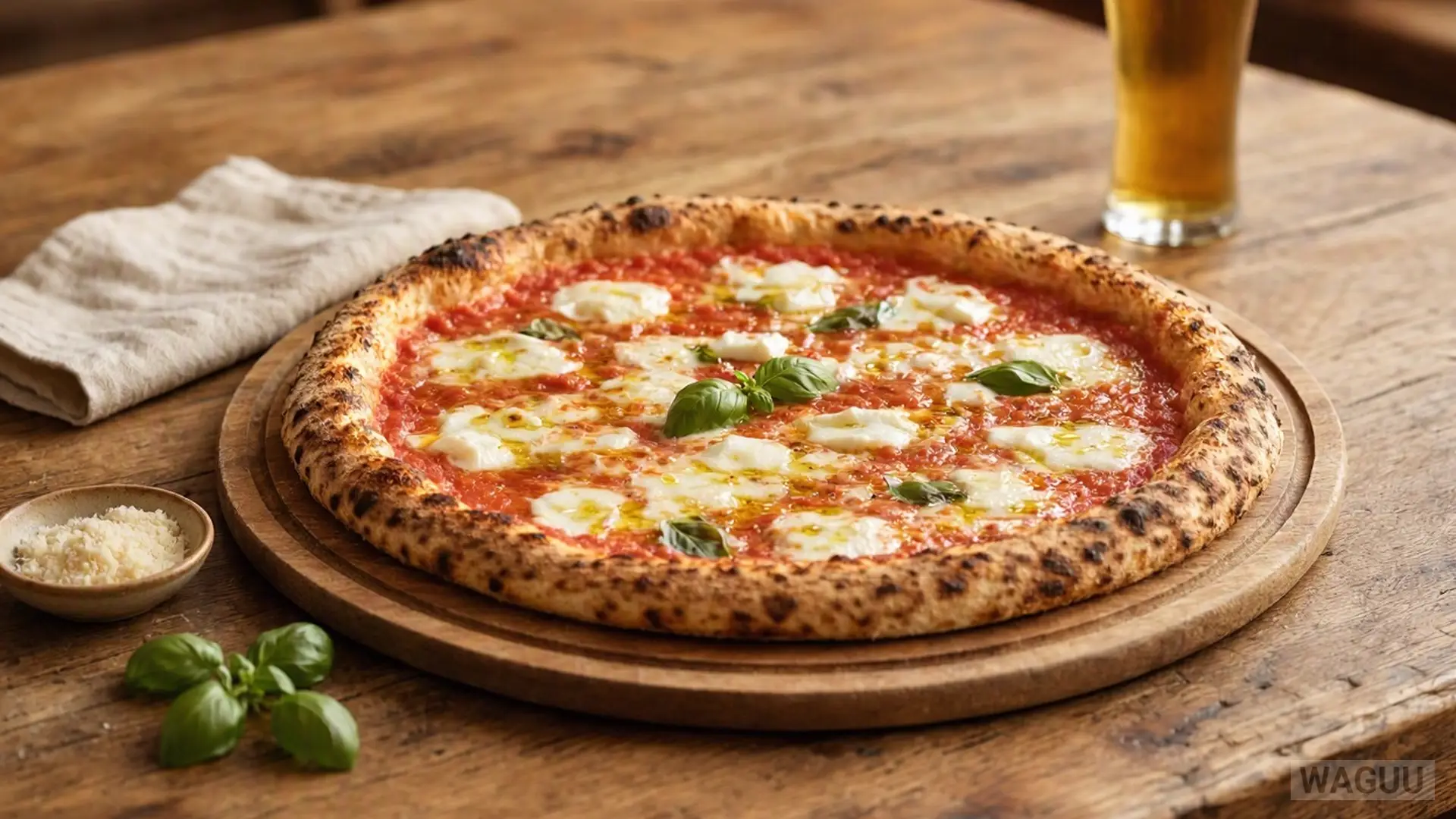
Summary: Traditional Neapolitan pizza featuring a light, fluffy, charred-edge crust topped with crushed San Marzano tomatoes, fresh Fior di Latte mozzarella, fragrant basil leaves, and extra virgin olive oil, baked at an extremely high temperature.
Did you make this recipe? Share the result with the community.
Category: Main Dishes, Italian Cuisine
Success rate: 96% of users successfully made this recipe
Quick overview
- Dish: Pizza Napoletana
- Category: Main Dishes, Italian Cuisine
- Cuisine: Italian
- Main ingredient: Bread flour, 1 lb 8 oz (high protein quality)
- Guide: 12 Most Popular Italian Dishes: Favorite Recipes of Italian Cuisine
- Total time: 1,465 minutes (1,440 min prep + 25 min cooking)
- Difficulty: Advanced
- Servings: 6 (Serving weight: 9.5 oz)
- Key technique: Long cold fermentation and high-heat baking
- Preparation types: Kneading, proofing, stretching, baking
- Dietary info & Allergens: Gluten, milk
- Suitable for: Family dinner, weekend gathering, pizza enthusiasts
- Nutritional values (per 1 serving): 420.5 kcal, Protein: 14.2 g, Fat: 11.8 g, Carbs: 64.5 g
- Storage: 2 days in the fridge, 1 month in the freezer
- Pairing: Craft Lager, Chianti Classico, San Pellegrino sparkling water
- In a nutshell: Master the art of Neapolitan pizza at home with a 24-hour dough fermentation and blistered, chewy crust.
- Last updated: September 21, 2026
WAGUU says: “True Neapolitan pizza is born from simplicity, patience, and blistering heat that transforms humble flour and water into an airy masterpiece.”
How to take it further: Add a drizzle of hot honey just after baking or incorporate smoked sea salt into the tomato sauce.
Key facts
| Prep time: | 1,440 minutes |
| Cooking time: | 25 minutes |
| Temperature: | 550 °F |
| Number of servings: | 6 |
In a nutshell
Experience authentic Neapolitan flavors with this meticulously crafted Pizza Napoletana. By combining high-protein bread flour, cold fermentation, sweet San Marzano tomatoes, and creamy Fior di Latte mozzarella, you will achieve a puffy, Leopard-spotted crust that melts in your mouth.
Ingredients
Base servings: 6 servings • Serving weight: 9.5 oz
| Ingredient | Quantity | Quality |
|---|---|---|
| Bread flour | 1.5 lb | High protein (12-14%) |
| Lukewarm water | 1.67 cups | Filtered, 95 °F |
| Fine sea salt | 2.5 tsp | Pure sea salt |
| Active dry yeast | 0.5 tsp | Fresh active dry |
| San Marzano tomatoes | 1.5 cups | Canned D.O.P., hand-crushed |
| Fior di Latte mozzarella | 8 oz | Fresh cow’s milk mozzarella, drained |
| Fresh basil leaves | 12 pieces | Fresh and vibrant |
| Extra virgin olive oil | 3 tbsp | High quality Italian |
Why you’ll love this recipe
- Authentic Texture: Delivers a light, airy, and puffy crust with classic charred spots.
- Pure Ingredients: Features simple, premium components that let the true Italian flavors shine.
- Home-Friendly: Optimized baking technique for standard home ovens using a heavy baking steel.
Why it works: The high hydration dough paired with a 24-hour cold fermentation builds complex gluten structures and deep flavor, while high-temperature baking locks in moisture.
Recipe overview
Prep: 1,440 min | Cooking: 25 min | Difficulty: Advanced | Servings: 6 | Type: Main Dish | Origin: Italian
Detailed instructions
Overall progress: 0% completed
Phase 1: Dough Preparation and Kneading – 20 min
Appliances: Stand mixer
1. Dissolve 0.5 tsp active dry yeast into 1.67 cups lukewarm water (95 °F) in a large bowl. Add 1.5 lb bread flour and 2.5 tsp fine sea salt. Mix using a stand mixer fitted with a dough hook attachment on low speed for 8 minutes until a smooth, elastic dough forms and pulls away from the sides of the bowl.
Visual check point (VKB): The dough temperature should be around 75 °F and feel tacky but not sticky to the touch.
Before moving to the next step:
Ensure the gluten is fully developed by performing the windowpane test before bulk fermentation.
Phase 2: Bulk Fermentation and Cold Proofing – 1,410 min
Appliances: Refrigerator
2. Cover the mixing bowl with plastic wrap and let the dough rise at room temperature for 2 hours. Divide the dough into 6 equal portions (approx. 4.4 oz each), shape them into tight smooth balls, place them in a lightly oiled proofing container, cover tightly, and transfer to the refrigerator for 22 hours of cold fermentation.
VKB: The dough balls will double in size and display visible gas bubbles underneath the surface.
Before moving to the next step:
Allow the dough balls to rest at room temperature for 2 hours before shaping so they relax properly.
Phase 3: Oven Preparation and Sauce Setup – 20 min
Appliances: Oven
3. Place a baking steel on the top rack of your oven and preheat the oven to its maximum temperature (550 °F) with the broiler turned on for at least 45 minutes. Meanwhile, crush the 1.5 cups of canned San Marzano tomatoes by hand in a bowl until smooth, seasoning lightly with a pinch of the total salt if desired.
VKB: The baking steel must reach at least 500 °F surface temperature measured with an infrared thermometer.
Before moving to the next step:
Tear the 8 oz Fior di Latte mozzarella into bite-sized pieces and let them drain on paper towels to remove excess moisture.
Phase 4: Shaping the Pizza Crust – 10 min
Appliances: None
4. Take one proofed dough ball and place it onto a heavily floured work surface. Using your fingertips, gently press the air from the center outward toward the edge, leaving a 0.5-inch border untouched to form the puffy crust. Pick up the dough and gently stretch it by draping it over your knuckles until it forms a 10-inch circle.
VKB: The center of the stretched dough should be translucent and thin without tearing or forming holes.
Before moving to the next step:
Transfer the stretched dough disk onto a wooden pizza peel lightly dusted with semolina flour to prevent sticking.
Phase 5: Assembling the Toppings – 3 min
Appliances: None
5. Spoon 0.25 cups of crushed San Marzano tomatoes onto the center of the dough base and spread outward in a spiral motion using the back of the spoon, leaving the outer crust bare. Distribute 1.3 oz of drained Fior di Latte mozzarella evenly over the sauce, add 2 fresh basil leaves, and drizzle with 0.5 tbsp extra virgin olive oil.
VKB: Shake the peel gently back and forth to confirm the unbaked pizza slides freely before launching into the oven.
Before moving to the next step:
Work quickly so the wet toppings do not soak through the delicate dough base.
Phase 6: High-Temperature Baking – 2 min
Appliances: Oven
6. Quickly launch the assembled pizza from the peel directly onto the preheated baking steel. Bake for 4 to 5 minutes, turning halfway through if necessary, until the crust puffs up, develops dark charred spots (Leopard spotting), and the cheese is bubbly and melted. Remove from the oven, slice, and serve immediately.
VKB: The bottom crust should be crisp with dark charred blisters, and the outer rim should be lofty and soft.
Required equipment
| Utensil | Ideal size | Alternative | Risk |
|---|---|---|---|
| Baking steel | 14×16 inches | Pizza stone | Cracked stone if heated too fast |
| Wooden pizza peel | 12-inch paddle | Inverted baking sheet | Sticking dough |
| Stand mixer | 5-quart bowl | Hand kneading | Under-kneaded gluten |
Shopping list
Nutrition profile
Values per 1 serving (excluding side dishes). Calculated from average ingredient nutrition values.
| Nutrient | Per 3.5 oz (100 g) | Per 1 serving | Per 6 servings |
|---|---|---|---|
| Energy | 245.5 kcal | 420.5 kcal | 2,523.0 kcal |
| Fat | 6.9 g | 11.8 g | 70.8 g |
| of which saturates | 3.2 g | 5.5 g | 33.0 g |
| Carbohydrates | 37.6 g | 64.5 g | 387.0 g |
| of which sugars | 1.8 g | 3.1 g | 18.6 g |
| Protein | 8.3 g | 14.2 g | 85.2 g |
| Salt | 1.1 g | 1.9 g | 11.4 g |
Reference intake of an average adult (8400 kJ / 2000 kcal).
WAGUU Pro level
- Pro standard: Verified recipe with precise ratios and visual checkpoints.
- Tip 1: Use high-protein flour (12–14% protein content) to withstand the long cold fermentation without breaking down.
- Tip 2: Ensure your baking steel is preheated for at least 45 minutes to simulate the intense heat of a wood-fired brick oven.
- Tip 3: Drain fresh mozzarella thoroughly on paper towels to prevent excess moisture from making the pizza soggy.
- Tip 4: Stretch the dough by hand using your fingertips rather than a rolling pin to preserve the delicate air bubbles inside the crust.
Scientific background
Cold fermentation slows down yeast activity while allowing bacterial fermentation (amylase and protease enzymes) to break complex starches down into simple sugars and amino acids. This chemical transformation enhances crust flavor, improves browning via Maillard reactions under high heat, and creates a digestible structure with light, airy gas pockets.
Fine Dining – Professional techniques
- Plate composition: Serve whole on a dark slate board, garnishing with fresh basil leaves placed just after removal from the oven to retain vibrant green color.
- Texture contrasts: Combine the crisp, blistered outer rim with a soft, pliable center and creamy melted mozzarella.
- Temperature contrast: Contrast the piping hot baked crust and sauce with cool, fresh basil leaves.
- Aromatic garnishes: Finish with a light spiral drizzle of premium cold-pressed extra virgin olive oil for herbaceous depth.
Sensory radar
- Appearance: Round pie with a lofty, charred-blister crust, bright red tomato sauce, and glistening pools of melted mozzarella.
- Aroma: Fragrant notes of baked bread yeast, sweet cooked tomatoes, peppery extra virgin olive oil, and fresh basil.
- Taste: Naturally sweet tomatoes balanced by sea salt, rich milky cheese, and a slightly nutty, fermented crust flavor.
- Texture: Crispy on the bottom, airy and chewy along the raised rim, with a velvety melted cheese center.
Pairing
- BEER: Crisp Italian Pilsner or dry Craft Lager.
- WINE: Light-bodied Chianti Classico or sparkling Lambrusco.
- NON-ALCOHOLIC: San Pellegrino sparkling mineral water with fresh lemon slice.
Various preparation methods
- Wood-Fired Oven: Bake in a traditional brick oven at 900 °F for 90 seconds for authentic smoky char.
- Cast-Iron Skillet: Cook on stovetop until bottom chars, then finish under the broiler for 2 minutes.
Allergens and dietary information
Contains: Gluten, milk • Gluten: Contains wheat flour • Not suitable for: Celiac disease, lactose intolerance
Suitable for
Family dinner, weekend gathering, pizza enthusiasts, casual Italian dinner parties
Substitution guide
- Bread flour: Type 00 Italian flour
FAQ
Can I make the dough without a stand mixer?
Yes, you can knead the dough by hand using a vigorous stretch-and-fold method for 12 to 15 minutes until smooth.
Why is my pizza sticking to the peel?
Ensure your peel is dusted with semolina flour and that you shake the peel gently before launching to confirm it slides freely.
Can I freeze the dough balls?
Yes, freeze the dough balls after the initial bulk rise, then thaw them overnight in the refrigerator before shaping.
What if I don’t have a baking steel?
You can use a heavy ceramic pizza stone or preheat an inverted heavy baking sheet in the oven.
WAGUU Petr advises: Cooking for 12 or more people?
12–16 people: Double the dough recipe and divide into 12 balls; prep toppings in advance and set up a stretching station. • 20+ people: Prepare dough across two separate mixing batches; bake in shifts using multiple preheated baking steels.
Sides and serving
- Arugula salad with lemon dressing – Fresh, peppery greens (not included in the recipe)
- Marinated mixed olives – Briny Mediterranean snacks (not included in the recipe)
Serving: Serve hot directly from the oven, sliced into wedges, garnished with fresh basil and extra virgin olive oil.
Storage and reheating
Fridge: 2 days • Freezer: 1 month • Reheating: Reheat slices in a hot skillet over medium heat for 3 minutes to restore crust crispness.
Author: WAGUU Petr & Team • Published: 21 Sep 2026 • Updated: 30 Oct 2026
More Recipes in This Article
Other recipes you might enjoy
Why WAGUU?
Recipes on WAGUU undergo checks for ingredient accuracy, procedures, and nutritional values.
Process photo gallery
Community photos: Cook, take a picture, and share your results.
You can upload photos in the comments below or send them via email.
Did you record a video of your process for our recipe? Paste a link to YouTube, YouTube Shorts, TikTok, Instagram Reels, Facebook Reels, Pinterest, Vimeo, or X (Twitter) in the comments – we’d love to share it and help give you and your content more visibility.
Common mistakes
- Using low-protein flour – Results in weak gluten structure that cannot hold the gas bubbles during fermentation.
- Skipping cold fermentation – Deprives the dough of complex flavors and proper enzyme breakdown.
- Overloading with wet mozzarella – Makes the center of the pizza soggy and prevents proper baking.
- Baking at too low temperature – Bakes the pizza too slowly, drying out the crust instead of creating a light, blistered rim.