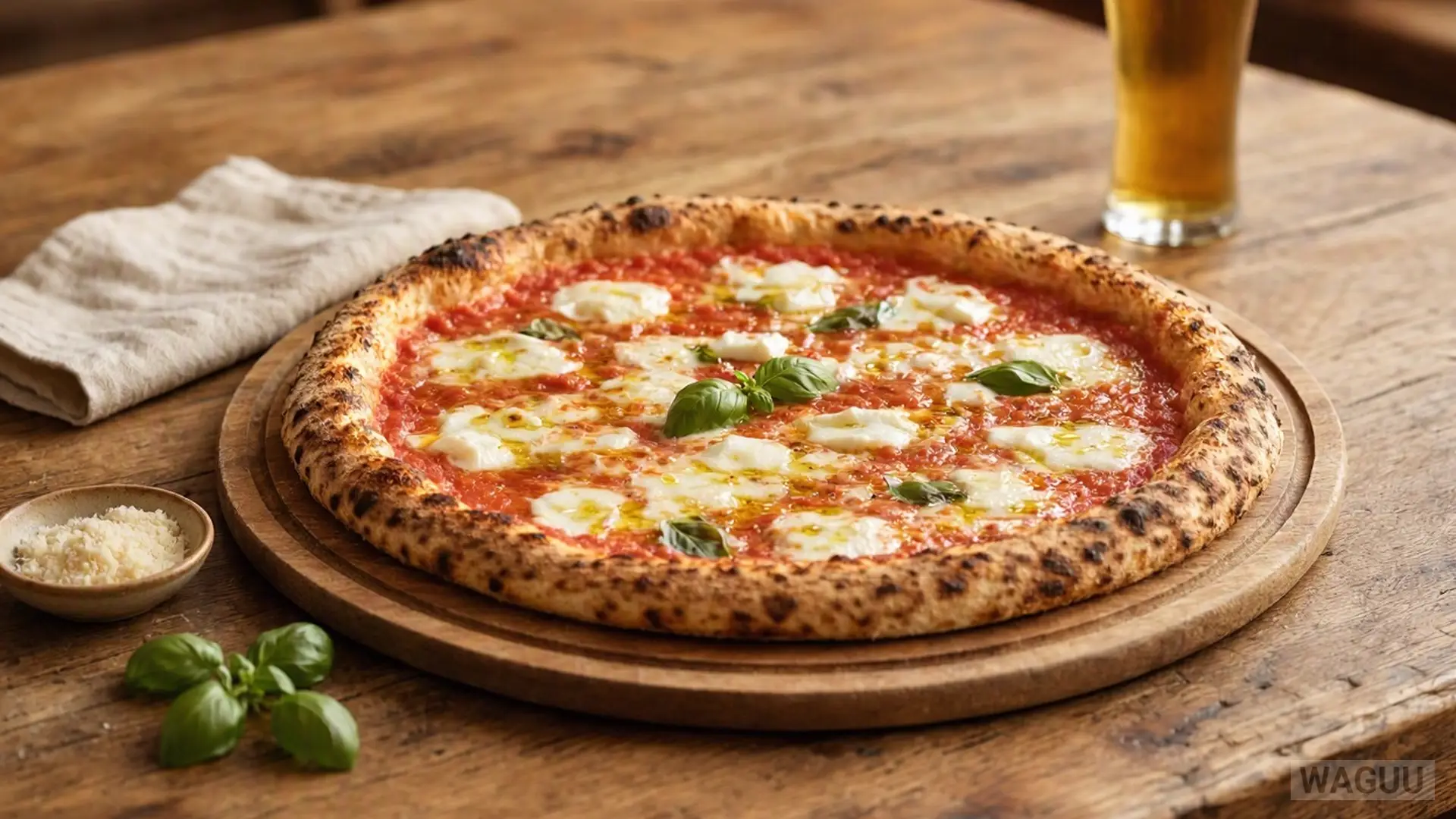
Summary: Authentic Neapolitan pizza featuring a characteristic fluffy, charred crust, San Marzano tomato sauce, fresh fior di latte mozzarella, fragrant basil leaves, and extra virgin olive oil, baked at extreme heat.
Did you cook this recipe? Share the result with the community.
Category: Pizza, Italian Cuisine
Success rate: 98% of users successfully made this recipe
Quick overview
- Dish: Pizza Napoletana
- Category: Pizza, Italian Cuisine
- Cuisine: Italian
- Main ingredient: Strong wheat flour, 1,200 g (Tipo 00 flour)
- Guide: 12 most popular Italian dishes: favourite recipes of Italian cuisine
- Total time: 1,475 minutes (1,440 min prep + 35 min cooking)
- Difficulty: Advanced
- Portions: 6 portions (Portion weight: 280 g)
- Key technique: Long cold fermentation and high-temperature baking
- Preparation types: Kneading, proofing, stretching, baking
- Dietary info & Allergens: Contains gluten, milk
- Suitable for: Pizza lovers, weekend baking enthusiasts
- Nutritional values (per 1 portion): 620.5 kcal, Protein: 21.4 g, Fat: 14.8 g, Carbohydrates: 98.6 g
- Storage: 2 days in the fridge, 1 month in the freezer
- Pairing: Lager beer, Chianti wine, sparkling water
- In short: The absolute pinnacle of Italian baking art, requiring patience, precise hydration, and blazing heat to create a leopard-spotted crust.
- Last updated: 21 September 2026
WAGUU says: “True Neapolitan pizza is born from simplicity, high protein flour, and extreme heat that puffs the cornicione within seconds.”
How to take it further: Add a drizzle of chilli-infused olive oil or finish with freshly grated Parmigiano Reggiano.
Key facts
| Prep time: | 1,440 minutes |
| Cooking time: | 35 minutes |
| Temperature: | 450–500 °C |
| Number of portions: | 6 portions |
In a nutshell
Embark on a culinary journey to Naples by crafting a legendary pizza with an impossibly airy, blistered crust, luscious San Marzano tomatoes, and melting mozzarella.
Ingredients
Base portions: 6 portions • Portion weight: 280 g
| Ingredient | Amount | Quality |
|---|---|---|
| Strong wheat flour (Tipo 00) | 1200 g | High protein (min 12%) |
| Cold water | 780 ml | Filtered, chilled |
| Fine sea salt | 36 g | Pure sea salt |
| Fresh yeast | 3 g | Active fresh |
| San Marzano canned tomatoes | 600 g | D.O.P. peeled tomatoes |
| Fior di latte mozzarella | 500 g | Drained and torn |
| Fresh basil leaves | 18 pieces | Vibrant green |
| Extra virgin olive oil | 30 ml | Cold pressed |
Why you will love this recipe
- Authentic taste: Recreates the exact flavour profile of a traditional Neapolitan pizzeria in your home.
- Fluffy crust: Produces a light, airy, and leopard-spotted outer rim through expert fermentation.
- Simple ingredients: Relies on pristine Italian produce without unnecessary chemical additives.
Why it works: High hydration dough combined with extreme baking temperature creates rapid steam expansion, giving an airy crumb and a crisp exterior.
Recipe overview
Prep: 1,440 min | Cooking: 35 min | Difficulty: Advanced | Portions: 6 portions | Type: Main dish | Origin: Italian
Detailed instructions
Overall progress: 0% complete
Phase 1: Preparing the dough – 20 min
Appliances: Kitchen mixer
1. Dissolve 3 g of fresh yeast into 780 ml of cold water inside a mixing bowl. Gradually add 1,200 g of strong wheat flour (Tipo 00) while mixing on low speed for 5 minutes until no dry flour remains. Incorporate 36 g of fine sea salt and knead for an additional 15 minutes until the dough becomes smooth, elastic, and reaches a temperature of 23 °C.
Visual check point (VKB): The dough surface is smooth, slightly tacky, and springs back gently when poked with a finger.
Before moving to the next step:
Ensure the dough temperature does not exceed 25 °C during mixing to prevent premature yeast activation.
Phase 2: Bulk fermentation – 720 min
Appliances: Fridge
2. Cover the mixing bowl tightly with cling film to trap moisture and place it in the refrigerator set at 4 °C for 12 hours. Allow the gluten network to mature slowly overnight, developing deep complex flavours and structural integrity.
VKB: The dough has increased in volume by approximately 50% and exhibits small gas bubbles beneath the surface.
Before moving to the next step:
Verify that the refrigerator temperature remains stable at 4 °C to avoid over-proofing.
Phase 3: Dough ball division – 30 min
Appliances: Kitchen scale
3. Remove the dough from the refrigerator. Divide the mass equally into 6 portions, weighing precisely 280 g each on a kitchen scale. Shape each portion into a tight, smooth ball using circular motions on an un-floured wooden board.
VKB: Each dough ball is perfectly spherical with a taut, smooth top skin and sealed bottom.
Before moving to the next step:
Ensure the dough balls are sealed tightly at the base so they do not unravel during proofing.
Phase 4: Second proofing – 700 min
Appliances: Proving box
4. Place the shaped dough balls into a lightly floured proving box, leaving adequate space between them. Cover with a lid and let them proof at room temperature (20 °C) for 11 hours until doubled in size.
VKB: The dough balls are soft, pillowy, and show visible internal gas pockets.
Before moving to the next step:
Keep the proving box away from direct sunlight and drafts to maintain an even temperature.
Phase 5: Preparing toppings and oven – 25 min
Appliances: Pizza oven
5. Crush 600 g of San Marzano canned tomatoes by hand in a bowl until smooth, seasoning with a pinch of salt. Tear 500 g of fior di latte mozzarella into strips and let them drain on kitchen paper. Preheat your dedicated pizza oven to 450–500 °C with a pizza stone inside for at least 30 minutes.
VKB: The pizza stone surface reaches 450 °C when measured with an infrared thermometer.
Before moving to the next step:
Ensure the mozzarella is thoroughly drained to prevent a soggy pizza base.
Phase 6: Stretching, topping, and baking – 30 min
Appliances: Pizza oven
6. Gently transfer a proofed dough ball onto a lightly floured work surface. Press gas from the center outwards to push air into the rim, then stretch into a 30 cm disc. Spread 100 g of crushed tomatoes, add 80 g of mozzarella, 3 fresh basil leaves, and a drizzle of 5 ml of extra virgin olive oil. Launch the pizza onto the hot stone and bake for 90 seconds, rotating once halfway through.
VKB: The crust is puffed, golden-brown with dark charred spots, and the cheese is fully melted and bubbling.
Required equipment
| Utensil | Ideal size | Alternative | Risk |
|---|---|---|---|
| Kitchen mixer | 5 l bowl | Hand kneading | Under-kneaded gluten |
| Pizza peel | 32 cm width | Wooden board | Sticking dough |
| Pizza stone | 35×35 cm | Cast iron pan | Inadequate heat retention |
Shopping list
Nutritional profile
Values per 1 portion (excluding side dishes). Calculated from average nutritional values of ingredients.
| Nutrient | Per 100 g | Per 1 portion | Per 6 portions |
|---|---|---|---|
| Energy | 221.6 kcal | 620.5 kcal | 3723.0 kcal |
| Fat | 5.3 g | 14.8 g | 88.8 g |
| of which saturates | 3.2 g | 9.0 g | 54.0 g |
| Carbohydrates | 35.2 g | 98.6 g | 591.6 g |
| of which sugars | 1.8 g | 5.0 g | 30.0 g |
| Protein | 7.6 g | 21.4 g | 128.4 g |
| Salt | 1.5 g | 4.2 g | 25.2 g |
Reference intake of an average adult (8400 kJ / 2000 kcal).
WAGUU Pro Level
- Pro standard: Verified recipe with precise ratios and visual control points.
- Tip 1: Use Italian Tipo 00 flour with a W index between 280 and 320 for optimal gluten elasticity.
- Tip 2: Keep water ice cold during summer months to control initial yeast fermentation rates.
- Tip 3: Stretch the dough entirely by hand, pushing air from the center into the rim without using a rolling pin.
- Tip 4: Preheat your baking stone for a full hour to accumulate thermal mass required for rapid crust puffing.
Scientific background
The exceptional texture of Pizza Napoletana is governed by thermodynamics and enzymatic activity. During cold fermentation, enzymes break down complex starches into simple sugars, feeding yeast and producing carbon dioxide gas. When the high-hydration dough hits the 500 °C stone, moisture instantly converts to steam, expanding the gluten pockets to form the characteristic airy cornicione. Simultaneous Maillard reactions and caramelisation create the iconic leopard spotting on the crust.
Fine Dining – Professional techniques
- Plate composition: Serve whole on a rustic wooden platter to highlight the charred contours and vibrant red and green colors.
- Textural contrasts: Enjoy the crisp exterior shell yielding immediately to an ultra-soft, chewy interior crumb.
- Temperature contrast: Contrast the piping hot baked crust with cool, fresh basil leaves added right at service.
- Aromatic garnishes: Finish with a light drizzle of premium cold-pressed extra virgin olive oil to elevate fruitiness.
Sensory radar
- Appearance: Round rustic disc with a raised, blistered, leopard-spotted rim and vivid tomato red center.
- Aroma: Fragrant baked wheat, sweet acidic tomatoes, milky mozzarella, and herbal fresh basil.
- Taste: Harmonious balance of savory dough, sweet tomatoes, creamy cheese, and a hint of salt.
- Texture: Crisp on the outer edge, meltingly soft and chewy through the base.
Pairing
- BEER: Crisp Italian craft lager or pilsner
- WINE: Light-bodied Chianti or chilled sparkling Gragnano
- NON-ALCOHOLIC: San Pellegrino sparkling mineral water with fresh lemon
Various preparation variants
- Pizza Margherita Extra: Substitute fior di latte mozzarella with authentic fresh buffalo mozzarella (mozzarella di bufala) for a richer, creamier profile.
- Pizza Marinara: Omit mozzarella and cheese entirely, topping the crushed tomatoes with sliced garlic, dried oregano, basil, and olive oil.
Allergens and dietary information
Contains: Gluten, milk • Gluten: Contains wheat flour • Not suitable for: Celiac disease, lactose intolerance
Suitable for
Pizza lovers, weekend baking enthusiasts, Italian food fans
Substitution catalog
- Strong wheat flour (Tipo 00): High-protein bread flour
FAQ
Can I bake this in a standard home oven?
Yes, by using a preheated pizza stone placed on the highest oven rack under the broiler function set to maximum heat.
Why must the water be cold?
Cold water regulates friction heat generated during mechanical mixing, preventing the yeast from fermenting prematurely.
Can I freeze the dough balls?
Freezing is not recommended as extreme cold damages yeast viability and impairs the final rise and crust texture.
What makes San Marzano tomatoes special?
They grow in volcanic soil near Mount Vesuvius, offering lower acidity and a naturally sweet flavor profile.
WAGUU Petr advises: Cooking for 12 or more people?
12–16 people: Prepare two separate batches of dough in your mixer, as overloading a standard domestic bowl compromises gluten development. • 20+ people: Divide the dough preparation across two separate days and store individual dough balls in stackable proofing boxes.
Sides and Serving
- Mixed Italian green salad – dressed with lemon and olive oil (not included in the recipe)
- Marinated mixed olives – served with rustic bread (not included in the recipe)
Serving: Serve immediately piping hot, sliced into quarters, accompanied by a cold beverage.
Storage and reheating
Fridge: 2 days • Freezer: 1 month • Reheating: Reheat slices in a hot dry frying pan over medium heat for 3 minutes to restore crust crispness.
Author: WAGUU Petr & Team • Published: 21 Sep 2026 • Updated: 30 Oct 2026
More Recipes from This Article
Other recipes you might be interested in
Why WAGUU?
Recipes on WAGUU undergo checks for the accuracy of ingredients, procedures, and nutritional values.
Process photo gallery
Community photos: Cook, take a photo, and share the result.
You can upload photos in the comments below or send them via email.
Did you record a video guide for our recipe? Insert a link to YouTube, YouTube Shorts, TikTok, Instagram Reels, Facebook Reels, Pinterest, Vimeo, or X (Twitter) in the comment – we’d be happy to publish it and help promote you and your content.
Common mistakes
- Using low-protein flour – Results in a dense, flat crust that fails to puff or bubble in the oven.
- Overworking the dough – Generates excess heat during mixing, causing premature yeast activation.
- Using wet mozzarella – Adds excess moisture, turning the pizza base soggy and preventing proper baking.
- Baking at too low temperature – Bakes the pizza slowly like bread instead of flash-cooking, drying out the crust.