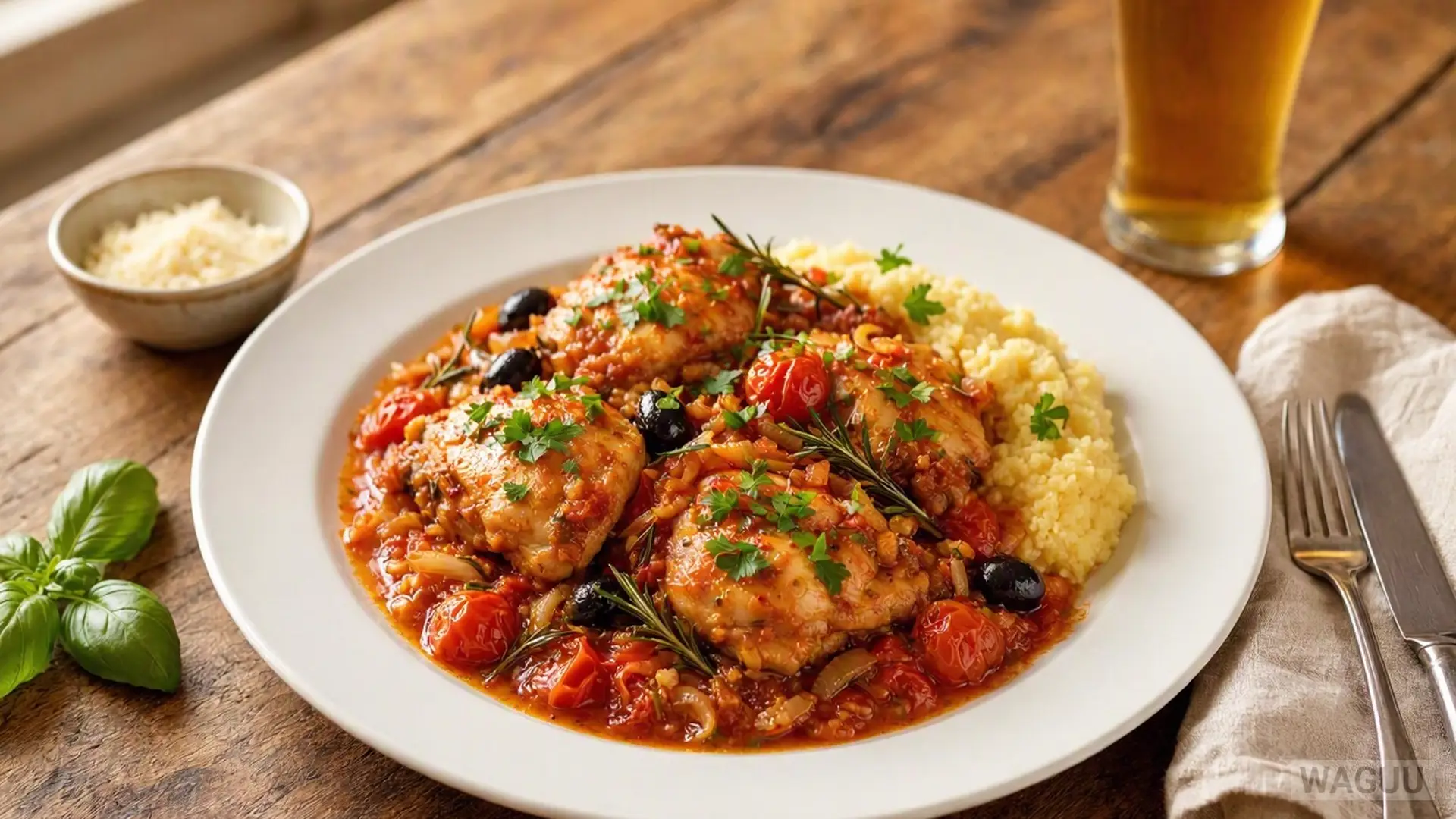
Summary: Pollo alla Cacciatora is a classic Italian hunter-style chicken braised with aromatic vegetables, tomatoes, herbs, and dry white wine until melt-in-the-mouth tender. This traditional braising technique creates a rich, rustic sauce infused with rosemary, sage, and garlic, prepared in 75 minutes for 6 portions.
Did you cook this recipe? Share the result with the community.
Category: Poultry, Italian Cuisine
Success rate: 98% of users successfully made this recipe
Quick overview
- Dish: Pollo alla Cacciatora
- Category: Poultry, Italian Cuisine
- Cuisine: Italian
- Main ingredient: chicken thighs, 1,200 g (free-range, bone-in and skin-on)
- Guide: 12 most popular Italian dishes: favourite recipes of Italian cuisine
- Total time: 75 minutes (20 min prep + 55 min cooking)
- Difficulty: Medium
- Portions: 6 portions (Portion weight: 350.0 g)
- Key technique: Braising
- Preparation types: Searing, simmering, braising
- Dietary info & Allergens: Sulphites (from wine)
- Suitable for: Sunday family dinner, hearty lunch
- Nutritional values (per 1 portion): 385.4 kcal, Protein: 34.2 g, Fat: 18.5 g, Carbohydrates: 12.1 g
- Storage: 3 days in the fridge, 3 months in the freezer
- Pairing: Craft Lager, Chianti Classico, Sparkling Mineral Water
- In short: Tender hunter-style chicken simmered in a fragrant tomato and white wine sauce.
- Last updated: 21 September 2026
WAGUU says: “Brown the chicken deeply before adding aromatics to build a rich flavor foundation for the hunter’s sauce.”
How to take it further: Add a handful of rinsed salted capers alongside the tomatoes, or finish the sauce with a drizzle of extra virgin olive oil infused with crushed chili flakes.
Key facts
| Prep time: | 20 minutes |
| Cooking time: | 55 minutes |
| Temperature: | Medium-high heat, 175 °C |
| Number of portions: | 6 portions |
In a nutshell
Pollo alla Cacciatora brings rustic Italian comfort straight to your table. Succulent chicken pieces are seared until golden, then gently braised in a fragrant reduction of white wine, crushed tomatoes, sweet onions, garlic, rosemary, and sage until the meat falls off the bone.
Ingredients
Base portions: 6 portions • Portion weight: 350.0 g
| Ingredient | Amount | Quality |
|---|---|---|
| chicken thighs | 1200 g | bone-in, skin-on |
| rapeseed oil | 30 ml | cold-pressed |
| yellow onions | 300 g | finely sliced |
| garlic cloves | 15 g | minced |
| dry white wine | 200 ml | crisp and dry |
| crushed tomatoes | 600 g | strained passata |
| chicken stock | 250 ml | clear and warm |
| fresh rosemary | 5 g | sprigs |
| fresh sage | 4 g | leaves |
| table salt | 18 g | fine grain |
| black pepper | 3 g | freshly ground |
Why you will love this recipe
- Authentic Italian flavours: Combines traditional herbs and wine for an unforgettable Mediterranean taste.
- One-pot simplicity: Minimizes washing up by searing and braising in a single heavy-duty casserole dish.
- Tender texture: Long simmering ensures the chicken becomes meltingly soft and infused with savory aromatics.
Success guaranteed: Follow the precise searing and simmering times to achieve perfectly tender meat and a perfectly reduced sauce.
Recipe overview
Prep: 20 min | Cooking: 55 min | Difficulty: Medium | Portions: 6 | Type: Main Dish | Origin: Italian
Detailed instructions
Overall progress: 0% complete
Phase 1: Preparing and Seasoning Chicken – 10 min
Appliances: None
1. Rinse 1200 g of chicken thighs under cold water and pat them completely dry with kitchen paper towels. Season all sides evenly with 12 g of table salt and 3 g of freshly ground black pepper.
VKB: Visual check point (VKB): Chicken surface is uniformly dry and seasoned without excess moisture.
Before moving to the next step:
Ensure the chicken skin is dry so it sears properly instead of steaming in the pan.
Phase 2: Searing the Chicken – 12 min
Appliances: Hob
2. Heat 30 ml of rapeseed oil in a heavy-duty cast-iron casserole dish over medium-high heat at 180 °C. Place the chicken thighs skin-side down and sear for 7 minutes until deeply golden brown. Flip and sear the other side for 5 minutes. Remove the chicken from the pot and set aside on a clean plate.
VKB: VKB: Chicken skin is crisp and rich amber-brown across the entire surface.
Before moving to the next step:
Keep the rendered chicken fat in the casserole dish to build flavor for the vegetables.
Phase 3: Sautéing Aromatics – 10 min
Appliances: Hob
3. In the remaining warm fat within the casserole dish, add 300 g of finely sliced yellow onions and 15 g of minced garlic. Sauté over medium heat for 10 minutes, stirring frequently with a wooden spatula, until the onions are translucent and lightly caramelized.
VKB: VKB: Onions are soft, sweet, and golden without any dark burning spots.
Before moving to the next step:
Ensure the garlic is fragrant but not browned to prevent a bitter taste.
Phase 4: Deglazing with Wine – 5 min
Appliances: Hob
4. Pour 200 ml of dry white wine into the casserole dish. Increase the heat to high and let it bubble vigorously for 5 minutes, scraping the bottom of the pot with a wooden spoon to dissolve all caramelized brown fond.
VKB: VKB: Wine volume is reduced by half and alcohol aroma has mellowed completely.
Before moving to the next step:
All pan drippings must be fully incorporated into the liquid.
Phase 5: Simmering the Sauce – 8 min
Appliances: Hob
5. Stir in 600 g of crushed tomatoes, 250 ml of chicken stock, 5 g of fresh rosemary sprigs, and 4 g of fresh sage leaves. Bring the mixture to a gentle boil, then reduce the heat to low.
VKB: VKB: Sauce bubbles uniformly with a vibrant red hue and herbal aroma.
Before moving to the next step:
Ensure herbs are fully submerged in the tomato sauce.
Phase 6: Braising and Finishing – 20 min
Appliances: Hob
6. Return the seared chicken thighs and any accumulated juices back into the simmering tomato sauce. Cover the casserole dish with a tight lid and braise over low heat at 95 °C for 20 minutes until the chicken is tender and cooked through. Remove the rosemary sprigs, check seasoning with remaining 6 g of table salt if needed, and serve hot.
VKB: VKB: Chicken meat easily separates from the bone and sauce is glossy and thick.
Required equipment
| Utensil | Ideal size | Alternative | Risk |
|---|---|---|---|
| cast-iron casserole dish | 28 cm diameter | heavy-bottomed saucepan | food burning due to thin base |
| wooden spatula | 30 cm length | silicone turner | scratching cookware surface |
| chef knife | 20 cm blade | utility knife | uneven slicing |
Shopping list
Nutritional profile
Values per 1 portion (excluding side dishes). Calculated from average nutritional values of ingredients.
| Nutrient | Per 100 g | Per 1 portion | Per 6 portions |
|---|---|---|---|
| Energy | 110.1 kcal | 385.4 kcal | 2312.4 kcal |
| Fat | 5.3 g | 18.5 g | 111.0 g |
| of which saturates | 1.4 g | 4.9 g | 29.4 g |
| Carbohydrates | 3.5 g | 12.1 g | 72.6 g |
| of which sugars | 2.1 g | 7.4 g | 44.4 g |
| Protein | 9.8 g | 34.2 g | 205.2 g |
| Salt | 0.9 g | 3.0 g | 18.0 g |
Reference intake of an average adult (8400 kJ / 2000 kcal).
WAGUU Pro Level
- Pro standard: Verified recipe with precise ratios and visual control points.
- Tip 1: Use bone-in chicken thighs as the bones release natural collagen during braising, giving the sauce a velvety body.
- Tip 2: Deglaze the pan with high-acid white wine to cut through the richness of the chicken skin and oil.
- Tip 3: Simmer uncovered during the final 5 minutes if the sauce requires extra thickening.
- Tip 4: Let the finished dish rest off the heat for 10 minutes before serving to allow the muscle fibers to relax.
Scientific background
Braising combines dry-heat searing with moist-heat simmering. Searing triggers the Maillard reaction between amino acids and reducing sugars on the chicken skin, creating hundreds of complex flavor compounds. Subsequent gentle simmering hydrolyses tough collagen connective tissue in the chicken thighs into soft, water-binding gelatin, thickening the surrounding tomato and wine sauce while rendering the meat exceptionally tender.
Fine Dining – Professional techniques
- Plate composition: Place a single golden chicken thigh in the center of a warm shallow bowl, spooning the glossy tomato and onion ragù neatly over and around it.
- Textural contrasts: Pair the tender braised meat with crispy toasted polenta cakes or crunchy sourdough bread.
- Temperature contrast: Serve piping hot directly from the braising vessel onto pre-warmed ceramic plates.
- Aromatic garnishes: Scatter finely minced fresh flat-leaf parsley and freshly grated lemon zest over the top just before serving.
Sensory radar
- Appearance: Deep golden-brown chicken pieces coated in a glossy, rich red tomato sauce with visible herbs.
- Aroma: Robust fragrance of stewed tomatoes, sweet caramelized onions, earthy rosemary, and crisp white wine.
- Taste: Savory and umami-rich with a balanced acidity from tomatoes and wine, complemented by herbal notes.
- Texture: Succulent, melt-in-the-mouth meat paired with a thick, velvety vegetable sauce.
Pairing
- BEER: Crisp Belgian Blonde Ale with subtle fruit notes
- WINE: Medium-bodied Italian Chianti Classico with bright cherry acidity
- NON-ALCOHOLIC: Sparkling apple and cranberry botanical infusion
Various preparation variants
- Tuscan Mushroom Variant: Add 200 g of sliced porcini or chestnut mushrooms during the onion sautéing stage for a deeper earthy flavor profile.
- Mediterranean Olive and Caper Variant: Stir in 50 g of pitted Kalamata olives and 25 g of rinsed capers along with the crushed tomatoes for a punchy, briny finish.
Allergens and dietary information
Contains: Sulphites • Gluten: Gluten-free naturally • Not suitable for: Vegan, vegetarian
Suitable for
Sunday family dinner, hearty lunch, Italian themed feasts
Substitution catalog
- chicken thighs: chicken drumsticks or bone-in chicken breasts (adjust cooking time)
- dry white wine: apple cider vinegar diluted with water
FAQ
Can I use skinless chicken pieces?
Yes, but skinless chicken releases less fat during searing, so you may need an extra tablespoon of oil.
Is white wine mandatory in this recipe?
White wine provides essential acidity to balance the tomatoes, but you can substitute it with chicken stock and a splash of lemon juice.
Can I make this dish in advance?
Yes, Pollo alla Cacciatora actually tastes even better the next day after the flavors have fully melded in the fridge.
What is the best cut of chicken to use?
Bone-in thighs or drumsticks remain succulent and tender during long braising without drying out.
WAGUU Petr advises: Cooking for 12 or more people?
12–16 people: Double all ingredient quantities and use two large heavy-duty casserole dishes to avoid overcrowding the chicken during searing. • 20+ people: Prepare the dish in a wide roasting pan in the oven at 180 °C for 60 minutes, ensuring even heat distribution across all portions.
Sides and Serving
- Creamy Polenta – Soft cornmeal porridge that absorbs the savory tomato sauce (not included in the recipe)
- Crunchy Ciabatta – Fresh crusty Italian bread for soaking up the juices (not included in the recipe)
Serving: Serve piping hot in shallow bowls, garnished with fresh herbs and a drizzle of premium olive oil.
Storage and reheating
Fridge: 3 days • Freezer: 3 months • Reheating: Reheat gently in a covered saucepan over medium-low heat with a splash of water until simmering throughout.
Author: WAGUU Petr & Team • Published: 21 Sep 2026 • Updated: 30 Oct 2026
More Recipes from This Article
Other recipes you might be interested in
Why WAGUU?
Recipes on WAGUU undergo checks for the accuracy of ingredients, procedures, and nutritional values.
Process photo gallery
Community photos: Cook, take a photo, and share the result.
You can upload photos in the comments below or send them via email.
Did you record a video guide for our recipe? Insert a link to YouTube, YouTube Shorts, TikTok, Instagram Reels, Facebook Reels, Pinterest, Vimeo, or X (Twitter) in the comment – we’d be happy to publish it and help promote you and your content.
Common mistakes
- Not drying the chicken – Failing to pat the chicken thighs dry prevents proper searing and browning of the skin.
- Rushing the wine reduction – Not reducing the white wine fully leaves a harsh, raw alcoholic taste in the sauce.
- Overcooking the chicken – Simmering at too high a boil makes the meat stringy rather than tender and juicy.
- Skipping the resting time – Cutting into the chicken immediately causes valuable juices to leak out onto the plate.